 English
 Le français
 Türkçe

At the same power, a 4-pole motor delivers roughly twice the shaft torque of a 2-pole motor, while it is lighter and fits in a smaller frame than a 6-pole motor. Since most machines that start under heavy load already reduce speed through a gearbox or pulleys, 1500 rpm is the option that strikes this balance most easily.
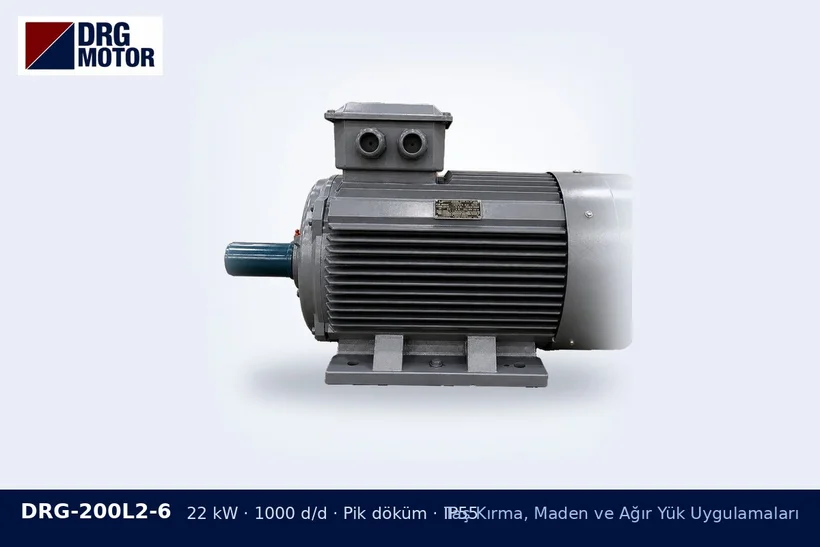
Same power, different torque
Shaft torque is found approximately with the relation M = 9550 × P / n (M: Nm, P: kW, n: rpm). Approximate values for 30 kW:
| Poles | Speed under load (approx.) | Rated torque (approx.) | DRG frame |
|---|---|---|---|
| 2 | 2950 rpm | 97 Nm | 200L |
| 4 | 1475 rpm | 194 Nm | 200L |
| 6 | 985 rpm | 291 Nm | 225M |
The speeds under load are given as examples; the actual value is on the nameplate.
Why not 6-pole?
A 6-pole motor gives more torque, but for the same power it needs a larger frame, a heavier rotor and a wider base. In geared systems the torque requirement is already met by the gearbox ratio, so 1500 rpm on the motor side is usually enough. On belt-driven crushers and mills, however, 6 poles may be preferred to reduce the pulley ratio.
The number of poles alone is not enough
What decides a heavy start is the comparison between the motor’s starting torque ratio and the breakaway torque of the load. Even a 4-pole motor may fail to lift a loaded machine if the wrong starting method is used. A decision should not be based on pole count alone without knowing the machine’s torque demand at start, its inertia and how often it starts. For geared drives, you can see the output torque on the gearbox output speed and torque calculation page.
All 1500 rpm options are listed in order of power in the three-phase motor shop; for general use, the general-purpose industrial motors page is also worth a look.