 English
 Le français
 Türkçe

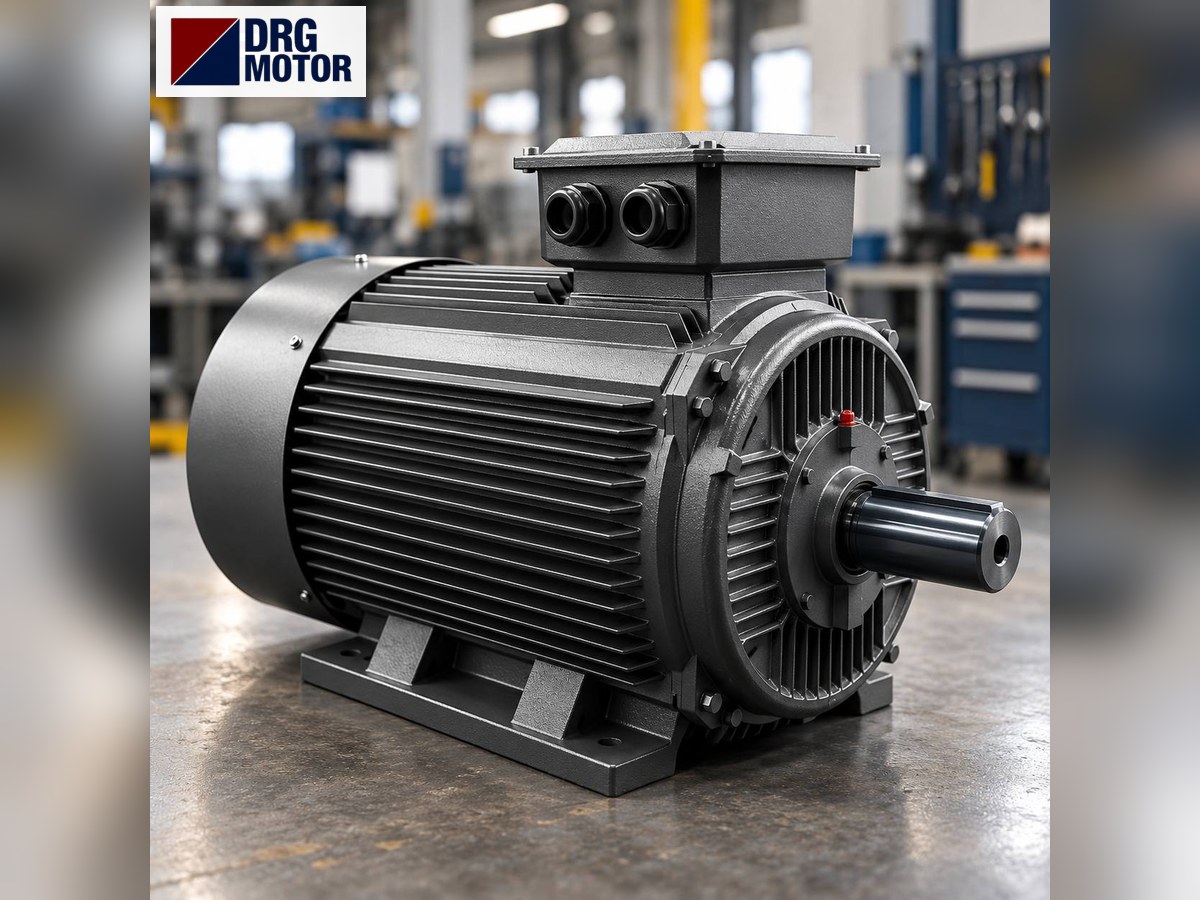
Behind every primary impact crusher sits a standard three-phase induction motor driving the heavy, wide horizontal rotor via belts and pulleys. On these machines, which break coarse quarry rock at the first stage, manufacturer catalogues show single motors from 160 kW to 355 kW; larger models use two motors and the total power rises to 500–630 kW [1][2][3]. One manufacturer states plainly that a single drive is possible only up to 355 kW [1].
Below we cover the primary impact crusher’s job in the quarry, the difference between single and dual drive, how rotor inertia affects starting and how DRG motors match. Motors in these sizes, with prices, can be seen in the Buy Electric Motors Online store. For the plant’s other machines, see the Stone Crushing Plant Motors category.
What is a primary impact crusher and which rock is it used for?
An impact crusher breaks rock by striking it rather than squeezing it. Blow bars fixed to a rotor on a horizontal shaft spin at high speed, hit the rock falling into the crusher and throw it against breaker plates opposite. The rock breaks both from the blow-bar impact and from hitting the plate. Product size is set by the gap between the breaker plates and the rotor.
“Primary” means the machine is large enough to take blasted rock straight from the quarry. These models have a wide feed opening, and the maximum feed size goes up to 1,000–1,300 mm [1]. Rotor diameter grows accordingly; manufacturers use rotor diameters of 1,100–1,600 mm [1][3].
It suits low-abrasion rock of medium hardness: limestone, dolomite, gypsum, phosphate. Typical users are cement plant raw-material preparation, lime quarries and large limestone quarries producing concrete and asphalt aggregate. It is also used to crush demolition concrete in recycling [3]. In hard, quartz-rich rock the blow bars wear very fast, so a jaw crusher is preferred there.
Where it differs from similar machines
- Jaw crusher: also a primary, but crushes by compression at low speed and copes with hard rock; its product is flakier.
- Secondary impact crusher: works the same way on the reduced rock fed from the primary, with a smaller, faster rotor.
- Hammer crusher: has freely swinging hammers and a bottom grate; it gives a finer product and does not accept coarse quarry rock.
A primary impactor is usually preceded by a vibrating feeder that delivers coarse rock evenly and a grizzly that removes fines; for their motors see the Vibration Motors page.
How the motor turns the rotor: belts, single and dual drive
The rotor shaft comes out on both sides of the crusher body. On a single-drive machine one shaft end carries a large pulley; the motor stands on a base beside the crusher and turns this pulley with V-belts. One manufacturer’s sheet gives rotor speeds of 800 rpm on its smallest primary model and 600 rpm on its largest [3]. The motor speed is reduced to this by the pulley ratio.
Above 355 kW the drive is split in two. On a dual-drive machine each end of the rotor shaft has a pulley, and each is turned by its own motor. One manufacturer’s largest primary model uses two 250 kW motors for 500 kW installed in total [2]. Another goes up to 630 kW in this class and notes that anything above 355 kW is only possible on dual drive [1].
On a dual drive both motors should be the same model, fitted with the same pulley diameter and the same belt length; otherwise one motor carries a larger share of the load. This is a general engineering rule for motor selection; exact pulley and belt sizes come from the crusher manufacturer’s drawing.
Rotor inertia and the flywheel effect
A primary impactor has no separate flywheel; the heavy rotor itself acts as one. One manufacturer’s sheet gives a shaft-line weight (rotor, shaft and pulley) of 15,020 kg for its largest primary model [1]. This mass carries a large amount of kinetic energy at speed. On the one hand it keeps the rotor speed up when a large block enters; on the other, the motor has to build up all of that energy from zero at start-up. That is why starting takes longer than on jaw or cone crushers.
Motor power of primary impact crushers on the market
The table separates single-motor and dual-motor models. For dual-drive rows the value shown is the total of both motors; the power per motor is given as well.
| Model group / capacity | Motor power | Single / total | Source |
|---|---|---|---|
| Maker C, smallest primary (rotor 1,100×1,100 mm, 150–250 t/h) | 160 kW | Not stated in source | [3] |
| Maker B, small primary (rotor 1,400×1,250 mm, 200–250 t/h) | 250 kW | Single motor | [2] |
| Maker A, primary (feed up to 1,000 mm) | 200–355 kW | Single motor | [1] |
| Maker B, largest primary (400–600 t/h) | 2 × 250 = 500 kW | Total, two motors | [2] |
| Maker A, largest primary (feed 1,300 mm) | 355–630 kW | Single up to 355 kW; dual total above | [1] |
In this machine group, motor options of roughly 160–630 kW are seen depending on the manufacturer’s model and capacity [1][3].
The main factors setting power are rotor diameter and width, rotor speed, feed size and required capacity. Across one manufacturer’s models, capacity goes from 200–250 t/h to 400–600 t/h while power goes from 250 kW to 2 × 250 kW [2]. Within one machine, the breaker plate gap, rock hardness and feed arrangement move the power draw: a tighter gap and harder rock raise the energy per tonne.
Its counterpart in the DRG range
The 160–355 kW motors of single-drive primary models fall within the DRG cast iron range. On dual-drive models the power per motor is 250 kW or 315 kW (630 kW = 2 × 315 kW), so both motors are available from DRG. A single-motor drive above 355 kW is outside the range. With rotor speeds of 600–800 rpm there is no need for a 750 rpm motor; 4- or 6-pole motors are used with belts.
Click to see current electric motor prices and order nowSEE PRICES →
Reading the selection table: pulley ratio and energy check
On a primary impact crusher the motor power is read from the crusher manufacturer’s table. What can be checked on site is speed and energy consistency. Using one manufacturer’s 355 kW model with a 1,500×1,500 mm rotor [3]:
- Rotor tip speed: v = π·D·n/60 = π × 1.5 × 650 / 60 ≈ 51 m/s. In the same sheet a 1,100 mm rotor at 800 rpm gives about 46 m/s and a 1,600 mm rotor at 600 rpm about 50 m/s; a larger rotor reaches the same tip speed at a lower rpm.
- Pulley ratio: with the 4-pole DRG-400M-4 (355 kW, 1490 rpm) the ratio is 1490 / 650 ≈ 2.29; with the 6-pole DRG-400L-6 (355 kW, 992 rpm) it is ≈ 1.53. Which is used depends on the crusher pulley size and the manufacturer’s base drawing.
- Energy check: the same manufacturer gives a consumption of 0.4–0.6 kWh per tonne [3]. At 600 t/h this means an average draw of 240–360 kW; a 355 kW motor is strained at the top of that range. Installed power is kept above the average to cover peak loads when large blocks arrive.
Current for a dual drive: two DRG-355M-4 motors (250 kW, 418 A at 400 V) draw 836 A in total. Panel, cables and transformer are sized for this total current. You can confirm the speed with your own pulley sizes in the pulley and belt calculator.
What to provide when ordering a primary impact crusher motor
- Crusher model, rotor diameter and width, rotor speed; single or dual drive.
- Power, speed and pulley diameter of each motor; on dual drive, whether both pulleys are equal.
- Motor base dimensions, belt tensioning arrangement (slide rail or hinged base), direction of rotation.
- Starting method and duration: time for the rotor to reach full speed, overload relay setting in the panel.
- On dual drive, whether both motors start together or one shortly after the other.
- Transformer rating and permitted voltage dip during start.
- Environment: lime and gypsum dust, open site, dust building up on motor cooling fins.
Starting, rotor inertia and connection
A primary impact crusher is always started empty. Feed begins once the rotor is at full speed; when stopping, feed is cut first, the chamber empties, and then the motor stops. If the rotor has stalled under load, the chamber is cleared by hand before restarting.
The large rotor inertia lengthens the start. On a direct-on-line start, a 355 kW 4-pole DRG motor has a rated current of 593 A at 400 V and a starting current ratio of 7.1; drawing that much current for a long time strains both the supply and the motor winding. At these powers a soft starter or VFD is the common choice. Star connection cuts torque to roughly a third, which may leave a heavy rotor short of speed before the switch to delta; if star-delta is used the motor must be wound for 400/690 V (all DRG motors from 4 kW are). Details are on the star-delta starting page and in our article on starting current. Overload protection should be chosen using the start-time data so that it does not trip during a long start. Only a qualified electrician should wire it.
On a dual drive, starting both motors at the same moment doubles the inrush. Starting them one after the other with a short delay, or driving both from a common VFD arrangement, is chosen according to the crusher manufacturer’s control scheme.
The motors are foot-mounted (B3) on bases that tension the belts. Mounting details follow the crusher maker’s drawing; check feet and shaft against our technical drawings.
| Model | Power / speed | Frame · current 400 V | Price |
|---|---|---|---|
| DRG-355M1-6200 HP | 160 kW · 1000 rpm | Cast iron 355M · 281 A | $6,285.89 (€5,613.69) Details & buy → |
| DRG-315L1-4200 HP | 160 kW · 1500 rpm | Cast iron 315L · 271 A | $6,135.24 (€5,479.15) Details & buy → |
| DRG-355M2-6270 HP | 200 kW · 1000 rpm | Cast iron 355M · 346 A | $9,015.18 (€8,051.11) Details & buy → |
| DRG-315L2-4270 HP | 200 kW · 1500 rpm | Cast iron 315L · 334 A | $7,115.64 (€6,354.71) Details & buy → |
| DRG-355L-6340 HP | 250 kW · 1000 rpm | Cast iron 355L · 433 A | $12,004.86 (€10,721.09) Details & buy → |
| DRG-355M-4340 HP | 250 kW · 1500 rpm | Cast iron 355M · 418 A | $9,826.77 (€8,775.92) Details & buy → |
| DRG-400M-6430 HP | 315 kW · 1000 rpm | Cast iron 400M · 546 A | $13,186.72 (€11,776.56) Details & buy → |
| DRG-355L-4430 HP | 315 kW · 1500 rpm | Cast iron 355L · 526 A | $11,417.31 (€10,196.37) Details & buy → |
| DRG-400M-4480 HP | 355 kW · 1500 rpm | Cast iron 400M · 593 A | $11,803.58 (€10,541.33) Details & buy → |
Matching DRG motors
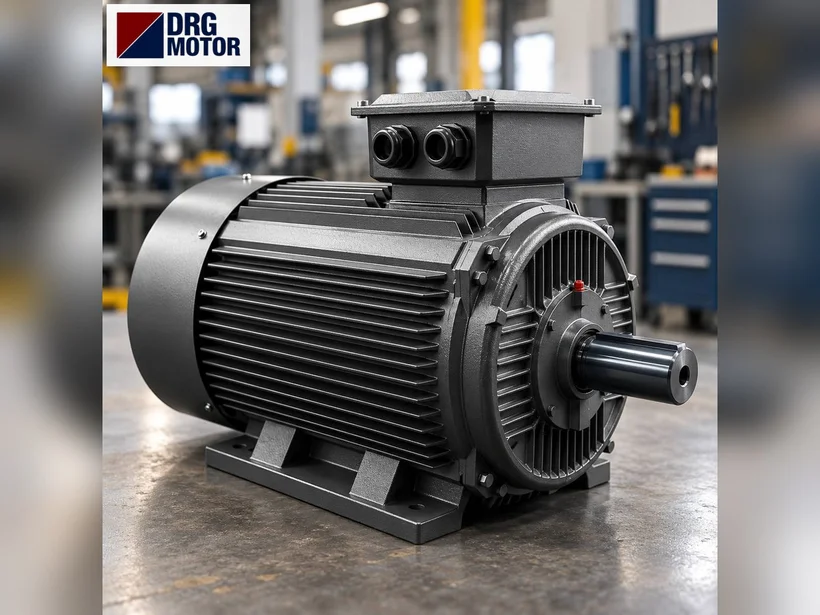
DRG Motor is a manufacturer, supplier and seller of electric motors. Our cast iron series runs from 0.55 kW to 355 kW and our aluminium series covers 0.25–11 kW. Speeds are 1000, 1500 and 3000 rpm, voltage 230/400 V or 400/690 V (3-phase), and mounting B3, B5, B14 or B35 is specified with an order note. For primary impact crushers we can supply 160–355 kW single motors and the 250–315 kW motor pairs of dual-drive machines. At these powers the starting torque ratio is 2.0 in our 4-pole series and 1.8 in our 6-pole series.
| Model | Power / speed | Frame | Current 400 V |
|---|---|---|---|
| DRG-315L1-4 | 160 kW / 1488 rpm | 315L cast iron | 271 A |
| DRG-355M-4 | 250 kW / 1490 rpm | 355M cast iron | 418 A |
| DRG-355L-4 | 315 kW / 1490 rpm | 355L cast iron | 526 A |
| DRG-400M-4 | 355 kW / 1490 rpm | 400M cast iron | 593 A |
| DRG-355M2-6 | 200 kW / 990 rpm | 355M cast iron | 346 A |
| DRG-400L-6 | 355 kW / 992 rpm | 400L cast iron | 615 A |
DRG MOTOR motors are guaranteed against material and manufacturing defects for 2 years from the delivery date (warranty certificate). General information on high-power plant motors: high kW motors for crushing and screening plants.
Motors in this power range for primary impact crushers
- DRG-315L1-4 – 160 kW – 1488 rpm – 315L cast iron
- DRG-315L2-4 – 200 kW – 1490 rpm – 315L cast iron
- DRG-355M-4 – 250 kW – 1490 rpm – 355M cast iron
- DRG-355L-4 – 315 kW – 1490 rpm – 355L cast iron
- DRG-400M-4 – 355 kW – 1490 rpm – 400M cast iron
- DRG-400L-6 – 355 kW – 992 rpm – 400L cast iron
Click to see current prices and order these motors nowSEE PRICES →
Frequently Asked Questions
How many kW is a primary impact crusher motor?
Catalogues show single motors of 160–250 kW on small primary models and 315–355 kW on medium ones, and a total of 500–630 kW with two motors on the largest models.
Why does an impact crusher use two motors?
One manufacturer states that a single drive is possible only up to 355 kW. When more power is needed, a motor is fitted at each end of the rotor and the load is shared between the two.
Should a primary impact crusher use a 1000 rpm or a 1500 rpm motor?
With the rotor at 600–800 rpm, both can be used with belts. What decides is the crusher pulley size and the manufacturer’s base drawing; when replacing, keeping the old motor’s pole count is the safest route.
Why does an impact crusher take long to start, and why does the overload trip?
The heavy rotor takes time to reach full speed, and meanwhile the motor draws several times its rated current. If the overload relay is not matched to the start time, it trips before the start is complete. The fix is protection suited to the start time and, if needed, a soft starter or VFD.
Send us the crusher’s model plate, the motor nameplate(s), pulley sizes and whether it is single or dual drive, and we will settle on the right DRG motor together. Call +90 (542) 666 11 11, write to [email protected] or use our contact page. Store: Buy Electric Motors Online.
Sources
- Metso – Nordberg NP Series HSI crushers (broşür) – Primary models 200–355 kW and 355–630 kW; “single drive is possible with 355 kW motor maximum”, 630 kW on dual drive; rotor diameters, maximum feed size.
- Constmach – Primary Impact Crushers, technical specifications – CPI-1412 250 kW (200–250 t/h), CPI-1415 315 kW (350–400 t/h), CPI-1620 2 × 250 kW (400–600 t/h).
- Polygonmach – PPI Series Primary Impact Crushers – PPI-1111…PPI-1620: 160–500 kW, rotor speed 800–600 rpm, rotor sizes; energy use 0.4–0.6 kWh/t.


