 English
 Le français
 Türkçe

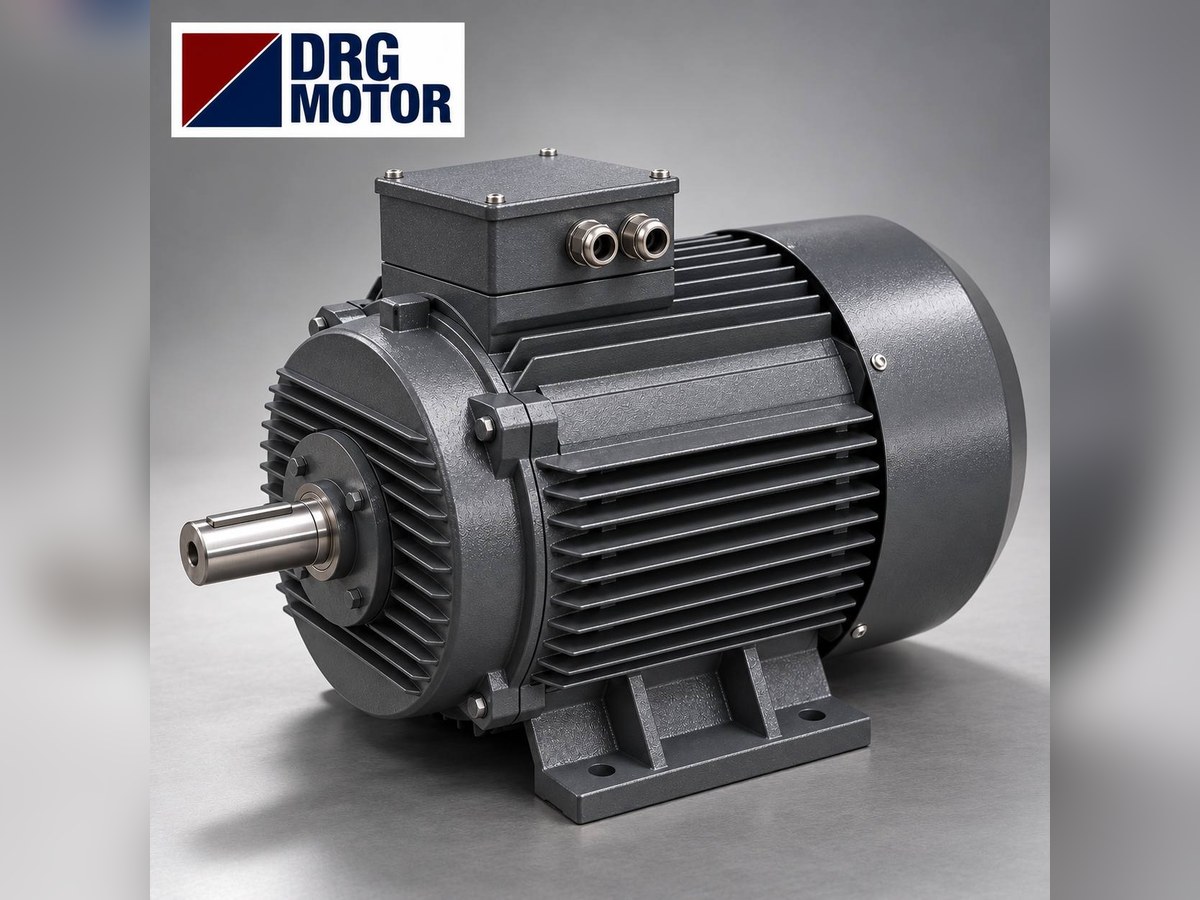
A feed machine electric motor is the three-phase induction motor that drives each machine in a feed mill or an on-farm feed unit: the equipment that conveys, grinds, mixes and pellets the raw material. There is no single “feed motor”. A hammer mill needs a high-speed motor with a heavy rotor, a mixer needs a slow-turning motor working through a gearbox, and the pellet mill alone draws the largest power on the line. Manufacturer catalogues show a wide span in these machines, from a 0.75 kW feeder motor up to a 450 kW mill motor.
This page walks through the feed production flow step by step, describing the motor's task in every machine group, what its power depends on and which selection conditions are shared. Separate pages are also in preparation for readers who need detail: motors for feed grinding and milling, feed mixing, feed pelleting, feed screw conveyors, feed conveyors, feed elevators and feed dosing. Browse matching models in our Buy Electric Motors Online store.
Where do motors work on a feed production line?
In a compound feed plant the product moves in the order below. Each step has at least one electric motor, and often several.
Raw material intake, pre-cleaning and silos
Maize, barley, wheat and oilseed meal are taken from the intake pit by a screw or chain conveyor, lifted by a bucket elevator, passed over pre-cleaning screens and a magnet, and filled into silos. The motors here are conveying motors: they turn a slow shaft through a gearbox and restart under load when the line stops full. The backstop on the elevator and the sequential start interlock on the conveyors must be kept in place when a motor is replaced.
Grinding and milling
Grain drawn from the silo is broken down to the target fineness by a hammer mill or a roller mill. The hammer mill motor turns the rotor directly through a coupling, and its speed sets the tip speed of the hammers. A feeding device sits in front of the mill and an aspiration fan that pulls the ground product sits behind it. One manufacturer catalogue lists a separate aspiration fan power of 11–30 kW for industrial mills; this fan has its own motor, separate from the mill motor.
Dosing and mixing
Ground grain, meal, minerals and additives are weighed according to the formula. Dosing screws under the scale bins usually run at two speeds on an inverter: they fill fast, then slow down near the target weight. The weighed batch is dropped into the mixer. Feed mills use horizontal twin-shaft or ribbon mixers, while farms use vertical screw mixers. The mixer motor has to start the batch with a full vessel; restarting after a power cut without emptying the mixer is a typical case.
Pelleting: feeder, conditioner, press, cooler and crumbler
The pellet line is where motors are most concentrated. A variable-speed feeder screw delivers meal to the conditioner, the paddle shaft of the conditioner mixes the meal with steam, and the main motor of the ring die press compresses the product between the rollers and the die. Hot pellets enter the cooler; its fan draws air through the product bed and a separate motor moves the discharge grid. For poultry and fish feed the cooled pellets are broken in a roller crumbler into small crumbles.
Screening, bagging and dispatch
Product from the final screen goes to a bulk silo or a bagging scale. Bagging and bag conveyor motors are small; the real burden here is frequent stop-start.
Motor power by machine group: catalogue ranges
A) Motor powers seen on machines on the market
| Machine group | Motor power | Single or total | Note |
|---|---|---|---|
| Farm-type hammer mill | 5.5–15 kW | Single motor | Manufacturer catalogue, small series |
| Industrial hammer mill | 75–355 kW | Single motor | Manufacturer catalogue, 1320 mm rotor |
| Large multi-chamber mill | 55–450 kW | Single motor | Manufacturer catalogue, 1500 rpm |
| Roller mill | 30–300 hp (≈22–224 kW) | Maximum per model | Manufacturer catalogue |
| Horizontal twin-shaft mixer | 4–45 kW | Single motor | 100–4000 kg batch |
| Vertical screw mixer | 3–7.5 kW | Single motor | 1000–3400 kg batch |
| Pellet mill main motor | 22–315 kW | Main motor | 1–40 t/h mill |
| Mill feeder / conditioner | 0.75–3 / 1.5–15 kW | Separate motors | Same catalogue line |
| Pellet cooler fan | 5.5–30 kW | Fan motor | Discharge motor separate |
| Pellet crumbler | 3–22 kW | Single motor | Two- and three-roll |
Feed machines show motor options of roughly 0.75–450 kW depending on manufacturer model and capacity. Auxiliary motors such as the press feeder and the cooler spreader sit at the bottom end, and large multi-chamber hammer mills at the top. Each value in the table is the motor of one machine. The total installed power of a feed mill is the sum of these motors and should never be mistaken for the rating of one machine.
Within one machine type, power grows with capacity and grinding fineness: in a mill the motor load rises as the screen hole gets smaller, in a mixer batch weight decides, in a press die size and tonnage. The exact value comes from the machine nameplate.
B) The part that overlaps with the DRG range
DRG Motor is a manufacturer, supplier and seller of electric motors. The motors we build span 0.25 to 355 kW; below 11 kW an aluminium housing is an option, while the cast iron series starts at 0.55 kW. Speed steps are 1000, 1500 and 3000 rpm, and windings for a 400 V supply come as 230/400 V or as 400/690 V versions. The part of the mill, mixer, press, cooler and crumbler motors in the table up to 355 kW is inside this range. Large mill motors above 355 kW and drives that call for 750 rpm are outside the DRG range.
Click to see current electric motor prices and order nowSEE PRICES →
Selection conditions shared by feed plant motors
Dust and meal build-up
Feed dust collects between the cooling fins of the motor frame and on the fan cover grille. The deposit chokes the cooling airflow, so winding temperature climbs without any change in load. DRG motors are IP55 protected; even so, periodic cleaning of the fan cover and checking that the terminal box lid and cable glands are tight should be on the maintenance list.
Areas with a dust explosion risk
Areas where a combustible dust cloud can form, such as around the mill, the elevator head and the filters, are classified in the plant's explosion risk assessment. If an Ex-marked motor is required for an area, that motor is not in the DRG range; our standard motors should be used only in unclassified locations. That decision comes from the plant's risk assessment, not from the motor supplier.
Moisture, steam and molasses
The area around the conditioner and press is steamy and the cooler outlet carries humid air; in mixers where molasses and fat are added, a sticky layer can settle on the motor frame. In these areas the drain holes must face downwards for the motor's mounting position, and the terminal box should be kept away from the steam direction.
Long shifts and loaded starts
Feed mills often run two or three shifts a day. Over long running hours, sizing the motor to the real machine load and checking for low voltage and phase imbalance prevents overheating. On the starting side there are two kinds of difficulty: large-inertia rotors such as mills and presses need a long run-up time, while mixers and elevators start full. To choose the starting method accordingly, see our star-delta starting page.
Example: a grinder and a mixer started from the same panel
Consider an on-farm unit where a 15 kW 2-pole grinder motor and a 3 kW 4-pole vertical mixer motor are fed from the same panel. Values are taken from the DRG catalogue:
- DRG-160M2-2: 26.5 A at 400 V, starting current ratio 8.1 → about 215 A on direct-on-line start.
- DRG-100L2-4: 6.02 A at 400 V, starting current ratio 7.6 → about 46 A.
- With both motors running the total rated current is about 32.5 A, but if both start at the same moment the line sees about 260 A in the first seconds.
Conclusion: the motors should start one after the other, the larger one first, and the supply capacity should be checked against this first current. With its 400/690 V winding, the grinder motor allows star-delta starting from a 400 V supply; the starting current then drops to about a third, and so does the starting torque. That is usually enough for a mill that starts with an empty rotor, but may not be enough for a mixer that starts full. Use the motor cable size calculator for the cable cross-section.
Which machine needs which speed?
| Machine | Typical poles | Drive | Seen in sources |
|---|---|---|---|
| Small hammer mill | 2-pole | Direct, coupling | 3000 rpm motor |
| Large-rotor mill | 4-pole | Direct, coupling | 1500 rpm motor |
| Feed mixer | 4-pole | Gearbox or belt | Geared motor |
| Pellet mill | 4-pole | Gearbox or belt | 1500 rpm motor |
| Cooler fan | Per fan drawing | Direct or belt | Set by fan maker |
In small hammer mills the rotor is coupled directly to a 2-pole motor; once the rotor diameter exceeds one metre the same tip speed is reached at a lower speed, so catalogues give 4 poles. A high-ratio gearbox on the mixer shaft, and a gearbox or belt on the press, bring the speed down. The exact pole number and mounting type come from the machine maker's drawing.
DRG motor range and models for feed machines
The table below shows models chosen from the power and speed steps common on feed lines. Values come from the store data:
| Model | Power / speed | Frame | Current 400 V |
|---|---|---|---|
| DRG-100L2-4 | 3 kW / 1450 rpm | 100L cast iron | 6.02 A |
| DRG-132M-4 | 7.5 kW / 1460 rpm | 132M cast iron | 14.3 A |
| DRG-160M2-2 | 15 kW / 2945 rpm | 160M cast iron | 26.5 A |
| DRG-200L1-2 | 30 kW / 2960 rpm | 200L cast iron | 52.1 A |
| DRG-225S-4 | 37 kW / 1485 rpm | 225S cast iron | 66.1 A |
| DRG-280M-4 | 90 kW / 1486 rpm | 280M cast iron | 155 A |
| DRG-315S-4 | 110 kW / 1488 rpm | 315S cast iron | 187 A |
The mounting type (B3 foot, B5 flange, B14 face flange, B35 foot and flange) is stated in the order note. For dimensions we recommend comparing the technical drawings with the old motor's nameplate and shaft size.
Live price table
Prices in the table come live from the store data:
| Model | Power / speed | Frame · current 400 V | Price |
|---|---|---|---|
| DRG-100L2-44 HP | 3 kW · 1500 rpm | Cast iron 100L · 6.02 A | $203.84 (€182.05) Details & buy → |
| DRG-132M-410 HP | 7.5 kW · 1500 rpm | Cast iron 132M · 14.3 A | $394.89 (€352.66) Details & buy → |
| DRG-160M2-220 HP | 15 kW · 3000 rpm | Cast iron 160M · 26.5 A | $570.23 (€509.25) Details & buy → |
| DRG-180L-430 HP | 22 kW · 1500 rpm | Cast iron 180L · 39.7 A | $919.45 (€821.13) Details & buy → |
| DRG-180M-230 HP | 22 kW · 3000 rpm | Cast iron 180M · 38.5 A | $857.53 (€765.83) Details & buy → |
| DRG-200L1-240 HP | 30 kW · 3000 rpm | Cast iron 200L · 52.1 A | $1,273.02 (€1,136.88) Details & buy → |
| DRG-225S-450 HP | 37 kW · 1500 rpm | Cast iron 225S · 66.1 A | $1,527.18 (€1,363.87) Details & buy → |
| DRG-280M-4125 HP | 90 kW · 1500 rpm | Cast iron 280M · 155 A | $3,268.56 (€2,919.03) Details & buy → |
| DRG-315S-4150 HP | 110 kW · 1500 rpm | Cast iron 315S · 187 A | $4,863.00 (€4,342.97) Details & buy → |
DRG MOTOR motors are guaranteed against material and manufacturing defects for 2 years from the delivery date (warranty certificate). Our earlier article on sourcing motors for a feed plant covers the supply process, and the article on feed grinder and mixer motors covers power and speed selection for those two machines.
Motors in this power range
- DRG-100L2-4 – 3 kW – 1450 rpm – 100L cast iron
- DRG-160M2-2 – 15 kW – 2945 rpm – 160M cast iron
- DRG-180M-2 – 22 kW – 2955 rpm – 180M cast iron
- DRG-180L-4 – 22 kW – 1470 rpm – 180L cast iron
- DRG-225S-4 – 37 kW – 1485 rpm – 225S cast iron
- DRG-315S-4 – 110 kW – 1488 rpm – 315S cast iron
Click to see current prices and order these motors nowSEE PRICES →
Frequently asked questions
What kW rating does a feed machine need?
It depends on the machine. Catalogues show 5.5–15 kW on farm-type grinders, 3–7.5 kW on vertical mixers and 22–315 kW on pellet mills. The right value is on the machine nameplate or in the maker's data sheet.
What motor speed is used in a feed mill?
3000 rpm is common on small hammer mills, and 1500 rpm on large-rotor mills, mixers and pellet mills. For fans and feeders the speed comes from the machine's own design.
Can a standard motor be fitted where there is a dust explosion risk?
Not in an area where the risk assessment calls for an Ex motor. Motors with Ex marking are not part of what DRG offers; our standard motors should only be used in unclassified locations.
What does a feed machine motor price depend on?
On power, number of poles and frame material. Current prices are in the live table above.
Send us the machine nameplate, the old motor label or your line's machine list and we will determine suitable motors together. Phone +90 (542) 666 11 11, e-mail [email protected], contact page. For all models and the feed machine motor price list, see Buy Electric Motors Online.


