 English
 Le français
 Türkçe

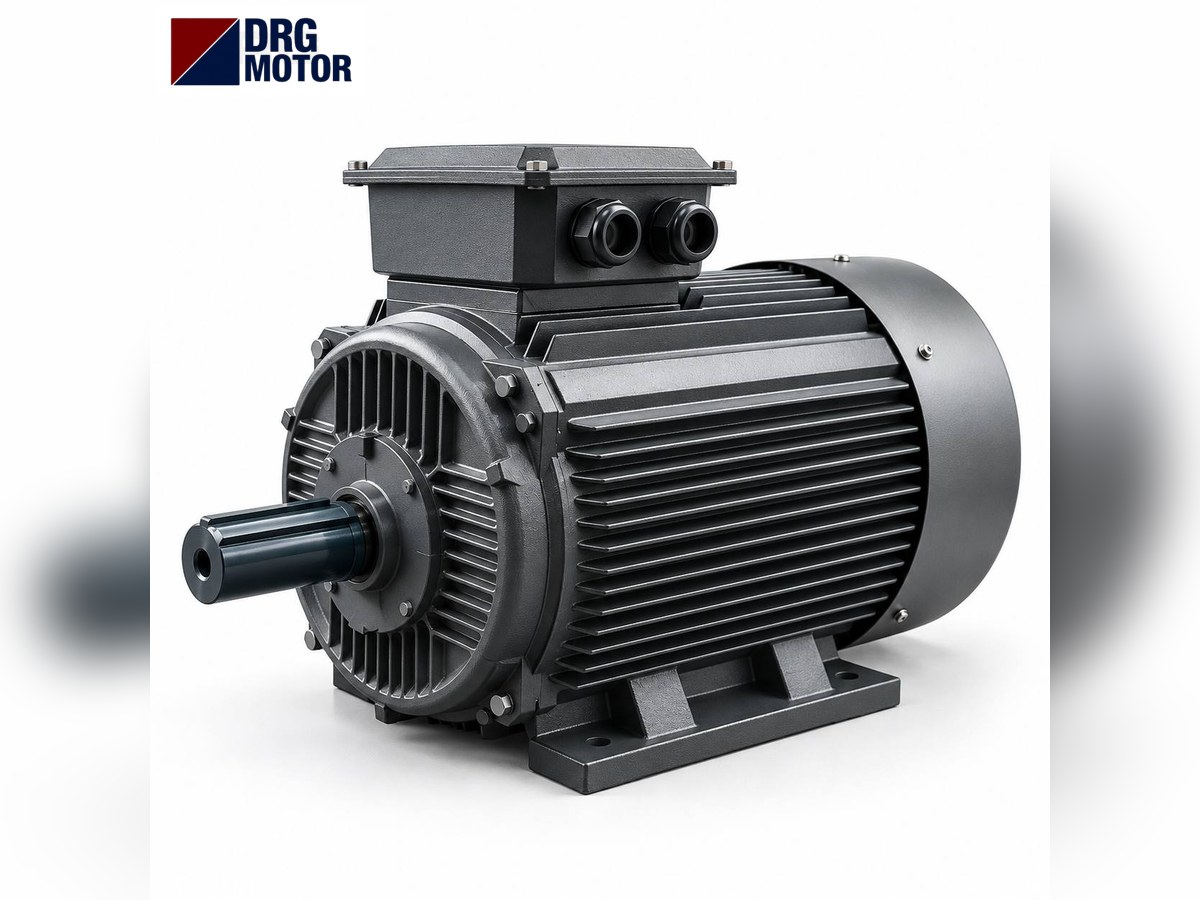
A tertiary crusher is the horizontal-shaft impact crusher at the third stage of a crushing line that takes pre-crushed rock of up to 150 mm and turns it into 0–5 mm sand and fine cubical aggregate. The motor drives the rotor through V-belts and the rotor turns at roughly 800–900 rpm [3]; it is this high peripheral speed that makes sand. On tertiary impact crushers on the market, the single motor rating is roughly 90–355 kW [1][2][4]. The power needed rises with the amount of sand required, the hardness of the rock and the rotor speed.
Below you will find the role of the tertiary crusher in fine crushing, how motor power is estimated with a capacity formula, and which DRG motors match these machines. For current prices of suitable motors, see Buy Electric Motors Online. Motors for the whole plant: Stone Crushing Plant Motors.
What is a tertiary crusher and what does it do in fine crushing?
A tertiary crusher processes rock that has already been reduced in the first and second stages. Its job is not to split the stone in two, but to knock off grain corners, make flaky and elongated particles cubical and produce sand-sized material. Besides the breaker plates, it has grinding plates in the lower zone; the gap between plates and rotor is set hydraulically [1]. One manufacturer gives 30–60 m/s peripheral speed for a four-bar rotor and 50–75 m/s for a two-bar rotor; the two-bar rotor is for producing fine sand at low capacity from feed of up to 80 mm [1].
Which materials and where?
- Concrete and plaster sand (0–5 mm) in limestone and dolomite quarries.
- River gravel plants crushing coarse pebbles to make up a sand shortfall.
- Cubical 5–12 mm chippings for asphalt, meeting flakiness limits.
- Added as a second machine to the sand circuit where the secondary crusher is not enough.
The impact principle is economical on medium-hard rock with low abrasiveness. In abrasive rock such as basalt and granite, blow bar consumption rises quickly; there a cone crusher or vertical shaft impactor is preferred at the tertiary stage.
What sets the tertiary crusher apart from the secondary crusher and the VSI?
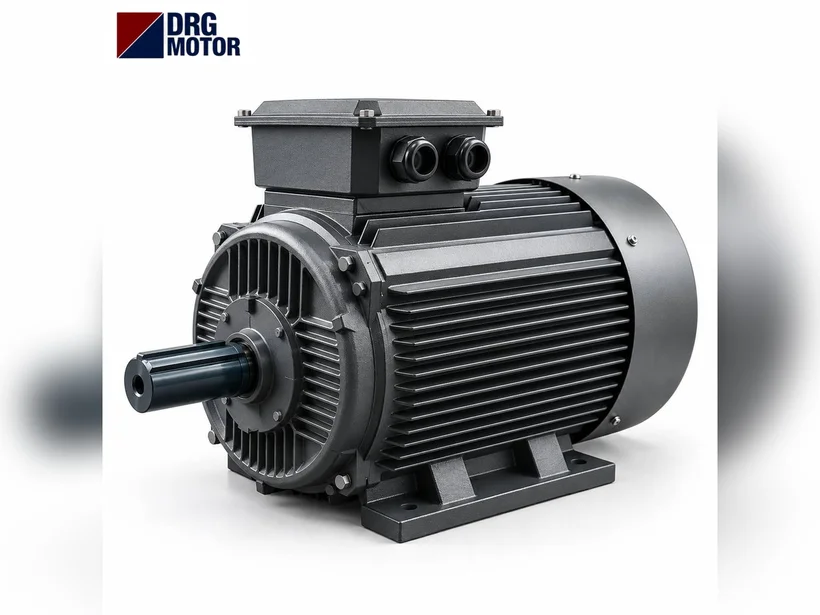
From the outside a tertiary impact crusher resembles a secondary impact crusher, but the feed is finer and the rotor spins much faster. In the secondary machine the rotor works to split rock; in the tertiary one, energy goes into correcting grain shape and producing fines. Fewer tonnes pass with the same motor power, because more work is done per tonne. One manufacturer gives a design factor of 0.70 for the tertiary stage and 1 for the secondary stage in limestone [1]; with the same power this means roughly 30% less capacity at the tertiary stage.
| Machine | Feed / product | Crushing action | Motor arrangement |
|---|---|---|---|
| Tertiary impact | ≤150 mm → sand, fine chips | Blow bars + plates, horizontal | Single motor, belt |
| Vertical Shaft Impactor (VSI) | Fine feed → sand | Rock-on-rock / anvil | Single or twin motor |
| Cone Crusher (tertiary) | Pre-screened fine feed | Compression, mantle-concave | Single motor + lube |
The Vertical Shaft Impactor (VSI) has a vertical rotor that takes rock at the centre and throws it outwards; its sand curve is finer and its grains rounder. The Cone Crusher is also used at the tertiary stage; in abrasive rock blow bar cost becomes prohibitive and a cone is preferred, but a VSI is often added behind it for cubicity. The horizontal-shaft tertiary crusher keeps the layout simple on medium-hard, low-abrasion rock, because a single machine yields both sand and cubical chippings.
How does the motor turn the rotor? Pulleys, belts and high speed
On a tertiary impact crusher the motor sits on a separate base and turns the large pulley on the rotor shaft through SPC-profile belts. On one manufacturer's three rotor sizes the drive pulley is about 800 mm in diameter and 10 SPC belts are used [1]. The pulley is fixed to the shaft with conical clamping rings [1].
Rotor speed is clearly higher than on a secondary machine. A 1,100 mm rotor reaches about 46 m/s at 800 rpm and about 52 m/s at 900 rpm. A 1,000 mm rotor must turn at about 955 rpm for 50 m/s. With an 800 mm rotor pulley, this speed needs a motor pulley of about 513 mm on a 4-pole (1490 rpm) motor and about 772 mm on a 6-pole (990 rpm) motor. With a 6-pole motor the two pulleys approach the same size; this is why a 4-pole motor is the more natural match on tertiary crushers. Check your own ratio with the pulley and belt calculator.
A higher rotor speed gives a finer product, but also more energy per tonne and more blow bar wear. When speed is changed by a pulley swap, the motor current must be monitored again and the overload setting reviewed. The pump of the hydraulic system that adjusts the plates runs on a small motor independent of the main motor [1]; this auxiliary motor is not added to the main motor's kW.
Click to see current electric motor prices and order nowSEE PRICES →
Tertiary crusher motor power: market data and DRG match
A) Motor power seen in models on the market
| Model group / capacity | Motor power | Single / total | Source |
|---|---|---|---|
| Maker A, Ø1000×500 rotor, 70–100 t/h | 90–160 kW | Single motor | [1] |
| Maker B, smallest, 60–80 t/h | 110 kW | Single motor | [2] |
| Maker A, Ø1000×1000, 130–170 t/h | 160–250 kW | Single motor | [1] |
| Maker B, largest, 230–250 t/h | 250 kW | Single motor | [2][3] |
| Maker A, Ø1000×1500, 170–250 t/h | 200–315 kW | Single motor | [1] |
| Maker C, secondary-tertiary, large | 250–355 kW | Single motor | [4] |
| Maker C, largest | 355–630 kW | Total, dual drive | [4] |
| Auxiliary: hydraulic adjustment pump | Listed separately | Separate motor | [1] |
In this machine group, single motor options of roughly 90–355 kW are seen, depending on the manufacturer's model and capacity [1][2][4]. The 630 kW figure is the total of two motors and must not be read as a single motor [4]. At the same rotor diameter, rotor width sets the power: as the width of a Ø1000 mm rotor grows from 500 mm to 1,500 mm, the motor class rises from 90–160 kW to 200–315 kW and capacity from 70–100 t/h to 170–250 t/h [1]. Even for one machine the value is given as a range, because the rock's work index, the required sand fineness and rotor speed change the power needed.
B) Motors with a match in the DRG range
All single motors between 90 and 355 kW are available in the DRG cast iron range at 1500 and 1000 rpm. Because of the high rotor speed on tertiary crushers, 4-pole (1500 rpm) options come first. Machines that exceed 355 kW on a single motor or that need 750 rpm are outside the DRG range; on dual-drive models, two separate DRG motors can be considered if the per-motor value does not exceed 355 kW.
Information needed to select a motor for sand production
- Rotor diameter × width, number of blow bars (2 or 4) and target peripheral speed.
- Rotor pulley and motor pulley diameters, belt profile and number of belts.
- Feed size (F80) and required product (P80); whether sand or cubical chippings are the goal.
- Rock type and moisture: limestone, river gravel, dolomite; washed or clayey.
- Circulating load returning from the screen in closed circuit; it raises the total tonnage entering the crusher.
- Old motor nameplate and shaft size (D×E), base hole spacing.
- Panel type and transformer rating; whether there is a soft starter or inverter.
Although the fast-spinning rotor is lighter than on a secondary machine, it stores a lot of kinetic energy at high speed; the no-load run-up is not short. The crusher starts empty and feed is opened once the rotor is at full speed. Choose the starting method according to the supply and the crusher manufacturer's advice; general information is in the star-delta starting tool and the starting current article.
Worked example: 120 tonnes per hour of sand and chippings from river gravel
The capacity approach in one manufacturer's technical article is as follows: specific crushing energy W = 11·Wi·(1/√P80 − 1/√F80), capacity Q = N / W · ft · fv · fm [1]. N is motor power (kW), Wi the Bond work index, ft the tertiary design factor, fv the speed factor and fm the material condition factor. Reversing the formula gives the required power: N = Q · W / (ft · fv · fm).
- Material: river stone, Wi = 13.53, tertiary design factor ft = 0.66 [1].
- Feed F80 = 60 mm, product P80 = 8 mm.
- Rotor peripheral speed 50 m/s, fv = 1.020; material moist but clean, fm = 0.90 [1].
- Target: 120 t/h.
W = 11 × 13.53 × (1/√8,000 − 1/√60,000) ≈ 1.06 kWh/t. Required power N = 120 × 1.06 / (0.66 × 1.020 × 0.90) ≈ 209 kW. The next standard rating is 250 kW; with the same formula 250 kW gives about 143 t/h and 200 kW about 115 t/h. As 200 kW would be marginal, 250 kW is chosen. This is only a preliminary estimate; the final power is confirmed from the crusher manufacturer's table.
A Ø1000 mm rotor turns at about 955 rpm for 50 m/s. With an 800 mm rotor pulley, the 4-pole DRG-355M-4 (250 kW, 1490 rpm, 355M, 418 A at 400 V) needs a motor pulley of about 513 mm. Rated torque at the motor shaft is 1,602 Nm; the belt raises this to about 2,500 Nm at the rotor shaft. In direct-on-line starting, the starting current reaches 7.1 × 418 ≈ 2,968 A; this is taken into account when choosing the transformer and switchgear. If the base accepts a larger frame and the pulley ratio is worked out accordingly, the 6-pole DRG-355L-6 (250 kW, 990 rpm, 355L, 433 A) can also be used.
DRG motor match and ordering
DRG Motor is a manufacturer, supplier and seller of electric motors. The product range includes 3-phase motors in aluminium (0.25–11 kW) and cast iron (0.55–355 kW) housings at 1000/1500/3000 rpm; windings are 230/400 V or 400/690 V and mounting is B3, B5, B14 or B35, stated with an order note. All models in the tertiary crusher class are wound for 400/690 V and suit foot-mounted (B3) base installation; exact mounting dimensions come from the crusher manufacturer's drawing.
| Model | Power / speed | Frame | Current 400 V |
|---|---|---|---|
| DRG-315S-4 | 110 kW / 1488 rpm | 315S cast iron | 187 A |
| DRG-315L1-4 | 160 kW / 1488 rpm | 315L cast iron | 271 A |
| DRG-315L2-4 | 200 kW / 1490 rpm | 315L cast iron | 334 A |
| DRG-355M-4 | 250 kW / 1490 rpm | 355M cast iron | 418 A |
| DRG-355L-6 | 250 kW / 990 rpm | 355L cast iron | 433 A |
| Model | Power / speed | Frame · current 400 V | Price |
|---|---|---|---|
| DRG-315M-6125 HP | 90 kW · 1000 rpm | Cast iron 315M · 161 A | $4,430.22 (€3,956.46) Details & buy → |
| DRG-280M-4125 HP | 90 kW · 1500 rpm | Cast iron 280M · 155 A | $3,268.56 (€2,919.03) Details & buy → |
| DRG-315S-4150 HP | 110 kW · 1500 rpm | Cast iron 315S · 187 A | $4,863.00 (€4,342.97) Details & buy → |
| DRG-315M-4180 HP | 132 kW · 1500 rpm | Cast iron 315M · 224 A | $5,621.72 (€5,020.55) Details & buy → |
| DRG-315L1-4200 HP | 160 kW · 1500 rpm | Cast iron 315L · 271 A | $6,135.24 (€5,479.15) Details & buy → |
| DRG-315L2-4270 HP | 200 kW · 1500 rpm | Cast iron 315L · 334 A | $7,115.64 (€6,354.71) Details & buy → |
| DRG-355L-6340 HP | 250 kW · 1000 rpm | Cast iron 355L · 433 A | $12,004.86 (€10,721.09) Details & buy → |
| DRG-355M-4340 HP | 250 kW · 1500 rpm | Cast iron 355M · 418 A | $9,826.77 (€8,775.92) Details & buy → |
| DRG-355L-4430 HP | 315 kW · 1500 rpm | Cast iron 355L · 526 A | $11,417.31 (€10,196.37) Details & buy → |
DRG MOTOR motors are guaranteed against material and manufacturing defects for 2 years from the delivery date (warranty certificate). For the overall motor needs of a crushing plant: electric motors for stone crushing plants.
DRG motors suitable for tertiary crushers
- DRG-280M-4 – 90 kW – 1486 rpm – 280M cast iron
- DRG-315S-4 – 110 kW – 1488 rpm – 315S cast iron
- DRG-315L1-4 – 160 kW – 1488 rpm – 315L cast iron
- DRG-355M-4 – 250 kW – 1490 rpm – 355M cast iron
- DRG-355L-4 – 315 kW – 1490 rpm – 355L cast iron
- DRG-355L-6 – 250 kW – 990 rpm – 355L cast iron
Click to see current prices and order these motors nowSEE PRICES →
Frequently asked questions about tertiary crusher motors
How many kW is a tertiary crusher motor?
It depends on rotor width and capacity. Single-motor models on the market show roughly 90–355 kW; small 70–100 t/h machines sit at the lower end, while above 200 t/h the figure is around 250–315 kW.
At what speed does a tertiary crusher rotor turn?
On one manufacturer's models it is 800–900 rpm; on a 1,100 mm rotor this means about 46–52 m/s peripheral speed. The motor turns at 1490 or 990 rpm and the pulleys provide the ratio.
Is a tertiary crusher or a vertical shaft impactor better for sand?
On medium-hard, low-abrasion rock, a horizontal-shaft tertiary crusher delivers both sand and cubical chippings with one machine. On abrasive rock or with a very strict sand specification, a vertical shaft impactor is preferred.
How many amps does a 250 kW tertiary crusher motor draw?
The DRG-355M-4 draws 418 A at 400 V and 440 A at 380 V. In direct-on-line starting, about 7.1 times this value is seen at start-up.
Send us the rotor size, pulley diameters, required product and the old motor nameplate; we will select the right DRG motor for your tertiary crusher together. Contact: +90 (542) 666 11 11, [email protected] or the contact form. Models and prices: online shop.
Sources
- MEKA – What Is a Tertiary Impact Crusher? (teknik yazı) – Ø1000×500/1000/1500 rotor: 90–160 / 160–250 / 200–315 kW, 70–250 t/h, maximum feed 150 mm, 30–60 m/s (4 bars), 50–75 m/s (2 bars), Ø800 mm drive pulley with SPC belts; capacity formula and factor tables.
- Constmach – Tertiary Impact Crushers (CTC serisi) – CTC-1275/1210/1212/1215: 60–250 t/h, 110/160/200/250 kW.
- Constmach – CTC-1215 Tertiary Impact Crusher (teknik föy) – Ø1,100 × 1,500 mm rotor, 800–900 rpm rotor speed, maximum feed 150 mm, 250 kW.
- Metso – Nordberg NP Series HSI crushers (broşür) – secondary-tertiary models: 200–315 / 250–355 kW single drive, 355–630 kW on the largest model (dual drive total); manufactured sand below 6 mm.


