 English
 Le français
 Türkçe

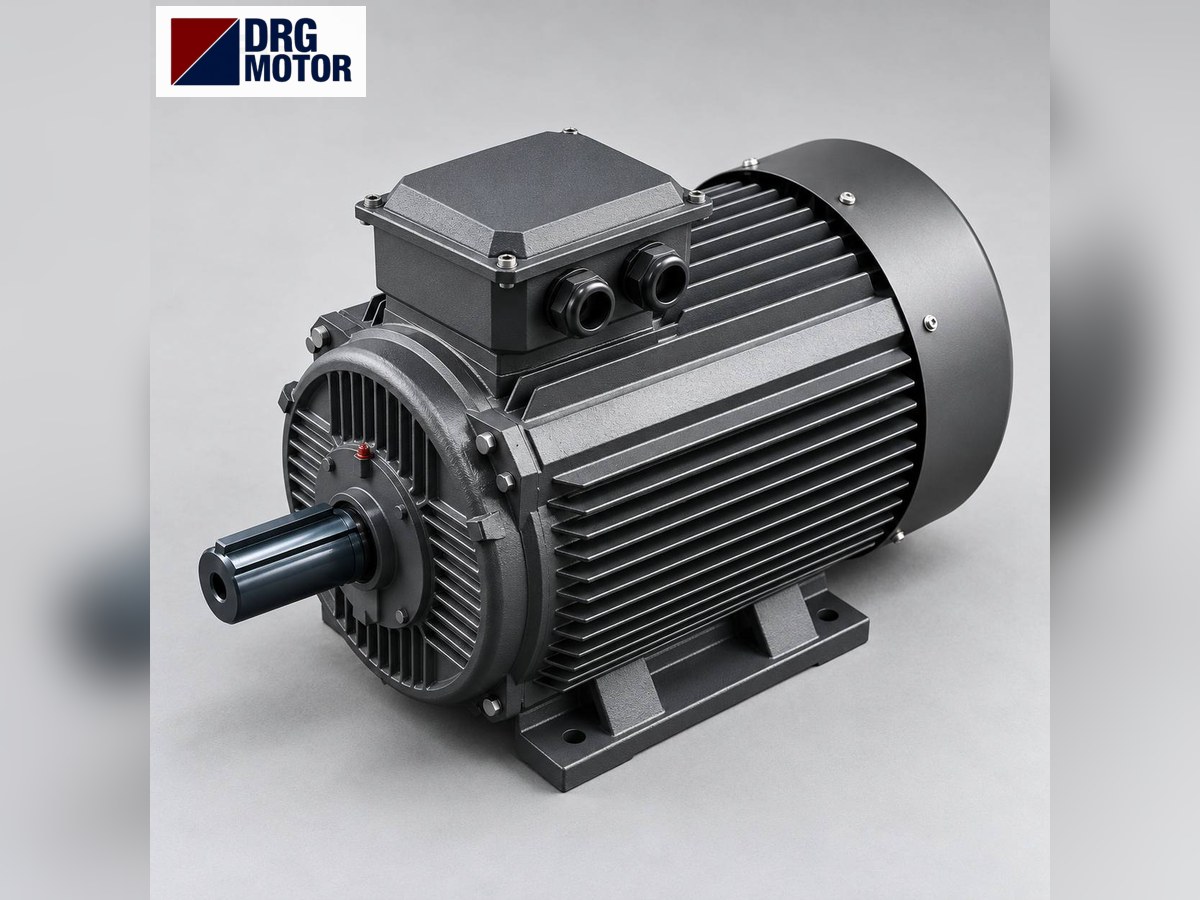
A vertical shaft impact crusher (VSI) is the machine that takes rock into the centre of a vertical-shaft rotor and throws it outwards at roughly 43–70 m/s to produce sand and fine cubical aggregate. The motor drives this rotor by belts; small models use one motor, large models use two motors placed on either side of the rotor. On models on the market, power per motor is roughly 55–250 kW, and total power on twin-motor models is 320–500 kW [1][2]. In one manufacturer's data sheet the motors are 4-pole squirrel cage induction motors [1].
This page covers the VSI's place in sand production, the difference between single and twin motor layouts, how belts set rotor speed, and which DRG motors match these machines. Current prices are on Buy Electric Motors Online; for the other machines in the plant, see Stone Crushing Plant Motors.
How does a vertical shaft impact crusher work: rock-on-rock and rock-on-anvil
Material drops from the feed hopper into the centre of the rotor. As the rotor spins, it accelerates the rock along its ports and throws it out. Where the rock strikes defines the machine type:
- Rock-on-rock (autogenous) crushing: The inside of the crushing chamber is lined with a bed of the same material; the thrown rock hits this bed. Wear is low and the product curve stays constant over time [1]. An open-rotor model accepts feed of up to 90 mm [4].
- Rock-on-anvil crushing: Steel anvils are arranged around the rotor; a closed rotor throws rock onto them. On less abrasive rock it gives a harder impact and more fines; on abrasive rock the anvils wear quickly and the rock-on-rock type is chosen [2]. On one closed-rotor model, feed is limited to 35 mm [3].
On some machines part of the feed bypasses the rotor and falls straight into the chamber, colliding in mid-air with rock coming from the rotor; one manufacturer states that this split flow allows extra material of about 20% of the rotor feed [1].
Where is it used?
- Production of 0–4 and 0–5 mm manufactured sand in aggregate quarries; concrete sand replacing river sand.
- Behind a cone crusher, to make flaky particles cubical.
- Roller-compacted concrete for dams and industrial minerals; glass and slag recycling [1].
Motor features that set the VSI apart from other crushers
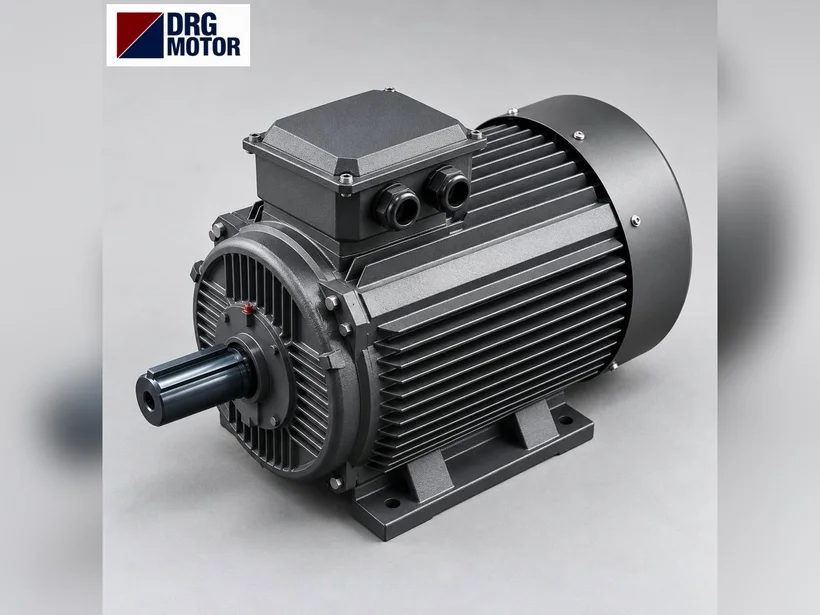
On the Cone Crusher and impact crushers the rotor or eccentric shaft is horizontal; on the VSI the rotor shaft is vertical and the belts run in a horizontal plane. Because both shafts of a V-belt drive must be parallel, the motor is placed beside the crusher with its shaft vertical. One manufacturer mounts the motor on a bracket that adjusts belt tension hydraulically [1]. For vertical operation, the motor must be ordered suitable for vertical mounting, and bearing load including belt pull must be confirmed with the crusher manufacturer; the exact mounting type comes from the crusher manufacturer's drawing.
The second difference is speed. While a Tertiary Crusher rotor turns at around 800–900 rpm, one manufacturer's VSI rotors turn at roughly 1,380–2,100 rpm depending on model and speed option [1]. So on a VSI the pulleys often do not reduce speed; they keep it equal or raise it: with a 4-pole motor at 1488 rpm, the ratio is about 1.08 (slight reduction) for a 1,381 rpm rotor and about 0.75 (step-up) for a 1,982 rpm rotor. One manufacturer states that rotor speed can be changed simply by swapping the motor pulley and taper locks [1]. Reaching the same rotor speed with a 6-pole motor needs a much larger motor pulley; this is why the 4-pole motor is the natural partner of this machine.
The third difference is feed: a Primary Impact Crusher takes blocks a metre in size, whereas a VSI accepts at most 35–90 mm [1][3][4]. Each impact is small; on the other hand the rotor is always at high speed and motor load depends heavily on tonnage.
Single motor or twin motor?
Small and medium VSIs run on one motor. Once the rotor grows and power goes beyond roughly 250 kW, manufacturers switch to two motors: one uses a single motor up to 220 kW and 2×185 and 2×250 kW above [1]; another supplies 110 kW with one motor and 2×160, 2×185 and 2×200 kW with two [2]. The two motors are belted to either side of the rotor pulley; their loads balance and two standard frames are used instead of one very large motor.
Points to watch in a twin-motor layout:
- Both motors must be the same model, same kW and same rated speed; pulley diameters and belt tension must be equal. Otherwise the motor with less slip takes most of the load.
- Both motors must start together, and if one stops on a protective trip, the other must be stopped as well; trying to carry a loaded rotor on one motor overloads that motor.
- Overload protection and current monitoring are done separately for each motor; two currents close to each other indicate balanced load.
- For spares, one motor may not be enough; a failure may require replacing both, which should be planned for.
Click to see current electric motor prices and order nowSEE PRICES →
VSI motor power: market data and the DRG range
A) Motor power seen in models on the market
| Model group / capacity | Motor power | Single / total | Source |
|---|---|---|---|
| Maker A, smallest, 10–50 t/h | 55 kW | Single motor | [1] |
| Maker B, Ø700 rotor, 60–100 t/h | 110 kW | Single motor | [2][3] |
| Maker A, medium, 193–250 t/h | 220 kW | Single motor | [1] |
| Maker B, Ø800 rotor, 150–200 t/h | 2 × 160 kW = 320 kW | Per motor / total | [2] |
| Maker B, Ø975 open rotor, 250–300 t/h | 2 × 200 kW = 400 kW | Per motor / total | [2][4] |
| Maker A, largest, 445–600 t/h | 2 × 250 kW = 500 kW | Per motor / total | [1] |
In this machine group, options of roughly 55–250 kW per motor are seen, depending on the manufacturer's model and capacity [1][2]; on twin-motor models the total installed power is 320–500 kW [1][2]. The total is not a single motor rating; a 500 kW VSI runs on two 250 kW motors. Capacity depends not only on power but also on rotor speed: one manufacturer states that at the same 185 kW the rotor passes 252 t/h at 52 m/s and 141 t/h at 62 m/s [1]. Higher speed gives a finer product but lowers rotor capacity and raises energy per tonne [1].
B) Match in the DRG range
The whole 55–250 kW per-motor band is available in the DRG cast iron range as 4-pole (1500 rpm) motors; on twin-motor models two identical DRG motors are used. None of the VSIs in the sources exceeds 355 kW per motor; should a machine need more than 355 kW on a single motor or require a 750 rpm motor, it would be outside the DRG range.
How to read a selection table: two examples
In one manufacturer's manual selection method, the required sand quantity is first divided by the share the crusher produces at that size to find the total tonnage entering the crusher [1]. In the same manufacturer's example, the breakage ratio at 5 mm is 30% for rock with a work index of 14 [1].
Example 1, single motor: 33 tonnes per hour of 0–5 mm sand are required. Total tonnage is 33 × 100 / 30 = 110 t/h. The table places this in the 110 kW single-motor model covering 51–121 t/h [1]. Taking a 20% split flow, the rotor throughput is about 92 t/h; with the manufacturer's rule of 0.9–1 kW per tonne [1] this gives 83–92 kW, which stays within the 110 kW motor. The matching motor is the DRG-315S-4: 110 kW, 1488 rpm, 315S frame, 187 A at 400 V, rated torque 706 Nm. In direct-on-line starting the starting current is about 7.0 × 187 ≈ 1,309 A.
Example 2, twin motor: A large plant is installing a 500 t/h VSI; the table shows 2 × 250 kW for 445–600 t/h [1]. Two DRG-355M-4 motors (250 kW, 1490 rpm, 355M, 418 A) are needed. Total power is 500 kW and the combined rated current of the two motors is 836 A at 400 V. The panel, cables and transformer are chosen for this total current and for both motors starting at the same time; staggering the start or using soft starters is assessed together with the crusher manufacturer.
These examples show how to read the table; in a real selection the rock's work index, moisture and the load returning from the screen circuit are given to the crusher manufacturer for confirmation.
Checklist for ordering the motor and DRG match
- Crusher model, single or twin motor, kW per motor.
- Rotor speed or tip speed; rotor and motor pulley diameters, belt profile.
- Whether the motor stands vertically or horizontally; bracket fixing dimensions and flange/foot type.
- Old motor nameplate, shaft diameter and length (the pulley bush is chosen accordingly).
- Feed size and moisture; material with 3–8% moisture may cause sticking [1].
- Starting: direct-on-line, soft starter or inverter; start sequence for twin motors.
- Connection of bearing temperature and vibration sensors (on the crusher side) [1].
The crusher is started empty; feed is opened once the rotor reaches full speed. One manufacturer asks that the crusher not be run below its recommended minimum tonnage; at low feed, crushing drops, the rock bed thins and the chamber may be damaged [1]. For the motor, this means long running at low current is also undesirable. For the starting method see the star-delta starting tool, and for pulleys the pulley and belt calculator.
DRG Motor is a manufacturer, supplier and seller of electric motors. Our range covers aluminium housings from 0.25 to 11 kW and cast iron from 0.55 to 355 kW; speeds of 1000, 1500 and 3000 rpm; 3-phase, 230/400 V or 400/690 V; mounting B3/B5/B14/B35 set by an order note. Suitable 4-pole models for a VSI:
| Model | Power / speed | Frame | Current 400 V |
|---|---|---|---|
| DRG-250M-4 | 55 kW / 1485 rpm | 250M cast iron | 97.6 A |
| DRG-315S-4 | 110 kW / 1488 rpm | 315S cast iron | 187 A |
| DRG-315L1-4 | 160 kW / 1488 rpm | 315L cast iron | 271 A |
| DRG-315L2-4 | 200 kW / 1490 rpm | 315L cast iron | 334 A |
| DRG-355M-4 | 250 kW / 1490 rpm | 355M cast iron | 418 A |
| Model | Power / speed | Frame · current 400 V | Price |
|---|---|---|---|
| DRG-250M-475 HP | 55 kW · 1500 rpm | Cast iron 250M · 97.6 A | $2,065.73 (€1,844.82) Details & buy → |
| DRG-280S-4100 HP | 75 kW · 1500 rpm | Cast iron 280S · 129 A | $2,916.93 (€2,605.00) Details & buy → |
| DRG-280M-4125 HP | 90 kW · 1500 rpm | Cast iron 280M · 155 A | $3,268.56 (€2,919.03) Details & buy → |
| DRG-315S-4150 HP | 110 kW · 1500 rpm | Cast iron 315S · 187 A | $4,863.00 (€4,342.97) Details & buy → |
| DRG-315M-4180 HP | 132 kW · 1500 rpm | Cast iron 315M · 224 A | $5,621.72 (€5,020.55) Details & buy → |
| DRG-315L1-4200 HP | 160 kW · 1500 rpm | Cast iron 315L · 271 A | $6,135.24 (€5,479.15) Details & buy → |
| DRG-315L2-4270 HP | 200 kW · 1500 rpm | Cast iron 315L · 334 A | $7,115.64 (€6,354.71) Details & buy → |
| DRG-355M-4340 HP | 250 kW · 1500 rpm | Cast iron 355M · 418 A | $9,826.77 (€8,775.92) Details & buy → |
DRG MOTOR motors are guaranteed against material and manufacturing defects for 2 years from the delivery date (warranty certificate). General information on torque and starting in crushers: why stone crushing needs high torque.
DRG motors for vertical shaft impact crushers
- DRG-250M-4 – 55 kW – 1485 rpm – 250M cast iron
- DRG-280M-4 – 90 kW – 1486 rpm – 280M cast iron
- DRG-315S-4 – 110 kW – 1488 rpm – 315S cast iron
- DRG-315L1-4 – 160 kW – 1488 rpm – 315L cast iron
- DRG-315L2-4 – 200 kW – 1490 rpm – 315L cast iron
- DRG-355M-4 – 250 kW – 1490 rpm – 355M cast iron
Click to see current prices and order these motors nowSEE PRICES →
Vertical shaft impact crusher motor: frequently asked questions
How many kW is a VSI crusher motor?
Roughly 55–250 kW per motor is seen. Large machines above 200 t/h mostly use two motors, with total power rising to 320–500 kW.
If one of the twin motors on a VSI fails, can the machine run on one motor?
This is not recommended. The rotor is fed for the combined power of both motors; a single motor will be overloaded. Until the faulty motor is replaced, the crusher should be stopped or run at a reduced tonnage permitted by the manufacturer.
Why is a 4-pole motor chosen for a VSI?
The VSI rotor turns at around 1,400–2,100 rpm. A 4-pole motor running at 1490 rpm reaches this speed with reasonable pulley ratios; a 6-pole motor would need a very large motor pulley.
How many amps does a 110 kW VSI motor draw?
The DRG-315S-4 draws 187 A at 400 V and 197 A at 380 V; in direct-on-line starting about 7 times this current is seen.
Share your VSI model, number of motors, pulley sizes and the old motor nameplate; we will pick the right DRG motor together. Reach us at +90 (542) 666 11 11, [email protected] or through the contact form. Current prices for all 120 models are in the online shop.
Sources
- Sandvik – CV200 Range VSI Crushers, Technical Specification – motor table: 55 / 110 / 185 / 220 kW single, 2×185 and 2×250 kW twin; 4-pole squirrel cage; rotor speed and tip speed options; cogged SPC belts, motor bracket with hydraulic belt tensioning; 40–55 mm feed; manual selection example and Bi-Flow rule.
- Constmach – Vertical Shaft Impact Crushers (VSI serisi) – 700–975 mm rotors; 110 kW single motor, 2×160, 2×185, 2×200 kW twin motor; 60–300 t/h; closed rotor/anvil and open rotor/rock-on-rock.
- Constmach – VSI-700-CR teknik föy – single 110 kW motor, maximum feed 35 mm, rotor 60–70 m/s, 60–100 t/h.
- Constmach – VSI-1000-OR teknik föy – open rotor (rock-on-rock), Ø975 mm, maximum feed 90 mm, 2×200 kW, 50–60 m/s, 250–300 t/h.


