 English
 Le français
 Türkçe

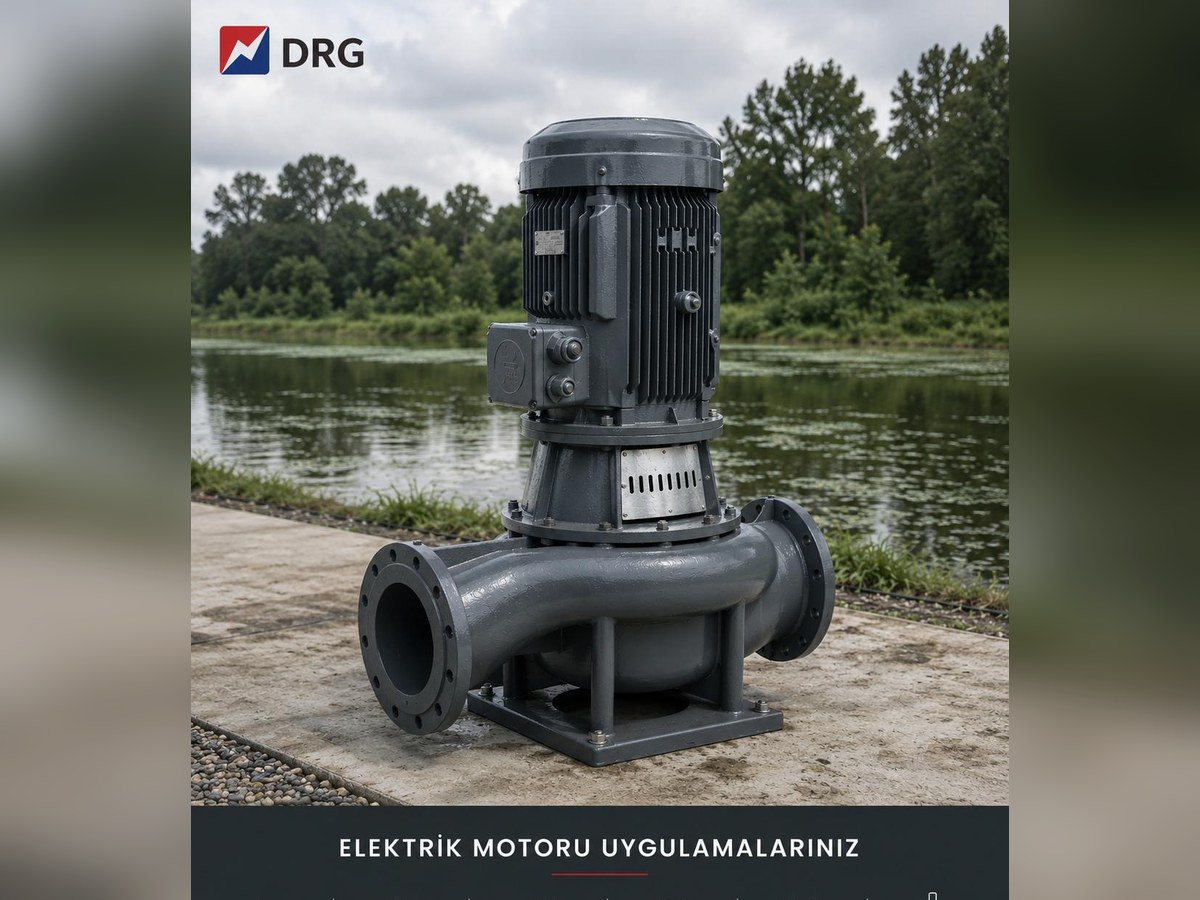
Heat in a pasteuriser comes from steam or hot water, not from the motor; the motor turns the pump that pushes product through the plate heat exchanger, the pump of the hot water circuit and, on tunnel machines, the belt carrying the bottles. In a homogeniser a single large motor turns the crankshaft of a high-pressure piston pump through V-belts or a gearbox. Maker catalogues list 0.37–3 kW for pasteuriser pumps and, depending on capacity and pressure, 2.2–315 kW for the homogeniser main motor.
DRG Motor is a manufacturer, supplier and seller of electric motors. We do not sell the pasteuriser, the homogeniser, plate heat exchangers, pump casings, gearboxes or inverters, and the high-pressure pump of the homogeniser is not part of our offer either. Our part in such a line is the three-phase induction motor behind each pump and behind the homogeniser crank. All models are listed on Buy Electric Motors Online.
What does the motor do in a pasteuriser and a homogeniser?
Milk, ayran, juice or ice cream mix is drawn from a balance tank in a plate (HTST) pasteuriser, preheated in the regeneration section, brought to pasteurising temperature with hot water, held in the holding tube and cooled. At no point does the motor touch the product: the product is inside the stainless pump casing, while the motor sits behind the pump on the skid.
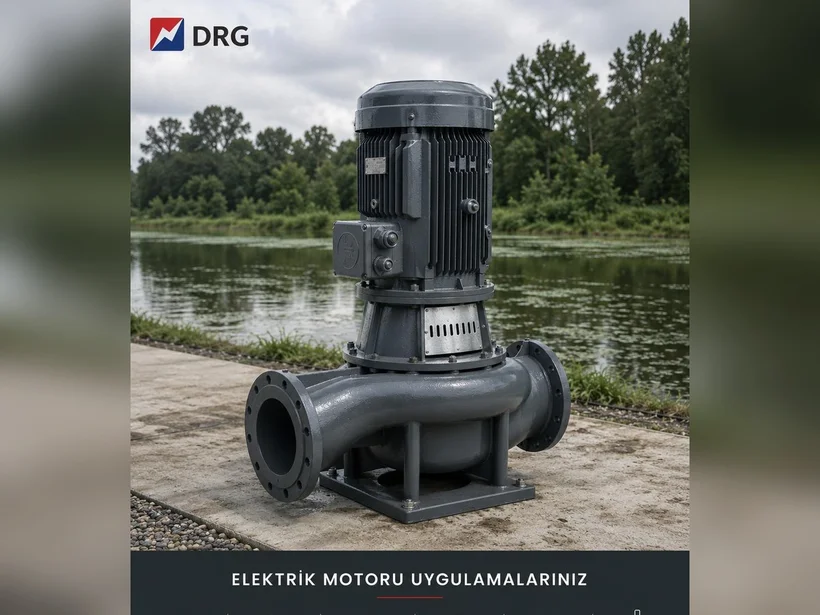
Pumps of a plate pasteuriser
The product (feed) pump covers the flow and the pressure drop across the exchanger; larger lines add a separate booster pump to keep the pasteurised side at higher pressure. The hot water pump circulates in a closed loop, so its head is low and its motor small. The first maker’s data sheet gives a 3 kW product pump and a 0.37 kW hot water pump on the 1,000 l/h unit, and a 1.1 kW hot water pump on the 4,000 l/h unit; its feed pump motor runs in the 2900 rpm class. For pump motor sizing and the usual mistakes on milk pumps see our milk and food transfer pump motor article; this page treats the pump as one part of the machine.
Main motor of the homogeniser
A homogeniser is a three- or five-piston high-pressure pump plus the homogenising valve that creates the pressure. The main motor turns the crankshaft; the pistons push the product to 150–250 bar and beyond. Motor power therefore grows with flow times pressure, and the largest motor of a pasteurising line usually sits in the homogeniser. Keep motor and pump apart: crank, pistons, seals and valves belong to the machine maker; we supply only the motor.
Tunnel pasteuriser: belt and circulation pumps
Product already in bottles, jars or cans is pasteurised in a tunnel: the packs travel on a wide belt through heating, pasteurising and cooling zones, and in every zone a pump draws water from the tank and sends it to the spray bars. The fifth maker’s manual lists seven water circulation pumps on an 8,700 bottles/h machine: six at 2.2 kW and one at 3 kW, all with 2-pole motors.
Main belt drive
The main belt moves very slowly along the tunnel; speed comes from a geared motor or a variable-ratio speed unit. On the sixth maker’s small machine the main belt motor is 0.18 kW and the infeed and outfeed belts 0.09 kW. These ratings are below 0.25 kW and therefore outside our range; for belt motors on large tunnels we found no catalogue value, so selection is made from application data: belt width and length, loaded pack weight, required dwell time and the input flange of the existing gearbox.
Where the motor sits in the wet, hot zone
The inside of the tunnel is always wet and full of vapour; pump motors stand outside the tunnel next to the tanks, and the belt motor sits behind a cover at the drive end. Hose-down water must not hit the motor casing directly, and the gland of the terminal box should point to the floor. Our motors are IP55; if a stainless steel housing or a motor built for high-pressure washdown is required, that type is not in our range, so please ask us.
How many kW for pasteuriser and homogeniser motors? Catalogue values
A) Motor ratings given in maker catalogues, data sheets and manuals:
| Machine / section | Motor power | Single / total | Note |
|---|---|---|---|
| Plate flash pasteuriser, 1,000 l/h: product pump | 3 kW | single motor | first maker’s data sheet |
| Same machine: hot water pump | 0.37 kW | single motor | first maker’s data sheet |
| Plate flash pasteuriser, 4,000 l/h: hot water pump | 1.1 kW | single motor; product pump 3 kW | first maker’s data sheet |
| Plate pasteuriser series, 1,000–20,000 l/h | 5.5–20 kW | machine total | second maker’s catalogue |
| Homogeniser, 250 l/h, 200 bar | 2.2 kW | main motor | third maker |
| Homogeniser, 5,000 l/h, 200 bar | 37 kW | main motor | third maker |
| Homogeniser, 25,000 l/h, 200 bar | 132 kW | main motor | third maker |
| Homogeniser series, 300–50,000 l/h (150 bar) | 3–315 kW | main motor, per model | fourth maker’s catalogue |
| Tunnel pasteuriser, 8,700 bottles/h: water circulation pumps | 6 × 2.2 kW + 1 × 3 kW | per pump; 2-pole | fifth maker’s manual |
| Small tunnel pasteuriser, 500 cans/h | belts 0.09 and 0.18 kW, pump 0.55 kW | per motor | sixth maker’s data sheet |
In this machine group pasteuriser pumps take roughly 0.37–3 kW, tunnel pumps 0.55–3 kW each, and homogeniser main motors 2.2–315 kW depending on capacity and pressure. The 5.5–20 kW on the plate pasteuriser row is a machine total covering pumps, controls and auxiliaries, not one motor.
B) Where DRG fits: 0.37–3 kW pump motors match our 2-pole 71 to 100 frames, and 2.2–315 kW homogeniser motors our 4-pole 100L to 355L frames. Belt motors below 0.25 kW (0.09 and 0.18 kW) are outside our range.
Click to see current electric motor prices and order nowSEE PRICES →
Worked example: reading a homogeniser catalogue table
The power a piston pump gives to the product is roughly flow times pressure difference: P ≈ Q × Δp. With 5,000 l/h = 0.00139 m³/s and 250 bar = 25,000,000 Pa, P ≈ 34.7 kW. Compared with the 250 bar column of the fourth maker’s catalogue:
| Catalogue row (250 bar) | Q × Δp | Main motor | Comment |
|---|---|---|---|
| 400 l/h | about 2.8 kW | 5.5 kW | large margin on a small machine |
| 1,200 l/h | about 8.3 kW | 11 kW | DRG-160M-4 class |
| 5,000 l/h | about 34.7 kW | 37 kW | DRG-225S-4 class |
| 9,500 l/h | about 66 kW | 75 kW | DRG-280S-4 class |
Motor power adds pump and belt losses on top of Q × Δp; on small machines this margin is proportionally large. That is why a homogeniser motor is read from the maker’s flow-pressure table rather than calculated. More pressure or more flow means a bigger motor; before running an existing machine at higher pressure, ask the maker whether crank and pistons can take the load.
Starting current of a large homogeniser
Take DRG-225S-4 for a 37 kW homogeniser in the 5,000 l/h class (rated torque: DRG-225S-4, 237.9 Nm):
| Case | Operation | Current (400 V) | Note |
|---|---|---|---|
| 37 kW homogeniser, rated | DRG-225S-4 | 66.1 A | data sheet |
| Direct-on-line start | 66.1 × 7.4 | about 489 A | Is/In = 7.4 |
| Star-delta, star step | 489 / 3 | about 163 A | valve unloaded |
| Product + hot water pump together | 5.71 + 0.89 | about 6.6 A | DRG-100L-2 + DRG-711-2 |
Homogenisers usually start with the homogenising valve unloaded and receive pressure once the motor is up to speed; check that sequence in your machine’s manual. With that routine a star-delta starter or soft starter noticeably cuts the shock on the supply. See our star-delta tool for details.
DRG motors for pasteurising and homogenising lines
DRG models covering pump and homogeniser duties, with 400 V current:
| Model | Power / speed | Frame · shaft D×E | Current 400 V |
|---|---|---|---|
| DRG-711-2 | 0.37 kW / 2750 rpm | 71 aluminium · 14×30 | 0.89 A |
| DRG-802-2 | 1.1 kW / 2880 rpm | 80 cast iron · 19×40 | 2.31 A |
| DRG-100L-2 | 3 kW / 2895 rpm | 100L cast iron · 28×60 | 5.71 A |
| DRG-112M-2 | 4 kW / 2905 rpm | 112M cast iron · 28×60 | 7.45 A |
| DRG-160M-4 | 11 kW / 1465 rpm | 160M cast iron · 42×110 | 20.4 A |
| DRG-225S-4 | 37 kW / 1485 rpm | 225S cast iron · 60×140 | 66.1 A |
| DRG-280S-4 | 75 kW / 1486 rpm | 280S cast iron · 75×140 | 129 A |
| DRG-315M-4 | 132 kW / 1488 rpm | 315M cast iron · 85×170 | 224 A |
Close-coupled pumps take a flange-mounted motor (B5 or B35), coupled pumps a foot-mounted (B3) motor on the baseplate; the homogeniser main motor is mostly foot-mounted on a belt-tensioning slide. Aluminium frames run to 11 kW and cast iron frames to 355 kW; all are three-phase IEC induction motors for 1000, 1500 and 3000 rpm. Single-phase motors used on small benchtop pasteurisers and brake motors are outside our range. Note the old motor’s plate power, speed, voltage and connection, shaft diameter and key, flange or foot size and pulley diameter; we compare those with the machine manual to confirm fit with you, and give no fit guarantee without the dimensions.
B5 dimensions for close-coupled pump motors
B5 flange values of the small frames common on pasteuriser pumps, mm:
| Frame | Shaft D×E | Flange P / M / N | Hole S |
|---|---|---|---|
| 71 | 14×30 | 160 / 130 / 110 | 10 |
| 80 | 19×40 | 200 / 165 / 130 | 12 |
| 90S/90L | 24×50 | 200 / 165 / 130 | 12 |
| 100L | 28×60 | 250 / 215 / 180 | 14.5 |
A close-coupled pump carries its impeller on the motor shaft itself; shaft size D × E and spigot N leave no room for approximation. For foot dimensions see the technical drawings page, and to size a pump from flow and head use our pump and fan motor power calculator.
Live price table
Prices of our models in pump and homogeniser sizes are pulled live from the shop:
| Model | Power / speed | Frame · current 400 V | Price |
|---|---|---|---|
| DRG-711-20.5 HP | 0.37 kW · 3000 rpm | Aluminium 71 · 0.89 A | $74.44 (€66.48) Details & buy → |
| DRG-802-21.5 HP | 1.1 kW · 3000 rpm | Cast iron 80 · 2.31 A | $96.26 (€85.96) Details & buy → |
| DRG-90L-23 HP | 2.2 kW · 3000 rpm | Cast iron 90L · 4.35 A | $154.45 (€137.93) Details & buy → |
| DRG-100L-24 HP | 3 kW · 3000 rpm | Cast iron 100L · 5.71 A | $177.89 (€158.87) Details & buy → |
| DRG-160M-415 HP | 11 kW · 1500 rpm | Cast iron 160M · 20.4 A | $568.76 (€507.94) Details & buy → |
| DRG-180L-430 HP | 22 kW · 1500 rpm | Cast iron 180L · 39.7 A | $919.45 (€821.13) Details & buy → |
| DRG-225S-450 HP | 37 kW · 1500 rpm | Cast iron 225S · 66.1 A | $1,527.18 (€1,363.87) Details & buy → |
| DRG-280S-4100 HP | 75 kW · 1500 rpm | Cast iron 280S · 129 A | $2,916.93 (€2,605.00) Details & buy → |
DRG MOTOR motors are guaranteed against material and manufacturing defects for 2 years from the delivery date (warranty certificate).
Motors in this power range
- DRG-100L-2 – 3 kW – 2895 rpm – 100L cast iron
- DRG-160M-4 – 11 kW – 1465 rpm – 160M cast iron
- DRG-225S-4 – 37 kW – 1485 rpm – 225S cast iron
- DRG-280S-4 – 75 kW – 1486 rpm – 280S cast iron
- DRG-315M-4 – 132 kW – 1488 rpm – 315M cast iron
Click to see current prices and order these motors nowSEE PRICES →
Browse the products, ask for a quote: suitable motors for your pasteuriser or homogeniser are on Buy Electric Motors Online. A picture of the nameplate together with the pump end or pulley end, sent over WhatsApp, lets us start; on the phone (+90 (542) 666 11 11) tell us the machine’s litres per hour and working pressure first.
Frequently asked questions
Is a homogeniser motor 4-pole?
The pole count is rarely printed in homogeniser catalogues. Belts or gears turn motor speed into crank speed, so a motor with a different rpm moves the pistons faster or slower and changes litres per hour; stay with the rpm on the old plate.
Will a stronger motor on the pasteuriser pump raise the flow?
No; impeller and speed set the flow. A stronger motor only runs with more reserve, and panel and cable must match the new rating.
What does the price of a pasteuriser motor depend on?
On kW, speed class, housing material and mounting form; the live table on this page reads those prices straight from our shop.
For questions: +90 (542) 666 11 11 · info@drgmotor.com · contact page. For the wider picture of motor choice in food plants, our food and beverage plant motor guide is also useful.


