 English
 Le français
 Türkçe

The number of shifts does not in itself change the motor power; but it determines whether the motor will sit for hours at a load close to its nameplate rating, when it can be stopped for maintenance and how many hours of production a failure will cost. A borderline choice that causes no trouble on a single day shift comes back as heating and shorter bearing life in round-the-clock operation.
Thermal balance and power margin
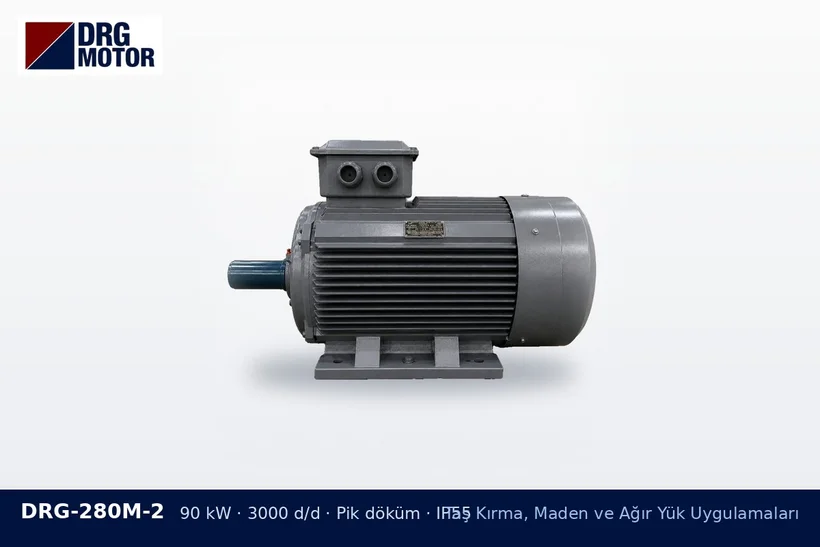
During a long shift the motor winding reaches a steady temperature and stays there. If the current is permanently above the nameplate value, insulation life is shortened. In summer, motors standing in the sun at the quarry also see a higher ambient temperature. For a crusher that will work 24 hours a day, the load current should therefore be measured, and if it is close to the limit the next power rating up should be considered. On crusher motors of 75 kW and above, the 1.15 service factor provided by DRG leaves headroom for short fluctuations; it is not a cure for permanent overload.
Night stops and condensation
If the plant runs only by day and stands at night, moisture can condense inside the cooling motor; the risk is higher for motors near the washing unit. In uninterrupted shift work the motor stays warm and condensation decreases, but the maintenance window narrows. Insulation should be checked before and after long stoppages.
Maintenance and standby plan
- Bearing greasing intervals should be tracked by running hours, not calendar dates.
- Fan covers and cooling fins should be cleaned of dust at shift changeover.
- Keeping a standby motor in the same frame size for the main crusher and critical conveyors shortens downtime.
- Since energy use rises in proportion to shift hours, annual consumption can be estimated with the energy consumption calculator.
Once the shift pattern is settled, motor options for crushers, screens and conveyors can be compared on the stone crushing plant motors page and among the three-phase models in the shop.