 English
 Le français
 Türkçe

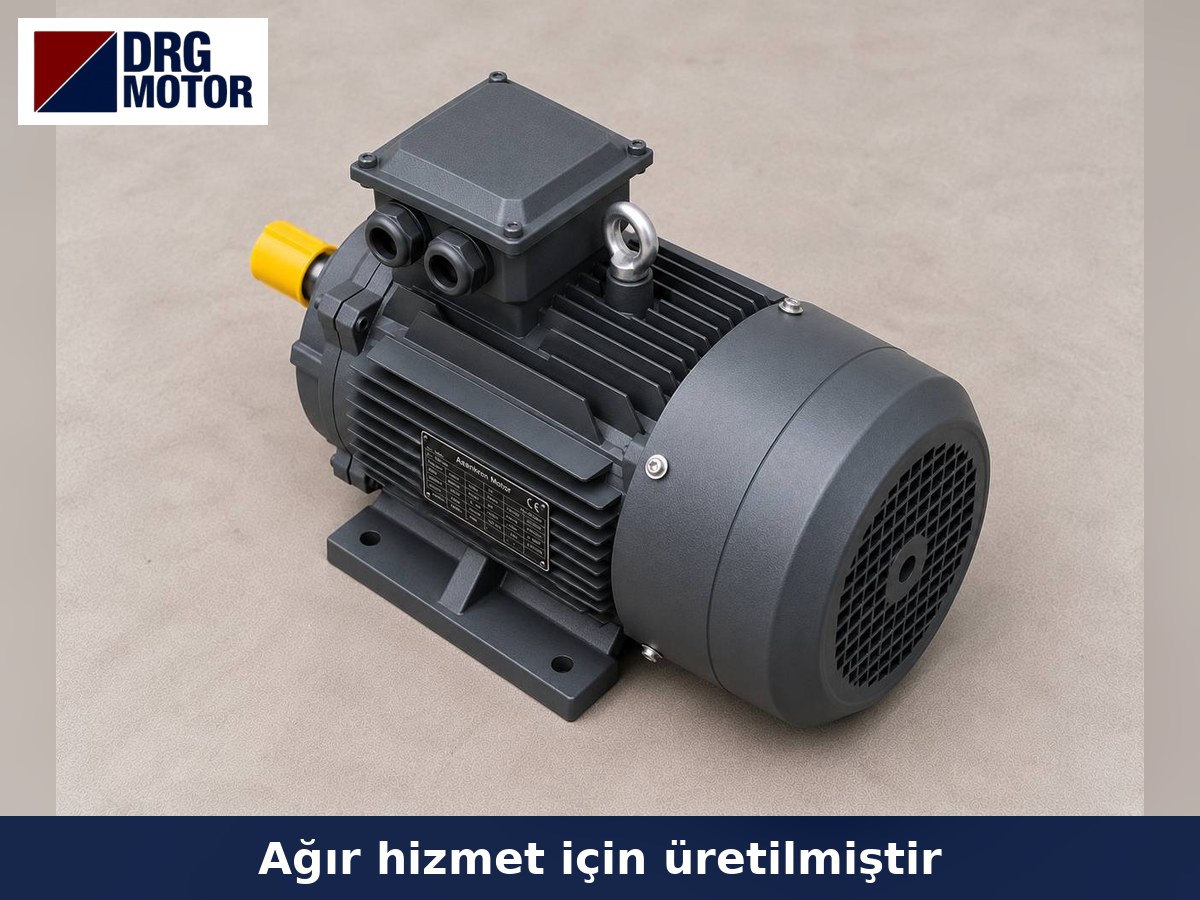
A scraper bridge is the mechanism that pushes the sludge settling on the floor of a clarifier towards the sludge hopper and skims the scum collecting on the surface. In circular tanks the bridge rotates about the tank centre; in rectangular tanks it either travels back and forth on rails or works with flights fixed to chains running the length of the tank. In every case the movement is very slow and the drive is a small electric motor coupled to a high-ratio gearbox. Manufacturer catalogues show 0.25–2.2 kW motors for circular bridges and 0.25–1.1 kW for rectangular tank scrapers; travelling bridges may have two drives.
DRG Motor is a manufacturer, supplier and seller of electric motors. We do not sell the bridge, scraper blades, chains, wheels, slip ring, gearbox or inverter; we supply the small motor that works with that gearbox. You will find every model under Buy Electric Motors Online.
Types of scraper bridge and where the drive sits
The scraper type decides where the motor is located and what load it carries. Two motors of the same kW rating live in very different conditions when one turns the large gear ring at the tank centre and the other turns a wheel at the bridge end.
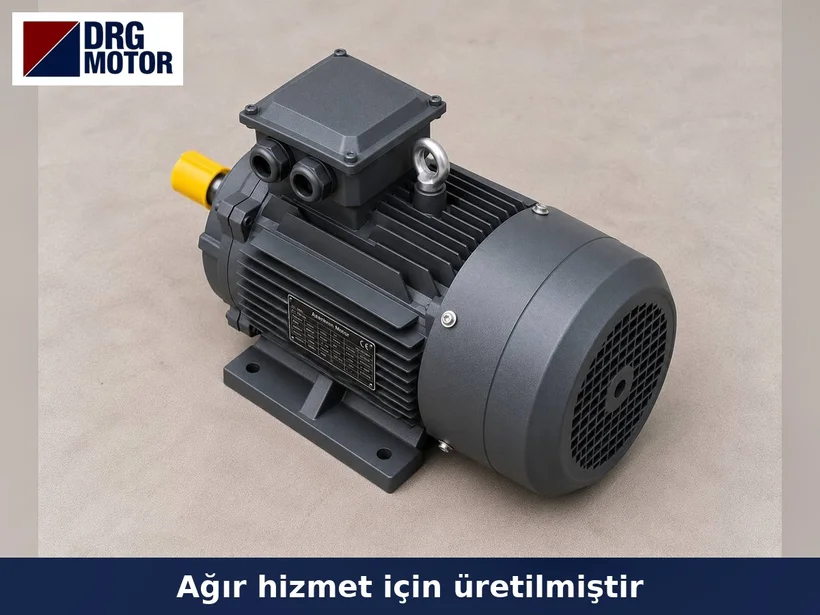
Circular tank: centre-drive bridge
In small and medium tanks the motor stands on top of the central column and turns a large gear ring through a multi-stage gearbox; the scraper arms hang from this ring. The motor sits mid-tank on a platform reached from the bridge. One maker uses 0.37–0.75 kW motors in its centre-drive series for tanks of 3–18 m diameter.
Circular tank: peripheral-drive bridge
In large tanks one end of the bridge rests on a pivot at the centre and the other runs on a rubber or steel wheel along the tank wall. Motor and gearbox sit on this wheel; power reaches the bridge through a slip ring at the centre. One maker’s table gives an edge speed of 3 m/min and a one-side drive of 1.1–2.2 kW for primary clarifiers, and 1.8 m/min with 0.37–1.1 kW for secondary clarifiers: primary sludge is heavier, so the motor grows at the same diameter.
Rectangular tank: travelling bridge
A bridge running the length of the tank on rails lowers its bottom rake to carry sludge to one end and moves scum to the other with a surface skimmer, reversing at limit switches at each end. Wide tanks have a travel motor on each side of the bridge, driven together; one maker’s series also has a separate 0.75 kW motor to lift the rake. A rake lift may need a brake to hold the load: brake motors are not in our range.
Rectangular tank: chain and flight scraper
In this bridgeless system, flights fixed to two chains running along the tank push sludge on the floor and scum on the surface on their return. The drive unit stands on a dry platform at one end of the tank, with the gearbox turning the chain sprocket. One maker’s data sheet gives a flight speed of 0.016–0.040 m/s, about 0.96–2.4 m/min, and an installed load of 0.25–1.1 kW.
How many kW for a scraper bridge motor? Catalogue values
A) Motor ratings printed in the data sheets and tables of circular and rectangular tank scraper makers:
| Scraper type / model group | Motor power | Single / total | Note |
|---|---|---|---|
| Centre-drive half bridge, Ø4–20 m | 0.37–0.75 kW | single motor | first maker |
| Centre-drive bridge, Ø3–18 m, peripheral speed 1–3 m/min | 0.37–0.75 kW | single motor | second maker |
| Rotating bridge (tank Ø6–32 m), max 0.25 rpm | 0.25–0.75 kW | single motor + gearbox | third maker, 0.8 A full-load current |
| Peripheral-drive bridge, secondary clarifier Ø16–50 m | 0.37–1.1 kW | one-side drive | fourth maker, edge speed 1.8 m/min |
| Peripheral-drive bridge, primary clarifier Ø16–50 m | 1.1–2.2 kW | one-side drive | fourth maker, edge speed 3 m/min |
| Travelling bridge (rectangular tank, width 5–20 m) | 0.75 kW; 2 × 0.75; 2 × 1.1 kW | travel, per bridge | fifth maker; rake lift extra 0.75 kW |
| Suction travelling bridge, span 8–20 m | 2 × 0.55 / 2 × 0.75 kW | two synchronised drives | fourth maker |
| Chain and flight scraper (rectangular, plastic chain) | 0.25–1.1 kW | single motor, by size | sixth maker, 0.016–0.040 m/s |
| Chain scraper, secondary tanks 25–60 m long | 0.37–0.55 kW | per tank | seventh maker, reference list |
Taken together, scraper bridge drives stay within 0.25–2.2 kW per motor; twin-drive travelling bridges total 1.1–2.2 kW per bridge, and rake-lifting types add another motor. As tank diameter or length, sludge weight and required edge speed increase, the motor moves up a step.
B) Overlap with the DRG range: the whole of this band lies within our range, which starts at 0.25 kW; 4- and 6-pole units serve here, aluminium-bodied at 0.25 and 0.37 kW and cast iron-bodied from the 0.55 kW step. Some makers’ smaller steps such as 0.18 kW are below our range; in that case a 0.25 kW motor is used only if the gearbox input and the bridge maker allow it. The bridge’s speed of less than one turn per minute comes from the gearbox; a slow-running motor is therefore unnecessary.
Click to see current electric motor prices and order nowSEE PRICES →
Worked example: gearbox ratio and thrust on a peripheral-drive bridge
Wheel speed
Assume a secondary clarifier of 30 m diameter whose bridge end moves at 1.8 m/min. The tank circumference is π × 30 ≈ 94 m, so the bridge completes one turn in about 52 minutes. With a 400 mm drive wheel, the wheel turns at only 1.43 rpm.
Gearbox ratio and torque at the wheel
To drive this wheel with the 0.55 kW DRG-801-4, an overall ratio of about 977:1 is needed to step down from the motor’s rated 1400 rpm; this is usually a two- or three-stage gearbox. The motor’s rated torque of 3.75 Nm is multiplied by this ratio; allowing a factor of 0.6 for gear losses gives roughly 2199 Nm at the wheel and about 11 kN of thrust at the rim of a 200 mm radius wheel. The force actually needed depends on bridge weight, wheel-to-rail friction and sludge resistance and is read from the bridge maker’s calculation. Ratio and output torque can be checked with your own numbers in our gearbox calculator.
Cycle time on a travelling bridge
On a rectangular tank 40 m long, a bridge travelling at 1.2 m/min covers one direction in about 33 minutes. The motor stops at each end and starts in reverse; with dozens of starts a day, the overload setting, contactor choice and the gearbox’s suitability for reversing all matter.
Outdoor conditions, mounting and gearbox connection
Motors on open tanks
Scraper motors work outdoors all year round in the damp air above the tank. Our motors are protected to IP55, and the catalogue limits are −15 °C to +40 °C ambient temperature and 1000 m altitude. In regions where winter falls below that limit, or on bridges in full sun, say so when ordering. Service life benefits from three simple habits: a rain hood above the motor, cable glands pointing downwards, and an insulation reading before restarting after a long idle spell.
Flange motor dimensions
Motors are usually connected to scraper gearboxes by a B5 flange, with the motor shaft entering the gearbox input bore. The B5 dimensions of our frames in this power band, taken directly from the catalogue, are:
| Frame | Shaft D×E | Flange P / M / N | Hole S |
|---|---|---|---|
| 71 | 14×30 | 160 / 130 / 110 | 10 |
| 80 | 19×40 | 200 / 165 / 130 | 12 |
| 90S/90L | 24×50 | 200 / 165 / 130 | 12 |
| 100L | 28×60 | 250 / 215 / 180 | 14.5 |
When replacing, compare the old motor’s flange diameter and shaft size with this table; where the gearbox takes a B14 small flange instead, measure the old motor or read the reducer’s own plate.
Supply, inverter and cases outside our range
Power reaches a rotating bridge through a slip ring at the centre or a cable reel; check voltage drop on long cable runs with the motor cable size calculator. If speed adjustment is wanted, the motor can run on an inverter; we do not sell the inverter. Some small scrapers run on single-phase motors, a type we do not offer; where a three-phase supply exists, a three-phase motor can replace it. Submersible sludge pumps on suction bridges are a separate subject outside the scope of this page.
Scraper bridge drives with DRG motors
Eight models covering scraper ratings, from a small centre-drive bridge to the peripheral drive of a primary clarifier:
| Model | Power / speed | Frame · shaft D×E | Current 400 V |
|---|---|---|---|
| DRG-711-4 | 0.25 kW / 1340 rpm | 71 aluminium · 14×30 | 0.66 A |
| DRG-712-4 | 0.37 kW / 1340 rpm | 71 aluminium · 14×30 | 0.92 A |
| DRG-801-6 | 0.37 kW / 890 rpm | 80 aluminium · 19×40 | 1.04 A |
| DRG-801-4 | 0.55 kW / 1400 rpm | 80 cast iron · 19×40 | 1.31 A |
| DRG-802-4 | 0.75 kW / 1420 rpm | 80 cast iron · 19×40 | 1.75 A |
| DRG-90S-4 | 1.1 kW / 1445 rpm | 90S cast iron · 24×50 | 2.48 A |
| DRG-90L-4 | 1.5 kW / 1445 rpm | 90L cast iron · 24×50 | 3.3 A |
| DRG-100L1-4 | 2.2 kW / 1450 rpm | 100L cast iron · 28×60 | 4.52 A |
Most scraper gearboxes are calculated for a 4-pole motor; a 6-pole motor on the same gearbox turns the bridge more slowly, so the old motor’s pole count should be kept. We offer foot-mounted B3, flange-mounted B5 and foot-and-flange B35 versions. For a quote, send photos of the motor plate, the gearbox plate and the flange-shaft connection; we do not promise a fit until the dimensions are verified.
Live price table
Prices for motors in scraper bridge ratings are refreshed from the shop every time the page opens:
| Model | Power / speed | Frame · current 400 V | Price |
|---|---|---|---|
| DRG-711-40.37 HP | 0.25 kW · 1500 rpm | Aluminium 71 · 0.66 A | $73.16 (€65.33) Details & buy → |
| DRG-801-60.5 HP | 0.37 kW · 1000 rpm | Aluminium 80 · 1.04 A | $99.32 (€88.70) Details & buy → |
| DRG-712-40.5 HP | 0.37 kW · 1500 rpm | Aluminium 71 · 0.92 A | $76.76 (€68.55) Details & buy → |
| DRG-801-40.75 HP | 0.55 kW · 1500 rpm | Cast iron 80 · 1.31 A | $91.72 (€81.91) Details & buy → |
| DRG-90S-61 HP | 0.75 kW · 1000 rpm | Cast iron 90S · 1.93 A | $109.90 (€98.15) Details & buy → |
| DRG-802-41 HP | 0.75 kW · 1500 rpm | Cast iron 80 · 1.75 A | $101.93 (€91.03) Details & buy → |
| DRG-90S-41.5 HP | 1.1 kW · 1500 rpm | Cast iron 90S · 2.48 A | $124.09 (€110.82) Details & buy → |
| DRG-90L-42 HP | 1.5 kW · 1500 rpm | Cast iron 90L · 3.3 A | $144.14 (€128.73) Details & buy → |
| DRG-100L1-43 HP | 2.2 kW · 1500 rpm | Cast iron 100L · 4.52 A | $188.32 (€168.18) Details & buy → |
DRG MOTOR motors are guaranteed against material and manufacturing defects for 2 years from the delivery date (warranty certificate).
Motors in this power range
- DRG-711-4 – 0.25 kW – 1340 rpm – 71 aluminium
- DRG-801-4 – 0.55 kW – 1400 rpm – 80 cast iron
- DRG-802-4 – 0.75 kW – 1420 rpm – 80 cast iron
- DRG-90S-4 – 1.1 kW – 1445 rpm – 90S cast iron
- DRG-100L1-4 – 2.2 kW – 1450 rpm – 100L cast iron
Click to see current prices and order these motors nowSEE PRICES →
Choose your scraper motor or ask for a quote: the small ratings are on the Buy Electric Motors Online page. Write the tank type (circular or rectangular), the plate photos and the daily running time and start frequency to our WhatsApp line, or call +90 (542) 666 11 11.
Frequently asked questions
Why is a scraper bridge motor so small?
The bridge moves very slowly; even though the force needed is large, power stays small because speed is low. The force comes from the high-ratio gearbox. A bigger motor does not speed the bridge up; it can only load the gearbox with more torque.
When the motor burns out, can I fit one of the same kW but another speed?
If you do, bridge speed changes: 6 poles instead of 4 slows the bridge by about a third, while 2 poles may push the gearbox input above its permitted speed. Keep the speed of the old motor.
If the bridge wheel slips, is the motor too small?
Usually not. Slipping is about wheel-to-track grip; ice, algae or a worn tyre cause it. Check the wheel and track before upsizing the motor.
For questions: +90 (542) 666 11 11 · info@drgmotor.com · contact.


