 English
 Le français
 Türkçe

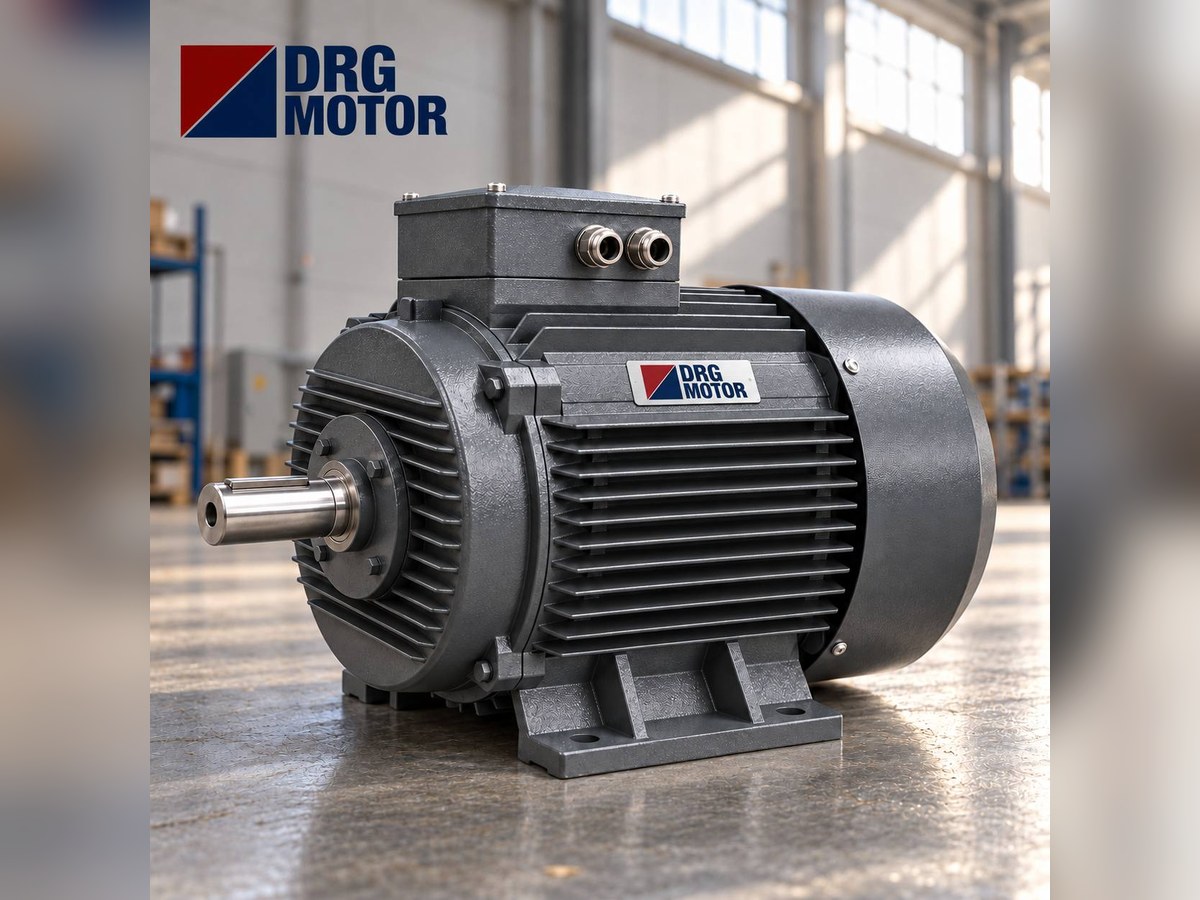
A compressor motor is the three-phase electric drive that spins the air end (the screw pair or the piston and crank group). The air end sets the flow and pressure of the compressor; the motor's job is to drive it at the right speed, with the required power, and to cope with frequent starts. This category page brings together the electric motors used in compressors, the values to check when choosing one and the DRG models that match them.
One clear distinction: DRG Motor does not sell compressors; it supplies the electric motor that drives your compressor. Ready models and current prices are on the Buy Electric Motors Online page; for a quote use WhatsApp or call +90 (542) 666 11 11.
What the electric motor does in a compressor
Whatever its type, an air compressor first turns electrical energy into shaft torque and then into compressed air. The motor is the first link of that chain. An undersized motor cannot bring the air end up to its rated speed, the current rises and the thermal protection trips; an oversized one only makes the frame, shaft and cable bigger with no gain.
Shaft power and speed
The air end delivers its rated flow when it turns at its design speed. The motor speed is either passed straight to the air end or reduced by a belt and pulley ratio. Motor speed is therefore judged together with the transmission: one air end can run with a 2-pole or a 4-pole motor through different pulley sets, but a directly coupled air end has no such freedom.
Pressure, flow and load
As outlet pressure and delivered air rise, the shaft power the air end asks for rises too. The kW on the motor plate is the power the compressor maker chose for that air end and working pressure. Raising the pressure setting, or fitting a bigger pulley to gain speed, can push the motor above its plate rating, which is why a replacement starts from the power of the old motor.
How motor needs differ between screw and piston compressors
Both main compressor types use the same kind of induction motor, yet they expect different behaviour from it. The short comparison below sums up the difference; the details are covered on the Screw Compressor Motors and Piston Air Compressor Motors sub-pages.
| Topic | Screw compressor | Piston compressor |
|---|---|---|
| Operation | Long running periods, switching between load and idle | Start-stop driven by the pressure switch |
| Drive | Belt, gear or direct coupling/flange | Mostly belt and flywheel pulley |
| Typical power | Medium and large ratings | Small and medium ratings |
| Critical point for the motor | Exact speed and flange size | Number of starts and starting torque |
What matters on screw units
On screw compressors the motor usually keeps running for long periods; when air demand falls the air end unloads while the motor keeps turning. With direct coupling or a flange the air end speed equals the motor speed, so the number of poles and the flange dimensions are treated as fixed. Cabinet temperature and cooling air are part of the choice as well.
What matters on piston units
On a piston compressor the pressure switch stops the motor when the tank reaches its upper limit and restarts it when pressure drops. The motor starts many times a day, so starting torque, starting current and starts per hour weigh more than on a screw unit. Single-phase motors, common on small workshop compressors, are not part of the DRG range.
Click to see current electric motor prices and order nowSEE PRICES →
Checks when choosing a compressor motor
Whether you pick a motor for a new compressor or replace a failed one, the six points below are checked together. If even one does not match, the motor will not fit or the compressor will not run as designed.
Power (kW)
The reference is the kW on the old motor's plate. If more air is needed and the power must grow, it has to stay within what the air end and the compressor maker allow; a bigger motor does not increase the air the air end can deliver.
Speed
DRG motors come as 2-pole (3000 rpm class), 4-pole (1500 rpm class) and 6-pole (1000 rpm class). Compressors mostly use 2- and 4-pole motors. Keeping the same number of poles is the shortest way to finish a replacement without changing pulley or coupling.
Voltage and star/delta connection
DRG windings are 230/400 V up to 3 kW and 400/690 V from 4 kW. On a 400 V supply the first group is connected in star and started direct on line; the second runs in delta and suits star-delta starting. If the starter in the panel was built around the old winding, the new motor's plate must match it. For the methods see the star-delta starting page.
Frame and mounting type
The IEC frame number (e.g. 112M, 160L) sets the shaft height and foot holes. On belt-driven compressors the motor usually sits on a slide rail as a foot-mounted (B3) unit; when the air end is bolted straight to the motor, a foot-and-flange (B35) or flange-only (B5) design is required.
Shaft and connection dimensions
Shaft diameter and length, key width and flange size must match the pulley hub or the coupling half exactly. Remember that the same power can fall into a different frame at another pole count, so the shaft diameter may change too.
Daily running hours and start-stop frequency
How many hours a day the compressor runs, how often it stops and starts each hour and how hot the cabinet gets decide how warm the motor runs. Sharing this when you ask for a quote makes the right frame and cooling choice easier.
What to read from the old motor's plate
The nameplate is the most reliable starting point for a correct match. A sharp photo is usually enough; if the plate is hard to read, note the following values by hand:
- Power (kW or HP) and rated speed (rpm)
- Voltage and connection (e.g. 400 V Δ or 400/690 V Δ/Y)
- Rated current (A) and frequency (Hz)
- IEC frame number and mounting (B3, B5, B35)
- Shaft diameter and length, key size
- For a flange motor: flange outer diameter, bolt circle and spigot diameter
- Terminal box position and cable entry
How to confirm the fit
Whether a motor suits a compressor is shown by comparing dimensions, not by a single figure. kW, speed, voltage and connection, frame and mounting type, shaft diameter and key, flange size and the pulley or coupling connection are checked one by one against the old motor and the compressor maker's documents. Until that comparison is done, no exact fit can be claimed.
Comparing with the dimension drawing
Frame, shaft and flange dimensions of DRG motors are on the technical drawings page and in the technical catalogue. Put the distances between the old feet holes and the axis height side by side with that drawing; it shows whether the slide rail or a flange adapter needs changing.
Checks at first start
Once connected, the motor must turn in the direction of the arrow on the compressor; if not, swap two phase leads. In the first minutes compare the current with the plate value and recheck belt tension or coupling alignment.
Motor options DRG offers for compressors
DRG Motor is a manufacturer, supplier and seller of electric motors. What we can cover in compressor applications is the three-phase, IEC-frame industrial induction motor. Housing, power, speed and mounting options are as follows:
| Housing | Power range | Speed | Mounting |
|---|---|---|---|
| Aluminium | 0.25–11 kW | 1000 / 1500 / 3000 rpm | B3, B5, B14, B34, B35 |
| Cast iron | 0.55–355 kW | 1000 / 1500 / 3000 rpm | B3, B5, B14, B34, B35 |
| Vertical version (by frame) | On order note | 1000 / 1500 / 3000 rpm | V1, V3, V5, V6 |
Compressor-specific shafts or flanges, motors running in oil or hermetic refrigeration compressor motors, brake motors, IP66 and Ex motors are not in our range; if you need one of these, ask us. The general features of the standard series are described on the General Purpose Industrial Motor page.
B5 flange dimensions (frames 63–160)
On directly coupled compressors the flange size is decisive. Summary from the B5 large-flange table of the DRG catalogue (mm):
| Frame | Shaft D×E | Flange P / M / N | Hole S |
|---|---|---|---|
| 63 | 11×23 | 140 / 115 / 95 | 10 |
| 71 | 14×30 | 160 / 130 / 110 | 10 |
| 80 | 19×40 | 200 / 165 / 130 | 12 |
| 90S/90L | 24×50 | 200 / 165 / 130 | 12 |
| 100L/112M | 28×60 | 250 / 215 / 180 | 14.5 |
| 132S/132M | 38×80 | 300 / 265 / 230 | 14.5 |
| 160M/160L | 42×110 | 350 / 300 / 250 | 18.5 |
Models often chosen for compressors
Below is a selection of 2- and 4-pole motors between 2.2 and 37 kW. The table pulls its prices straight from our online shop:
| Model | Power / speed | Frame · current 400 V | Price |
|---|---|---|---|
| DRG-100L1-43 HP | 2.2 kW · 1500 rpm | Cast iron 100L · 4.52 A | $188.32 (€168.18) Details & buy → |
| DRG-90L-23 HP | 2.2 kW · 3000 rpm | Cast iron 90L · 4.35 A | $154.45 (€137.93) Details & buy → |
| DRG-100L-24 HP | 3 kW · 3000 rpm | Cast iron 100L · 5.71 A | $177.89 (€158.87) Details & buy → |
| DRG-112M-45.5 HP | 4 kW · 1500 rpm | Cast iron 112M · 7.95 A | $254.38 (€227.18) Details & buy → |
| DRG-132S1-27.5 HP | 5.5 kW · 3000 rpm | Cast iron 132S · 10.1 A | $338.72 (€302.50) Details & buy → |
| DRG-132M-410 HP | 7.5 kW · 1500 rpm | Cast iron 132M · 14.3 A | $394.89 (€352.66) Details & buy → |
| DRG-160M1-215 HP | 11 kW · 3000 rpm | Cast iron 160M · 19.6 A | $527.95 (€471.49) Details & buy → |
| DRG-160L-420 HP | 15 kW · 1500 rpm | Cast iron 160L · 27.3 A | $678.13 (€605.61) Details & buy → |
| DRG-180M-230 HP | 22 kW · 3000 rpm | Cast iron 180M · 38.5 A | $857.53 (€765.83) Details & buy → |
| DRG-225S-450 HP | 37 kW · 1500 rpm | Cast iron 225S · 66.1 A | $1,527.18 (€1,363.87) Details & buy → |
DRG MOTOR motors are guaranteed against material and manufacturing defects for 2 years from the delivery date (warranty certificate).
Motors in this power range
- DRG-100L-2 – 3 kW – 2895 rpm – 100L cast iron
- DRG-112M-4 – 4 kW – 1450 rpm – 112M cast iron
- DRG-132M-4 – 7.5 kW – 1460 rpm – 132M cast iron
- DRG-160M1-2 – 11 kW – 2945 rpm – 160M cast iron
- DRG-180M-2 – 22 kW – 2955 rpm – 180M cast iron
Click to see current prices and order these motors nowSEE PRICES →
Catalogue and quote
Download the technical catalogue to see all frame dimensions, current and torque values. Then message us a picture of the existing nameplate along with the drive arrangement (belt, coupling or flange) and we will settle the right model together.
Browse the products, ask for a quote: models and current prices are on the Buy Electric Motors Online page; for a quick quote write to us on WhatsApp or call +90 (542) 666 11 11. You can also reach us through the contact page.

