 English
 Le français
 Türkçe

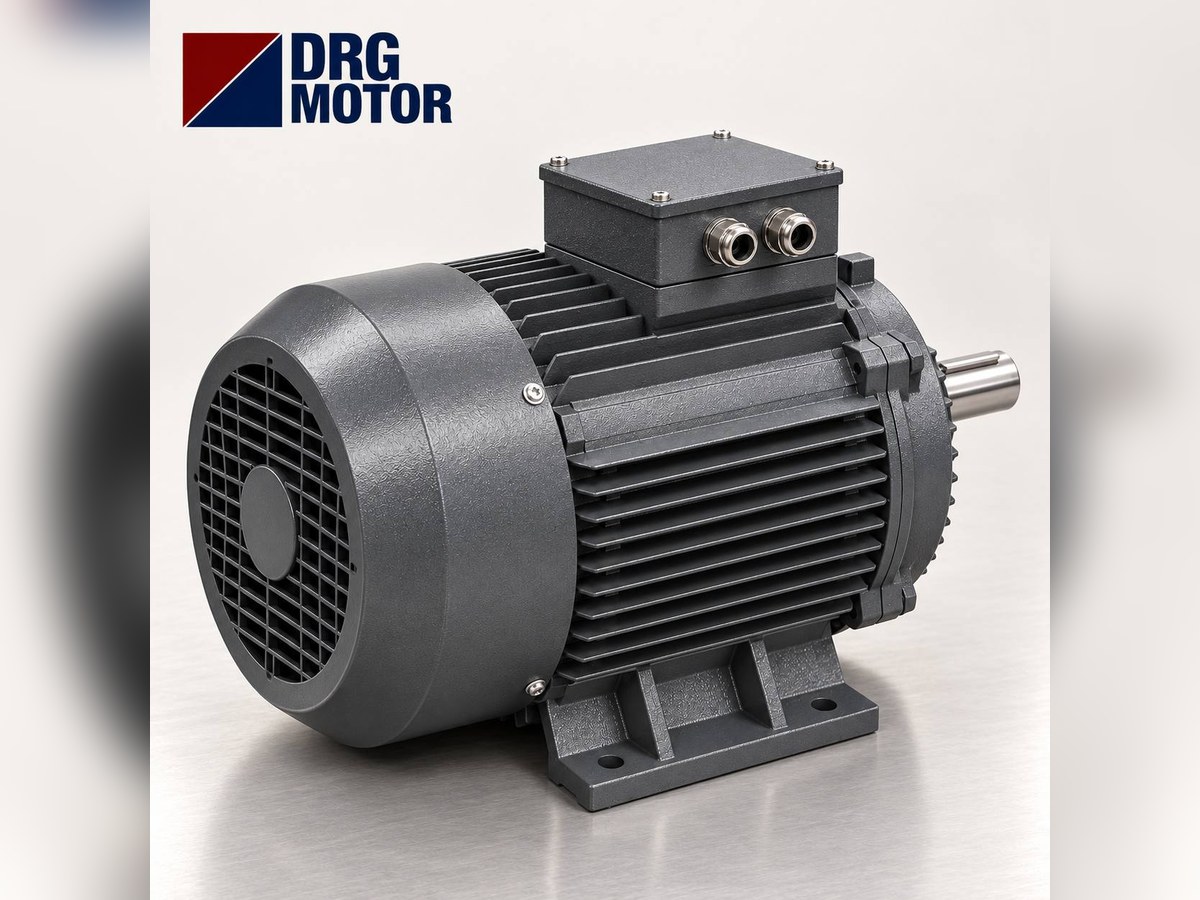
A centrifugal pump motor is a standard three-phase induction motor that turns the pump impeller; the impeller gives the water velocity and the volute casing converts that velocity into pressure. Motor power is not read from the pump's name but set by the flow (Q), head (H), liquid density (ρ) and pump efficiency (η_pump) at the duty point: a pump delivering 50 m³/h at 30 m with a pump efficiency of 0.68 needs about 6 kW of shaft power and runs on a 7.5 kW, 2-pole motor.
The same centrifugal principle is sold in different casing and installation forms, and the way the motor is connected changes with the form. This page draws the general map: the principle, the difference between close-coupled and long-coupled layouts, the variables that set the power and the matching DRG motors. All sub-pages of the pump group are on the Pump Motors page; suitable motors and current prices are among the 120 models on Buy Electric Motors Online.
What is a centrifugal pump and what does the motor do in it?
"Centrifugal" is the name of an operating principle; horizontal or vertical shaft describes the layout, and fire-fighting or irrigation describes the purpose. One pump can carry a label from each group, for example a horizontal-shaft centrifugal fire pump.
Water enters at the eye of the impeller, is thrown outward between the rotating vanes and gains speed. The volute around the impeller acts as a widening channel; the water slows down, its pressure rises and it leaves through the discharge. The motor's job is to turn the impeller at a fixed speed and supply the torque it demands. Flow and head result from the hydraulic design, i.e. impeller diameter and casing; the motor does not change them, it only supplies the speed.
Sub-types of the centrifugal family
The same principle is built with different casings for different needs. In an end-suction pump the water enters along the shaft axis and leaves upward; its standard-dimension casings are the most common industrial pump. In an inline pump the suction and discharge ports are on the same axis and the motor usually stands vertically on top. A multistage pump connects several impellers in series and head rises with the number of stages. In a split case pump the casing is divided along the shaft axis and a double-suction impeller carries large flows. Each of these has its own page; this one covers what they share.
- Water supply for buildings and plants, booster and pressurisation lines.
- Circulation in heating and cooling circuits, cooling tower and chiller loops.
- Clean-water transfer in irrigation, pools and treatment plants.
- Process water, boiler feed and washing lines in industry.
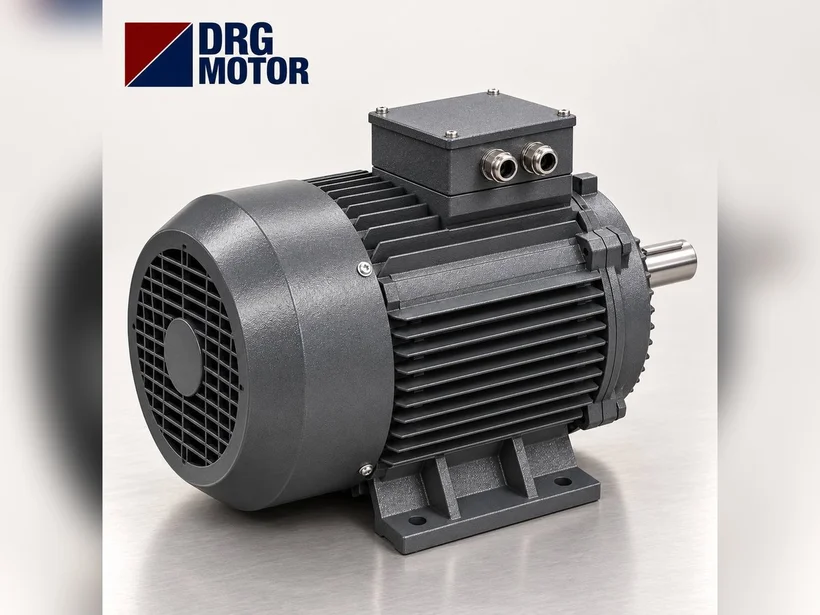
Close-coupled or long-coupled? How the motor connects to the pump
In a centrifugal pump the motor drives the impeller directly; belts or gearboxes are rare because 2- and 4-pole motor speeds already suit the impeller design speed. The difference lies in how the motor shaft reaches the impeller.
Close-coupled layout
The pump casing bolts to the motor flange; there is no common baseplate and no separate coupling. Two designs exist. In the first, a flanged motor with standard IEC main dimensions is used and the pump side has a shaft extension or rigid coupling [1]. In the second, the impeller is mounted directly on the motor's extended shaft; that shaft is not a standard IEC shaft end [5]. In the second design a standard catalogue motor cannot replace the failed one: either the same special motor or a new pump is needed. For this decision see the checks in our pump motor supply article.
Long-coupled (bearing-frame) layout
The pump has its own bearing housing and shaft. Motor and pump sit on a common baseplate and are joined by a flexible coupling. One manufacturer's catalogue supplies these pumps with a B3 (IM 1001) foot-mounted standard motor [1]. When the motor fails only the motor is replaced; if the new motor has the same shaft height, shaft diameter and foot holes, baseplate and coupling stay as they are. Coupling alignment must be checked again.
| Feature | Close-coupled | Long-coupled | Motor replacement |
|---|---|---|---|
| Space needed | Small | Baseplate needed | No effect |
| Motor connection | Flange (B5/B35) | Feet (B3) | Same mounting type |
| Special shaft risk | Yes (extended shaft) | No | Check shaft size |
Click to see current electric motor prices and order nowSEE PRICES →
How many kW is a centrifugal pump motor? Powers seen in market models
No fixed kW can be assigned to a centrifugal pump. The same casing needs very different power with a different impeller diameter and speed. The rows below are motor ratings seen in manufacturers' catalogues; each pump has a single motor.
| Model group / capacity | Motor power | Single / total | Source |
|---|---|---|---|
| Maker B, smallest close-coupled (≈21 m³/h, 24 m) | 1.5 kW | Single motor | [2] |
| Maker B, mid close-coupled (≈144 m³/h, 40 m) | 15 kW | Single motor | [2] |
| Maker B, largest close-coupled (≈345 m³/h, 89 m) | 75 kW | Single motor | [2] |
| Maker C, close-coupled range limit | up to 110 kW | Single motor | [3] |
| Maker A, EN 733 close- and long-coupled | 0.25–400 kW | Single motor | [1] |
| Maker D, EN 733 normalised range | up to 355 kW | Single motor | [4] |
In this pump group, motor options of roughly 0.25–400 kW are seen depending on the manufacturer's model and capacity [1][2]. The flow in the table is the curve's maximum flow and the head its maximum head; the two do not occur at the same point. Power grows with the product of flow and head: in maker B's range the smallest pump at 21 m³/h needs only 1.5 kW, while the largest, reaching 345 m³/h and 89 m, needs 75 kW [2]. Do not confuse a station's total installed pump power with one pump's motor; each pump in a three-pump station is sized with its own motor.
Matching DRG range
The DRG range is 0.25–355 kW at 1000/1500/3000 rpm. The 0.25–355 kW part of the range above overlaps with it. Large long-coupled pumps that need motors above 355 kW and close-coupled pumps with special extended shafts are outside the DRG range.
Variables that set the power and a worked example
Shaft power is P = ρ·g·Q·H / η_pump (ρ kg/m³, g 9.81 m/s², Q m³/s, H m; result in W). Four practical points follow: doubling the flow doubles the power; doubling the head also doubles the power; a denser liquid (e.g. brine) needs more power at the same Q and H; a pump with lower efficiency needs a larger motor.
Example: in a plant's cooling-water line, 50 m³/h (0.0139 m³/s) of water must be pumped to 30 m head including pipe losses; pump efficiency read from the curve is 0.68. P = 1000 × 9.81 × 0.0139 × 30 / 0.68 ≈ 6.0 kW. If the pump curve's power rises with flow and the system calculation is uncertain, about 10% margin is added: 6.6 kW. The standard rating is 7.5 kW; the 2-pole DRG-132S2-2 (2930 rpm) draws 13.7 A at 400 V. You can run the same calculation with your own values in the Pump & Fan Motor Power Calculator.
What happens when speed changes? (affinity relation)
With the same impeller, flow varies with speed, head with the square of speed and power with the cube of speed. If the example pump is run at 90% speed with an inverter, power falls to 0.9³ ≈ 0.73 times, about 4.4 kW. The reverse also holds: fitting a 2900 rpm motor to a pump designed for 1450 rpm tries to quadruple the head and multiply the power by eight; the motor is overloaded and the impeller and seal are stressed. See our affinity laws article for details.
Motor selection checklist
Selecting the pump, its curve and impeller diameter is the job of the pump manufacturer or design engineer. The motor supplier provides a motor matching the given shaft power, speed, mounting and ambient conditions. Before asking for a centrifugal pump motor, collect:
- Pump nameplate: type, impeller diameter, rated flow and head, speed.
- Old motor nameplate: kW, rpm, IEC frame, voltage, mounting (B3 foot, B5 or B35 flange).
- Layout: close-coupled or long-coupled? On close-coupled, whether the shaft end is standard or extended.
- Shaft diameter and length, key size of the coupling or impeller hub.
- Does the pump run with its valve fully open, without throttling? A duty point shifting right raises the power.
- Starting: direct, star-delta or inverter; the panel's voltage arrangement.
- Pump room: humidity, water splashes, ambient temperature.
Speed, poles and mounting type
Centrifugal pumps most often use 2-pole (about 2900 rpm) and 4-pole (about 1450 rpm) motors; 6 poles are used with large impellers [1]. A slower pump is quieter and wears its impeller less. The motor must have the same number of poles as the speed on the pump nameplate; a motor with different poles changes the whole pump curve.
On a long-coupled pump the motor is foot-mounted B3. On a close-coupled pump the motor is flanged; whether the flange is B5 (large, through holes) or B14 (small, tapped) depends on the pump casing interface. The exact type comes from the pump manufacturer's drawing; at DRG the mounting type is specified with the order note. DRG motors of 4 kW and above are wound 400/690 V and suit star-delta starting on a 400 V supply; those up to 3 kW are 230/400 V.
| Model | Power / speed | Frame · current 400 V | Price |
|---|---|---|---|
| DRG-90L-23 HP | 2.2 kW · 3000 rpm | Cast iron 90L · 4.35 A | $154.45 (€137.93) Details & buy → |
| DRG-100L2-44 HP | 3 kW · 1500 rpm | Cast iron 100L · 6.02 A | $203.84 (€182.05) Details & buy → |
| DRG-112M-25.5 HP | 4 kW · 3000 rpm | Cast iron 112M · 7.45 A | $225.65 (€201.52) Details & buy → |
| DRG-132M-410 HP | 7.5 kW · 1500 rpm | Cast iron 132M · 14.3 A | $394.89 (€352.66) Details & buy → |
| DRG-132S2-210 HP | 7.5 kW · 3000 rpm | Cast iron 132S · 13.7 A | $369.43 (€329.92) Details & buy → |
| DRG-160M1-215 HP | 11 kW · 3000 rpm | Cast iron 160M · 19.6 A | $527.95 (€471.49) Details & buy → |
| DRG-160L-420 HP | 15 kW · 1500 rpm | Cast iron 160L · 27.3 A | $678.13 (€605.61) Details & buy → |
| DRG-180M-230 HP | 22 kW · 3000 rpm | Cast iron 180M · 38.5 A | $857.53 (€765.83) Details & buy → |
| DRG-200L-440 HP | 30 kW · 1500 rpm | Cast iron 200L · 53.8 A | $1,235.00 (€1,102.93) Details & buy → |
Matching DRG motors
DRG Motor is a manufacturer, supplier and seller of electric motors. Our range covers 0.25–11 kW in aluminium and 0.55–355 kW in cast iron; 1000, 1500 and 3000 rpm; 3-phase, 230/400 V or 400/690 V; mounting B3, B5, B14 and B35 (with order note). All long-coupled centrifugal pumps and close-coupled pumps using a standard IEC flanged motor fall within this range. Options for the 7.5 kW requirement in the example and nearby ratings:
| Model | Power / speed | Frame | Current 400 V |
|---|---|---|---|
| DRG-112M-2 | 4 kW / 2905 rpm | 112M cast iron | 7.45 A |
| DRG-132S1-2 | 5.5 kW / 2930 rpm | 132S cast iron | 10.1 A |
| DRG-132S2-2 | 7.5 kW / 2930 rpm | 132S cast iron | 13.7 A |
| DRG-132M-4 | 7.5 kW / 1460 rpm | 132M cast iron | 14.3 A |
| DRG-160M1-2 | 11 kW / 2945 rpm | 160M cast iron | 19.6 A |
DRG MOTOR motors are guaranteed against material and manufacturing defects for 2 years from the delivery date (warranty certificate).
DRG motors for centrifugal pumps
- DRG-100L2-4 – 3 kW – 1450 rpm – 100L cast iron
- DRG-112M-2 – 4 kW – 2905 rpm – 112M cast iron
- DRG-132S2-2 – 7.5 kW – 2930 rpm – 132S cast iron
- DRG-132M-4 – 7.5 kW – 1460 rpm – 132M cast iron
- DRG-160M1-2 – 11 kW – 2945 rpm – 160M cast iron
Click to see current prices and order these motors nowSEE PRICES →
Centrifugal pump motor: frequently asked questions
When a centrifugal pump motor burns out, is only the motor replaced?
On a long-coupled pump, yes; a motor with the same kW, speed, frame and mounting is fitted and the coupling is realigned. On a close-coupled pump with a special extended shaft a standard motor will not fit; the same motor or a complete pump is needed.
Can a 1450 rpm motor be fitted to a 2900 rpm pump?
The pump will run, but head drops to about a quarter and flow to half. Choose a motor with the same poles as the pump's design speed.
Is the kW on the pump nameplate the same as the motor power?
The value on the pump plate is usually the rating of the fitted motor and is higher than the shaft power at the duty point. If the pump is run at higher flow, recalculate the power.
How many amps does a 7.5 kW centrifugal pump motor draw?
The 2-pole DRG-132S2-2 draws 13.7 A at 400 V and 14.4 A at 380 V; the 4-pole DRG-132M-4 draws 14.3 A at 400 V. Set the overload relay to the nameplate current.
Send us the pump nameplate, the old motor's nameplate and the panel's starting method, and we will confirm the right DRG model together. Phone +90 (542) 666 11 11, e-mail [email protected], contact page. For all models and current prices see Buy Electric Motors Online.
Sources
- Grundfos – NB, NBE, NK, NKE data booklet (EN 733) – motor steps 0.25–400 kW; NK long-coupled with B3 (IM 1001) standard motor; NB close-coupled with IEC main-dimension motor.
- Pedrollo – F series, centrifugal pumps to EN 733 (50 Hz) – close-coupled range 1.5–75 kW; flow and head ranges in the model table.
- KSB – Etabloc type series booklet – close-coupled volute casing pump; motor rating PN ≤ 110 kW, Q ≤ 660 m³/h, H ≤ 160 m.
- Caprari – Product overview – power up to 355 kW for EN 733 normalised pumps.
- Ebara – 3M / 3M4 data sheet – extended-shaft motor on a small close-coupled pump (not a standard shaft end).


