 English
 Le français
 Türkçe

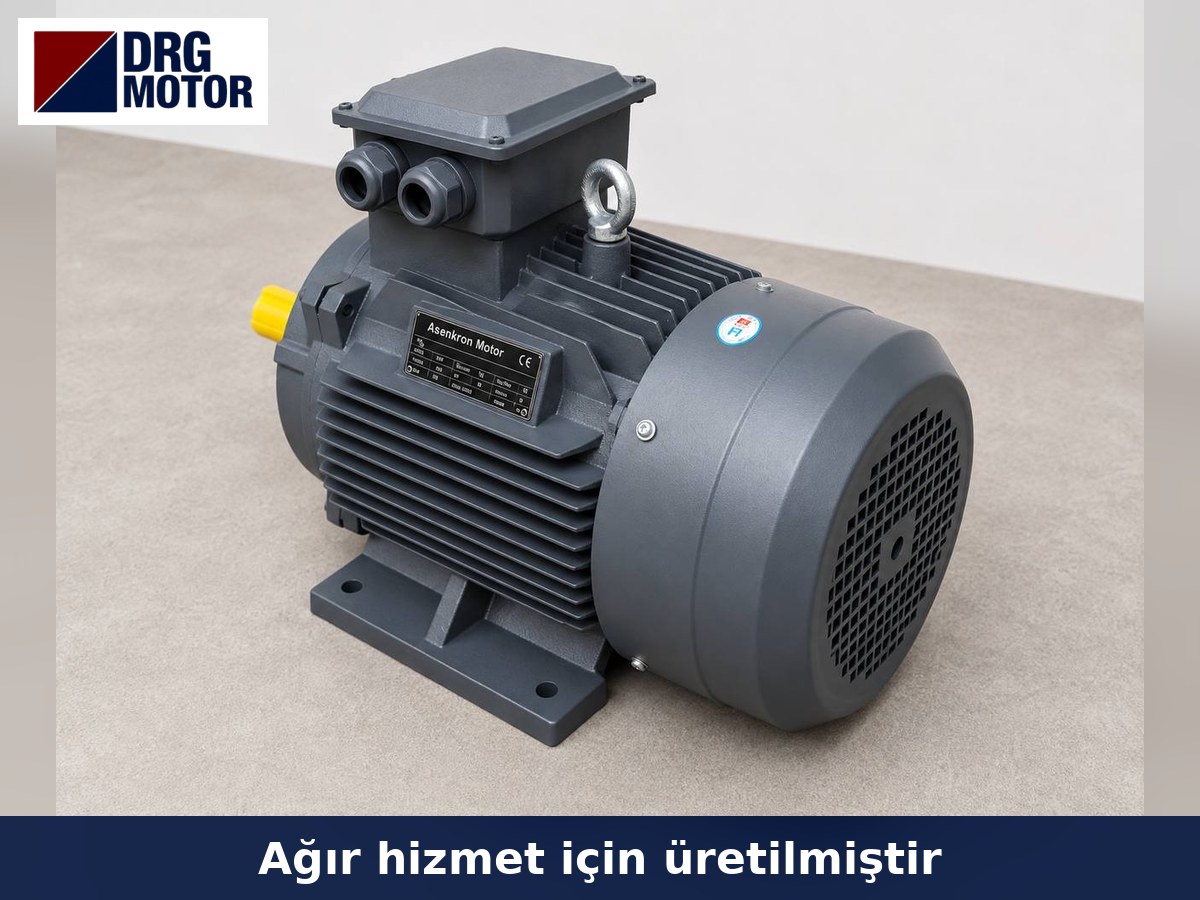
A tea rolling machine motor drives the eccentric mechanism that turns a bowl of withered green leaf over a ribbed table under pressure; the leaf cells break, the juice comes out and the leaf twists into shape. In the same factory the withering trough fans, the cutting rollers of the CTC machine, the dryer fans and the sorting screens also run on electric motors. Maker catalogues give 0.37–5.5 kW for rolling tables, 20–40 HP per CTC cutting unit and 3–7.5 HP for withering fans.
DRG Motor is a manufacturer, supplier and seller of electric motors. We do not sell rolling tables, CTC machines, rollers, fan impellers, gearboxes or inverters. Our contribution to a tea factory is the three-phase induction motor fitted to these machines; models are listed on Buy Electric Motors Online.
From green leaf to made tea: where are the motors?
As in the tea factories around Rize, black tea production follows withering → rolling (or CTC) → oxidation (fermentation) → drying → sorting and grading. Leaf cannot wait in the plucking season, so a motor failure means lost product; that makes a spare motor plan important.
Withering: trough fans
Leaf is spread in long troughs and air is blown up through it by axial fans until it loses moisture and softens. One maker’s trough fans carry one-piece aluminium impellers mounted straight on the motor shaft and use 3, 5 and 7.5 HP motors at 1000 rpm. The more air a fan must move, the bigger its motor; trough length, leaf depth and factory altitude change fan choice.
Rolling table: eccentric, crank and belt
In an orthodox roller the leaf-filled bowl moves in a circle over a table fitted with battens, and a pressure cap above sets rolling intensity. The motor turns the crank through a belt and a worm gearbox; one catalogue gives a bowl speed of 45–55 rpm, another a 1400 rpm motor and a 44 rpm bowl. Black tea rolling can last 30–90 minutes, so the motor stays under load for long periods.
CTC machine: cutting rollers
In the CTC (crush-tear-curl) method the leaf passes between two toothed rollers turning against each other at different speeds. One maker gives a fast roller speed of 720 rpm and a 10:1 ratio to the slow roller. Machines are built from several cutting units in a row, each with its own motor.
Oxidation, drying and sorting
Oxidation and dryer fans
Rolled leaf oxidises in humid air and is then dried with hot air. In a fluid bed dryer a vibrating perforated grid and hot air blown from below fluidise the tea; the grid is shaken by a crank driven by a motor. On one maker’s dryer the drying section has 21.6–43.6 kW installed and the dust collection section 11.6–24.2 kW; these are totals of several fans and drives. For hot-air fan selection see our drying oven fan motor article.
Sorting, grading and stalk removal
Made tea is graded by size and stalk and fibre are taken out. Power here is small; one maker states under 2 HP at full load for its green leaf sifter. A tea sifter shaken by vibration motors falls outside the shop; we quote it directly, and our vibration motors page describes that family.
Motor power in tea machinery: catalogue values
A) Motor ratings published by makers of rolling, CTC, withering and drying machines:
| Machine / model group | Motor power | Single / total | Note |
|---|---|---|---|
| Rolling table, 25 cm bowl, 3–5 kg batch | 0.37 kW | single motor, bowl 55 rpm | first maker |
| Rolling table, 45 cm bowl, 15–25 kg batch | 1.1 kW | single motor | first maker |
| Rolling table, 55 cm bowl, 30–50 kg batch | 2.2 kW | single motor | first maker |
| Rolling table, 75 cm bowl, 150–200 kg batch | 5.5 kW | single motor, bowl 45 rpm | first maker |
| Double-arm rolling table, 65 cm bowl, 60 kg batch | 4 kW, 1400 rpm | single motor, bowl 44 rpm | second maker |
| CTC machine, 13″ roller, 1st cut | 25–40 HP | per cutting unit | third maker |
| CTC machine, 13″ roller, later cuts | 20–30 HP | per cutting unit | third maker |
| Withering trough axial fan, 40–52″ | 3 / 5 / 7.5 HP, 1000 rpm | per fan | fourth maker |
| Fluid bed dryer, 200–800 kg/h | drying 21.6–43.6 kW; dust collection 11.6–24.2 kW | section total | fourth maker |
In this group a rolling table takes roughly 0.37–5.5 kW, a CTC cutting unit 20–40 HP (about 15–30 kW) and a withering fan 3–7.5 HP. Dryer figures are section totals, not single motors. Rolling motors grow with batch size and bowl diameter.
B) Where DRG fits: 0.37–5.5 kW rolling motors, 2.2–5.5 kW withering fans and 15–30 kW CTC motors are all within our range. For 1000 rpm fan motors our 6-pole models suit, and for CTC and rolling our 4-pole models.
Click to see current electric motor prices and order nowSEE PRICES →
Worked example: HP to kW and pulley ratio
Tea machinery catalogues mostly give power in horsepower (HP). Let us convert to kW and match the nearest model in our range:
| Catalogue value | Operation | Result | DRG equivalent |
|---|---|---|---|
| Withering fan 3 HP, 1000 rpm | 3 × 0.7457 | about 2.24 kW | DRG-112M-6 (2.2 kW, 955 rpm) |
| Withering fan 5 HP, 1000 rpm | 5 × 0.7457 | about 3.73 kW | DRG-132M1-6 (4 kW, 968 rpm) |
| Withering fan 7.5 HP, 1000 rpm | 7.5 × 0.7457 | about 5.59 kW | DRG-132M2-6 (5.5 kW, 968 rpm) |
| CTC 1st cut 25 HP | 25 × 0.7457 | about 18.64 kW | DRG-180M-4 (18.5 kW) |
| CTC fast roller 720 rpm, 4-pole motor | 1,470 / 720 | pulley ratio about 2.04 | larger motor pulley |
Choosing the next size up is the safer match, but for the 3 HP fan 2.2 kW is close. In that case measure the fan’s real current and compare it with the plate current (5.09 A at 400 V for DRG-112M-6). Try pulley sizes with our pulley and belt tool.
Starting a rolling table
With the bowl full of leaf and the pressure cap down, the start is heavy. Lifting the cap, running empty and then raising pressure slowly protects the motor. On CTC units star-delta starting is common for the larger motors; see the current difference in our star-delta tool.
Moisture, leaf juice and motor position
Motor outside the product-contact area
The juice released in rolling is sticky and drips under the table. The motor belongs outside the product-contact area, on the roller frame and behind the belt guard. Withering and oxidation rooms are humid; our IP55 motors suit that climate, though they are never hosed directly during washing. A stainless washdown frame for wet tea rooms is something we do not make; ask us for options.
Motors outside our range
Small bench-type rollers often use single-phase motors; one catalogue lists a 30 cm bowl model with a 0.55 kW, 220 V motor. That single-phase type is outside our range, and so are the brake motor, the servo and the pole-changing two-speed motor. Trough fan speed can be trimmed by feeding a standard motor from an inverter bought elsewhere.
DRG motors for tea machinery
Models matching rolling, CTC and withering ratings (current at 400 V):
| Model | Power / speed | Frame · shaft D×E | Current 400 V |
|---|---|---|---|
| DRG-801-4 | 0.55 kW / 1400 rpm | 80 cast iron · 19×40 | 1.31 A |
| DRG-90S-4 | 1.1 kW / 1445 rpm | 90S cast iron · 24×50 | 2.48 A |
| DRG-100L1-4 | 2.2 kW / 1450 rpm | 100L cast iron · 28×60 | 4.52 A |
| DRG-112M-4 | 4 kW / 1450 rpm | 112M cast iron · 28×60 | 7.95 A |
| DRG-132S-4 | 5.5 kW / 1460 rpm | 132S cast iron · 38×80 | 10.7 A |
| DRG-112M-6 | 2.2 kW / 955 rpm | 112M cast iron · 28×60 | 5.09 A |
| DRG-132M2-6 | 5.5 kW / 968 rpm | 132M cast iron · 38×80 | 12 A |
| DRG-180M-4 | 18.5 kW / 1470 rpm | 180M cast iron · 48×110 | 33.5 A |
On a rolling table the motor is usually foot-mounted (B3) and belts the gearbox; fan motors carry the impeller on their own shaft and bolt to the trough by flange or feet. Tell us the old motor’s plate power, speed, shaft diameter and key and its mounting; we weigh them against the roller’s documentation and confirm suitability, with no fit guarantee before dimensions.
Live price table
Prices of models close to rolling, fan and CTC ratings in a tea factory:
| Model | Power / speed | Frame · current 400 V | Price |
|---|---|---|---|
| DRG-801-40.75 HP | 0.55 kW · 1500 rpm | Cast iron 80 · 1.31 A | $91.72 (€81.91) Details & buy → |
| DRG-90S-41.5 HP | 1.1 kW · 1500 rpm | Cast iron 90S · 2.48 A | $124.09 (€110.82) Details & buy → |
| DRG-112M-63 HP | 2.2 kW · 1000 rpm | Cast iron 112M · 5.09 A | $237.30 (€211.93) Details & buy → |
| DRG-100L1-43 HP | 2.2 kW · 1500 rpm | Cast iron 100L · 4.52 A | $188.32 (€168.18) Details & buy → |
| DRG-132M1-65.5 HP | 4 kW · 1000 rpm | Cast iron 132M · 8.99 A | $326.05 (€291.19) Details & buy → |
| DRG-112M-45.5 HP | 4 kW · 1500 rpm | Cast iron 112M · 7.95 A | $254.38 (€227.18) Details & buy → |
| DRG-132M2-67.5 HP | 5.5 kW · 1000 rpm | Cast iron 132M · 12 A | $423.04 (€377.80) Details & buy → |
| DRG-180M-425 HP | 18.5 kW · 1500 rpm | Cast iron 180M · 33.5 A | $873.49 (€780.08) Details & buy → |
| DRG-180L-430 HP | 22 kW · 1500 rpm | Cast iron 180L · 39.7 A | $919.45 (€821.13) Details & buy → |
DRG MOTOR motors are guaranteed against material and manufacturing defects for 2 years from the delivery date (warranty certificate).
Motors in this power range
- DRG-100L1-4 – 2.2 kW – 1450 rpm – 100L cast iron
- DRG-112M-4 – 4 kW – 1450 rpm – 112M cast iron
- DRG-132M1-6 – 4 kW – 968 rpm – 132M cast iron
- DRG-132M2-6 – 5.5 kW – 968 rpm – 132M cast iron
- DRG-180M-4 – 18.5 kW – 1470 rpm – 180M cast iron
Click to see current prices and order these motors nowSEE PRICES →
Browse the motors, ask for a quote: for tea rolling, withering and CTC motors see Buy Electric Motors Online. Send your pre-season spare motor needs with plate photos via WhatsApp or call +90 (542) 666 11 11.
Frequently asked questions
How many kW is a tea rolling machine motor?
It depends on bowl size: catalogues show 0.37 kW for a 25 cm bowl, 2.2 kW for 55 cm and 5.5 kW for 75 cm.
What speed should a withering fan motor have?
In the catalogues we checked the impeller sits on the motor shaft and the motor runs at 1000 rpm, which means a 6-pole motor. Changing speed changes the fan’s air and power.
What determines the price of a tea machine motor?
Motor rating, pole count and frame material; the table is refreshed live from the shop.
For questions: +90 (542) 666 11 11 · info@drgmotor.com · contact.


