 English
 Le français
 Türkçe

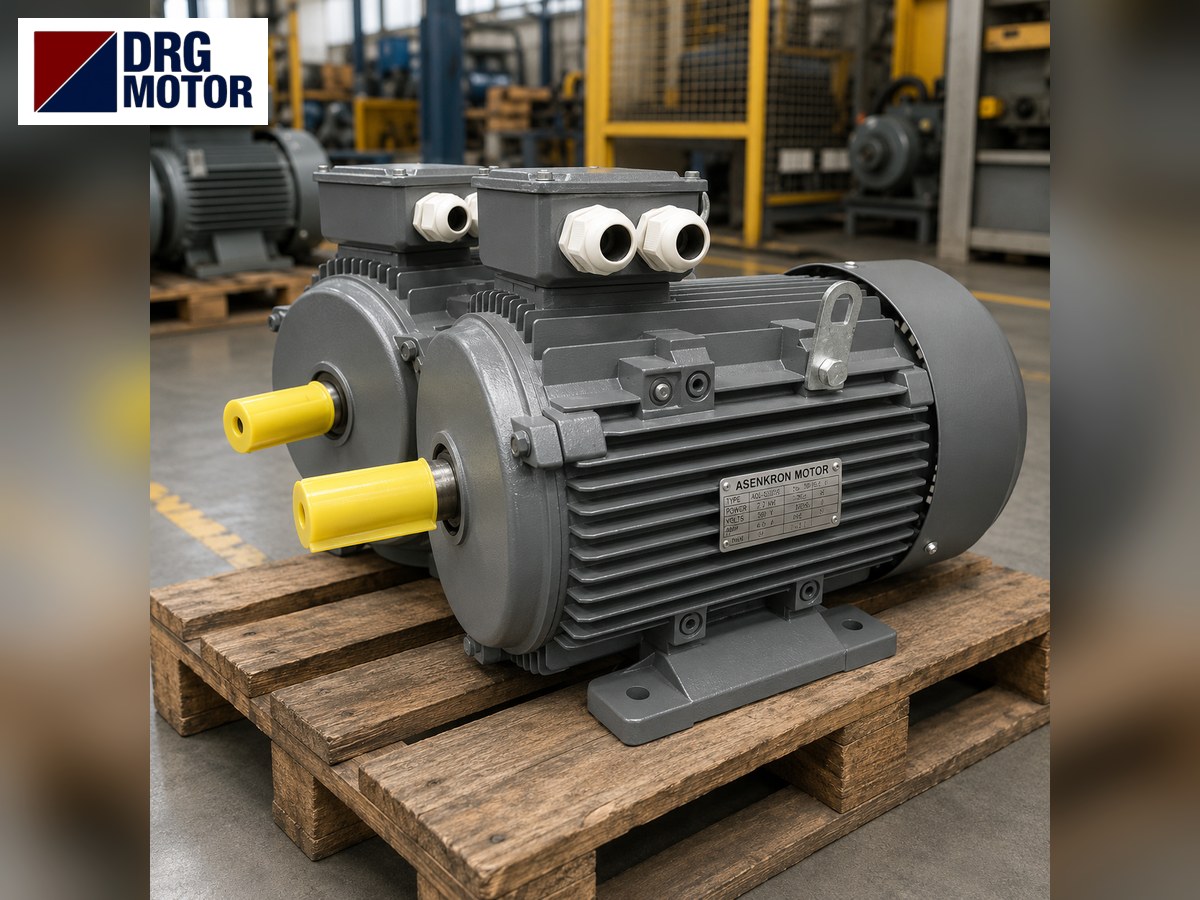
Electric motors for brick, roof tile, ceramic and concrete block production machinery are the three-phase motors turning every machine that clay from the pit, or milled ceramic raw material, passes through until it is shaped and fired. This category is about the motor fitted to those machines, not the machines themselves: what kind of load each stage puts on it, how it is chosen, and which part our range covers.
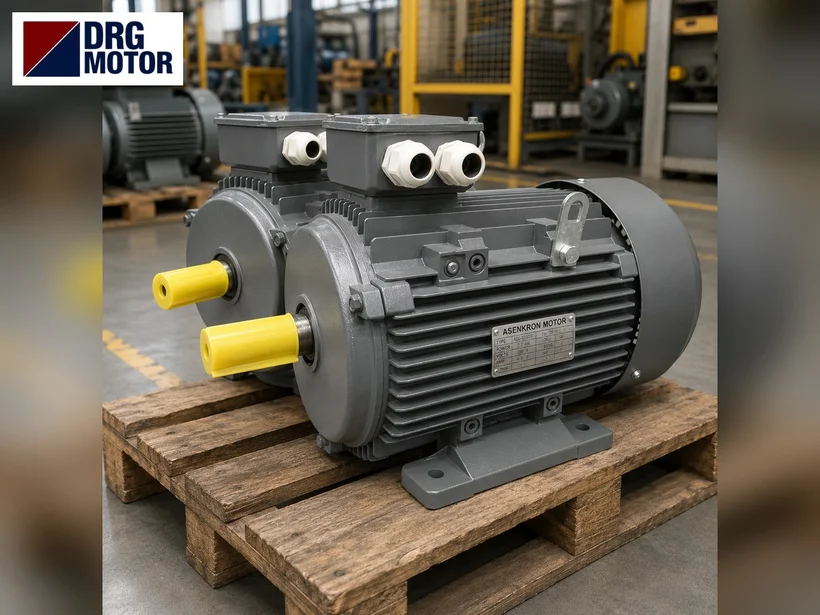
DRG Motor is a manufacturer, supplier and seller of electric motors. We do not sell machines, gearboxes, hydraulic power packs, pumps and their casings, fan impellers, inverters, extrusion dies or mill balls; our part is the standard IEC motor that drives such equipment. Models are listed on Buy Electric Motors Online.
Four production flows and where the motors sit
The sector has four flows that look alike but load the motors differently. One plant may run two of them side by side.
Clay brick
Clay is tipped into a box feeder and travels on to crushers, a stone separator and grinding rolls. In the mixer water makes it uniform, the de-airing extruder compacts it and the column leaving the die is cut by wires. Green ware goes through the dryer, then the kiln, and is stacked and packed at the exit.
Roof tile
Preparation matches brick; the clay slab from the extruder is shaped in a moulding press and travels to the dryer on trays.
Ceramic tile
Raw material is wet-ground in ball mills, the slip is stirred in tanks and turned into granulated powder in the spray dryer. A hydraulic press forms the tile, the glazing line follows the dryer, a roller kiln fires it, and on porcelain tile a squaring and edge grinding line finishes the job.
Concrete block and paver
Aggregate and cement are mixed, carried to the machine on a belt, and the vibro-press fills the mould and compacts it with vibration and pressure. Pallets go to the curing room and are then stacked. Vibration is a topic of its own: some machines use a vibration motor, others a vibrator shaft turned by a standard motor and belts.
Click to see current electric motor prices and order nowSEE PRICES →
Motor power on machines in the market
A) Values seen in maker data sheets and plant quotations (they vary by machine; the exact value is on the motor plate):
| Machine | Motor power | Single / total | Note |
|---|---|---|---|
| Brick: apron box feeder, 1,500 mm bed | 5.5 + 7.5 kW | two motors: apron and chipper shaft | plant quotation sheet |
| Brick: fine roller mill, Ø1,200 × 1,100 mm | 90 + 75 kW | one motor per roll | plant quotation sheet |
| Brick: de-airing extruder main drive | 200 kW, 6-pole | single motor; feeder-mixer another 90 kW | plant quotation sheet |
| Roof tile: de-airing extruder | 55 kW | per extruder, three on the line | feasibility report |
| Ceramics: batch ball mill | 2.2–75 kW | 0.05–15 t charge, single motor | mill maker’s catalogue |
| Block: semi-automatic machine | 7.5 + 5.5 + 7.5 kW | hydraulics, vibrator, mixer separate | machine maker’s page |
| Block: automatic line hydraulic unit | 30–75 kW | single unit motor | machine maker’s page |
The table shows there is no single typical rating in this sector: a feeder’s apron motor is a few kW while the extruder on the same line reaches 200 kW. The plant total is not one machine’s power; each motor is chosen on its own.
B) Where DRG fits: the biggest single motor in the table is 200 kW, below our 355 kW ceiling, so each listed standard rating has a match in aluminium or cast iron. Large motors such as 200 kW 6-pole are in the range too; bigger mill and press motors and medium voltage are outside our range.
Common points in motor selection
Power, speed, mounting and environment change with the machine model. We confirm fit by comparing the old motor plate and machine documents on these points; we give no blanket fit guarantee:
- kW, speed, voltage and connection
- IEC frame, mounting arrangement, shaft end with its keyway
- flange size, pulley, coupling or gearbox interface
Clay dust, moisture and slurry
The preparation hall is full of dry clay dust; the mixer and extruder area brings water and slurry. IP55 protects against both; keep the fan cowl clean and do not let the terminal box face the wash water.
Heavy starting and shift work
A loaded mixer, extruder auger or ball mill starts under load. On larger ratings star-delta, a soft starter or an inverter is used; we do not supply drives, but our motors run on them. For long shift work, choose the rating with margin and plan the starting method together with the panel.
The DRG range: what is in, what is not
| Topic | In the DRG range | Note |
|---|---|---|
| Power | aluminium 0.25–11 kW; cast iron 0.55–355 kW | above 355 kW and medium voltage are outside our range |
| Speed | 3000, 1500 and 1000 rpm (2, 4, 6 poles) | slower output comes from a gearbox or belts |
| Mounting | B3, B5, B14, B34, B35; V1/V3/V5/V6 | vertical variants for mixers and tank drives |
| Connection | star up to 3 kW, delta from 4 kW | winding suited to star-delta starting |
| Protection | IP55 | against clay dust and water splashes |
| Not offered | brake, servo, single-phase, vibration, Ex, in-kiln motors | see the explanation below |
Brake motors are needed on setting and lifting gear, servo motors on robot axes, single-phase motors on small workshop machines; none of the three is in our range. A fan motor serving a kiln or dryer is mounted away from the heat, and its selection starts from the air temperature you measure there; a motor built to sit inside the firing zone is not something we produce. If the glaze room handles solvents or is classified for combustible dust, the motor must come with Ex approval papers, which our standard series lacks. For general guidance in ceramic plants see our ceramic plant motor guide; for the hydraulic side of block machines, our block machine pump motor article.
Live price table
Live shop prices of models picked from ratings common between feeder and extruder:
| Model | Power / speed | Frame · current 400 V | Price |
|---|---|---|---|
| DRG-112M-45.5 HP | 4 kW · 1500 rpm | Cast iron 112M · 7.95 A | $254.38 (€227.18) Details & buy → |
| DRG-132M-410 HP | 7.5 kW · 1500 rpm | Cast iron 132M · 14.3 A | $394.89 (€352.66) Details & buy → |
| DRG-160L-420 HP | 15 kW · 1500 rpm | Cast iron 160L · 27.3 A | $678.13 (€605.61) Details & buy → |
| DRG-180M-425 HP | 18.5 kW · 1500 rpm | Cast iron 180M · 33.5 A | $873.49 (€780.08) Details & buy → |
| DRG-200L-440 HP | 30 kW · 1500 rpm | Cast iron 200L · 53.8 A | $1,235.00 (€1,102.93) Details & buy → |
| DRG-250M-475 HP | 55 kW · 1500 rpm | Cast iron 250M · 97.6 A | $2,065.73 (€1,844.82) Details & buy → |
| DRG-315M-6125 HP | 90 kW · 1000 rpm | Cast iron 315M · 161 A | $4,430.22 (€3,956.46) Details & buy → |
| DRG-280M-4125 HP | 90 kW · 1500 rpm | Cast iron 280M · 155 A | $3,268.56 (€2,919.03) Details & buy → |
DRG MOTOR motors are guaranteed against material and manufacturing defects for 2 years from the delivery date (warranty certificate).
Motors in this power range
- DRG-132M-4 – 7.5 kW – 1460 rpm – 132M cast iron
- DRG-180M-4 – 18.5 kW – 1470 rpm – 180M cast iron
- DRG-250M-4 – 55 kW – 1485 rpm – 250M cast iron
- DRG-280M-4 – 90 kW – 1486 rpm – 280M cast iron
- DRG-315M-6 – 90 kW – 988 rpm – 315M cast iron
Click to see current prices and order these motors nowSEE PRICES →
Browse the products, ask for a quote: every model is on Buy Electric Motors Online. Send a photo of the plate of the motor you are replacing via WhatsApp or call +90 (542) 666 11 11.
Frequently asked questions
What speed is a brick machine motor?
It depends on the machine: large roller mills and mixers often use 4 poles, some extruders 6 poles. Matching the pole count on the plate keeps pulleys and gearbox unchanged.
What matters for a ceramic factory motor near the kiln?
Tell us the air temperature at the motor position; keep the frame clear of the kiln shell so the fan can breathe.
Written questions: info@drgmotor.com · contact page.


