 English
 Le français
 Türkçe

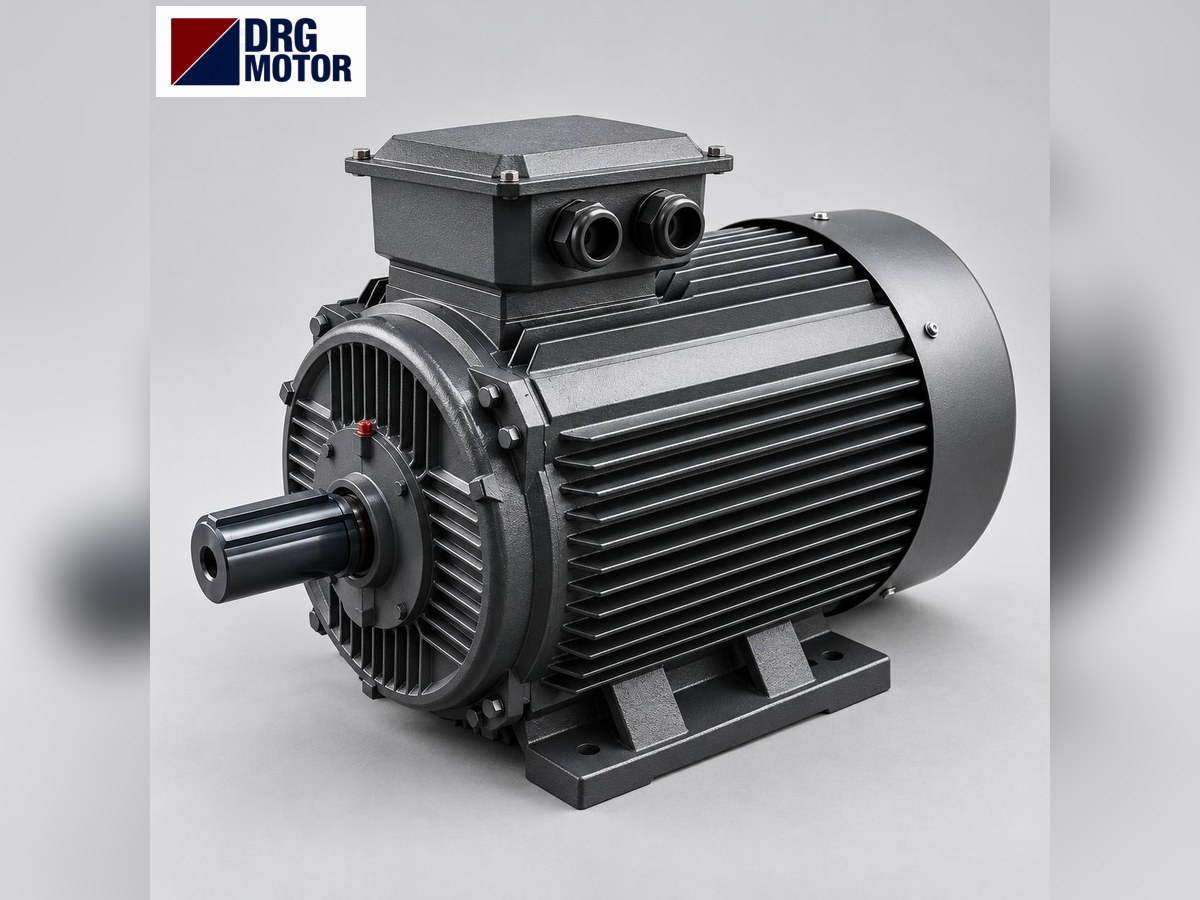
A jaw crusher motor is a standard three-phase induction motor, usually 6-pole (about 1000 rpm), that turns the crusher’s eccentric shaft through V-belts and a flywheel; its power is set by the crusher manufacturer according to the feed opening. Manufacturer catalogues show 30 kW on a small primary crusher with a 600×380 mm opening, 90 kW on a 1,100×700 mm model and 400 kW on the largest 2,000×1,500 mm models [1][2][3]. The motor does not crush directly: it spins the flywheel, and the energy stored there is delivered to the jaw on every crushing stroke.
This page covers the jaw crusher’s place in the plant, how the motor works in this machine, catalogue power ratings and the matching motors in the DRG range. All motors and current prices are on the Buy Electric Motors Online page; for other crusher and screen motors see Stone Crushing Plant Motors.
What is a jaw crusher and where does it sit in the line?
A jaw crusher breaks rock by squeezing it between a fixed jaw and a second jaw that moves back and forth against it. The two jaws form a V-shaped gap, wide at the top and narrow at the bottom. As the rock moves down, it is compressed and leaves through the bottom setting (CSS) in smaller pieces. Crushing is by compression, which is what separates it from impact machines.
It is the first crusher in the plant, i.e. it works at the primary stage. Large blasted blocks from the quarry first pass a vibrating feeder and grizzly, fines are removed and the coarse rock enters the jaw. The jaw’s product goes on to the secondary crusher. Feeders and grizzlies usually run on vibration motors; see the Vibration Motors page for those.
Jaw crushers are chosen for hard, abrasive rock: basalt, granite, andesite, quartzite, iron and copper ore. They are also used in limestone quarries and are the first crusher of mobile units in concrete demolition and asphalt recycling.
How it differs from other crushers
- Primary impact crusher: breaks rock by striking it with a fast rotor; gives a cubical product in low-abrasion rock such as limestone, but wear cost rises in hard, abrasive rock.
- Cone crusher: also crushes by compression but takes the smaller rock coming from the primary; it works at the secondary and tertiary stages.
- Jaw crusher: accepts the largest blocks, its wear parts (jaw plates) are simple to change, but the product can be flakier.
How the motor drives the jaw: eccentric shaft, flywheel, belts
The moving jaw hangs from an eccentric shaft at the top and rests on a toggle plate at the bottom. Each turn of the shaft closes and opens the jaw once. Two heavy flywheels sit on the shaft ends; one of them is also the large pulley. The motor drives this flywheel with a small pulley and V-belts.
A 90 kW model in one manufacturer’s data sheet shows the layout in figures: the motor runs at 985 rpm, 7 SPC belts are used, the motor pulley diameter is 335 mm and the crusher runs at 270 rpm [2]. The belts reduce the speed and also soften the shocks that would otherwise reach the motor.
The flywheel stores energy. Crushing resistance rises sharply as the jaw closes and falls almost to zero as it opens. The flywheel takes energy from the motor during the opening half and gives it back during the closing half, so the motor covers the average load rather than the peak. The same sheet gives a moment of inertia of 388 kg·m² for this model and 4,200 kg·m² for the largest one [2].
Motor power of jaw crushers on the market
A jaw crusher has a single main motor; every value in the table is the crusher’s one main motor. Options such as a hydraulic setting unit come with separate small motors whose power is taken from the manufacturer’s sheet.
| Model group / capacity | Motor power | Single / total | Source |
|---|---|---|---|
| Maker C, smallest model (600×380 mm opening, 60–110 t/h) | 30 kW | Single motor | [3] |
| Maker A, smallest model (800×510 mm opening) | 75 kW | Single motor | [1] |
| Maker B, 1,100×700 mm opening (110–490 t/h) | 90 kW | Single motor | [2] |
| Maker A, 1,200×870 mm opening | 160 kW | Single motor | [1] |
| Maker B, largest model (1,500×1,300 mm) | 200 kW | Single motor | [2] |
| Maker A, largest model (2,000×1,500 mm) | 400 kW | Single motor | [1] |
In this machine group, motor options of roughly 30–400 kW are seen depending on the manufacturer’s model and capacity [1][3].
The main factor setting the power is the feed opening, because a larger opening means heavier rock and higher crushing force. On a given machine, capacity changes with the setting: the 1,100×700 mm model gives 110–160 t/h at CSS 60 mm and 300–490 t/h at CSS 200 mm [2]. A wider setting lets more rock through but with less crushing work per tonne; the installed motor power stays the same. In harder rock the crusher is run at a wider setting with the same motor.
One manufacturer states plainly that its crusher is designed for the listed motor power and that fitting a larger motor sharply shortens crusher life [2]. In other words, “one size up in kW is safer” is wrong for a jaw crusher: a heavy start is solved by the right starting method, not a bigger motor.
How this range maps to the DRG range
The 30–355 kW models in the table can be covered by DRG cast iron motors; the DRG 6-pole (1000 rpm) series goes up to 355 kW. The largest 400 kW models and designs that call for 750 rpm (8-pole) motors are outside the DRG range.
Click to see current electric motor prices and order nowSEE PRICES →
Reading the selection table: pulley, speed and starting check
On a jaw crusher the motor power is not calculated; it is read from the crusher manufacturer’s table. When replacing a motor, the real checks are speed, pulley and starting. Using the 90 kW model from the sheet:
- Ratio: 985 / 270 ≈ 3.65. With a 335 mm motor pulley, the effective belt diameter on the flywheel is about 1,222 mm [2].
- Speed with DRG: the 90 kW 6-pole DRG-315M-6 runs at 988 rpm. With the same 335 mm pulley the crusher turns at 988 × 335 / 1,222 ≈ 271 rpm, matching the 270 rpm on the sheet; the pulley stays.
- Torque: this motor’s rated torque is 869.9 Nm with a starting torque ratio of 2.0, giving about 1,740 Nm at direct-on-line start. On the crusher shaft the same 90 kW at 270 rpm means about 3,183 Nm.
- Inertia: the 388 kg·m² flywheel stores about 155 kJ at 270 rpm; referred to the motor shaft its inertia becomes 388 / 3.65² ≈ 29 kg·m². On the largest model (4,200 kg·m², 200 rpm) the stored energy is about 921 kJ [2]. The bigger the flywheel, the longer the start.
- Current: DRG-315M-6 draws 161 A at 400 V with a starting current ratio of 6.7; a direct-on-line start gives an inrush of about 1,080 A.
You can check the speed with your own pulley size in the pulley and belt calculator.
Data needed to select a jaw crusher motor
- Crusher model and feed opening, the motor power and speed recommended by the manufacturer (old motor nameplate).
- Motor pulley diameter, number of grooves and belt section; pulley bush and shaft diameter.
- Whether the motor sits on a slide rail (belt tensioner) or a fixed base; foot hole dimensions.
- Starting method: star-delta, soft starter or VFD; panel and cable current capacity.
- How the crusher is cleared if it stops full (can the setting be opened hydraulically?).
- Environment: heavy dust from the crusher mouth, rain on an open site, winter cold and altitude.
Speed, starting method and mounting
Crusher speed lies between 200 and 350 rpm [1]; the motor speed is reduced to this by belts. Data sheets give a 985 rpm motor at 50 Hz [2], which is a 6-pole motor. A 4-pole motor is technically possible, but the pulley ratio rises to about 5.5, the motor pulley gets smaller and more belts are needed; the crusher manufacturer should approve this change.
In normal practice a jaw crusher is started empty and feed begins once the flywheel is up to speed. The motor then has to overcome flywheel inertia. In star-delta starting the torque falls to about one third; for the example motor that is around 580 Nm. On models with large flywheels this can make the start very long. A soft starter limits current but also lowers torque; a VFD gives a start close to full torque at low current. See the star-delta starting page and our article on starting current. The connection must be made by a qualified electrician.
The motor is almost always foot-mounted (B3) on a slide rail or hinged base that tensions the belts. The exact mounting and base size come from the crusher manufacturer’s drawing; DRG motor dimensions are on the technical drawings page. Why high torque matters in stone crushing in general is covered in our article on stone crushing plant motors.
| Model | Power / speed | Frame · current 400 V | Price |
|---|---|---|---|
| DRG-225M-640 HP | 30 kW · 1000 rpm | Cast iron 225M · 56.2 A | $1,487.70 (€1,328.61) Details & buy → |
| DRG-250M-650 HP | 37 kW · 1000 rpm | Cast iron 250M · 68.1 A | $2,056.71 (€1,836.77) Details & buy → |
| DRG-280M-675 HP | 55 kW · 1000 rpm | Cast iron 280M · 98.1 A | $2,805.93 (€2,505.87) Details & buy → |
| DRG-315S-6100 HP | 75 kW · 1000 rpm | Cast iron 315S · 136 A | $3,889.23 (€3,473.33) Details & buy → |
| DRG-315M-6125 HP | 90 kW · 1000 rpm | Cast iron 315M · 161 A | $4,430.22 (€3,956.46) Details & buy → |
| DRG-315L1-6150 HP | 110 kW · 1000 rpm | Cast iron 315L · 196 A | $5,122.19 (€4,574.43) Details & buy → |
| DRG-315L2-6180 HP | 132 kW · 1000 rpm | Cast iron 315L · 232 A | $5,691.81 (€5,083.14) Details & buy → |
| DRG-355M1-6200 HP | 160 kW · 1000 rpm | Cast iron 355M · 281 A | $6,285.89 (€5,613.69) Details & buy → |
| DRG-355M2-6270 HP | 200 kW · 1000 rpm | Cast iron 355M · 346 A | $9,015.18 (€8,051.11) Details & buy → |
Matching DRG motors
DRG Motor is a manufacturer, supplier and seller of electric motors. Our range covers 0.25–11 kW in aluminium frames and 0.55–355 kW in cast iron; 1000, 1500 and 3000 rpm; 3-phase, 230/400 V or 400/690 V; mounting B3, B5, B14 and B35 (with an order note). For jaw crushers our 6-pole cast iron motors from 30 to 355 kW are used; models from 4 kW up are wound for 400/690 V and therefore suit star-delta panels. Note: in our 6-pole series the starting torque ratio is 2.0 up to 132 kW and 1.8 from 160 kW; on crushers with large flywheels the starting method should be chosen accordingly.
| Model | Power / speed | Frame | Current 400 V |
|---|---|---|---|
| DRG-225M-6 | 30 kW / 980 rpm | 225M cast iron | 56.2 A |
| DRG-315S-6 | 75 kW / 985 rpm | 315S cast iron | 136 A |
| DRG-315M-6 | 90 kW / 988 rpm | 315M cast iron | 161 A |
| DRG-355M2-6 | 200 kW / 990 rpm | 355M cast iron | 346 A |
| DRG-355L-6 | 250 kW / 990 rpm | 355L cast iron | 433 A |
DRG MOTOR motors are guaranteed against material and manufacturing defects for 2 years from the delivery date (warranty certificate).
Motors in this power range for jaw crushers
- DRG-225M-6 – 30 kW – 980 rpm – 225M cast iron
- DRG-280M-6 – 55 kW – 985 rpm – 280M cast iron
- DRG-315M-6 – 90 kW – 988 rpm – 315M cast iron
- DRG-315L2-6 – 132 kW – 988 rpm – 315L cast iron
- DRG-355M2-6 – 200 kW – 990 rpm – 355M cast iron
- DRG-355L-6 – 250 kW – 990 rpm – 355L cast iron
Click to see current prices and order these motors nowSEE PRICES →
Frequently Asked Questions
How many kW should a jaw crusher motor be?
It depends on the feed opening and is read from the manufacturer’s table. Catalogues show 30 kW for a 600×380 mm opening, 90 kW for 1,100×700 mm and 400 kW for the largest models. Fitting a motor larger than the listed value can damage the crusher.
Is a 1000 rpm or 1500 rpm motor used on a jaw crusher?
Manufacturer sheets mostly give a 985 rpm motor at 50 Hz, i.e. 6-pole. A 1500 rpm motor is used only if the pulley ratio is recalculated and the crusher manufacturer approves it.
Can a jaw crusher start on star-delta?
With an empty start, small and medium models usually can; the motor must be wound for 400/690 V. On models with large flywheels the torque may not be enough, and a soft starter or VFD is considered.
If the crusher stops full of rock, can the motor restart it?
Starting with a full jaw is not recommended. The jaw is first relieved by opening the setting or clearing it by hand, then the motor is started; forcing it strains the belts, shaft and motor.
Send us the crusher’s model plate, the old motor’s nameplate and the pulley size, and we will identify the right DRG motor together. Phone +90 (542) 666 11 11, e-mail [email protected], contact page. For all models and current prices: Buy Electric Motors Online.
Sources
- Metso – Nordberg C Series jaw crushers (broşür) – C80–C200: maximum installed power 75–400 kW, crusher speed 350–200 rpm, feed opening sizes, capacity by CSS.
- Sandvik – Jaw Crusher Series, Technical Specification – CJ211–CJ815: motors 75–200 kW, motor speed 985 rpm (50 Hz), V-belt count and motor pulley, crusher speed, flywheel inertia; oversize-motor warning.
- Constmach – CJC-60 Jaw Crusher – 600×380 mm opening, 30 kW motor, 330 rpm flywheel speed, 60–110 t/h.


