 English
 Le français
 Türkçe

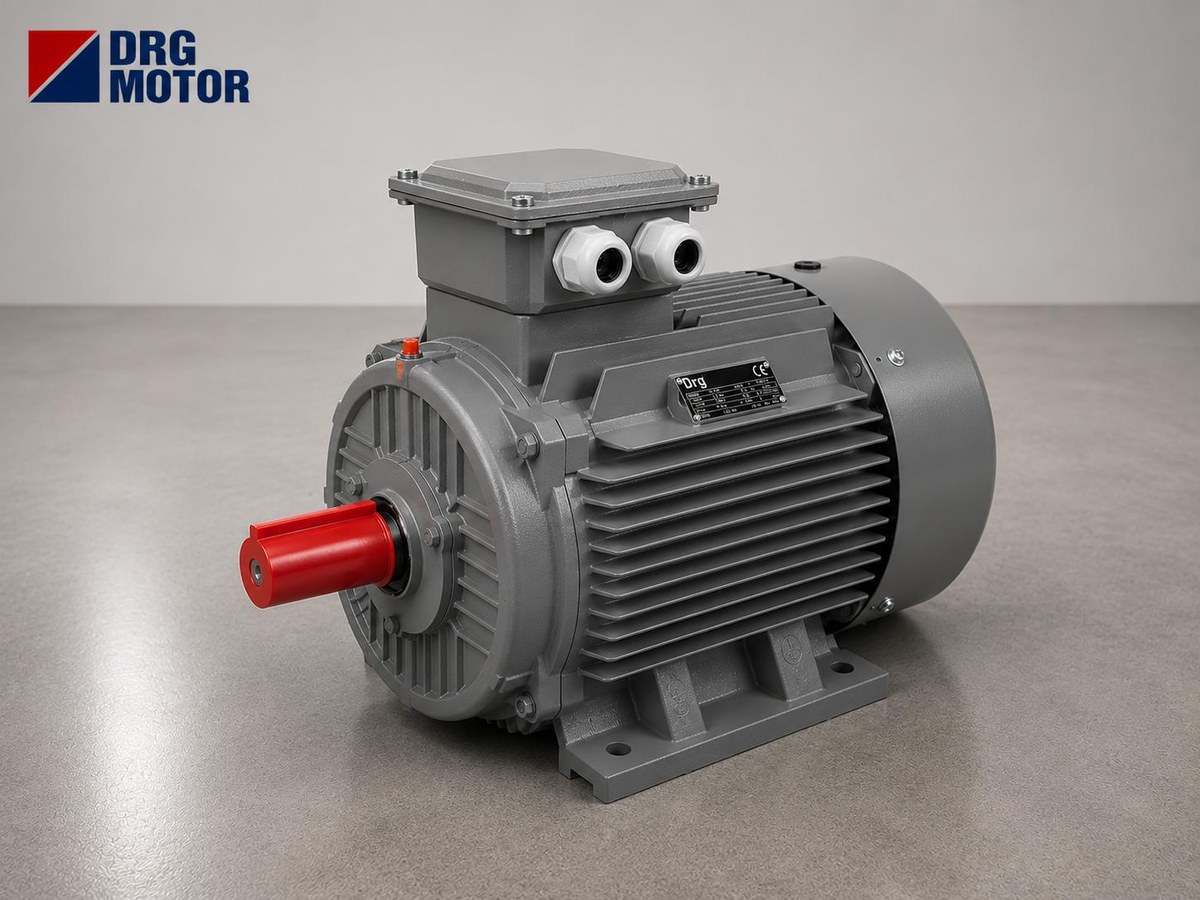
In ceramic tile and porcelain slab plants, moist granules from the spray dryer are filled into a die on a hydraulic press and compacted with thousands of tonnes of force into a green tile. Here the electric motor never touches the pressing piston: it turns the pump in the hydraulic unit, the pump pressurises the oil and the cylinder produces the force. Maker catalogues show 75–132 kW for the hydraulic circuit motors of tile presses and 9–14 kW in total for feeding and auxiliary motors; on the largest slab presses the total installed power of the motors reaches 212 kW. The press motor is a hydraulic pump motor sized from pump flow and working pressure; for the detailed kW calculation see our hydraulic pump motor selection article.
DRG Motor is a manufacturer, supplier and seller of electric motors. We do not sell the press, the hydraulic unit, the pump, the valve block, the die, the filling carriage or the drive. What you get from us is the three-phase motor turning the hydraulic pump and auxiliary equipment; models are on Buy Electric Motors Online. For an overview of motors elsewhere in the factory, read our ceramic plant motor article.
How does a ceramic tile press work?
The press cycle is short and repetitive: the filling carriage loads granules into the die cavities, the large cylinder carrying the moving crossbeam comes down, the granules are first lightly pre-pressed to release air, full pressure follows, then the crossbeam rises and the ejector lifts the green tile out of the die. The first maker’s catalogue gives a maximum of 15–25 cycles per minute for this series, depending on model. High pressure is generated only in the cylinder chamber by a multiplier fitted inside the piston; the rest of the circuit stays at lower pressure.
Main hydraulic unit and pump motor
The hydraulic unit in the catalogue comprises a pressurised tank, a variable-displacement constant-power main pump, a centrifugal booster pump feeding the main pump inlet, an oil cooling heat exchanger, a 12-micron filter group and the valve block, all inside a soundproof cabinet. The load on the electric motor is the product of the pump’s flow and pressure at each moment. A constant-power pump reduces flow on its own as pressure rises, so the motor is sized to the set power, not to a hypothetical point where maximum pressure and maximum flow occur together.
Filling carriage and powder feeding
The filling carriage takes granules from a homogenising hopper and travels back and forth over the die. On the first maker’s presses the carriage is driven by a brushless servo motor through toothed belts; servo motors of this kind are not in our range. Belts, elevators and hopper vibrators bringing granules from the silos to the press are auxiliary equipment running on standard motors and fall under the “auxiliary motors” line in catalogues.
Ceramic press versus roof tile press
Both are called “presses”, but the motor’s job differs. On rotary roof tile presses the motor turns a flywheel and an eccentric or crank mechanism; the force is produced mechanically and the motor works against the energy drawn from the flywheel on each stroke. On a ceramic tile press there is no mechanical link between motor and die: the motor only turns the pump and the hydraulic cylinder supplies the force. That is why a tile press motor is chosen like a hydraulic unit motor; press types on the brick and roof tile line are covered separately under “Roof Tile Moulding Presses”.
Intermittent load, frequent cycles
At 15–25 cycles per minute pressure rises and falls within seconds; the pump is loaded and unloaded every cycle. The motor rides through this with its inertia and the thermal capacity of the rotor. When choosing the motor, the torque at the pressure peak counts as well as the average load across the cycle; in practice this means staying with the motor rating given by the hydraulic unit maker.
Technical ceramics and continuous compaction lines
Technical ceramics presses work at higher pressures: the second maker’s 15,000 kN model runs the pump at 160 bar, the high-pressure circuit at 300 bar and a single 90 kW pump motor. For large slabs some plants use continuous lines compacting granules between two belts instead of a hydraulic press; installed power there is clearly lower than on a classic press and most motors drive belts and rollers.
How many kW is a ceramic press motor? Catalogue values
A) Ratings published in maker catalogues and technical pages for hydraulic ceramic presses:
| Press / force | Motor rating | Single / total | Note |
|---|---|---|---|
| Tile press 1500–2000 t, 180 bar | 75 kW hydraulic circuit | hydraulic motors | first maker’s catalogue |
| Tile press 2800 t, 180 bar | 90 kW hydraulic circuit | hydraulic motors | first maker’s catalogue |
| Tile press 3500–5500 t, 200 bar | 110–132 kW hydraulic circuit | hydraulic motors | first maker’s catalogue |
| Same series, auxiliary motors | 9–14 kW | total, auxiliary motors | first maker’s catalogue |
| Same series, die heating | 37–50 kW | heater, not a motor | first maker’s catalogue |
| Tile press 27,500–42,000 kN | 97.5–117.5 kW | total installed electric power | second maker |
| Tile/slab press 51,000–82,000 kN | 211–212 kW | total installed power in motors | second maker |
| Technical ceramics press 15,000 kN, 160/300 bar | pump 90 kW; connected load 110 kW | single pump motor + total | second maker |
Read across the table, hydraulic circuit motors sit between 75 and 132 kW and the auxiliary group between 9 and 14 kW, rising with pressing force; in technical ceramics the single pump motor is 90 kW. The 97.5–212 kW figures are the press’s total installed power, not a single motor; die heating (37–50 kW) is a heater load and does not enter motor selection. As pressing force, cycle rate and die area grow, pump flow and therefore motor power increase.
B) Where the DRG range fits: for the circuit ratings in the table we have 4-pole cast iron motors in frames 280S (75 kW), 280M (90 kW), 315S (110 kW) and 315M (132 kW), and the auxiliary motors making up the 9–14 kW total by small frames. Where the hydraulic circuit power is split between several motors, each motor is matched separately. The carriage servo motor, drives and brake motors are outside our range.
Click to see current electric motor prices and order nowSEE PRICES →
Worked example: from motor power to pump flow
The relation we use: power [kW] = pressure [bar] × flow [l/min] ÷ (600 × η). We took both ends of the catalogue and worked backwards: if motor power and circuit pressure are known, what flow can the pump deliver, and what displacement in cm³/rev does that need? Motor speeds and currents are from our data sheet (DRG-280S-4: 1,486 rpm, 129 A, Is/In 6.9; DRG-315M-4: 1,488 rpm):
| Case | Operation | Result | Note |
|---|---|---|---|
| 75 kW, 180 bar: flow the pump can deliver | 75 × 600 × 0.85 / 180 | about 212 l/min | overall η assumed 0.85 |
| Pump displacement for that flow | 212 × 1,000 / 1,486 | about 143 cm³/rev | at DRG-280S-4 speed |
| 132 kW, 200 bar: flow | 132 × 600 × 0.85 / 200 | about 337 l/min | same assumption |
| Displacement for that flow | 337 × 1,000 / 1,488 | about 226 cm³/rev | at DRG-315M-4 speed |
| 75 kW motor, starting in star | 129 × 6.9 / 3 | about 297 A | if the pump starts unloaded |
Overall efficiency (η) is an assumed value; a real calculation uses the pump maker’s volumetric and mechanical efficiencies. The last row is for starting: if the hydraulic unit is switched on with the pump unloaded, that is without pressure, the motor accelerates almost unloaded and star-delta starting is enough. If starting under load is required, consider a soft starter or inverter; our starting methods page sums up the differences.
Keeping the speed on replacement
Inlet conditions keep most piston and vane pumps around 1500 rpm, so 4-pole motors are common on hydraulic units. The centrifugal booster pump in the catalogue likewise exists to prevent cavitation at the main pump inlet. When replacing the motor on an existing press, keep the old speed; a different speed changes pump flow and therefore cycle time.
Environment, cooling and maintenance
The press area combines granule dust, oil mist and heat from the die heaters. If air circulation inside the hydraulic unit cabinet is limited, the motor fan re-ingests hot air; cabinet ventilation and clearance around the motor matter for that reason. Our IP55 motors are protected against dust. The oil cooler runs on water (3.6–4.5 m³/h in the catalogue); if cooling water stops, the oil heats up, pump efficiency drops and the motor does the same work at a higher current.
Coupling and bell housing
The main pump is usually joined to the motor through a bell housing (pump mounting flange) and a flexible coupling; in this layout the motor is flange-mounted (B5) or foot-and-flange (B35). On large frames the feet carry the motor’s weight and the flange only keeps the axes aligned. Source the bell housing and coupling from the hydraulic unit supplier, not from us.
Press hydraulic units with DRG motors
Our 4-pole models for the main pump and auxiliary equipment (current at 400 V):
| Model | Power / speed | Frame · shaft D×E | Current 400 V |
|---|---|---|---|
| DRG-112M-4 | 4 kW / 1450 rpm | 112M cast iron · 28×60 | 7.95 A |
| DRG-132M-4 | 7.5 kW / 1460 rpm | 132M cast iron · 38×80 | 14.3 A |
| DRG-160M-4 | 11 kW / 1465 rpm | 160M cast iron · 42×110 | 20.4 A |
| DRG-160L-4 | 15 kW / 1465 rpm | 160L cast iron · 42×110 | 27.3 A |
| DRG-250M-4 | 55 kW / 1485 rpm | 250M cast iron · 65×140 | 97.6 A |
| DRG-280S-4 | 75 kW / 1486 rpm | 280S cast iron · 75×140 | 129 A |
| DRG-280M-4 | 90 kW / 1486 rpm | 280M cast iron · 75×140 | 155 A |
| DRG-315S-4 | 110 kW / 1488 rpm | 315S cast iron · 85×170 | 187 A |
| DRG-315M-4 | 132 kW / 1488 rpm | 315M cast iron · 85×170 | 224 A |
All our motors are three-phase asynchronous IEC types; aluminium bodies reach 11 kW and cast iron bodies 355 kW, with two-, four- or six-pole windings. For a replacement we need the plate power, speed, voltage and connection (400/690 V motors are delta-connected on a 400 V network), mounting type, flange and shaft dimensions, and the spigot diameter of the bell housing. We compare this information with the hydraulic unit documents to confirm the right motor; without the dimensions we cannot vouch for the fit.
B5 flange dimensions of large frames
B5 values of the frames used for main pump motors, mm:
| Frame | Shaft D×E | Flange P / M / N | Hole S |
|---|---|---|---|
| 250M | 60×140 | 550 / 500 / 450 | 18.5 |
| 280S/280M | 65×140 | 550 / 500 / 450 | 18.5 |
| 315S/315M | 65×140 | 660 / 600 / 550 | 24 |
On a motor seated in a bell housing the N spigot and the D×E shaft size must match exactly. Foot dimensions and full drawings are on the technical drawings page; for general selection on the pump side see also the Pump Motors category.
Live price table
Prices of the models at press hydraulic circuit and auxiliary motor ratings are read live from the shop:
| Model | Power / speed | Frame · current 400 V | Price |
|---|---|---|---|
| DRG-132M-410 HP | 7.5 kW · 1500 rpm | Cast iron 132M · 14.3 A | $394.89 (€352.66) Details & buy → |
| DRG-160M-415 HP | 11 kW · 1500 rpm | Cast iron 160M · 20.4 A | $568.76 (€507.94) Details & buy → |
| DRG-160L-420 HP | 15 kW · 1500 rpm | Cast iron 160L · 27.3 A | $678.13 (€605.61) Details & buy → |
| DRG-250M-475 HP | 55 kW · 1500 rpm | Cast iron 250M · 97.6 A | $2,065.73 (€1,844.82) Details & buy → |
| DRG-280S-4100 HP | 75 kW · 1500 rpm | Cast iron 280S · 129 A | $2,916.93 (€2,605.00) Details & buy → |
| DRG-280M-4125 HP | 90 kW · 1500 rpm | Cast iron 280M · 155 A | $3,268.56 (€2,919.03) Details & buy → |
| DRG-315S-4150 HP | 110 kW · 1500 rpm | Cast iron 315S · 187 A | $4,863.00 (€4,342.97) Details & buy → |
| DRG-315M-4180 HP | 132 kW · 1500 rpm | Cast iron 315M · 224 A | $5,621.72 (€5,020.55) Details & buy → |
DRG MOTOR motors are guaranteed against material and manufacturing defects for 2 years from the delivery date (warranty certificate).
Motors in this power range
- DRG-160L-4 – 15 kW – 1465 rpm – 160L cast iron
- DRG-280S-4 – 75 kW – 1486 rpm – 280S cast iron
- DRG-280M-4 – 90 kW – 1486 rpm – 280M cast iron
- DRG-315S-4 – 110 kW – 1488 rpm – 315S cast iron
- DRG-315M-4 – 132 kW – 1488 rpm – 315M cast iron
Click to see current prices and order these motors nowSEE PRICES →
Browse the products, ask for a quote: motors for your press hydraulic unit are on Buy Electric Motors Online. Send photos of the motor plate and the pump-motor joint via WhatsApp; to talk through pressing force and circuit pressure by phone, +90 (542) 666 11 11.
Frequently asked questions
Will the press run faster with a more powerful motor?
Not by itself; cycle time is set by pump settings, valves and the control system. More power only makes sense with a pump and setting change approved by the hydraulic unit maker.
Why does a hydraulic press motor run hot?
Insufficient oil cooling, hot air building up in the cabinet or the pump running at higher pressure than needed are the most common causes. Measure oil temperature and motor current first.
What does the price of a press motor depend on?
Rating, pole count, frame and mounting set the price; current figures are in the table above.
Write or call us: +90 (542) 666 11 11 · info@drgmotor.com · contact.


