 English
 Le français
 Türkçe

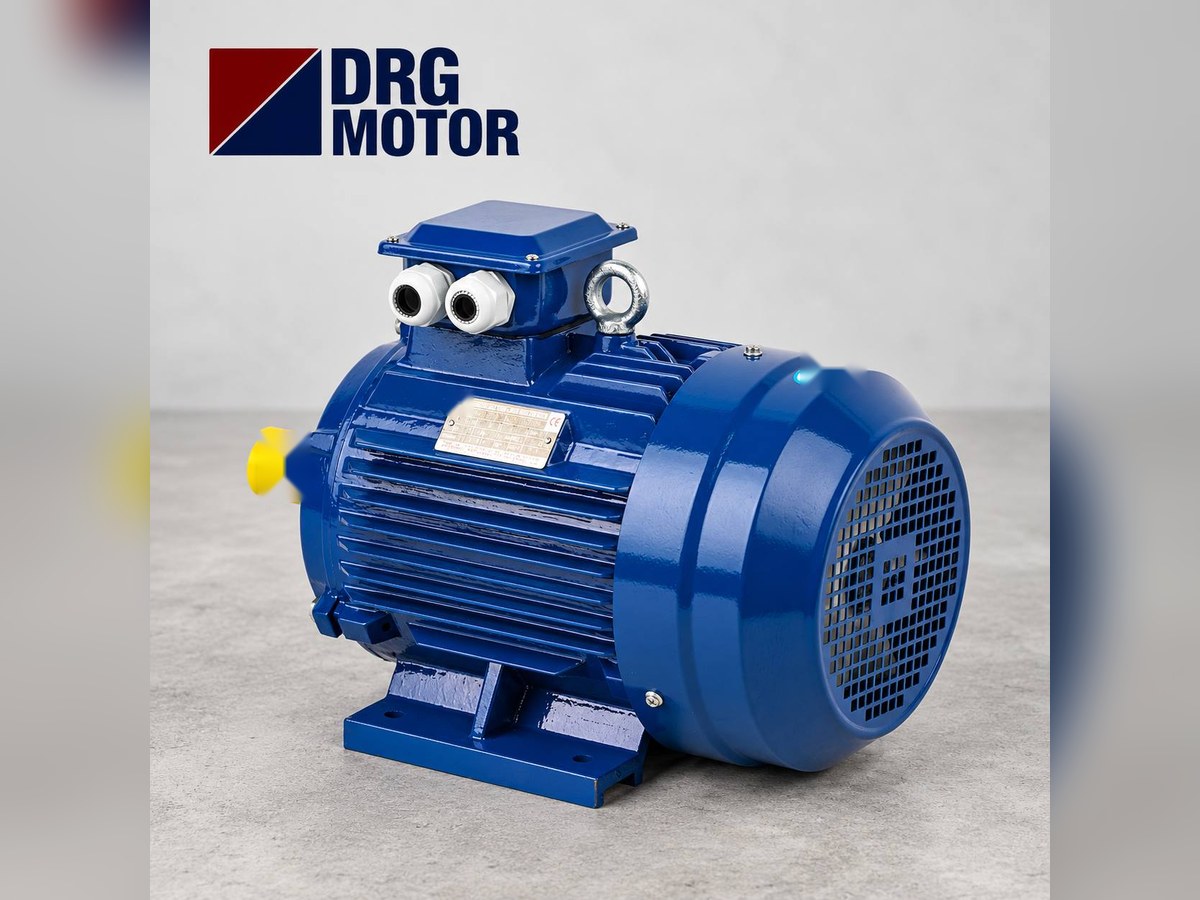
A head cutting machine is the station that squares off and discards the irregular ends of marble or granite strips coming from the sizing line and, where needed, divides the strip into set lengths in the same stroke. The electric motor’s job here is to turn one or two diamond blades; the blade crosses the strip, returns and waits for the next strip. Maker data sheets put the head motor at 5.5–15 kW, and it works in a cycle that is mostly waiting rather than cutting.
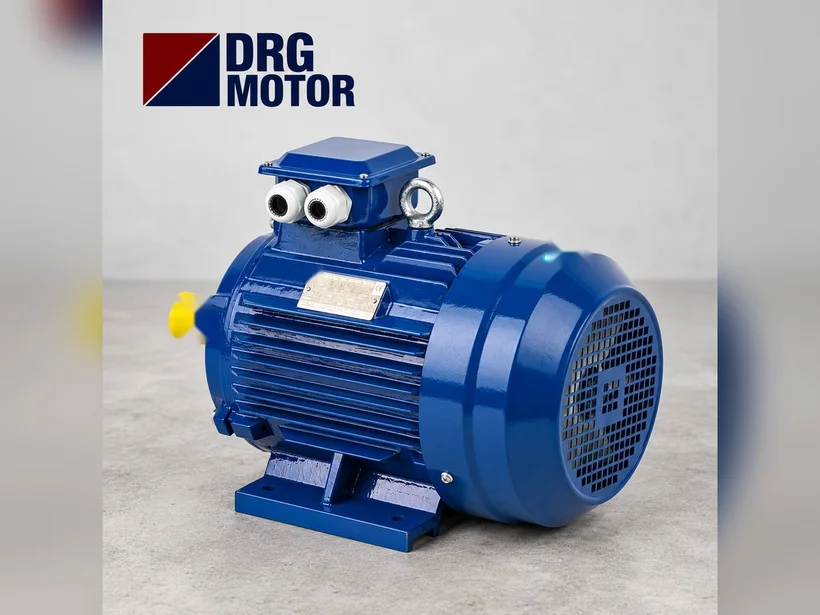
DRG Motor is a manufacturer, supplier and seller of electric motors. We do not sell the head cutting station, its head travel gearbox, drives (inverters) or servo systems; we supply the standard asynchronous motor that turns the blade head and the belts. Suitable models are on Buy Electric Motors Online.
Where does head cutting sit on the line?
The sizing machine brings the strip to width, but both ends of the strip come from the slab edge and remain broken, skewed or cracked. The head cutting station steps in at exactly this point: the strip is stopped on the belt, an aligning device squares it, and the blade cuts first the head end and then the tail end. Off-cuts are taken by a separate belt to a scrap bin. On some lines the same station also makes intermediate cuts to divide the remaining length into modular sizes.
Single-blade and twin-blade layouts
On a single-blade station one head cuts both ends in turn, with the belt shifting the strip between cuts. On a twin-blade station two heads sit on the same bridge, their spacing is set to strip length and both ends are taken in one pass. The second is faster but needs two head motors plus a small extra motor to position the head.
Slab, strip and tile
The station mostly works with strips up to roughly 3 m long. On wide slabs end trimming is done by the bridge saw or by the cross head of a slab sizing line; on small tiles and pavers it usually ends right on the multi-blade cutter. That is why the product the station cuts should be clear before a head cutting motor is chosen.
How it differs from sizing: short, frequent, intermittent load
On a sizing line the blades cut along the strip without a break; the blade motor sees steady load for long periods and line power grows with blade count. In head cutting there are only one or two blades, but on every strip the motor makes a short cut and then idles. Both machines may use motors of the same kW, yet one is stressed by heat build-up and the other by repeated load pulses. If sizing is the bottleneck the head cutter waits; the other way round, strips pile up in front of it.
Cutting time versus idling
One maker data sheet gives a head cutting bridge feed rate of 1.5–12 m/min and a maximum strip width of 650 mm. From these two figures the duration of a single end cut can be worked out:
| Bridge feed rate | Time for a 650 mm cut | Both ends of one strip | What the motor sees |
|---|---|---|---|
| 1.5 m/min | 26 s | 52 s | long loaded period, hard stone |
| 3 m/min | 13 s | 26 s | load and idle roughly balanced |
| 6 m/min | 6.5 s | 13 s | motor mostly idles |
| 12 m/min | 3.25 s | 6.5 s | short, sharp load pulse |
At a fast feed the motor is loaded for only a few seconds per strip and idles the rest of the time. In that case the motor is chosen less for heating and more for instant torque: speed must not sag when the blade enters the stone.
Keep it running or stop it?
If strips arrive often and regularly, it is healthier to let the blade motor run as long as the line runs. Stopping and restarting on every strip draws several times rated current each time and heats the winding; on the DRG-132M-4 that multiple is 7.5. With long waits the control can stop the motor; if starts per hour run high, review the starting method together with the machine builder.
Click to see current electric motor prices and order nowSEE PRICES →
Blade motor: speed, mounting and connection
Data sheets list head cutting blade diameters of 350–600 mm. On one maker’s cross cutter the 7.5 kW blade motor is given at 1420 rpm, a 4-pole speed; other types reduce a 2-pole motor through belts. The highest permitted speed is printed on the blade and must not be exceeded. To adjust speed by changing pulleys, use our pulley and belt calculator.
Swinging head and flange motor
On some stations the motor and blade arbor are mounted on a carrier that swings to lift the blade at the end of the cut. The motor is then both a rotating and a moving mass; flange mounting (B5 or B35) and bolts kept tight against vibration matter. Where the blade fits straight onto the motor shaft a special long shaft is needed; that shaft is not in our range, so we compare the old dimension with our catalogue.
Head travel and belt motors
Moving the head across the strip and driving the belt are done by geared motors, usually with inverter speed control; data sheets show these at 0.75–1.1 kW. Neither gearboxes nor inverters come from DRG; the small 4-pole motor bolted to the gearbox input is something we can provide. Water and stone slurry are present here too: the terminal entry of an IP55 motor should face down and the frame must not sit under slurry.
How many kW for a head cutting machine motor?
A) What head cutting and cross cutting data sheets list for each motor:
| Station / blade | Head motor | Auxiliary motors | Note |
|---|---|---|---|
| Single blade, marble strip, Ø350 mm | 5.5 kW | Belt 1.1 kW; 7 kW installed | maker data sheet, marble version |
| Single blade, granite strip, Ø350 mm | 7.5 kW | Belt 1.1 kW; 9 kW installed | same sheet, granite version |
| Twin blade, two heads, Ø350 mm | 11 kW per head | Infeed rollers 0.75 kW; 24.5 kW installed | same sheet, both ends in one pass |
| Head cutting / length sizing, Ø400–600 mm | 11 / 11 / 15 kW | 12 / 12 / 16 kW installed | second maker, three models |
| Twin-saw head cutter, Ø350 mm | 7.5 kW per saw | Bridge forward-back 1.1 kW | same maker |
| Cross cutter, Ø400–500 mm | 7.5 kW, 1420 rpm | Head travel 0.75 kW; 8.75 kW installed | third maker |
Across these stations a head motor of roughly 5.5–15 kW is seen, depending on model and blade size, and auxiliary motors run at 0.75–1.1 kW. In the same data sheet the marble version gets 5.5 kW and the granite version 7.5 kW: harder stone on the same blade needs more power.
B) Where DRG fits: head motors of 5.5, 7.5, 11 and 15 kW are covered by our 4-pole and 2-pole cast iron models, and 0.75 and 1.1 kW auxiliary motors by our small 4-pole models. Brake motors for vertical movements that need a brake are not in our range.
DRG motors and what a replacement needs
Before changing the head motor, write down the old nameplate (kW, speed, voltage), the mounting method, shaft diameter and key, pulley diameter and whether the head swings. Add the machine builder’s drawing if you have it; we confirm fit by comparing these documents and give no blanket promise of compatibility.
| Model | Power / speed | Frame · shaft D×E | Current 400 V |
|---|---|---|---|
| DRG-132S-4 | 5.5 kW / 1460 rpm | 132S cast iron · 38×80 | 10.7 A |
| DRG-132M-4 | 7.5 kW / 1460 rpm | 132M cast iron · 38×80 | 14.3 A |
| DRG-160M-4 | 11 kW / 1465 rpm | 160M cast iron · 42×110 | 20.4 A |
| DRG-160L-4 | 15 kW / 1465 rpm | 160L cast iron · 42×110 | 27.3 A |
| DRG-160M1-2 | 11 kW / 2945 rpm | 160M cast iron · 42×110 | 19.6 A |
| DRG-802-4 | 0.75 kW / 1420 rpm | 80 cast iron · 19×40 | 1.75 A |
| DRG-90S-4 | 1.1 kW / 1445 rpm | 90S cast iron · 24×50 | 2.48 A |
B5 flange dimensions
B5 dimensions (mm) from our catalogue for frames used on head and auxiliary motors:
| Frame | Shaft D×E | Flange P / M / N | Hole S |
|---|---|---|---|
| 80 | 19×40 | 200 / 165 / 130 | 12 |
| 90S/90L | 24×50 | 200 / 165 / 130 | 12 |
| 132S/132M | 38×80 | 300 / 265 / 230 | 14.5 |
| 160M/160L | 42×110 | 350 / 300 / 250 | 18.5 |
Live price table
Live shop prices for motors in the ratings used on a head cutting station:
| Model | Power / speed | Frame · current 400 V | Price |
|---|---|---|---|
| DRG-802-41 HP | 0.75 kW · 1500 rpm | Cast iron 80 · 1.75 A | $101.93 (€91.03) Details & buy → |
| DRG-90S-41.5 HP | 1.1 kW · 1500 rpm | Cast iron 90S · 2.48 A | $124.09 (€110.82) Details & buy → |
| DRG-132S-47.5 HP | 5.5 kW · 1500 rpm | Cast iron 132S · 10.7 A | $342.01 (€305.44) Details & buy → |
| DRG-132M-410 HP | 7.5 kW · 1500 rpm | Cast iron 132M · 14.3 A | $394.89 (€352.66) Details & buy → |
| DRG-132S2-210 HP | 7.5 kW · 3000 rpm | Cast iron 132S · 13.7 A | $369.43 (€329.92) Details & buy → |
| DRG-160M-415 HP | 11 kW · 1500 rpm | Cast iron 160M · 20.4 A | $568.76 (€507.94) Details & buy → |
| DRG-160M1-215 HP | 11 kW · 3000 rpm | Cast iron 160M · 19.6 A | $527.95 (€471.49) Details & buy → |
| DRG-160L-420 HP | 15 kW · 1500 rpm | Cast iron 160L · 27.3 A | $678.13 (€605.61) Details & buy → |
DRG MOTOR motors are guaranteed against material and manufacturing defects for 2 years from the delivery date (warranty certificate).
Motors in this power range
- DRG-132S-4 – 5.5 kW – 1460 rpm – 132S cast iron
- DRG-132M-4 – 7.5 kW – 1460 rpm – 132M cast iron
- DRG-160M-4 – 11 kW – 1465 rpm – 160M cast iron
- DRG-802-4 – 0.75 kW – 1420 rpm – 80 cast iron
- DRG-90S-4 – 1.1 kW – 1445 rpm – 90S cast iron
Click to see current prices and order these motors nowSEE PRICES →
Browse the motors, request a quote: All options are on Buy Electric Motors Online. Photograph the head motor plate and the head itself, then message WhatsApp or ring +90 (542) 666 11 11.
Frequently asked questions
Can a marble head cutting motor and a sizing blade motor replace each other?
If kW, speed, shaft and mounting match, the motor will fit; but the two machines load it differently. Head cutting brings frequent load pulses, sizing long steady load; set the overload relay for the new position.
Should a trimming machine motor be upsized when moving to granite?
Data sheets show the granite version with a stronger motor on the same blade diameter. If the machine was built for marble, ask the builder before switching to granite; blade, pulleys and feed rate may change along with the motor.
Why does the motor on a marble cutting head run hot?
Frequent stop-start, a glazed blade, belt slip and cooling fins packed with slurry are the usual causes. Check these four before replacing the motor.
Questions: +90 (542) 666 11 11, info@drgmotor.com or our contact page. Head cutting machine motor models are on Buy Electric Motors Online.


