 English
 Le français
 Türkçe

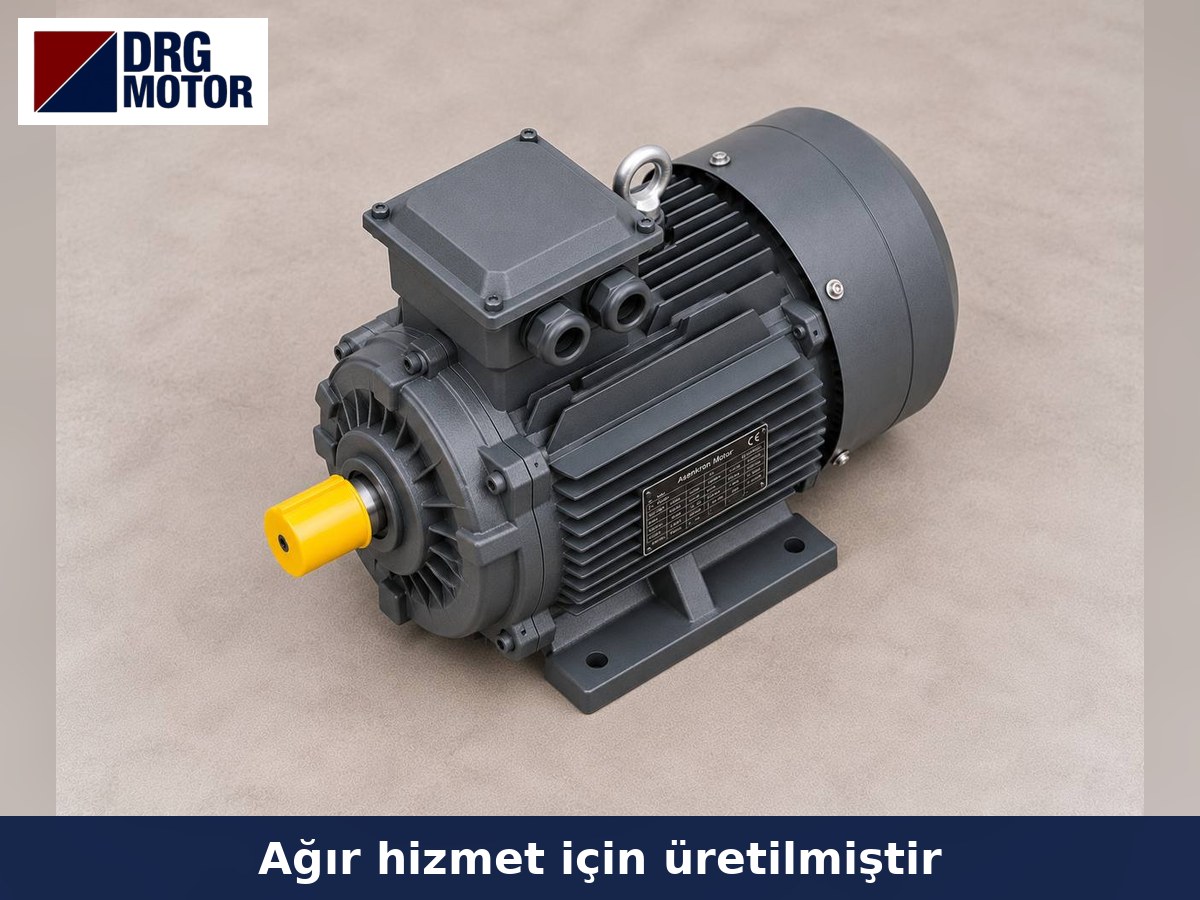
Rubber processing machine motors turn the mixers that knead raw rubber with fillers and chemicals, the open mills and calenders that turn the compound into sheet, the extruders that form profiles and hoses, and the hydraulic pumps of the vulcanizing presses that close the moulds. They share high torque, very low output speed and restarts with a machine full of compound. Manufacturer catalogues show 5.5–250 kW for open mills, from 37 kW up to thousands of kilowatts for internal mixers, 15–185 kW for calenders, 15–355 kW for cold feed extruders and 2 × 4 … 2 × 11 kW for press pumps.
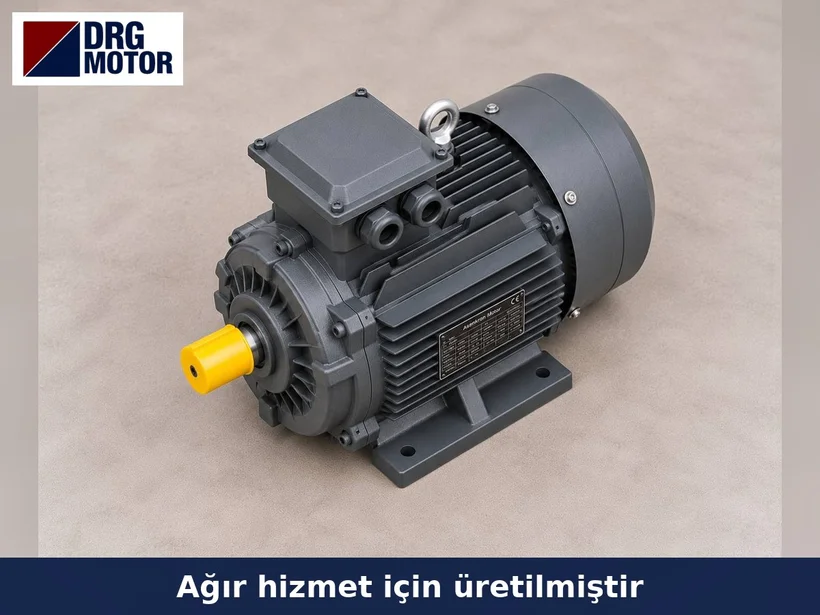
DRG Motor is a manufacturer, supplier and seller of electric motors. We do not sell mixers, mills, calenders, extruders, presses, gearboxes, hydraulic units or drives; what we provide is the three-phase cage motor that drives them. Every model is in the Buy Electric Motors Online section, and machines from the same series are collected under General Purpose Industrial Electric Motors.
From compound to finished part: machines and their motors
In a plant making tyres, seals, hoses, soles or rubber-covered rollers, the compound is first mixed in batches, cooled and sheeted on a mill, then either drawn into thin sheet on a calender or pushed through an extruder die. In the last step the moulded part is cured under heat and pressure. For an overview of the sector and of drive points in a tyre plant see electric motors in the rubber industry; this page focuses on motor power per machine.
Internal mixer (Banbury type)
Rubber, carbon black and oil are charged into a closed two-rotor chamber, and a ram presses the material onto the rotors. Rotor speed is a few dozen rpm, reached from the main motor through a gearbox. At the end of the batch the chamber tilts or a drop door opens; a separate small motor handles the tilting. On large mixers the main drive is very powerful and runs on medium voltage.
Open two-roll mill
The two rolls turn towards each other at slightly different speeds; this ratio is called friction and catalogues show it between 1:1.17 and 1:1.35. One motor, a gearbox and friction gears drive both rolls together. Motor sizing, the gearbox ratio and the restart problem after an emergency stop are covered in our rubber mixing machine motor article; we do not repeat that calculation here.
Calender
A three- or four-roll calender draws the compound into sheet of set thickness or coats fabric with rubber. The rolls run at fixed speed ratios, and sheet thickness depends on the roll speeds staying locked together. The main drive therefore runs on a drive, and the take-up and haul-off motors follow it.
Rubber extruder and vulcanizing press
In a cold feed extruder a strip at room temperature warms up along a long screw and leaves the die as a profile or hose; the screw needs high torque at low speed. In a platen vulcanizing press the motor turns the hydraulic pump feeding the clamping piston; pressing force is set by the pump and cylinder, not by the motor. Pump motor sizing is explained in our hydraulic pump motor selection article.
How many kW for a rubber machine motor? Manufacturer catalogue values
A) Motor powers stated in the data sheets of rubber machinery builders:
| Machine / model group | Motor power | Single / total | Note |
|---|---|---|---|
| Open mill, 160 mm roll (laboratory) | 5.5 kW | one motor, two rolls | first maker; friction 1:1.35 |
| Open mill, 300–400 mm rolls | 22–37 kW | single motor | first maker |
| Open mill, 450–610 mm rolls | 55–160 kW | single motor | first maker |
| Open mill, 660 mm rolls | 185 / 250 kW | single motor | first maker; largest 710 mm model at 180 kW |
| Internal mixer, 20–200 L working volume | main motor 37–280 kW; tilting motor 1.5–11 kW | two separate motors | second maker |
| Internal mixer, 110–423 L working volume | 600–3200 kW | main drive | third maker; size outside our range |
| Four-roll calender, 230–710 mm rolls | 15–185 kW | main drive | fourth maker |
| Cold feed rubber extruder, 65–200 mm screw | 15–355 kW | screw drive | fifth maker |
| Platen vulcanizing press, 150–500 t | 2 × 4 … 2 × 11 kW | two hydraulic pump motors | sixth maker |
Read together, the table spans roughly 1.5 kW to 3200 kW, yet most machines cluster in the 15–250 kW band. Power climbs quickly as roll diameter, chamber volume and screw diameter grow. The press line gives the rating of each of the two pump motors on the machine.
B) Overlap with the DRG range: main motors of mills, calenders, extruders and small to mid-size mixers, along with tilting and press pump motors, are covered by our cast iron series; 250 kW and 315 kW come in 355 frames. Mixer drives beyond 355 kW, anything on medium voltage, and the DC motors some plants use to vary rotor speed with the compound all fall outside our range.
Click to see current electric motor prices and order nowSEE PRICES →
Ratio and torque on a mill drive: a worked example
The most frequent question at replacement time is whether the same machine takes a 4-pole or a 6-pole motor. The existing gearbox ratio answers it; the calculation below shows why, using the 560 mm mill from the catalogue.
Example: 110 kW on a 560 mm mill
Assumptions: front roll surface speed 26.4 m/min, roll diameter 0.56 m, friction 1:1.22, catalogue motor 110 kW and a 0.95 factor for gearbox and gear losses.
| Step | Operation | Result | Note |
|---|---|---|---|
| Front roll speed | 26.4 / (π × 0.56) | about 15.0 rpm | from the catalogue surface speed |
| Back roll speed | 15.0 × 1.22 | about 18.3 rpm | friction 1:1.22 |
| Ratio, 4-pole DRG-315S-4 | 1488 / 15.0 | about 99.2 | rated torque 706.0 Nm |
| Ratio, 6-pole DRG-315L1-6 | 988 / 15.0 | about 65.8 | rated torque 1063.0 Nm |
| Front roll shaft torque | 706.0 × 99.2 × 0.95 | about 66,500 Nm | same for both options |
Both motors deliver roughly the same torque to the front roll; the difference lies in the gearbox ratio. Fit a 6-pole motor to a machine with a ratio of about 99 and the roll slows by about a third, changing the operator’s rhythm and sheet quality. Keep the polarity you had before; changing the ratio is a decision for whoever built the machine. To see ratio and output torque with your own values, use our output speed and torque page.
Starting and stopping a loaded machine
Mixers and mills often restart with compound inside. Switching straight onto the mains may load the supply hard, and star-delta leaves only a third of the torque, which a packed chamber can refuse; the methods are compared on our motor starting page. The emergency stopping distance of a mill comes from the machine’s own brake or from an electronic brake in the panel; brake motors are not in our range.
DRG motors for rubber machines
Eight models, from the press pump to large mill and extruder drives:
| Model | Power / speed | Frame · shaft D×E | Current 400 V |
|---|---|---|---|
| DRG-112M-4 | 4 kW / 1450 rpm | 112M cast iron · 28×60 | 7.95 A |
| DRG-132M-4 | 7.5 kW / 1460 rpm | 132M cast iron · 38×80 | 14.3 A |
| DRG-180M-4 | 18.5 kW / 1470 rpm | 180M cast iron · 48×110 | 33.5 A |
| DRG-225S-4 | 37 kW / 1485 rpm | 225S cast iron · 60×140 | 66.1 A |
| DRG-250M-4 | 55 kW / 1485 rpm | 250M cast iron · 65×140 | 97.6 A |
| DRG-280S-4 | 75 kW / 1486 rpm | 280S cast iron · 75×140 | 129 A |
| DRG-315S-4 | 110 kW / 1488 rpm | 315S cast iron · 85×170 | 187 A |
| DRG-315L1-6 | 110 kW / 988 rpm | 315L cast iron · 85×170 | 196 A |
Small auxiliaries such as tilting motors and press pumps start from 4 kW, while mill and extruder main drives use 18.5–110 kW models. When the ratio is kept, the pole number stays the same as the old motor, which is why the table lists both a 4-pole and a 6-pole 110 kW option. Frames are cast iron, protection IP55, insulation class F. A foot-mounted motor joins the gearbox input through a coupling on a common base, a flange motor through a bell housing; check shaft and flange against the technical drawings.
Live price table
Current prices for models matching rubber machines come from the shop data:
| Model | Power / speed | Frame · current 400 V | Price |
|---|---|---|---|
| DRG-112M-45.5 HP | 4 kW · 1500 rpm | Cast iron 112M · 7.95 A | $254.38 (€227.18) Details & buy → |
| DRG-132M-410 HP | 7.5 kW · 1500 rpm | Cast iron 132M · 14.3 A | $394.89 (€352.66) Details & buy → |
| DRG-180M-425 HP | 18.5 kW · 1500 rpm | Cast iron 180M · 33.5 A | $873.49 (€780.08) Details & buy → |
| DRG-225S-450 HP | 37 kW · 1500 rpm | Cast iron 225S · 66.1 A | $1,527.18 (€1,363.87) Details & buy → |
| DRG-250M-475 HP | 55 kW · 1500 rpm | Cast iron 250M · 97.6 A | $2,065.73 (€1,844.82) Details & buy → |
| DRG-280S-4100 HP | 75 kW · 1500 rpm | Cast iron 280S · 129 A | $2,916.93 (€2,605.00) Details & buy → |
| DRG-315L1-6150 HP | 110 kW · 1000 rpm | Cast iron 315L · 196 A | $5,122.19 (€4,574.43) Details & buy → |
| DRG-315S-4150 HP | 110 kW · 1500 rpm | Cast iron 315S · 187 A | $4,863.00 (€4,342.97) Details & buy → |
DRG MOTOR motors are guaranteed against material and manufacturing defects for 2 years from the delivery date (warranty certificate).
Motors in this power range
- DRG-132M-4 – 7.5 kW – 1460 rpm – 132M cast iron
- DRG-180M-4 – 18.5 kW – 1470 rpm – 180M cast iron
- DRG-225S-4 – 37 kW – 1485 rpm – 225S cast iron
- DRG-280S-4 – 75 kW – 1486 rpm – 280S cast iron
- DRG-315L1-6 – 110 kW – 988 rpm – 315L cast iron
Click to see current prices and order these motors nowSEE PRICES →
Environment: carbon black, heat and sulphur
Around mixers there is fine carbon black and filler dust; around presses and extruders, hot air. IP55 keeps dust and splashing water out; what remains is to clear the fan cowl and fins often, since carbon black clogs them fast. Our motors are rated for −15 °C to +40 °C ambient; in hotter press pits the motor is moved somewhere cooler or chosen with the actual ambient temperature stated. For a quotation send the nameplate photo of the old motor, the machine type (mixer, mill, calender, extruder, press), the gearbox ratio, shaft and flange sizes, the starting method, daily operating hours and number of starts.
Browse the products, request a quote: suitable motors are on the Buy Electric Motors Online page. Send the nameplate photo by WhatsApp or call us on +90 (542) 666 11 11.
Frequently asked questions
Why does a mill motor look so big?
Because the work is done at a very low roll speed and the gearbox multiplies the motor torque many times. Catalogue ratings reflect this: 110 kW is normal for a mill with 560 mm rolls.
Which motor goes on a vulcanizing press?
The pump motor is usually 4-pole and joined to the hydraulic unit with a bell housing. Flow and pressure of the pump set its rating, and the catalogue presses use a pair of pump motors.
Can we buy the main motor of an internal mixer from you?
Yes if it is up to 355 kW and low voltage; larger or medium-voltage motors are outside our range. Auxiliary tilting and feeding motors usually fall within our power range; the nameplate tells.
Questions: +90 (542) 666 11 11 · info@drgmotor.com · contact.


