 English
 Le français
 Türkçe

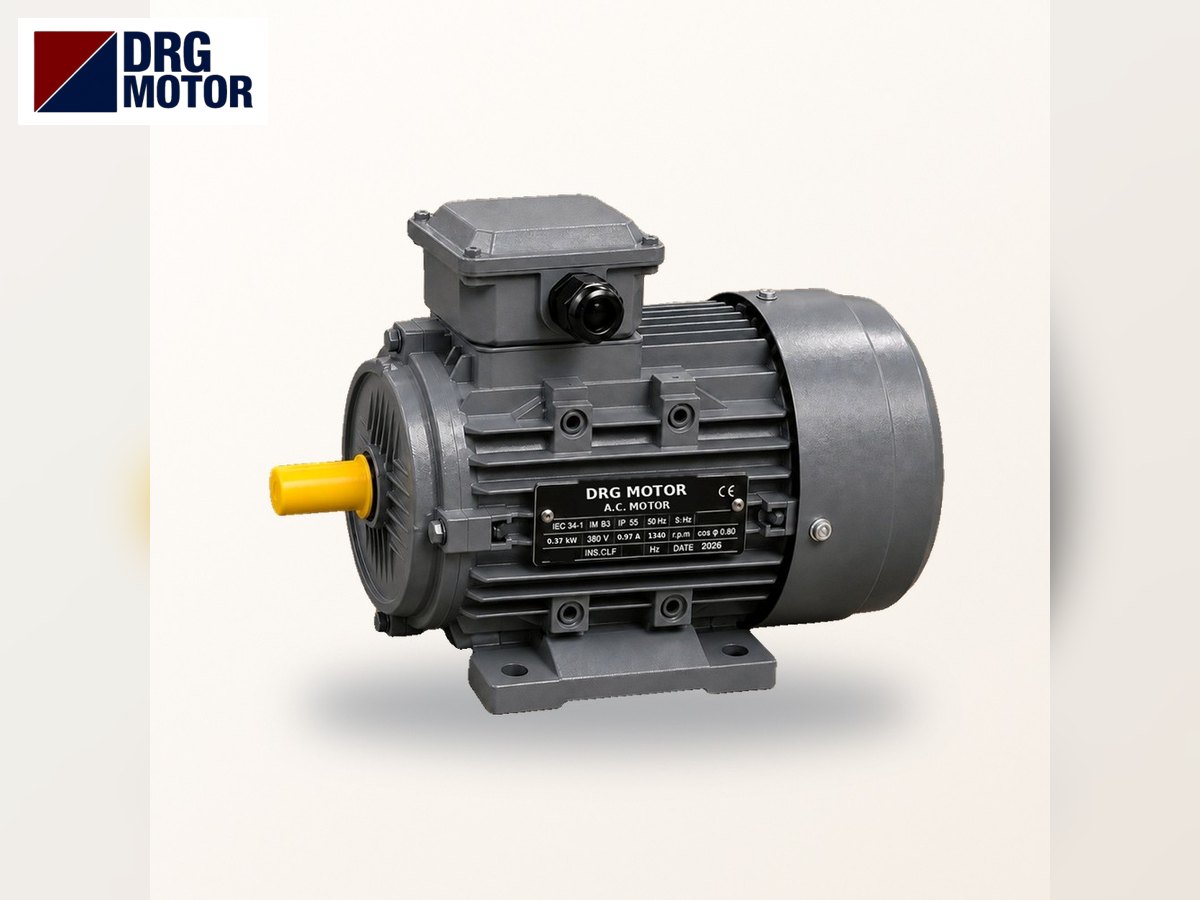
Looking for a single motor in an industrial laundry is misleading: the washer-extractor drum, the tumble dryer drum and fan, the ironer roll and its suction fans, the folder, the conveyors between stations and the water and chemical pumps all run on separate motors. This page explains at which of these points a standard aluminium-housing motor makes sense and where a machine-specific motor cannot simply be swapped. For a general view on humidity, spin vibration and maintenance see our article on the industrial laundry electric motor; here we focus on motor selection machine by machine.
DRG Motor is a manufacturer, supplier and seller of electric motors. We do not sell washing machines, dryers, ironers, folders, pump bodies, gearboxes or inverters; our part is the induction motor itself, in three-phase IEC design. This series covers only aluminium housing electric motors: 0.25–11 kW, IEC frames 63–160.
What does the motor do in laundry machines?
The washer-extractor drum
During washing the drum turns slowly and reverses; during extraction it climbs to several hundred revolutions per minute. On most models this wide range comes from an inverter-driven motor chosen by the machine maker, and on some the motor housing, pulley and sensor are made for that machine. On machines with a foot-mounted IEC-dimension motor and a belt, the motor can be replaced; plate values, pulley diameter and inverter settings are then checked together. The two-speed motors (separate wash and spin windings) of older machines are outside our range.
Tumble dryer: drum and fan are separate
A tumble dryer usually has two motors: one turns the drum through a belt at low speed, the other drives the fan that pulls hot air out of the drum into the exhaust duct. The drum motor may stop, start and reverse; the fan motor runs through the whole cycle and sits closest to the hot air.
Ironer roll and suction fans
A flatwork ironer has a drive that turns the heated roll at a low, adjustable speed; because roll speed follows the moisture of the linen, this drive usually works through a gearbox and an inverter. One or two small suction fans that draw vapour through or above the roll have their own motors.
Folder, transfer conveyor and pumps
In a folder, belts and folding blades are moved by small motors, and most folding strokes are pneumatic. In tunnel washers and large plants, belts that carry linen between stations, water reclaim pumps and chemical dosing pumps are also part of the system. Most dosing pumps are replaced complete with their own motor; on a surface pump with a separate IEC motor, only the motor can be changed.
How many kW are laundry machine motors? Values from maker data sheets
A) Motor powers given in machine makers’ data sheets:
| Machine / model group | Motor power | Single / total | Note |
|---|---|---|---|
| Washer-extractor, 10–30 kg | 1.5–4 kW | single drive motor | belt-and-pulley machine catalogue |
| Washer-extractor, 40–60 kg | 5.5–7.5 kW | single drive motor | same catalogue, mid range |
| Washer-extractor, 110 kg | 15 kW | single drive motor | above the aluminium range |
| Tumble dryer, 11–24 kg | 0.19–0.37 kW drum; 0.19–0.37 kW fan | two separate motors | small and mid drum data sheet |
| Tumble dryer, large drum | 0.56 kW drum; 0.75–2.24 kW fan | two separate motors | heavy-duty data sheet, three models |
| Flatwork ironer | 0.28–0.37 kW roll; 0.12–0.25 kW × 2 suction | three motors | three separate ironer data sheets |
Values grow with load capacity: a washer-extractor has one motor sized to its kilogram class, while dryers and ironers use small motors but more of them. Heater power (electric elements or steam) is not motor power; the heater sizes the panel, not the motor. We found no reliable data-sheet value for folders and pumps; those are selected from the machine data.
B) Overlap with the DRG aluminium range: for dryers, ironers and small to mid washers, the 0.25–7.5 kW drives fall within our aluminium frames 71–132. Outside our range: suction and drum motors below 0.25 kW, machine-specific inverter drum motors, two-speed motors and drives above 11 kW such as the 110 kg class. For that last group see General Purpose Electric Motors or the cast iron models.
When does an aluminium housing make sense in a laundry?
Where light weight helps
The dryer fan motor sits at the back of the machine and the ironer roll motor in a narrow compartment behind the side cover. When they fail, one technician should be able to remove and refit them; the low weight of an aluminium housing shortens that job. On a fan motor the impeller sits directly on the shaft, so a light housing also loads the supporting sheet less when the motor hangs on a flange. Aluminium housings are common at low power, which makes a same-size spare easy to find.
Where cast iron is the better choice
On large washers, unbalanced loads during spinning send hard vibration into the motor; at higher power and with heavy belt pull a cast iron housing is the sturdier choice. Above 11 kW we have no aluminium option anyway. The advantage of aluminium is weight and compactness, not resistance to impact and heavy vibration.
Click to see current electric motor prices and order nowSEE PRICES →
Humidity, water and IP55: where and how should the motor be mounted?
What IP55 covers and what it does not
DRG motors are IP55: dust-protected and resistant to low-pressure water jets from any direction. High-pressure jet washing, steam cleaning and submersion are not covered. If the laundry floor is hosed down, the motor must not be in the line of that water, nor close to pools under the machine.
Mounting position, drainage and covers
Turn the terminal box downward and water running along the housing has no path into the gland; the cable should form a drip loop below the gland. In compartments where condensation collects, check that the drain hole at the lowest point of the housing is open. The machine’s own cover shields the motor from water and chemical splashes from above; leaving it off after service is the most common cause of humidity failures.
Belt, gearbox and inverter: how does the connection affect selection?
Belt-driven drum and fan
With a belt drive, the pulleys set the ratio between motor speed and drum speed. If the old motor was 4-pole, the new one must be 4-pole too, otherwise drum speed and spin speed change. Belt tension puts a side load on the shaft, so shaft diameter D and length E stay the same as the old motor and the pulley must sit fully on the shaft.
Rolls and belts driven through a gearbox
Ironer rolls and transfer belts turn slowly, so the motor is connected to a gearbox. We do not supply gearboxes; the input flange and bore of the existing gearbox are compared with our B5 flange motor. For flange and shaft dimensions see Electric Motors for Gearboxes.
Starting, stop-start and temperature
When a wash drum reverses, the motor starts again at each change of direction; if this is not done by an inverter, frequent starts heat the winding and must be considered in selection. Air around the dryer fan motor must stay within the catalogue range of −15…+40 °C: the motor stays outside the hot air duct, on the side that breathes clean air. Lint and fibre dust clog the motor fan cover; cleaning it belongs on the maintenance list.
Worked example: current of two dryers and one ironer
Assumption: each of two dryers has a 0.55 kW drum motor and a 2.2 kW fan motor; the ironer has a 0.37 kW roll motor and two 0.25 kW suction fans. Currents are taken from the product records:
| Point | DRG model | Current 400 V | Connection |
|---|---|---|---|
| Dryer drum 0.55 kW (2 units) | DRG-801-4 | 1.31 A × 2 | star |
| Dryer fan 2.2 kW (2 units) | DRG-100L1-4 | 4.52 A × 2 | star |
| Ironer roll 0.37 kW | DRG-712-4 | 0.92 A | star |
| Ironer suction fan 0.25 kW (2 units) | DRG-711-4 | 0.66 A × 2 | star |
| All running together | — | 13.9 A | — |
With everything running, the motors draw about 13.9 A on a 400 V supply; the two motors of one dryer account for 5.83 A. Each of the four models is wound for 230/400 V, which means star on a 400 V network. Heater current is not included and is added separately in the panel calculation.
Information we need for a replacement
- Machine type and capacity (kg), and the motor’s job: drum, fan, roll, belt or pump
- Plate photo of the old motor: kW, speed, voltage, connection
- Mounting: foot, flange or both; flange outer diameter and hole spacing
- Shaft diameter and length, key size; whether a pulley, impeller or coupling sits on the shaft
- Whether the motor runs on an inverter or direct on line; whether it has a two-speed winding
- Daily operating hours and switching frequency, compartment temperature and humidity
Aluminium housing DRG models for laundries
Aluminium models matching dryer, ironer and small to mid washer drives:
| Model | Power / rated speed | Frame · shaft D×E | Current 400 V · torque |
|---|---|---|---|
| DRG-711-4 | 0.25 kW / 1340 rpm (synchronous 1500) | 71 aluminium · 14×30 | 0.66 A · 1.78 Nm |
| DRG-712-4 | 0.37 kW / 1340 rpm (synchronous 1500) | 71 aluminium · 14×30 | 0.92 A · 2.64 Nm |
| DRG-801-4 | 0.55 kW / 1400 rpm (synchronous 1500) | 80 aluminium · 19×40 | 1.31 A · 3.75 Nm |
| DRG-802-4 | 0.75 kW / 1420 rpm (synchronous 1500) | 80 aluminium · 19×40 | 1.75 A · 5.04 Nm |
| DRG-100L1-4 | 2.2 kW / 1450 rpm (synchronous 1500) | 100L aluminium · 28×60 | 4.52 A · 14.5 Nm |
| DRG-112M-4 | 4 kW / 1450 rpm (synchronous 1500) | 112M aluminium · 28×60 | 7.95 A · 26.3 Nm |
| DRG-132M-4 | 7.5 kW / 1460 rpm (synchronous 1500) | 132M aluminium · 38×80 | 14.3 A · 49.1 Nm |
DRG-112M-4 and DRG-132M-4 are intended only for washer-extractors with a standard foot-mounted motor and belt; a purpose-built drum motor is swapped only after comparing it with the washer maker’s motor sheet and fixing dimensions.
Live price table
Prices of the aluminium versions come live from the shop:
| Model | Power / speed | Frame · current 400 V | Price |
|---|---|---|---|
| DRG-711-40.37 HP | 0.25 kW · 1500 rpm | Aluminium 71 · 0.66 A | $73.16 (€65.33) Details & buy → |
| DRG-712-40.5 HP | 0.37 kW · 1500 rpm | Aluminium 71 · 0.92 A | $76.76 (€68.55) Details & buy → |
| DRG-801-40.75 HP | 0.55 kW · 1500 rpm | Aluminium 80 · 1.31 A | $87.55 (€78.19) Details & buy → |
| DRG-802-41 HP | 0.75 kW · 1500 rpm | Aluminium 80 · 1.75 A | $97.30 (€86.90) Details & buy → |
| DRG-100L1-43 HP | 2.2 kW · 1500 rpm | Aluminium 100L · 4.52 A | $179.76 (€160.54) Details & buy → |
| DRG-112M-45.5 HP | 4 kW · 1500 rpm | Aluminium 112M · 7.95 A | $242.82 (€216.85) Details & buy → |
| DRG-132M-410 HP | 7.5 kW · 1500 rpm | Aluminium 132M · 14.3 A | $376.94 (€336.63) Details & buy → |
DRG MOTOR motors are guaranteed against material and manufacturing defects for 2 years from the delivery date (warranty certificate).
Motors in this power range
- DRG-712-4 – 0.37 kW – 1340 rpm – 71 aluminium
- DRG-801-4 – 0.55 kW – 1400 rpm – 80 aluminium
- DRG-802-4 – 0.75 kW – 1420 rpm – 80 aluminium
- DRG-100L1-4 – 2.2 kW – 1450 rpm – 100L aluminium
Click to see current prices and order these motors nowSEE PRICES →
Browse the products, ask for a quote: all models are on the Buy Electric Motors Online page. Tell us which laundry machine the motor works in and what it does, and send a plate photo via WhatsApp; we will match kW, speed, shaft and flange together. Phone: +90 (542) 666 11 11.
Frequently asked questions
Can an aluminium motor of the same kW replace a dryer fan motor?
Yes, if speed, shaft diameter and length and mounting are the same. The impeller sits directly on the shaft, so shaft size and key must match exactly; a different speed changes the fan’s airflow and the power it draws.
My washer motor is single-phase; can I use a three-phase motor?
Single-phase motors are outside our range. A three-phase motor needs a three-phase supply in the laundry; if the machine already has an inverter, the power limit of single-phase-input inverters is checked separately. We do not supply inverters.
Is a brake motor needed to stop the drum quickly after spinning?
Most modern machines brake the drum with the inverter. Brake motors are not in our range; a machine that requires a mechanically braked motor should keep the maker’s motor.
Why is an ironer roll motor usually connected to a gearbox?
The roll turns slowly enough to pass a few metres of linen per minute. A standard 4-pole motor reaches that speed only through a high-ratio gearbox, and the speed is adjusted with an inverter.
For questions: +90 (542) 666 11 11 · info@drgmotor.com · contact.


