 English
 Le français
 Türkçe

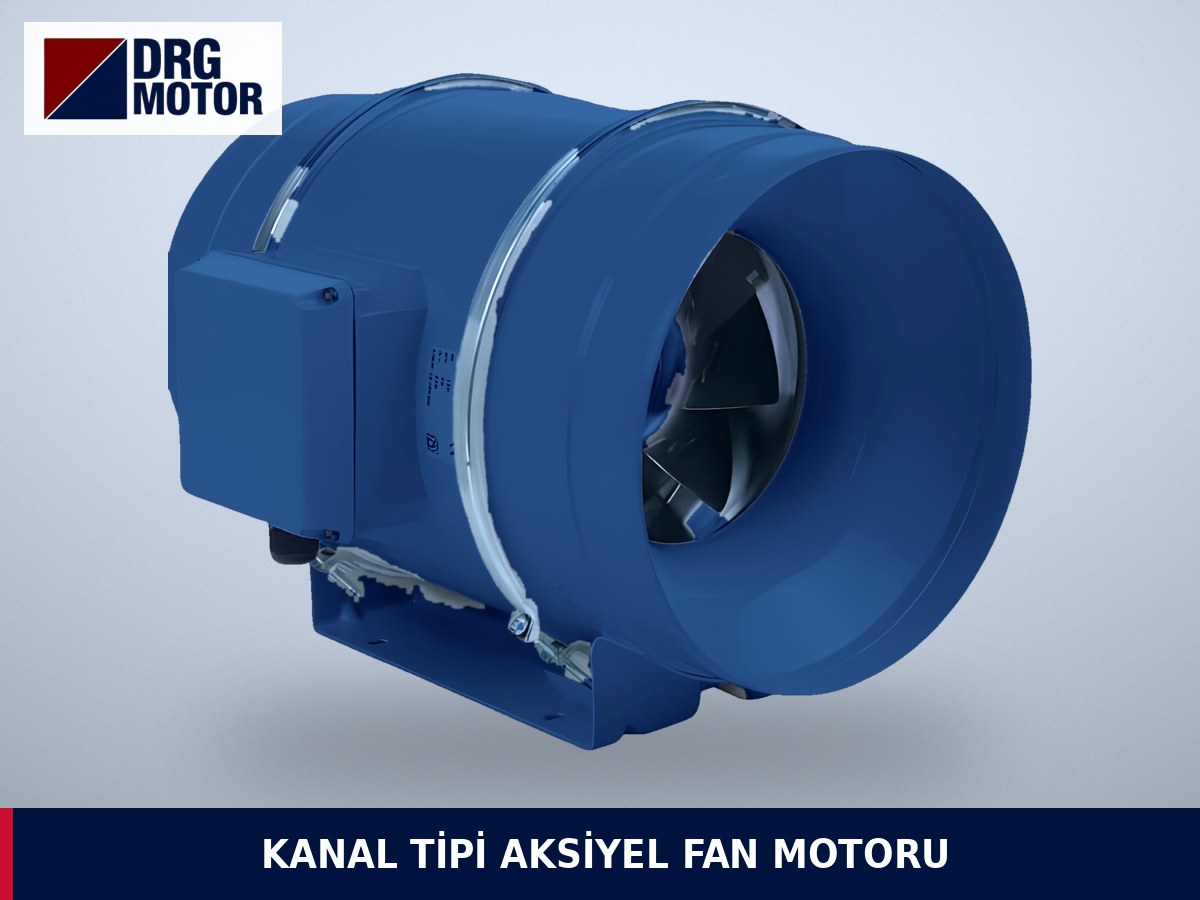
In a duct-type axial fan the motor sits in the middle of the cylindrical casing and runs inside the air the fan is moving; the impeller is mounted directly on the motor shaft. So choosing a duct fan motor is not only about kW and speed: the motor frame has to fit inside the casing, the motor has to tolerate the temperature and dust of the air stream, and the cable has to reach the terminal box outside the casing safely. As an example, a 500 mm casing handling 9,000 m³/h at 350 Pa works out to a 2.2 kW, 4-pole motor; in this class the DRG-100L1-4 draws 4.52 A at 400 V and has a frame diameter (AC) of 205.4 mm.
This article covers the motor side of tube-axial (pipe or tube type) fans: where the motor sits in the air stream, whether it fits the casing, how the power is found and which DRG model suits which case. If you have the fan curve, you can pick the motor from the 120 models on the Buy Electric Motors Online page using the frame, power and speed filters. Wiring and the direction-of-rotation check must be done by a qualified electrician.
What is a duct-type axial fan and which group does it belong to?
A duct-type axial fan houses an axial impeller in a cylindrical sheet-metal casing and is bolted straight into the ductwork by flanges at both ends. Air enters the impeller along the axis and leaves along the same line. Tube-axial, pipe or cased axial are names for the same layout.
"Duct type" is not an operating principle but a housing and installation form. The principle is axial; what separates it from a wall-mounted axial fan is the casing and the flanged duct connection. The casing keeps the gap between blade tips and sheet metal small, which lets the fan reach a higher pressure than a free-blowing propeller.
Typical uses: workshop and warehouse exhaust lines, car park and boiler room ventilation ducts, suction lines of paint and drying booths, greenhouse and livestock building ducts, fresh-air supply in industrial plants. What they have in common is high airflow at medium to low pressure.
It should not be confused with the duct-type centrifugal (in-line centrifugal) fan. A centrifugal impeller turns the air through 90° and then guides it back to the axis, producing a higher pressure for the same size; a duct-type axial is shorter and lighter, with high airflow and limited pressure. The difference on the motor side is large too: most in-line centrifugal fans come with a motor built into the fan.
The motor inside the casing: a cooling bonus, a risk in hot or dusty air
In a duct-type axial fan the motor is fixed to support arms welded or bolted inside the casing, and the impeller sits on the end of the motor shaft. There is no coupling, belt or intermediate shaft; motor speed is fan speed. This arrangement has two consequences.
Benefit: The air the fan moves passes over the motor frame. In clean, cool air this adds to the cooling from the motor's own fan; the motor runs in a constant air stream rather than in a closed pocket of the duct.
Risk: If the same air is hot, humid, oily or dusty, the motor takes that too. Paint mist settles on the frame, chips and fibres clog the cooling fins, greasy kitchen air works into the end-shield seals, and hot exhaust raises the motor's ambient temperature. One manufacturer's catalogue states that its standard duct-type axial fans are offered for exhaust air up to 55 °C and that hotter air calls for a special motor version [1]. If the air exceeds that limit or contains flammable or explosive vapour, a design that keeps the motor in the air stream is not suitable; a belt-driven fan with the motor outside the casing, or a special certified set, is needed.
Who is responsible for what: Choosing the casing diameter, blade angle and operating point is the job of the fan manufacturer or the design engineer. The motor supplier's job is to provide a motor that matches the given shaft power, speed, mounting type and ambient conditions.
Click to see current electric motor prices and order nowSEE PRICES →
Will the motor frame fit the casing? Cross-section, hub and cable exit
The casing diameter is fixed; the bigger the motor, the narrower the ring the air has to pass through. The hub and motor create an air shadow behind the impeller. If the motor is oversized, the air speeds up in the remaining area and pressure loss and noise increase; a frame that is far too big will not fit the support arms at all. The table below shows, for a 500 mm casing at 9,000 m³/h, the share of the cross-section taken by the motor frame and the mean air velocity in the remaining ring (frame diameters from DRG catalogue data, velocities calculated):
| Frame | Motor diameter AC | Share of the cross-section | Velocity in remaining area |
|---|---|---|---|
| 90L | 182.4 mm | 13 % | 14.7 m/s |
| 100L | 205.4 mm | 17 % | 15.3 m/s |
| 112M | 230 mm | 21 % | 16.1 m/s |
| 132S | 258.4 mm | 27 % | 17.4 m/s |
| 160M | 314 mm | 39 % | 21 m/s |
The practical conclusion: in the same casing, going from a 100L frame to a 160M frame multiplies the share taken by the motor by about 2.3. That is why "one size up for safety" is often impossible in a duct-type axial fan; compare the AC and L dimensions of the new motor with the old one. Dimensions for each frame are on the technical drawings page.
How do the terminal box and cable get outside the casing?
Because the motor is inside the casing, the terminal box is handled in one of two ways: the motor's own terminal box lines up with an opening in the casing, or the cable is run in a protective conduit to a separate junction box outside. In one manufacturer's catalogue the terminal box is mounted outside the casing with IP65 protection [1]. When replacing: the new motor's terminal box position and cable entry (e.g. 1 × M25×1.5 on the 100L frame) must end up in the same place as before. If the box is on the opposite side, the motor may not be able to be rotated on its support; note this in the order.
Information needed to select a duct fan motor
Collect the following before asking for a motor. The first half of the list concerns the fan, the second half the motor:
- Airflow (m³/h) and total pressure (Pa) from the fan nameplate, or the operating point on the fan curve
- Casing inner diameter and impeller diameter (mm), plus the setting if the blade angle is adjustable
- Temperature, humidity and dust of the air, and whether it carries oil or paint vapour
- The old motor's nameplate: kW, rpm, frame (e.g. 100L), voltage and connection
- Motor mounting: fixed to the support by its feet (B3) or by its flange (B5/B14)
- Shaft diameter × length, key and how the impeller hub is secured
- Clearance left in the casing for motor diameter (AC) and length (L)
- Terminal box position and the cable route out of the casing
- Starting: direct-on-line, star-delta or VFD; frequency range if a VFD is used
Power calculation: 500 mm casing, 9,000 m³/h, 350 Pa
Fan shaft power is found with P_shaft = Q·Δp / η_fan (Q in m³/s, Δp in Pa, P in W). 9,000 m³/h = 2.5 m³/s; assuming a fan efficiency of 0.62, P_shaft = 2.5 × 350 / 0.62 ≈ 1,410 W, about 1.41 kW. With direct drive there is no drive loss (η_drive = 1). Adding a 15% margin gives ≈ 1.62 kW; 1.5 kW is not enough, and the next standard rating is 2.2 kW. A 4-pole 2.2 kW motor uses the 100L frame and, as the table shows, takes about 17% of the cross-section of a 500 mm casing. You can run the same calculation with your own figures in the Pump & Fan Motor Power calculator.
In duct-type axial fans the power depends on casing and impeller diameter, airflow, pressure, blade angle, speed, duct system resistance and air density. So there is no fixed "duct fan = so many kW". A sourced example: in one manufacturer's catalogue, industrial axial fans with 400, 500 and 630 mm casings are supplied with standard induction motors up to 11 kW [1]; the EC-motor version of the same series goes up to 15 kW in the 315–800 mm range [2]. With EC, external-rotor or built-in motors, a failure usually means replacing the whole fan unit; DRG does not sell such integrated motors.
The DRG range must be stated separately: aluminium frame 0.25–11 kW, cast iron 0.55–355 kW; 1000, 1500 and 3000 rpm; 3-phase, 230/400 V or 400/690 V; mounting B3, B5, B14 or B35 by order note. If the motor the duct fan needs falls within this range, a DRG motor can be fitted; not every fan power on the market corresponds to a DRG product.
The table below shows, with current prices, 4-pole models in the 0.55–5.5 kW range suitable for direct drive on duct-type axial fans, plus one 2-pole model for small casings. Current values are for setting the overload relay; for more, see the overload, fuse and contactor selection tool.
| Model | Power / speed | Frame · current 400 V | Price |
|---|---|---|---|
| DRG-801-40.75 HP | 0.55 kW · 1500 rpm | Cast iron 80 · 1.31 A | $91.72 (€81.91) Details & buy → |
| DRG-802-41 HP | 0.75 kW · 1500 rpm | Cast iron 80 · 1.75 A | $101.93 (€91.03) Details & buy → |
| DRG-90S-41.5 HP | 1.1 kW · 1500 rpm | Cast iron 90S · 2.48 A | $124.09 (€110.82) Details & buy → |
| DRG-90L-42 HP | 1.5 kW · 1500 rpm | Cast iron 90L · 3.3 A | $144.14 (€128.73) Details & buy → |
| DRG-100L1-43 HP | 2.2 kW · 1500 rpm | Cast iron 100L · 4.52 A | $188.32 (€168.18) Details & buy → |
| DRG-90L-23 HP | 2.2 kW · 3000 rpm | Cast iron 90L · 4.35 A | $154.45 (€137.93) Details & buy → |
| DRG-100L2-44 HP | 3 kW · 1500 rpm | Cast iron 100L · 6.02 A | $203.84 (€182.05) Details & buy → |
| DRG-112M-45.5 HP | 4 kW · 1500 rpm | Cast iron 112M · 7.95 A | $254.38 (€227.18) Details & buy → |
| DRG-132S-47.5 HP | 5.5 kW · 1500 rpm | Cast iron 132S · 10.7 A | $342.01 (€305.44) Details & buy → |
For small-casing 2-pole fans the DRG-90L-2 (2.2 kW, 2895 rpm) is given as an example. Higher powers continue in cast iron frames; a larger frame at the same speed makes the fit check from the cross-section table above essential. For a general comparison of mounting on axial and radial fans see the ventilation fan motor article, and for all fan applications the Fan Motors page.
Speed, poles and mounting: what does the casing diameter limit?
In a duct-type axial fan the speed is usually set by blade tip speed: v = π·D·n/60. On a 500 mm impeller the tip speed is about 38 m/s with a 4-pole motor (1450 rpm) and about 76 m/s with a 2-pole motor (2895 rpm). Higher tip speed raises pressure and noise and pushes the strength and balance limits of the impeller. That is why 2-pole motors are common in small (315–400 mm) duct fans, 4-pole from 500 mm upwards, and 6-pole in large diameters. The exact pole count comes from the fan manufacturer's curve.
If the same impeller with the same blade angle is moved from 4 poles to 2 poles, the fan laws say power rises with the cube of the speed ratio: (2895/1450)³ ≈ 8. In the example above the 1.41 kW shaft power would climb to about 11 kW; neither the motor nor the impeller was chosen for that. So changing poles "to pull more air" is not done; if the speed has to change, a VFD is used. Details are in the article on affinity laws in fans and pumps.
Mounting: Bolting the fan to the duct and the motor's IEC mounting type are separate things. In a duct-type axial fan the motor is usually fixed to the support plate by its feet (B3) or its front flange (B5 or B14); which one applies is taken from the fan manufacturer's drawing and the old motor. On a fan in a vertical duct the shaft points up or down, so vertical operation must also be stated in the order. Note whether the air flows from motor to impeller or from impeller to motor: the motor's direction of rotation is set accordingly.
DRG motors for duct axial fans
- DRG-90L-2 – 2.2 kW – 2895 rpm – 90L aluminium
- DRG-90L-4 – 1.5 kW – 1445 rpm – 90L aluminium
- DRG-100L1-4 – 2.2 kW – 1450 rpm – 100L aluminium
- DRG-132S-4 – 5.5 kW – 1460 rpm – 132S aluminium
- DRG-132M-4 – 7.5 kW – 1460 rpm – 132M aluminium
Click to see current prices and order these motors nowSEE PRICES →
Duct axial fan motor: FAQ
How many kW should a duct fan motor be?
There is no fixed value; it is calculated from airflow, pressure and fan efficiency. Example: for 9,000 m³/h at 350 Pa in a 500 mm casing the shaft power is about 1.41 kW, and with a margin the chosen motor is 2.2 kW, 4-pole.
When a duct-type axial fan motor burns out, is only the motor replaced?
If the fan has a standard IEC-frame three-phase motor, yes; it is replaced with the same frame, shaft, mounting and terminal arrangement. If the motor is built into the fan, has an external rotor or is an EC type, the fan unit is usually replaced; such motors are not in the DRG range.
What current does the 2.2 kW motor on a 500 mm tube-axial fan draw?
The 4-pole DRG-100L1-4 draws 4.52 A at 400 V and 4.76 A at 380 V; set the overload relay to this value.
Can a standard motor be used in a duct fan handling hot air?
Because the motor sits in the air stream, the air temperature is the motor's ambient temperature. One manufacturer's catalogue offers the standard version up to 55 °C [1]; hotter air requires a belt-driven fan that keeps the motor out of the stream, or the manufacturer's special version.
Send us the fan nameplate, the old motor's nameplate and the casing diameter, and we will work out together the DRG model that fits the casing and meets the operating point. Phone +90 (542) 666 11 11, e-mail [email protected], contact page. For all models and current prices see Buy Electric Motors Online.
Sources
- Systemair – AXC-E axial fans (product page) – sizes 400, 500 and 630 mm, motors up to 11 kW; terminal box outside the casing, exhaust air up to 55 °C
- Systemair – AXC-EC axial fans (product page) – 315–800 mm, EC-motor version up to 15 kW


