 English
 Le français
 Türkçe

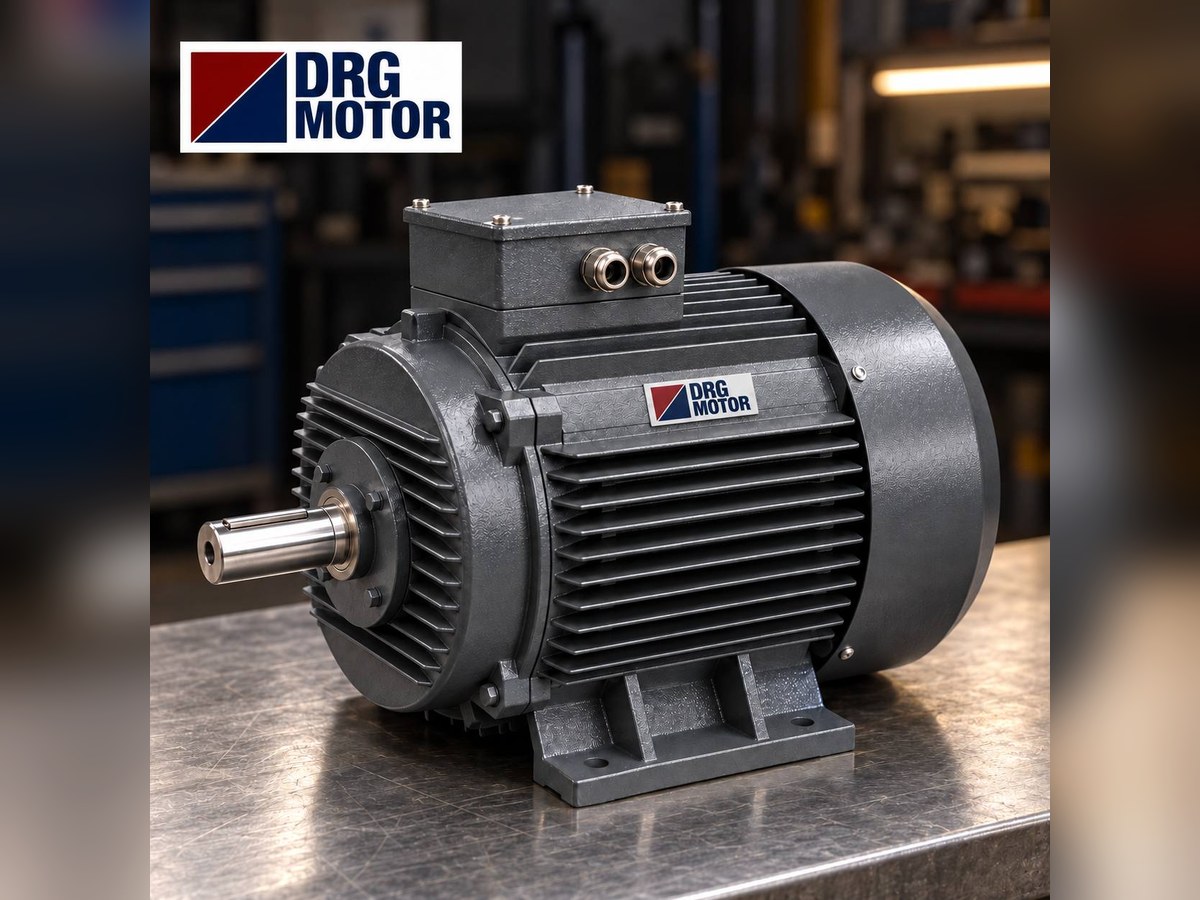
A tyre shredding machine motor is the three-phase induction motor inside the machines that reduce end-of-life car, truck and off-road tyres to pieces, chips and crumb. A tyre recycling line has no single motor: separate motors turn the shafts of the primary shredder, the rotors of the wire-liberating rasper and of the granulator, the magnetic separator, the conveyors and the screen. Manufacturer catalogues show 45–160 kW per motor on primary shredders, 75–315 kW on raspers, 37–135 kW on rubber granulators and 0.55–3 kW on auxiliary equipment.
DRG Motor does not sell these machines or parts such as knives, gearboxes, hydraulic pumps and drives; we supply the electric motor at every stage of the line. Below we go step by step through the load that steel-belted tyres put on the motor and the power found at each stage.
Stages of a tyre recycling line
A tyre is rubber, steel wire and textile cord vulcanised together. The line separates these three materials into saleable products: coarse chips for tyre-derived fuel, wire-free rubber pieces for fill and surfacing, 1–6 mm crumb for sports pitches and asphalt, and scrap steel.
Primary shredding
The whole tyre is cut into 50–150 mm pieces on a low-speed, high-torque shredder. One manufacturer gives 13–16 rpm for the main shaft of twin-shaft machines; single-shaft tyre shredders run faster, 41 rpm in one catalogue. For truck and off-road tyres some lines first use a separate machine that pulls out the bead wire.
Steel wire liberation (rasper)
In the second stage the rasper reduces chips to 10–30 mm while tearing rubber away from the wire. A magnetic belt or drum separator then removes the steel. A heavy shredder maker states that with the right cutter set a product below 50 mm is reached in one pass and an overband magnet can separate up to 80% of the wire.
Granulation and screening
Wire-free rubber is cut to 1–6 mm crumb in a knife granulator; remaining fine wire and textile fibre are cleaned out with magnets, air separators and screens. Sizing into fractions is mostly done on vibrating screens. Those screens run on vibration motors, which are a separate product family and not standard induction motors; tell us the screen data and read more in vibration motors.
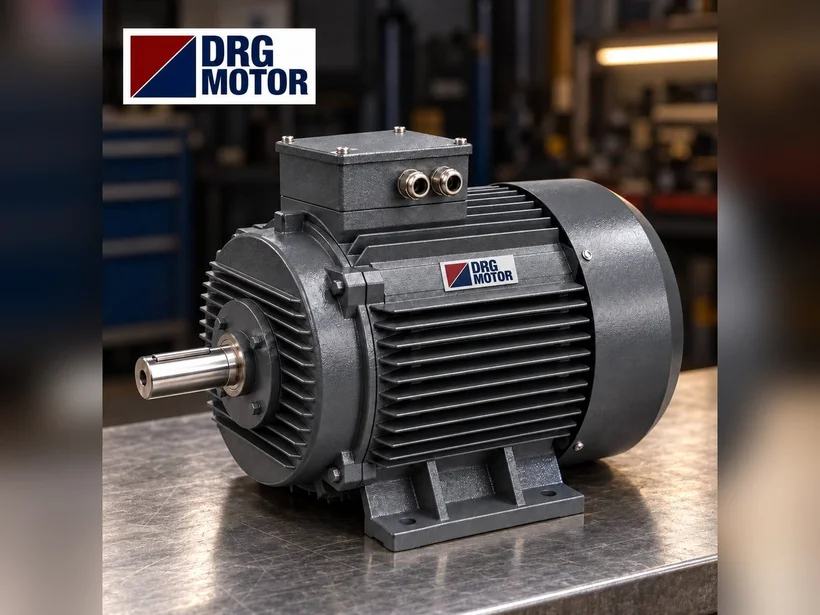
How does steel wire affect the motor?
What sets tyres apart from plastic is the steel inside. Car tyres carry a tread belt and bead wire, truck tyres a heavy steel carcass. This steel loads both the knife and the motor.
Knife wear and current
On steel-belted tyres knives blunt much faster than on plastic. A blunt knife pushes through by crushing rather than cutting; at the same feed the motor current rises and so does heating. That is why makers fit tyre machines with wear-resistant carbide knives, hard-facing on the rotor and replaceable wear plates. One catalogue notes that an adjustable knife gap improves the separation of wire and rubber. The motor's nameplate current is a good gauge of knife condition: on the same tyre type, current creeping up over weeks usually signals that knives are due.
Who takes the shock: gearbox, torque arm, flywheel
On a primary shredder a high-ratio gearbox sits between motor and shaft, and when wire reaches the knife the shock hits the gearbox first. One maker describes the oversized rotor gearbox sitting on a sturdy torque arm that cushions the shocks. On the faster rasper and granulator, rotor and pulley mass act like a flywheel. These two mechanical measures reduce how much of each peak the motor sees directly; but a bigger motor does not replace knife maintenance.
Starting torque, reversing on jams and thermal settings on the primary shredder are worked through with numbers in our article tyre shredder motor and starting torque; here we look at the line as a whole.
How many kW do tyre shredding motors need?
A) Power seen in manufacturer catalogues
| Machine group | Motor power | Single / total | Note |
|---|---|---|---|
| Twin-shaft primary shredder, small | 45 kW + 4 kW | main + auxiliary motor | manufacturer data, main shaft 16 rpm, 0.8–3 t/h |
| Twin-shaft primary shredder, large | 155 kW + 7.5 kW | main + auxiliary motor | same data, 13 rpm, 2–5 t/h |
| Single-shaft tyre shredder, 760 mm rotor | 2 × 90 – 2 × 110 kW | two motors | manufacturer catalogue, 41 rpm |
| Heavy single-shaft shredder (whole tyres) | 132 kW – 2 × 160 kW | one or two motors | manufacturer product page |
| Rasper (second stage, wire liberation) | 75 / 135 / 315 kW | single motor | manufacturer page, 0.7–6 t/h |
| Rubber granulator | 37 / 45 / 90 / 135 kW | single motor | same manufacturer, 1–6 mm crumb |
| Magnetic separator, feed conveyor | 0.55–3 kW | auxiliary motors | two manufacturer data sheets |
Motor by motor, these tyre machines span roughly 0.55 kW to 315 kW; primary shredders reach 320 kW in total with two motors. The total installed power of the line is not the power of one machine: one rasper line offer, for example, lists a 315 kW main motor, a 3–4 kW feed conveyor and a 1.5 kW magnet, about 328 kW in total.
B) The DRG side of the table
This whole range falls within DRG's low-voltage range up to 355 kW: DRG-355L-4 for a 315 kW rasper motor, DRG-315L1-4 for 160 kW, DRG-280M-4 for a 90 kW granulator. Where a catalogue shows non-standard values such as 135 or 155 kW, the old motor nameplate governs and the nearest standard step is chosen together with the machine builder. Windings are 400/690 V; a 6 or 10 kV machine is outside what we build.
Click to see current electric motor prices and order nowSEE PRICES →
Capacity, power and electrical supply
Power per tonne: a rasper example
Placing three rasper models of the same maker side by side by motor power and capacity shows that power per tonne does not fall much as capacity grows:
| Rasper model | Motor | Capacity | kW per t/h |
|---|---|---|---|
| Large | 315 kW | 3–6 t/h | 52–105 |
| Medium | 135 kW | 1.5–3 t/h | 45–90 |
| Small | 75 kW | 0.7–1 t/h | 75–107 |
So each extra t/h needs roughly 45–110 kW of extra motor power; the wide spread comes from tyre type (car or truck), pre-shred size and target output size. These figures belong to the machine, not to the motor: the same motor processes fewer tonnes with blunt knives.
Example line and motor list
For a mid-size line with a twin-shaft primary shredder, a rasper and a granulator, the motor list matched to the DRG range could look like this:
| Line section | Example motor | DRG code | Current 400 V |
|---|---|---|---|
| Primary shredder, two shafts | 2 × 75 kW | 2 × DRG-280S-4 | 2 × 129 A |
| Rasper | 315 kW | DRG-355L-4 | 526 A |
| Granulator | 90 kW | DRG-280M-4 | 155 A |
| Magnet, conveyors and trommel | 1.5 + 3 + 3 kW | small 4-pole motors | – |
In this example the installed power comes to about 562 kW. Transformer and switchboard are designed for this total and for not starting the large motors at the same time.
Starting a 315 kW motor
At 400 V the rasper motor (DRG-355L-4) takes 526 A, with Is/In = 7.1. Direct-on-line, starting current is about 3,735 A; star-delta cuts it to one third, about 1,245 A, but starting torque drops by the same ratio. In the sample rasper line offer the main motor runs on a soft starter, the feed conveyor on an inverter, and the magnet and vibrating feeders direct-on-line. So the rasper is started empty, and its infeed belt waits until the rotor has reached speed. Starting methods side by side: motor starting and star-delta.
Nameplate and checklist for motor replacement
On a tyre line a motor is often replaced after a failure, and the machine drawing may not be at hand. The old motor's nameplate is then the most reliable source.
- Power, speed, voltage and connection on the plate (400 V delta or 690 V star).
- Frame size (IEC 280, 315, 355 and so on) and mounting: foot B3, flange B5 or B35.
- Shaft diameter and length, key width; the coupling or pulley bore is machined to it.
- Gearbox input or pulley layout, number and section of belts.
- Starting method: direct, star-delta, soft starter or inverter.
- Environment: rubber dust, wire fragments, rain and sun on open yards.
How is the fit confirmed?
Only once these items agree with the old plate and with the builder's documents do we name a motor; a tyre machine gets no exact-fit promise before then. Rubber dust clogs fan cowls quickly, so cleaning belongs in the maintenance plan; on open yards a simple roof over the IP55 motor helps as well.
DRG motors: frames suited to tyre lines
DRG Motor is a manufacturer, supplier and seller of electric motors. 4-pole cast iron frames we supply for shredder, rasper and granulator duty on tyre lines:
| Model | Power / speed | Frame · shaft D×E | Current 400 V |
|---|---|---|---|
| DRG-225M-4 | 45 kW / 1485 rpm | 225M cast iron · 60×140 | 80.2 A |
| DRG-280S-4 | 75 kW / 1486 rpm | 280S cast iron · 75×140 | 129 A |
| DRG-280M-4 | 90 kW / 1486 rpm | 280M cast iron · 75×140 | 155 A |
| DRG-315M-4 | 132 kW / 1488 rpm | 315M cast iron · 85×170 | 224 A |
| DRG-315L1-4 | 160 kW / 1488 rpm | 315L cast iron · 85×170 | 271 A |
| DRG-355L-4 | 315 kW / 1490 rpm | 355L cast iron · 100×170 | 526 A |
Our range is made of three-phase induction IEC motors; from 0.55 kW to 355 kW in cast iron frames and up to 11 kW in aluminium frames, at 1000, 1500 and 3000 rpm. Mounting comes as B3, B5, B14, B34, B35 and vertical variants depending on frame. Small aluminium frames can also be chosen for auxiliary conveyor and magnet motors. For motors in other machines of the tyre and rubber sector, see our article electric motors in the rubber industry.
Live price table
Current prices for our motors in the powers seen on tyre shredding lines come live from the shop:
| Model | Power / speed | Frame · current 400 V | Price |
|---|---|---|---|
| DRG-180L-430 HP | 22 kW · 1500 rpm | Cast iron 180L · 39.7 A | $919.45 (€821.13) Details & buy → |
| DRG-200L-440 HP | 30 kW · 1500 rpm | Cast iron 200L · 53.8 A | $1,235.00 (€1,102.93) Details & buy → |
| DRG-225M-460 HP | 45 kW · 1500 rpm | Cast iron 225M · 80.2 A | $1,688.50 (€1,507.94) Details & buy → |
| DRG-250M-475 HP | 55 kW · 1500 rpm | Cast iron 250M · 97.6 A | $2,065.73 (€1,844.82) Details & buy → |
| DRG-280S-4100 HP | 75 kW · 1500 rpm | Cast iron 280S · 129 A | $2,916.93 (€2,605.00) Details & buy → |
| DRG-280M-4125 HP | 90 kW · 1500 rpm | Cast iron 280M · 155 A | $3,268.56 (€2,919.03) Details & buy → |
| DRG-315S-4150 HP | 110 kW · 1500 rpm | Cast iron 315S · 187 A | $4,863.00 (€4,342.97) Details & buy → |
| DRG-315M-4180 HP | 132 kW · 1500 rpm | Cast iron 315M · 224 A | $5,621.72 (€5,020.55) Details & buy → |
| DRG-315L1-4200 HP | 160 kW · 1500 rpm | Cast iron 315L · 271 A | $6,135.24 (€5,479.15) Details & buy → |
| DRG-355L-4430 HP | 315 kW · 1500 rpm | Cast iron 355L · 526 A | $11,417.31 (€10,196.37) Details & buy → |
DRG MOTOR motors are guaranteed against material and manufacturing defects for 2 years from the delivery date (warranty certificate).
Motors in this power range
- DRG-250M-4 – 55 kW – 1485 rpm – 250M cast iron
- DRG-280S-4 – 75 kW – 1486 rpm – 280S cast iron
- DRG-280M-4 – 90 kW – 1486 rpm – 280M cast iron
- DRG-315L1-4 – 160 kW – 1488 rpm – 315L cast iron
- DRG-355L-4 – 315 kW – 1490 rpm – 355L cast iron
Click to see current prices and order these motors nowSEE PRICES →
Browse the motors, ask for a quote. Send us the motor nameplates of the machines on your line, or the line layout, and we will set out power and frame for each stage in one list. Each code has its own page in Buy Electric Motors Online; plate photos are welcome on WhatsApp, and +90 (542) 666 11 11 answers line questions.
Frequently asked questions
What kW motor does a tyre shredding machine use?
It depends on the stage: 45–160 kW per motor on the primary shredder, 75–315 kW on the rasper, 37–135 kW on the granulator. Auxiliary conveyor and magnet motors are a few kW.
Why is a rasper motor started with a soft starter?
At high power, direct-on-line starting current strains the supply. A soft starter limits current and mechanical shock; it is the common solution, provided the heavy rotor starts empty.
Will a stronger tyre shredder motor lower the current?
High current usually comes from blunt knives or overfeeding. A stronger motor carries more torque into the gearbox; knives and feed should be checked first, and any power increase agreed with the machine builder.
Where can I see tyre recycling motor prices?
The table above shows motor prices only; machine, knives, gearbox and starter are priced by their own suppliers.
For the motors of your tyre recycling line our line is +90 (542) 666 11 11; detailed lists can go to [email protected] or through the contact form.


