 English
 Le français
 Türkçe

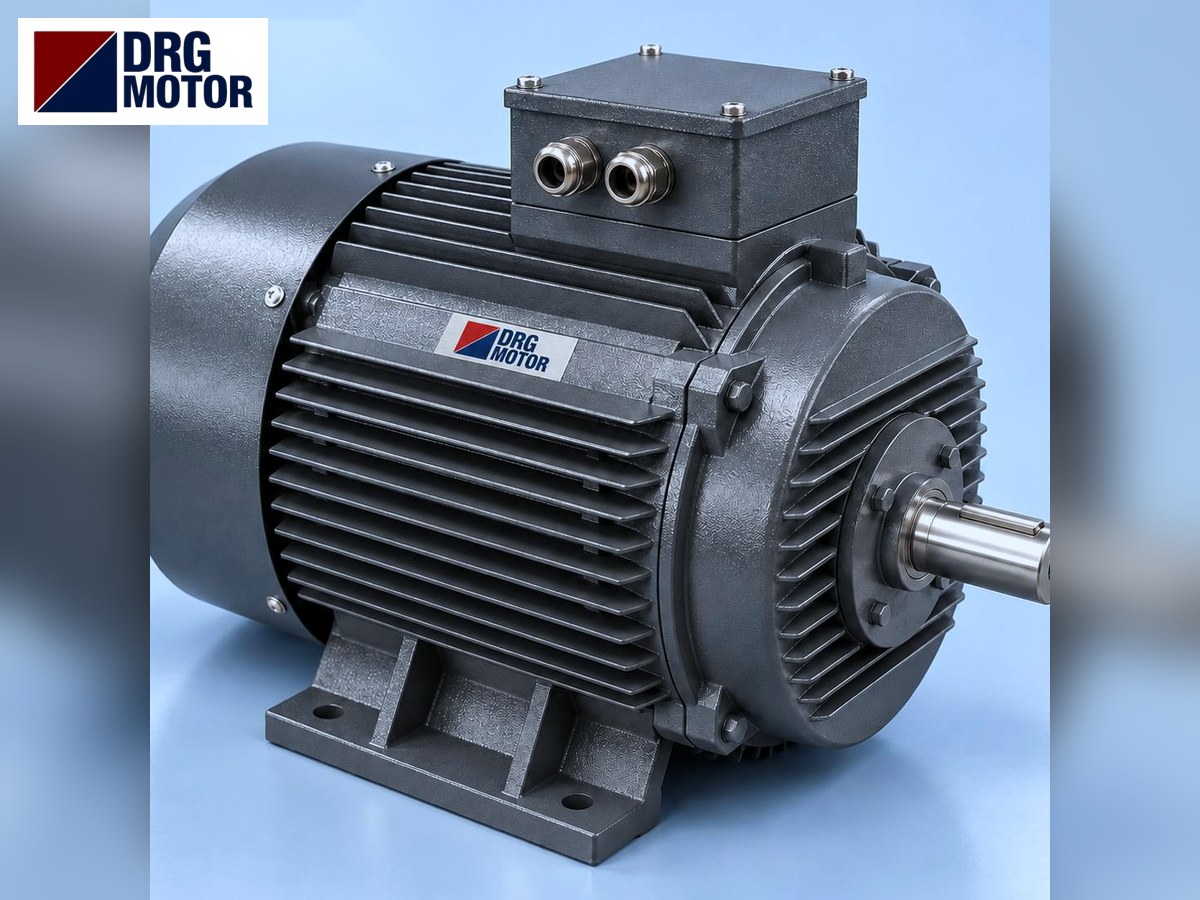
In a recycling baling press the electric motor does not push the platen: it turns the pump in the hydraulic power unit, and the oil from that pump moves the cylinder. Choosing a baler motor therefore starts from the flow and pressure the pump needs; the press tonnage, its cylinder and valve block are not part of the motor. Small vertical balers commonly use 1.5–4 kW, horizontal auto-tie balers 22–75 kW.
To set the scope clearly: DRG Motor is a manufacturer, supplier and seller of electric motors. We do not sell balers, cylinders, pumps, valves, gearboxes or drives (inverters); what we sell is the three-phase motor fitted to the power unit. The matching models can be ordered from Buy Electric Motors Online.
What does the motor drive in a baler, and how?
The energy path of a baler is short: motor → coupling → hydraulic pump → valve block → cylinder → platen. The motor is only the first link. The cylinder force is set by the pressure the pump can reach, the platen speed by the pump flow. The motor’s job is to deliver the torque the pump asks for at that pressure and flow without losing speed.
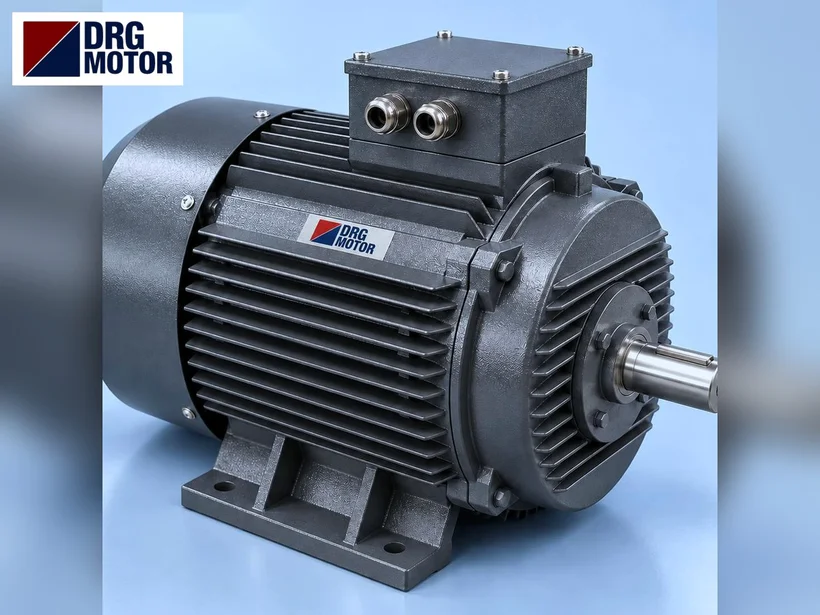
Power unit parts and where our scope ends
A power unit consists of an oil tank, suction filter, pump, motor, bell housing and coupling, relief valve, directional valves and often an oil cooler. Hydraulic component catalogues commonly show the motor-pump group mounted horizontally on the tank lid. Of these parts only the electric motor is our subject; the relief valve setting, pump type and cylinder bore are the baler maker’s design and are not changed when the motor is replaced.
Motor fault or hydraulic fault?
If the press has slowed down or bales come out loose, the fault is usually not the motor but pump wear, internal leakage or valve setting. Before changing the motor, measure current at idle and under load: if current is at the nameplate value and speed is normal but pressure is low, the problem is hydraulic. If the winding is burnt, the bearing is noisy or insulation resistance is low, replacing the motor is the right step.
Vertical and horizontal balers: what differs for the motor
Vertical baler
Used in shops, warehouses and small sites for cardboard, film and paper. Material is loaded by hand through a door, the platen comes down from above and the bale is tied by hand. Cycles are short and infrequent; the motor sees load for a few tens of seconds per compression, then waits for a long time. Motor power is small and there is usually a single motor.
Horizontal (auto-tie) baler
Used in sorting plants, printing works, cardboard factories and retail distribution centres. Material is fed continuously by belt or air duct, the ram pushes horizontally, the bale is tied with wire automatically and leaves through the channel. Besides the main pump motor there are auxiliary motors such as the feed belt, a PET bottle perforator and the tying unit; their power is not added to the main motor and quoted as a single figure.
Motor power from pump flow and pressure
Hydraulic power is pressure times flow. In practical units the formula reads: P = p × Q / (600 × η), with P in kW, p in bar and Q in L/min. Here p is the highest pressure set on the relief valve, Q the real pump flow and η the overall pump efficiency. Hydraulics training material gives η ≈ 0.87 as an example for axial piston pumps; for a gear pump use the value in its own catalogue. The formula and tables are covered in our article Electric Motor Selection for a Hydraulic Pump.
Example: vertical baler power unit
Take a vertical baler that needs a 210 bar relief setting and 9 L/min flow, with a gear pump efficiency of 0.85:
| Step | Operation | Result | Meaning |
|---|---|---|---|
| 1 | 210 × 9 | 1890 | bar × L/min |
| 2 | 600 × 0.85 | 510 | constant × pump efficiency |
| 3 | 1890 / 510 | 3.71 kW | power at the pump shaft |
| 4 | next standard size | 4 kW | DRG-112M-4 |
| 5 | 9 × 1000 / 1450 | 6.2 cm³/rev | pump displacement needed |
| 6 | 9550 × 3.71 / 1450 | 24.4 Nm | below the motor’s 26.3 Nm |
The result is never rounded down: 3 kW does not cover the 3.71 kW needed. If the relief valve is raised later the margin narrows; moving to 5.5 kW increases the frame to 132 and changes the bell housing and coupling.
Variable displacement pumps on large balers
One horizontal baler data sheet lists a 105 cm³/rev pump, 200–280 bar working pressure and a 30 kW motor together. At 1475 rpm and full displacement this pump delivers about 155 L/min; giving full flow at 280 bar would need 72 kW even before efficiency. The difference comes from the pump reducing its flow as pressure rises on large balers: the platen approaches quickly in free travel and slows down in compression. On such units the motor power is read from the pump’s power setting, not from maximum pressure times maximum flow; always ask for the pump nameplate and the unit circuit diagram.
Click to see current electric motor prices and order nowSEE PRICES →
How many kW is a baler motor? Values seen on the market
A) What baler makers list as the drive motor:
| Baler type / size | Motor power | Single / total | Note |
|---|---|---|---|
| Vertical, 57 kN, small retail type | 1.5 kW | Single motor | maker catalogue, smallest |
| Vertical, 120 kN | 3 kW | Single motor | same catalogue |
| Vertical, 185–594 kN | 4 kW | Single motor | same catalogue, top models |
| Vertical, heavy duty (OCC) | 7.45–14.9 kW | Single motor | second maker, 10–20 hp |
| Horizontal auto-tie, 40–200 t | 22–55 kW | Single motor | third maker series |
| Horizontal auto-tie, 70 t | 30 kW + 2 × 2.2 kW | Main + perforator | fourth maker data sheet |
| Horizontal auto-tie, 80 t | 55 or 75 kW | Single motor | fifth maker, optional |
| Horizontal auto-tie, 150 t | 2 × 55 kW | Total 110 kW | fourth maker; feed belt 5.5 kW extra |
Across these balers a single drive motor sits somewhere between 1.5 and 75 kW, while the large two-motor horizontal baler reaches 110 kW in total. Even at the same tonnage the power differs: a shorter cycle time means more flow and therefore more power. Some of the vertical balers in the table work from 185 kN to 594 kN with the same 4 kW motor; what raises the tonnage is cylinder bore and pressure, not the motor.
B) Where DRG fits: the whole 1.5–75 kW band, and each motor of a 2 × 55 kW layout, is covered by our 4-pole (1500 rpm) cast iron and aluminium frame models. Single-phase motors used on the smallest shop balers are not the subject of this page; write to us about them.
Motor to pump connection: B35, B5 flange and bell housing
Bell housing and coupling
The pump is joined to the motor through an adaptor called a bell housing: one face sits on the motor’s B5 flange, the other on the pump flange, and the flexible coupling inside connects the two shafts. Hydraulic accessory catalogues show one-piece bell housings machined for IEC motors from frame 80 (about 0.5 kW) up to frame 225 (37/45 kW). If the unit is also fixed to the tank by its feet, the motor is ordered as B35 (feet + large flange); on small units hanging only from the bell housing, B5 is enough.
B5 flange dimensions
Baler power units mostly carry the following frames; values copied from the B5 page of our catalogue (mm):
| Frame | Shaft D×E | Flange P / M / N | Hole S |
|---|---|---|---|
| 90S/90L | 24×50 | 200 / 165 / 130 | 12 |
| 100L/112M | 28×60 | 250 / 215 / 180 | 14.5 |
| 132S/132M | 38×80 | 300 / 265 / 230 | 14.5 |
| 160M/160L | 42×110 | 350 / 300 / 250 | 18.5 |
| 180M/180L | 48×110 | 350 / 300 / 250 | 18.5 |
| 200L | 55×110 | 400 / 350 / 300 | 18.5 |
| 225S | 60×140 | 450 / 400 / 350 | 18.5 |
If the new motor’s shaft diameter (D), shaft length (E) and flange spigot diameter (N) do not match the old one, the coupling hub and bell housing will not fit. Measure these three dimensions with a caliper and send them to us together with the old nameplate. B14 small flange dimensions are not given in our catalogue; in that case we confirm the flange with you.
Direction of rotation
Most hydraulic pumps are unidirectional and carry an arrow on the body. After the new motor is connected, direction is checked with a short jog before the pump is run; a gear pump turning backwards cannot draw oil within seconds and may be damaged. Reversing means swapping two phase leads, a job for a qualified electrician only.
Speed, idling and starting
Why mostly 1500 rpm?
Pump flow is displacement times speed. A 4-pole motor stays within the speed limits that gear and vane pumps allow and keeps cavitation risk at the suction and noise low. A 2-pole motor gives the same flow with a smaller pump, but cannot be used if the pump catalogue does not allow that speed.
Stop-start and idling
A baler works intermittently all day: the platen waits while the chamber is filled, and compression brings a short load. In many designs the motor keeps turning while waiting and the pump discharges into a pressure-free circuit; if nothing happens for a while the control stops the motor. Every start pulls a multiple of rated current (7.8 times on the DRG-112M-4). Seeing dozens of starts per hour? Ask the baler maker to lengthen the idle timer.
Star-delta starting
From 4 kW our windings are rated 400/690 V; on a 400 V network that means delta connection, which makes star-delta starting possible. Since the pump turns unloaded through the unloading valve at start, the low torque of the star step is usually enough. See our Motor Starting Methods: Star-Delta tool for details.
DRG motors: models suited to a baler power unit
4-pole motors chosen by starting and load data (current at 400 V):
| Model | Power / speed | Frame · shaft D×E | Current 400 V |
|---|---|---|---|
| DRG-90L-4 | 1.5 kW / 1445 rpm | 90L cast iron · 24×50 | 3.3 A |
| DRG-100L2-4 | 3 kW / 1450 rpm | 100L cast iron · 28×60 | 6.02 A |
| DRG-112M-4 | 4 kW / 1450 rpm | 112M cast iron · 28×60 | 7.95 A |
| DRG-160L-4 | 15 kW / 1465 rpm | 160L cast iron · 42×110 | 27.3 A |
| DRG-200L-4 | 30 kW / 1475 rpm | 200L cast iron · 55×110 | 53.8 A |
| DRG-250M-4 | 55 kW / 1485 rpm | 250M cast iron · 65×140 | 97.6 A |
Our motors are three-phase, IP55 and available at 1000/1500/3000 rpm; the mounting type (B3, B5, B35, B14, B34 or vertical variants) is stated in the order note. If the pump sits vertically inside the tank with the motor on top, vertical operation requires the motor to be ordered for vertical mounting and the axial load to be confirmed by the unit maker. A swap is approved only once we have read three things together: the old nameplate, the baler builder’s manual and our own data sheet. Power, speed, winding voltage, frame size, mounting form, shaft with keyway, spigot flange and coupling hub must all agree; we make no general promise beyond that.
Live price table
The table below pulls today’s shop prices for the motor sizes found on baler power units:
| Model | Power / speed | Frame · current 400 V | Price |
|---|---|---|---|
| DRG-90L-42 HP | 1.5 kW · 1500 rpm | Cast iron 90L · 3.3 A | $144.14 (€128.73) Details & buy → |
| DRG-100L1-43 HP | 2.2 kW · 1500 rpm | Cast iron 100L · 4.52 A | $188.32 (€168.18) Details & buy → |
| DRG-112M-45.5 HP | 4 kW · 1500 rpm | Cast iron 112M · 7.95 A | $254.38 (€227.18) Details & buy → |
| DRG-132M-410 HP | 7.5 kW · 1500 rpm | Cast iron 132M · 14.3 A | $394.89 (€352.66) Details & buy → |
| DRG-160L-420 HP | 15 kW · 1500 rpm | Cast iron 160L · 27.3 A | $678.13 (€605.61) Details & buy → |
| DRG-180L-430 HP | 22 kW · 1500 rpm | Cast iron 180L · 39.7 A | $919.45 (€821.13) Details & buy → |
| DRG-200L-440 HP | 30 kW · 1500 rpm | Cast iron 200L · 53.8 A | $1,235.00 (€1,102.93) Details & buy → |
| DRG-225S-450 HP | 37 kW · 1500 rpm | Cast iron 225S · 66.1 A | $1,527.18 (€1,363.87) Details & buy → |
| DRG-250M-475 HP | 55 kW · 1500 rpm | Cast iron 250M · 97.6 A | $2,065.73 (€1,844.82) Details & buy → |
| DRG-280S-4100 HP | 75 kW · 1500 rpm | Cast iron 280S · 129 A | $2,916.93 (€2,605.00) Details & buy → |
DRG MOTOR motors are guaranteed against material and manufacturing defects for 2 years from the delivery date (warranty certificate).
Motors in this power range
- DRG-100L2-4 – 3 kW – 1450 rpm – 100L cast iron
- DRG-112M-4 – 4 kW – 1450 rpm – 112M cast iron
- DRG-180L-4 – 22 kW – 1470 rpm – 180L cast iron
- DRG-200L-4 – 30 kW – 1475 rpm – 200L cast iron
- DRG-225S-4 – 37 kW – 1485 rpm – 225S cast iron
Click to see current prices and order these motors nowSEE PRICES →
Browse the products, ask for a quote: all models are on the Buy Electric Motors Online page. Send a photo of the old motor nameplate and the pump label via WhatsApp or call +90 (542) 666 11 11; we will pick the right motor with you.
Frequently asked questions
If a baler motor burns out, is a motor of the same kW enough?
Yes, if the cause has been removed. First check that the relief valve is at its factory setting, that the pump is not seizing and that motor protection is set to the nameplate current; if the valve has been raised, a new motor of the same power will also struggle.
Does a hydraulic power unit motor need B3 or B35?
If the pump is joined to the motor flange through a bell housing, at least B5 is required. If the motor also rests on the tank lid by its feet, choose B35. A foot-mounted B3 motor is used only when the pump stands on its own bracket and is joined with a coupling.
What does the price of a baler electric motor depend on?
On power, frame material and mounting type; the live table above is refreshed from the shop.
For questions: phone +90 (542) 666 11 11, e-mail [email protected] or our contact page. For all models and baler electric motor options, see Buy Electric Motors Online.


