 English
 Le français
 Türkçe

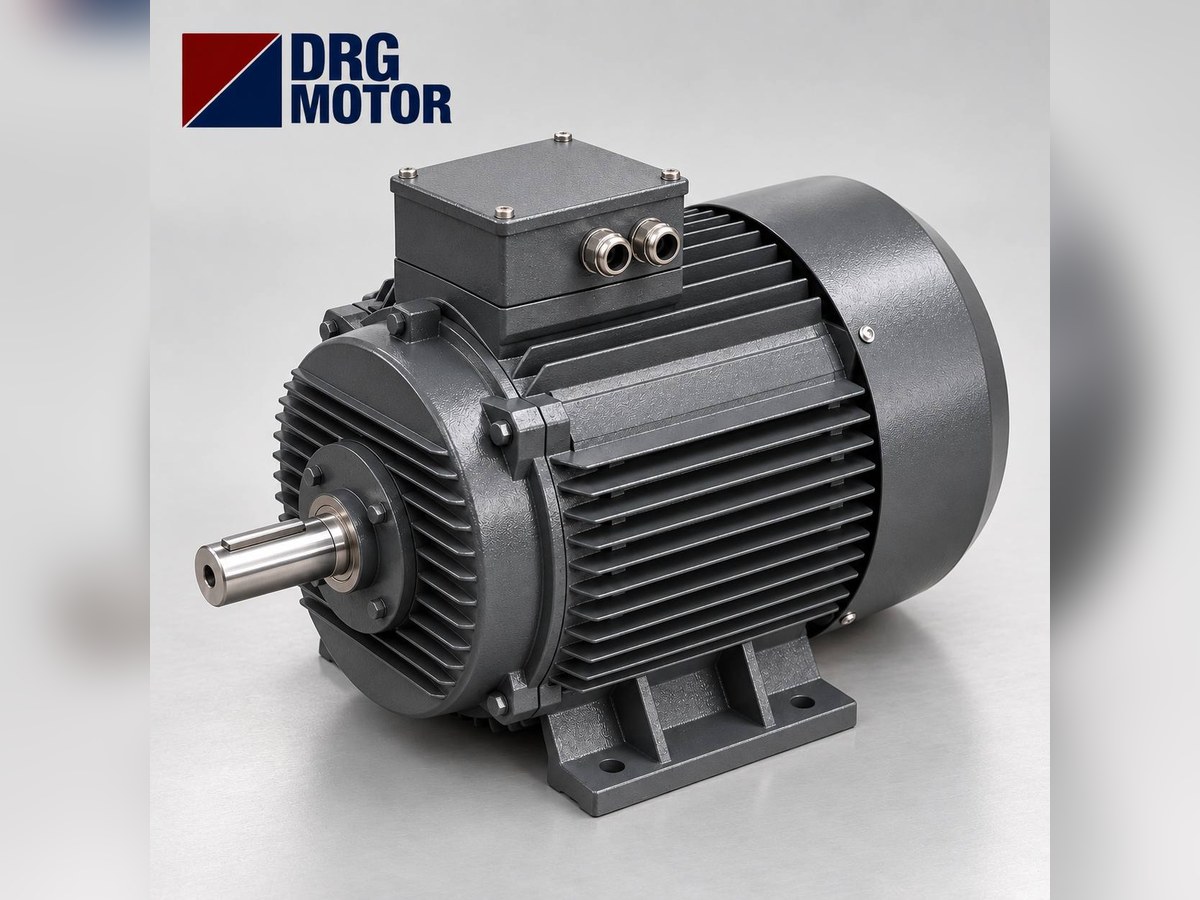
An agricultural elevator is the bucket conveyor that lifts grain vertically at grain receiving points and farm silos; the electric motor drives a shaft-mounted gearbox on the head pulley, which moves the bucket belt or chain. Grain tipped from a truck into the intake pit is picked up at the elevator boot, lifted to the head and sent through a distributor and spouts to the silos, the dryer or the cleaning machine. In manufacturer catalogues, motor power on farm and receiving-point elevators ranges from roughly 0.75 kW to 30 kW depending on capacity and height; on large terminal elevators the upper limit exceeds 75 kW.
This page treats the elevator as one link in the post-harvest chain: intake pit capacity, the height needed to reach the distributor above the silos, the heavy running that lasts for days at harvest, and how these affect motor selection. Power formula, loaded starting and backstop are treated in depth in a separate article, bucket elevator motor selection, so the calculation is not repeated here. Feed-mill elevators are handled on the Feed Elevator Electric Motors page. You can browse suitable motors on Buy Electric Motors Online.
Where does the elevator sit at a grain receiving point?
At a typical receiving point or farm silo group, grain follows this path: the truck or trailer tips into a grated intake pit, the auger or chain conveyor under the pit carries the grain to the elevator boot, the elevator lifts it to the head and the distributor at the head directs it to the chosen silo, the dryer or the pre-cleaner.
Intake pit and elevator boot
The elevator boot is often below ground, in a pit beside the intake hopper. This depth adds to the elevator's total height; one catalogue states plainly that pit depth must be added when the boot is below grade. The boot pit collects rainwater and humidity; the motor at the head is not directly affected, but the speed sensor and belt tensioning at the boot must not be neglected.
Distributor above the silos and spout angle
Grain leaving the head flows from the distributor to the silos through inclined spouts. The steeper the spouts must be, the taller the elevator is built. One manufacturer's catalogue recommends a 35° spout angle for dry grain and 45° for wet grain. The difference is not small: to reach a silo 12 m from the head, dry grain needs about 8.4 m of fall, wet grain 12 m. So an elevator that sends maize wet to the dryer must be 3–4 m taller than one that only carries dry wheat, and its motor grows accordingly.
Feeding the dryer
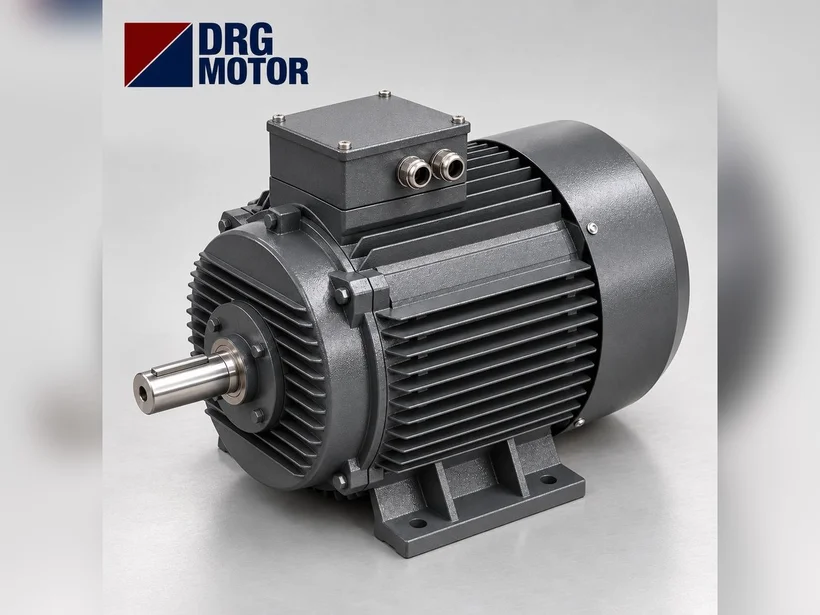
Sites with a dryer usually have two elevators: one carries wet grain from the intake pit to the top of the dryer, the other carries dried grain from the bottom of the dryer to the silos. The wet elevator runs at the dryer's pace throughout the harvest; if the dryer stops, the elevator stops too. The dryer's own motors are covered separately on the Grain Dryer Electric Motors page.
How many kW is an agricultural elevator motor?
A) Power values in manufacturer catalogues
| Elevator / capacity | Motor power | Height | Note |
|---|---|---|---|
| 13 t/h, bucket 152 × 102 mm | 0.75–1.5 kW | 6–24 m | Maker catalogue, smallest type |
| 54 t/h, pulley 406 mm | 2.2–7.5 kW | 6–32 m | Same catalogue, medium type |
| 136 t/h, pulley 762 mm | 11.2–29.8 kW | 12–55 m | Same catalogue, large farm type |
| 14–21 m³/h, 100 mm belt | 1.1–2.2 kW | up to 35 m | Second catalogue, small model |
| 94–145 m³/h | 5.5–15 kW | up to 36 m | Second catalogue, medium model |
| 166–259 m³/h | 11–30 kW | up to 41 m | Second catalogue, largest model |
| 180–300 t/h, terminal type | 45–75 kW (upper limit) | 55–70 m | Third catalogue |
For the farm and receiving-point elevators in this table, motor power varies between roughly 0.75 and 30 kW; for large terminal-type elevators one catalogue gives a motor upper limit of 75 kW, and 132 kW for the largest type. Each figure is one elevator's only drive motor. Within the same capacity row the power range grows with height: on the 136 t/h type 11.2 kW is enough at 12 m, while 29.8 kW is needed at 55 m. Horsepower figures appear here in kW (1 HP = 0.746 kW).
Capacity, height and product density
Catalogue values are generally for grain with a bulk density of about 0.75–0.77 t/m³. One catalogue shows by example that power can be scaled down by the density ratio for a lighter product; the reverse applies to heavy, wet product. Choose the elevator not by how many tonnes it will carry, but by how many tonnes of the heaviest product it must lift to the highest point.
B) The match in the DRG range
DRG Motor is an electric motor manufacturer, supplier and seller. The DRG motors that can go on an elevator head are three-phase, 1000/1500/3000 rpm and come in two frame families: aluminium up to 11 kW and cast iron from 0.55 kW to 355 kW. Small ratings are wound 230/400 V and those from 4 kW up 400/690 V; B3, B5, B14 or B35 mounting is stated when ordering. The 0.75–30 kW drive motors of farm and receiving-point elevators, and the terminal-type motors up to 75 kW, are within this range. Elevators in enclosed, dusty areas that call for an explosion-protected (Ex) motor are outside the DRG range.
| Model | Power / speed | Frame · current 400 V | Price |
|---|---|---|---|
| DRG-90L-42 HP | 1.5 kW · 1500 rpm | Cast iron 90L · 3.3 A | $144.14 (€128.73) Details & buy → |
| DRG-100L2-44 HP | 3 kW · 1500 rpm | Cast iron 100L · 6.02 A | $203.84 (€182.05) Details & buy → |
| DRG-112M-45.5 HP | 4 kW · 1500 rpm | Cast iron 112M · 7.95 A | $254.38 (€227.18) Details & buy → |
| DRG-132S-47.5 HP | 5.5 kW · 1500 rpm | Cast iron 132S · 10.7 A | $342.01 (€305.44) Details & buy → |
| DRG-132M-410 HP | 7.5 kW · 1500 rpm | Cast iron 132M · 14.3 A | $394.89 (€352.66) Details & buy → |
| DRG-160M-415 HP | 11 kW · 1500 rpm | Cast iron 160M · 20.4 A | $568.76 (€507.94) Details & buy → |
| DRG-160L-420 HP | 15 kW · 1500 rpm | Cast iron 160L · 27.3 A | $678.13 (€605.61) Details & buy → |
| DRG-180M-425 HP | 18.5 kW · 1500 rpm | Cast iron 180M · 33.5 A | $873.49 (€780.08) Details & buy → |
| DRG-180L-430 HP | 22 kW · 1500 rpm | Cast iron 180L · 39.7 A | $919.45 (€821.13) Details & buy → |
| DRG-200L-440 HP | 30 kW · 1500 rpm | Cast iron 200L · 53.8 A | $1,235.00 (€1,102.93) Details & buy → |
Click to see current electric motor prices and order nowSEE PRICES →
How is the peak load at harvest handled?
The elevator at a receiving point works little for most of the year; during the two or three weeks of harvest it does not stop from morning to night. The truck queue depends directly on the elevator's capacity.
| Case | Elevator capacity | Unloading a 25 t truck | Comment |
|---|---|---|---|
| Small intake site | 54 t/h | ≈ 28 minutes | Queues grow at harvest |
| Medium intake site | 136 t/h | ≈ 11 minutes | Five trucks an hour |
| Full-day peak | 136 t/h × 10 hours | ≈ 1,360 t | A 1,000 t silo fills in a day |
The elevator, not the motor, sets capacity
Because trucks are waiting, it may seem tempting to fit a bigger motor; but the elevator's capacity is fixed by bucket size, bucket spacing and belt speed. A bigger motor on the same elevator does not raise capacity; it only exposes the mechanical parts to a larger force when something jams. If capacity is to be increased, bucket and speed changes should be discussed with the elevator manufacturer and motor power recalculated for the new values.
Daily running hours and drive class
One manufacturer divides its drives into three classes by running hours: seasonal use up to 10 hours a day, use above 10 hours a day, and continuous or severe duty. The seasonal class takes a belt safety factor of 1.3, the other two classes 2.0. A receiving elevator that will run day and night at harvest should therefore be chosen to the second class: belt and gearbox as well as the motor's thermal margin. On the motor side this means a correctly set overload relay under a sustained load close to nameplate current, and clean cooling fins.
Motor, shaft-mounted gearbox and backstop
On agricultural elevators the most common arrangement is a shaft-mounted gearbox slid directly onto the head shaft. Catalogues show three variants: the motor driving the gearbox by V-belt, a helical geared motor flanged straight to the gearbox, and a geared motor splined to the head shaft with a backstop, run from a soft starter.
Speed and gearbox ratio
The head pulley turns slowly. On the 136 t/h type in the catalogue, a 762 mm pulley turns at 67 rpm and belt speed is about 2.76 m/s. With a 4-pole 22 kW motor (DRG-180L-4, 1470 rpm) this means an overall ratio of about 22. In a belt-driven arrangement the pulleys provide part of the ratio and the gearbox the rest; changing a pulley changes head speed and therefore centrifugal discharge. Try your own pulley diameter and target belt speed in the gearbox output speed and torque calculator.
Backstop and motor replacement
When the elevator stops loaded, the weight in the up leg tries to run the belt backwards; a backstop, fitted either inside the reducer or on the head shaft, blocks that reverse motion. This part is left alone when the motor is replaced, but the new motor's direction must be checked before the belt or coupling is fitted. A start in the reverse sense hits the backstop and reducer with a shock load.
Checklist when choosing a receiving elevator motor
- Elevator capacity (t/h) and total height from boot to distributor, including pit depth if the boot is below ground.
- The heaviest product to be carried: wet maize or dry wheat? Wet grain needs steeper spouts and a taller elevator.
- Drive arrangement: belt-driven shaft-mounted gearbox, flanged geared motor or splined geared motor. When the motor is flanged on, its B5 or B14 flange and shaft must fit the gearbox input without adapters.
- Daily running time: if it exceeds 10 hours at harvest, belt, gearbox and motor must be selected for it.
- Starting: for an elevator that may stop loaded, direct-on-line, soft starter or inverter. Star-delta is possible with DRG motors of 4 kW and above, yet on a loaded elevator the reduced torque in star often falls short. See the star-delta starting page for options.
- Interlock sequence: the elevator must start before the intake conveyor that feeds it and stop after it. A slipping belt is picked up by the boot speed sensor, which then halts the feeder. These interlocks must not be bypassed when the motor is replaced.
- Conditions at the head: open air, sun, rain and grain dust. One catalogue offers a rain cap for the motor as an accessory on outdoor elevators.
DRG models for intake and silo elevators
The 4-pole cast iron models below correspond to the small, medium and large farm elevators in the catalogue table. Because the motor sits on the head platform, weight and dimensions also matter; compare the technical drawings before ordering.
| Model | Power / speed | Frame | Current 400 V |
|---|---|---|---|
| DRG-100L1-4 | 2.2 kW / 1450 rpm | 100L cast iron | 4.52 A |
| DRG-112M-4 | 4 kW / 1450 rpm | 112M cast iron | 7.95 A |
| DRG-132M-4 | 7.5 kW / 1460 rpm | 132M cast iron | 14.3 A |
| DRG-160M-4 | 11 kW / 1465 rpm | 160M cast iron | 20.4 A |
| DRG-180M-4 | 18.5 kW / 1470 rpm | 180M cast iron | 33.5 A |
| DRG-200L-4 | 30 kW / 1475 rpm | 200L cast iron | 53.8 A |
DRG MOTOR motors are guaranteed against material and manufacturing defects for 2 years from the date of delivery (warranty certificate). The intake pit augers that feed the elevator and the silo unloading augers are described on the Agricultural Auger and Conveyor Electric Motors page. Irrigation pumps have their own Pump Motors category.
Motors in this power range
- DRG-100L2-4 – 3 kW – 1450 rpm – 100L cast iron
- DRG-132S-4 – 5.5 kW – 1460 rpm – 132S cast iron
- DRG-132M-4 – 7.5 kW – 1460 rpm – 132M cast iron
- DRG-160L-4 – 15 kW – 1465 rpm – 160L cast iron
- DRG-180L-4 – 22 kW – 1470 rpm – 180L cast iron
Click to see current prices and order these motors nowSEE PRICES →
Agricultural elevator motor: FAQ
How many kW motor does a grain elevator need?
It depends on capacity and height. In manufacturer catalogues, small elevators of 13 tonnes an hour run on 0.75–1.5 kW, and farm elevators of 136 tonnes an hour on 11–30 kW. The exact value is on the elevator's nameplate or in its manufacturer's selection table.
Should an elevator motor be 4-pole?
The head pulley turns at 60–110 rpm, so motor speed is reduced with a gearbox; gear units built for a 1500 rpm input make the 4-pole motor the usual choice. Changing the old motor's speed changes belt speed and discharge.
Why does the elevator motor run hot at harvest?
Long running close to nameplate current, cooling fins clogged with dust and high ambient temperature in the sun are the most common causes. Feeding the elevator above its capacity also chokes the boot and raises the current; set the feed gate to the elevator's capacity.
What current does a 7.5 kW elevator motor take?
The DRG-132M-4 (7.5 kW, 1460 rpm) is rated 14.3 A at 400 V on its nameplate; overload protection is not set above this current.
Share the elevator's capacity and height, a photo of the old motor's plate and the reducer type with us, and we can settle on the motor well ahead of harvest. Phone +90 (542) 666 11 11, e-mail [email protected], contact page. You can place your order on Buy Electric Motors Online.


