 English
 Le français
 Türkçe

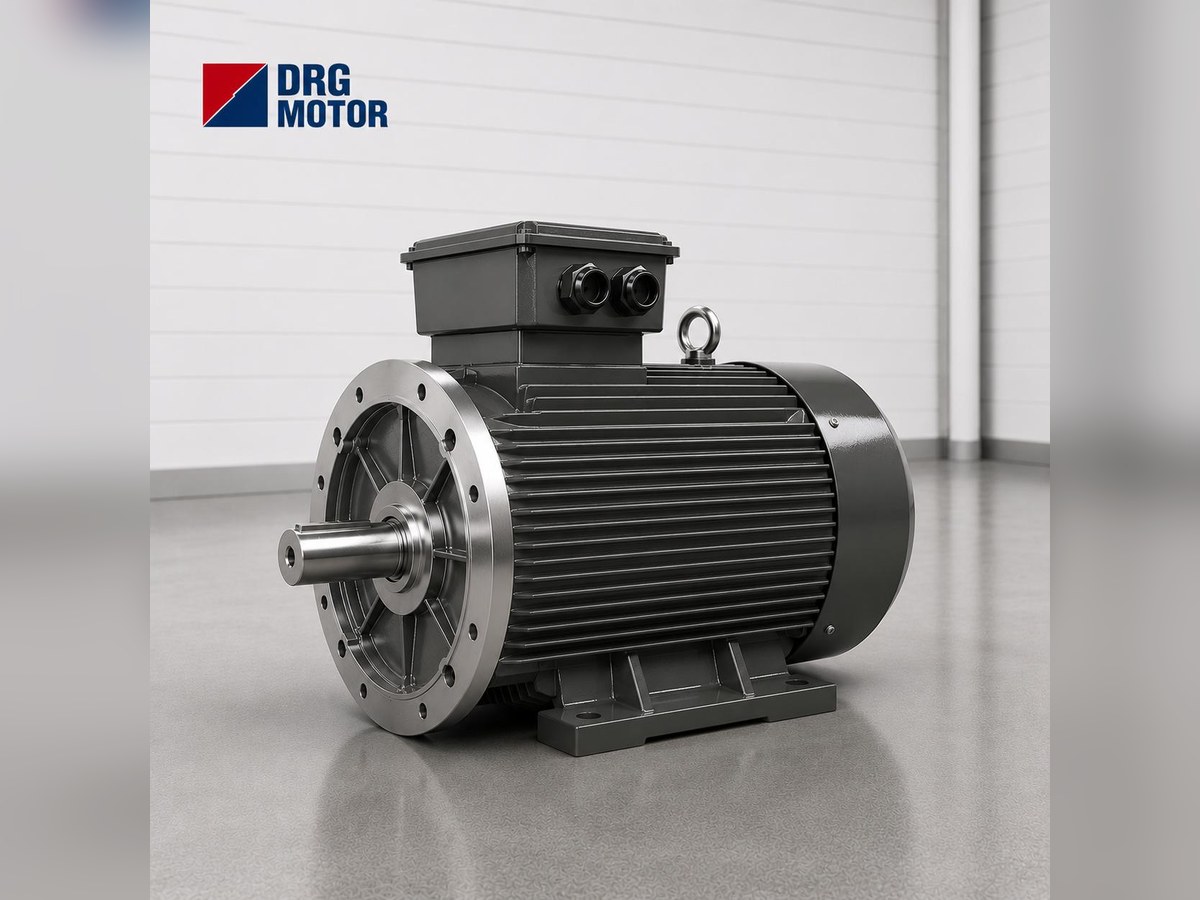
To be clear from the start: the electrospindle that turns the tool on a CNC router (HSK or ISO30 tool holder, 18,000–24,000 rpm class, drive-fed) and the servo and stepper motors that move the X, Y and Z axes are not part of the DRG range. Neither is on our price list, and no induction motor of ours is put forward as a stand-in; for such a failure we point you to the machine builder or a spindle repair service. This page covers the motors around woodworking and furniture CNC machines that we can supply: the vacuum pump holding the panel, the extraction fan pulling chips and dust, and on some nesting lines the loading and unloading conveyors.
DRG Motor is a manufacturer, supplier and seller of electric motors. We do not sell the CNC machine, the controller, drives (inverters), gearboxes, the vacuum pump body or the fan impeller; our part is the three-phase IEC motor behind the pump or fan. Models are listed on the Buy Electric Motors Online page.
Which motors does a wood CNC router contain?
A nesting CNC in furniture production lays a full panel on the table and clamps it by vacuum, then the electrospindle travels across it cutting cabinet sides, doors and shelves. The electrical load splits into three groups: tool and axis motors (electrospindle, servos), holding and cleaning equipment (vacuum pump, extraction fan) and material flow (loading table, pusher, outfeed belt). DRG supplies motors only for part of the second and third groups.
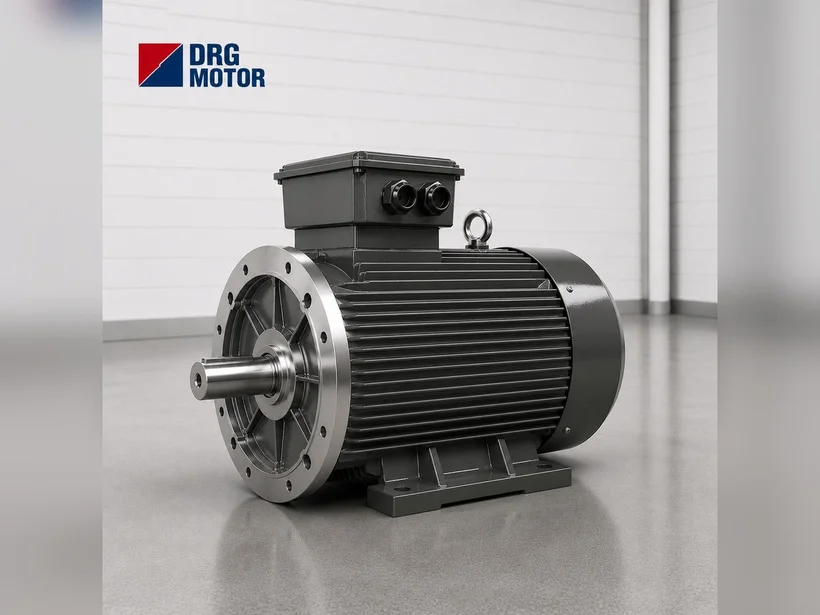
Why can an electrospindle not be swapped for a standard motor?
In an electrospindle the rotor is the tool shaft itself; precision bearings, a pneumatic tool clamp and a cooling jacket are built around it. A drive takes it anywhere from a few hundred rpm to 24,000 rpm, so its winding expects a supply frequency far above mains. A two-pole IEC motor on 50 Hz stays near 2,900 rpm, and multiplying that tenfold with pulleys is impossible for the bearings and for tool safety. That is why a DRG motor does not replace an electrospindle.
Servo and stepper axis motors
Axis motors move the gantry, the Y carriage and the Z slide with position feedback. A servo motor works as one unit with its encoder and drive; a stepper turns in the steps its driver sends. Both are made for position control, so a fixed-speed induction motor cannot stand in for them, nor they for it. For a failed axis motor contact a servo service that matches the drive make.
Spindle moulder versus CNC
On a table spindle moulder the motor that turns the spindle by belt is a standard IEC motor and can be replaced directly. On a CNC the cutting is done by the electrospindle. Even when both machines stand side by side in one workshop, they must be treated separately for motor supply; the spindle moulder motor is covered on its own page.
Vacuum pump motor: the power that holds the panel down
On a nesting table the panel is held by suction through an MDF spoil board. As small parts are cut free, air leakage grows, so pump flow is kept high. Woodworking CNCs mostly use dry (oil-free) claw pumps and oil-lubricated vane pumps. In manufacturer datasheets the claw pump motor is two-pole and flange mounted, coupled to the pump shaft.
What to check when replacing a pump motor
If the pump maker fitted a flange motor (B5) coupled to the gearbox, the new motor needs exactly the same spigot diameter, shaft diameter and shaft length. The nameplate speed also matters: fitting a two-pole motor where a four-pole one belongs doubles the pump speed and destroys the pump. The pump body, rotors and gears are the pump maker’s domain; we supply only the motor.
Extraction fan motor: taking chips away from the machine
The brush hood on the spindle head and the outlets under the table are connected to an extraction fan or a central system. The machine datasheet gives outlet diameters and duct air speed; the fan has to pull that airflow against the pressure losses of ducts and filter. Fan motor power follows from these two values. For fan selection and impeller types see our Fan Motors category, and for protecting motors in dusty extraction see motor supply for dust and aspiration.
Ex zones and the filter side
Wood dust can form an explosive atmosphere at certain concentrations. If a zone has been classified inside or next to the filter, silo or collection cell, that zone needs an Ex motor with the matching documentation; a DRG standard motor is not sold with it. The fan motor usually sits on the clean-air side, outside the zone. The plant’s explosion protection document decides this; if unsure, tell us before ordering.
Click to see current electric motor prices and order nowSEE PRICES →
How many kW for a CNC router? Catalogue values
A) Ratings stated in manufacturer catalogues for wood nesting CNCs and their peripheral equipment:
| Equipment | Motor power | Single / total | Note |
|---|---|---|---|
| Nesting CNC, electrospindle | 12 kW, 24,000 rpm | single | manufacturer catalogue; outside the DRG range |
| Nesting CNC, axis servos | 1.3 kW | per axis (2 on the X axis) | same catalogue; outside the DRG range |
| Nesting CNC, vacuum pump | 7.5 kW, 250 m³/h | per pump; 1 or 2 pumps | same catalogue, small and mid models |
| Nesting CNC, machine total | 24 kW | total installed power | same catalogue, single machine |
| Nesting line with loading and unloading | 43.1 kW | total installed power | same catalogue; line equipment included |
| Dry claw vacuum pumps | 4–11 kW (210–501 m³/h, 50 Hz) | per pump | second manufacturer datasheet; 2,850–2,950 rpm |
| Dry claw vacuum pump | 6.2 kW, 295 m³/h | per pump | third manufacturer datasheet |
| Mobile dust extractor for CNC | 2 × 5.5 kW, 10,000 m³/h | two fan motors | fourth manufacturer; suction pressure 2,550 Pa |
| Bag-type dust collector for CNC | 5.5 kW, 6,000 m³/h | single fan motor | fifth manufacturer |
| Dust extractors for CNC and panel lines | 7.5 kW and 11 kW (up to 8,900 and 11,300 m³/h) | one fan motor per model | sixth manufacturer; fan at 3,000 rpm |
In this equipment group, depending on model and table size, roughly 4–11 kW per vacuum pump and about 5.5–11 kW per fan in a CNC dust extractor are seen. Electrospindle and servo ratings appear in the table only for comparison. A CNC’s total installed figure says nothing about any one motor; it grows when a loading-unloading line is added, but catalogues do not list the conveyor motors of the line one by one. For those motors, power, speed and mounting are read from the machine documents or the old nameplate.
B) Overlap with the DRG range: the 4–11 kW pump and fan band lands on our two-pole cast iron 112M, 132S and 160M frames. For a non-standard value such as 6.2 kW the next standard rating (7.5 kW) is chosen. For nesting line conveyors and pushers, our small four-pole models are considered according to the application data; these usually work through a gearbox, which we do not supply. Electrospindles and servo/stepper motors are outside our range.
Worked example: extraction air and pump starting current
One nesting catalogue gives outlets of 1 × Ø150 mm and 3 × Ø125 mm with a duct speed of 28 m/s. The required airflow is outlet area times speed:
| Step | Calculation | Result | Comment |
|---|---|---|---|
| Total outlet area | π/4 × (0.150² + 3 × 0.125²) | about 0.0545 m² | all four outlets open |
| Airflow | 0.0545 × 28 × 3,600 | about 5,490 m³/h | flow the fan must pull |
| One pump, direct on line | DRG-132S1-2: 10.1 A × 8.3 | about 84 A | 5.5 kW pump motor, Is/In = 8.3 |
| Two pumps at once | 2 × 83.8 | about 168 A | to be avoided |
| Two pumps in sequence | 83.8 + 10.1 | about 94 A | second pump a few seconds later |
| 11 kW fan, star-delta | DRG-160M1-2: 19.6 × 8.1 / 3 | about 53 A | the fan’s inertia gives a long run-up |
About 5,500 m³/h sits close to the 5.5 kW, 6,000 m³/h bag collector in the table, yet duct length, elbows and a clogging filter all raise the pressure needed. Read fan power from the operating point on the fan maker’s curve, not from flow alone. On the starting side, switching the pumps and the fan on a few seconds apart eases the main breaker; see the star-delta starting tool for the method.
DRG motors for CNC peripheral equipment
Models from our range for the vacuum pump, extraction fan and auxiliary drives (current at 400 V):
| Model | Power / speed | Frame · shaft D×E | Current 400 V |
|---|---|---|---|
| DRG-802-4 | 0.75 kW / 1420 rpm | 80 cast iron · 19×40 | 1.75 A |
| DRG-90L-4 | 1.5 kW / 1445 rpm | 90L cast iron · 24×50 | 3.3 A |
| DRG-112M-2 | 4 kW / 2905 rpm | 112M cast iron · 28×60 | 7.45 A |
| DRG-132S1-2 | 5.5 kW / 2930 rpm | 132S cast iron · 38×80 | 10.1 A |
| DRG-132S2-2 | 7.5 kW / 2930 rpm | 132S cast iron · 38×80 | 13.7 A |
| DRG-160M1-2 | 11 kW / 2945 rpm | 160M cast iron · 42×110 | 19.6 A |
Vacuum pump motors are mostly flange mounted (B5 or B35), while extraction fans use a foot-mounted (B3) motor with a direct impeller fit or a belt. Housing choice for CNC peripherals: aluminium covers the small end up to 11 kW (from 0.25), cast iron starts at 0.55 and goes to 355 kW; pole count is two, four or six, and the B3, B5, B14, B34, B35 or vertical form is named on the order. From 4 kW up, the DRG nameplate reads 400/690 V, so a big extraction fan can run up in star then switch to delta. Before ordering, send the kW and speed from the pump or fan nameplate, the flange size, shaft diameter, key and coupling type; those values go beside the pump or fan maker’s data sheet before we agree on a model. We give no blanket guarantee of fit.
B5 flange dimensions
From the B5 table of the DRG catalogue, frames suited to pump and fan motors (mm):
| Frame | Shaft D×E | Flange P / M / N | Hole S |
|---|---|---|---|
| 100L/112M | 28×60 | 250 / 215 / 180 | 14.5 |
| 132S | 38×80 | 300 / 265 / 230 | 14.5 |
| 160M | 42×110 | 350 / 300 / 250 | 18.5 |
On a flange sitting on the pump gearbox, the spigot diameter N and the bolt circle M must match exactly; shaft diameter D and length E set the coupling hub. Compare your pump flange against the DRG drawings and the B5/B14 flange guide.
Live price table
Current shop prices for motors in CNC peripheral power ratings:
| Model | Power / speed | Frame · current 400 V | Price |
|---|---|---|---|
| DRG-802-41 HP | 0.75 kW · 1500 rpm | Cast iron 80 · 1.75 A | $101.93 (€91.03) Details & buy → |
| DRG-90L-42 HP | 1.5 kW · 1500 rpm | Cast iron 90L · 3.3 A | $144.14 (€128.73) Details & buy → |
| DRG-112M-25.5 HP | 4 kW · 3000 rpm | Cast iron 112M · 7.45 A | $225.65 (€201.52) Details & buy → |
| DRG-132S1-27.5 HP | 5.5 kW · 3000 rpm | Cast iron 132S · 10.1 A | $338.72 (€302.50) Details & buy → |
| DRG-132S2-210 HP | 7.5 kW · 3000 rpm | Cast iron 132S · 13.7 A | $369.43 (€329.92) Details & buy → |
| DRG-160M1-215 HP | 11 kW · 3000 rpm | Cast iron 160M · 19.6 A | $527.95 (€471.49) Details & buy → |
DRG MOTOR motors are guaranteed against material and manufacturing defects for 2 years from the delivery date (warranty certificate).
Motors in this power range
- DRG-112M-2 – 4 kW – 2905 rpm – 112M cast iron
- DRG-132S1-2 – 5.5 kW – 2930 rpm – 132S cast iron
- DRG-132S2-2 – 7.5 kW – 2930 rpm – 132S cast iron
- DRG-160M1-2 – 11 kW – 2945 rpm – 160M cast iron
Click to see current prices and order these motors nowSEE PRICES →
Browse the products, ask for a quote: vacuum pump and extraction fan motors for your CNC shop are all on the Buy Electric Motors Online page. A photo of the pump or fan motor nameplate sent via WhatsApp is enough; you can also call +90 (542) 666 11 11 and start with the pump flow and speed. For an electrospindle or servo failure we direct you to the right service.
Frequently asked questions
The electrospindle of my CNC router burned out; can a DRG motor be fitted?
No. An electrospindle is a unit fed by a high-frequency drive, with a tool holder and bearings built for it; a standard IEC motor cannot take its place. Contact a spindle repairer or the machine builder. If the vacuum pump or fan motor on the same machine has failed, we can cover that from our range.
Can the vacuum pump motor be replaced on its own?
In most cases yes, when the motor is joined to the pump by flange and coupling. Flange, shaft and speed must match; on some small pumps motor and pump share one housing and the motor is not replaced separately. A photo of the pump plate and the motor flange is enough for us to tell.
What does the price of a CNC router motor depend on?
On the DRG side we are talking about pump and fan motors; output, pole count, frame and flange type set the price, and the table above reads it live from the shop. For electrospindle and servo prices ask the machine builder.
Pump or fan motor questions for a nesting line: write to info@drgmotor.com or use the contact form, or ring +90 (542) 666 11 11. A general overview of woodworking motors: woodworking motor guide.


