 English
 Le français
 Türkçe

Crushing rolls take pre-prepared clay through two smooth, hard rolls set to a gap of around a millimetre, refining and homogenising the raw material before the press. The two rolls are turned by separate electric motors, usually through belts, and one roll runs at a slightly higher surface speed than the other; the clay is smeared and crushed by this speed difference. Catalogues for brick and ceramic raw material list 37–160 kW per roll. This page covers the fine rolling stage of the line; stone removal belongs to the machine before it, and shaping to the de-airing extruder.
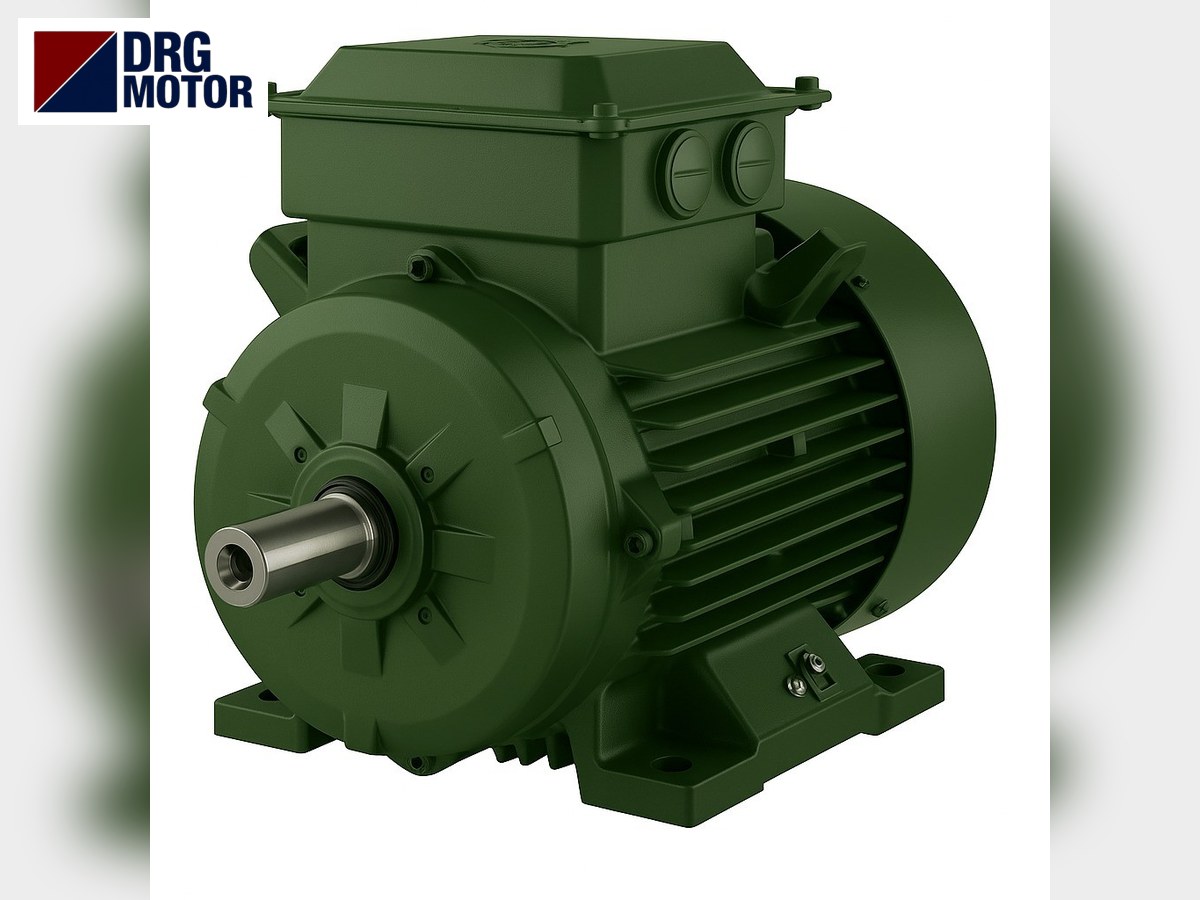
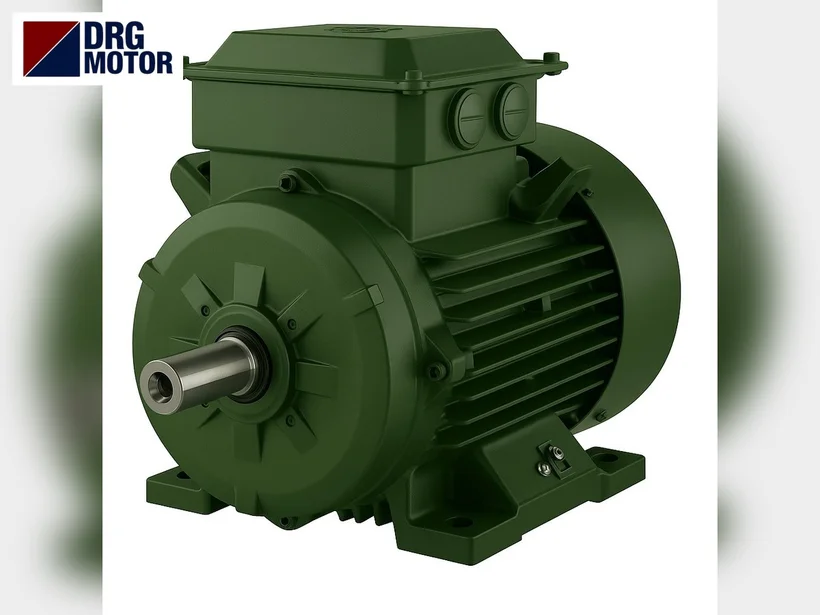
DRG Motor is a manufacturer, supplier and seller of electric motors. We do not sell the roller mill, roll shells, grinding lathe, hydraulic pressure unit or inverter; the three-phase asynchronous motors on each roll are where we come in. Suitable models are on the Buy Electric Motors Online page.
Coarse and fine crushing rolls: how many in a line?
A domestic maker writes that 1, 2 or 3 crushing rolls are run one after another on the production line, as required. The first (pre- or coarse roll) works with a gap of a few millimetres; the fine rolls behind it close the gap step by step. A European maker bases its rolls on a 1:2 crushing ratio: to get 0.8 mm at the outlet, the incoming material should be 1.6 mm. A line reaching 0.8 mm therefore has at least two roller mills, each with its own pair of motors.
Roll gap and motor load
Catalogues show fine rolls working at 0.8 mm, extra-fine types at 0.5 mm and one maker at a 0.6 mm minimum. As the gap narrows, less clay passes through the same roll width while the force pushing the rolls apart grows; a hydraulic or disc-spring preload holds the roll in place. The motor supplies the torque that drags clay through against that separating force. Finer product means a larger motor at the same capacity, or lower capacity with the same motor.
Surface speed and the difference between rolls
One maker’s data sheet groups speeds into 12, 19 and 21 m/s classes, with different speeds for the two rolls in each (for example 246/232, 371/350, 416/371 rpm). The difference does more than crush: it shears and kneads the clay on the roll surface. Higher surface speed passes more clay but needs a larger motor: the same 1000 mm diameter, 1400 mm wide mill is listed with 2 × 90 kW at 12 m/s and 2 × 160 kW at 21 m/s.
How it differs from a stone separating roller
In a stone separating roller one roll carries a helical groove and the aim is to remove stones; the gap is a few millimetres, surface speed is low and motors are typically 22–75 kW per roll. In crushing rolls both rolls are smooth, the gap goes below a millimetre, surface speed is several times higher and motor power grows accordingly. Crushing rolls are among the most energy-hungry preparation machines; a domestic maker calls them the most important machine in the line after the extruder. Without a stone separator in front, hard stones score the shells and holding a fine gap becomes difficult.
Shell wear and the grinding lathe
Clay, especially sandy clay, wears the roll shells; on a worn surface the gap is no longer even along the roll and fineness suffers. Rolls are therefore reground regularly, in place or removed. Grinding lathes have their own small motors and a frequency converter for speed; one maker states it is built into the panel with 8 stored speeds. We found no reliable catalogue figure for these small motors, so selection follows application data: send us the lathe nameplate, whether feed and rotation motors are separate, and how they are connected. If an auxiliary drive turns the roll slowly during grinding, add its nameplate too.
How many kW for a crushing roll motor?
A) Coarse and fine crushing roll motors as published by machine makers:
| Machine / roll | Motor power | Single / total | Note |
|---|---|---|---|
| Fine crushing rolls, Ø1000×600 mm, 12 m/s | 2 × 37 kW | two motors, 1000 rpm class | first maker, lowest speed class |
| Fine crushing rolls, Ø1000×1400 mm, 19 m/s | 2 × 132 kW | two motors, 1500 rpm class | first maker |
| Fine crushing rolls, Ø1000×1400 mm, 21 m/s | 2 × 160 kW | two motors, 320 kW total | first maker, highest speed |
| Fine roller mill, Ø1000×800 mm, 0.8 mm gap | 2 × 55–90 kW | per roll | second maker |
| Fine roller mill, Ø1000×1500 mm | 2 × 110–160 kW | per roll | second maker, 122–140 t/h wet |
| Extra-fine roller mill, 0.5 mm gap, Ø800×1000 mm | 2 × 75–90 kW | per roll | second maker, second or third mill in line |
| Fine roller mill, Ø1000×800 mm, 18 m/s | 2 × 55 kW | two motors, 110 kW total | third maker, 36 t/h at 1 mm |
| Crushing rolls, Ø1000×600 mm | 55 kW + 55 kW | two motors | fourth maker, 275/250 rpm |
| Crushing rolls, Ø1200×1200 mm | 110 kW + 132 kW | two motors of different power | fifth maker, 15–22 m/s |
Across these machines, depending on model, roll width, surface speed and gap, about 37–160 kW per roll is seen; a twin-motor mill totals 74–320 kW. One maker gives both rolls equal power, another lists the fast roll with a larger motor (for example 110 kW + 132 kW). Dividing installed power by capacity at a 1 mm gap gives about 3–4 kW per t/h (110 kW / 36 t/h and 264 kW / 68 t/h from the third maker’s table); this is for comparison only, not a design rule.
B) Overlap with the DRG range: each roll rating from 37 to 160 kW has a matching DRG cast iron motor, 4 or 6 poles, frames 250M to 355M. Data sheets specify 6-pole motors for the 1000 rpm class and 4-pole motors for the 1500 rpm class; we check whether a 400/690 V connection is available on the relevant models against the nameplate and order note. Special mills needing more than 160 kW per roll, and medium-voltage lines, lie beyond what we offer.
Click to see current electric motor prices and order nowSEE PRICES →
Example: pulleys and torque on a 19 m/s fine roller mill
For 1000 mm diameter rolls in the 19 m/s class, the first maker’s data sheet gives 371/350 rpm, 2 × 90 kW at 1000 mm width, and 1500 rpm class motors. With these values let us work out pulley ratios and shaft torque for two DRG-280M-4 motors:
| Quantity | Calculation | Result | Comment |
|---|---|---|---|
| Fast roll surface speed | π × 1.0 × 371 / 60 | about 19.4 m/s | first maker, 1000 mm roll |
| Slow roll surface speed | π × 1.0 × 350 / 60 | about 18.3 m/s | difference of roughly 5.7 per cent |
| Fast-side ratio with DRG-280M-4 | 1486 / 371 | about 4.01 | 90 kW, 4 poles |
| Slow-side ratio with DRG-280M-4 | 1486 / 350 | about 4.25 | same motor, larger roll pulley |
| Ratio in the 6-pole version (246 / 232 rpm) | 985 / 246 and 985 / 232 | about 4.00 and 4.25 | DRG-280M-6, 55 kW, 12 m/s class |
| Torque on the fast roll shaft | 9550 × 90 / 371 | about 2,317 Nm | rated torque at the motor shaft 578.4 Nm |
Although both motors have the same power and speed, the roll pulleys differ; the roughly 6 per cent speed difference comes from this pulley difference. Keeping the pole count on replacement leaves both pulleys untouched. Repeat the calculation with your own diameters in the pulley and belt tool.
Starting two large motors
| Case | Calculation | Current (400 V) | Note |
|---|---|---|---|
| Both motors at rated load | 155 + 155 | 310 A | two DRG-280M-4 |
| One motor direct-on-line | 155 × 6.9 | about 1,070 A | Is/In = 6.9 |
| Second in star-delta while first runs | 155 + 1,070 / 3 | about 512 A | staggered start |
Rolls start empty, but the inertia of 1000 mm rolls is large; staggering the two starts and using star-delta or a soft starter keeps the supply dip small. The feed belt should not run before the rolls are up to speed. Compare methods with our star-delta tool.
Information needed and items outside our range
- Nameplates of both roll motors: kW, speed, voltage (400 V or 400/690 V) and connection.
- Roll diameter, width and the speed class (m/s) from the data sheet.
- Motor and roll pulley diameters, number of belts.
- Position in the line: coarse, fine or extra-fine; working gap.
- Starting method; interlock between both motors and the feed belt.
- Environment: clay dust, damp clay splashes (our motors are IP55).
What we do not supply
The pump of the hydraulic preload unit and special motorised lathe units are not supplied by us; for the motor driving a hydraulic pump see our hydraulic pump motor article. Brake motors, servo motors, single-phase motors and anything above 355 kW are outside our range. Where a ceramic raw material plant has an explosive atmosphere classification because of coal dust or solvent, an Ex-rated motor is required; that document does not come with our standard motors. For a general view of motor selection in ceramic plants, see our ceramic plant article.
DRG models for crushing rolls
Cast iron models matching roll motor ratings of coarse and fine mills (current at 400 V):
| Model | Power / speed | Frame · shaft D×E | Current 400 V |
|---|---|---|---|
| DRG-250M-4 | 55 kW / 1485 rpm | 250M cast iron · 65×140 | 97.6 A |
| DRG-280S-4 | 75 kW / 1486 rpm | 280S cast iron · 75×140 | 129 A |
| DRG-280M-4 | 90 kW / 1486 rpm | 280M cast iron · 75×140 | 155 A |
| DRG-315S-4 | 110 kW / 1488 rpm | 315S cast iron · 85×170 | 187 A |
| DRG-315M-4 | 132 kW / 1488 rpm | 315M cast iron · 85×170 | 224 A |
| DRG-315L1-4 | 160 kW / 1488 rpm | 315L cast iron · 85×170 | 271 A |
| DRG-280M-6 | 55 kW / 985 rpm | 280M cast iron · 75×140 | 98.1 A |
| DRG-315S-6 | 75 kW / 985 rpm | 315S cast iron · 85×170 | 136 A |
| DRG-315M-6 | 90 kW / 988 rpm | 315M cast iron · 85×170 | 161 A |
| DRG-355M1-6 | 160 kW / 990 rpm | 355M cast iron · 100×170 | 281 A |
Crushing roll motors are large-frame machines, usually foot-mounted (B3) on slides beside the roll or piggy-back on the frame. Our whole range consists of 3-phase asynchronous IEC motors, with cast iron frames up to 355 kW. We compare foot holes, shaft height and shaft-key dimensions with the old motor using the technical drawings.
Live price table
Prices of models in crushing roll ratings are displayed live from the shop:
| Model | Power / speed | Frame · current 400 V | Price |
|---|---|---|---|
| DRG-280M-675 HP | 55 kW · 1000 rpm | Cast iron 280M · 98.1 A | $2,805.93 (€2,505.87) Details & buy → |
| DRG-250M-475 HP | 55 kW · 1500 rpm | Cast iron 250M · 97.6 A | $2,065.73 (€1,844.82) Details & buy → |
| DRG-280S-4100 HP | 75 kW · 1500 rpm | Cast iron 280S · 129 A | $2,916.93 (€2,605.00) Details & buy → |
| DRG-315M-6125 HP | 90 kW · 1000 rpm | Cast iron 315M · 161 A | $4,430.22 (€3,956.46) Details & buy → |
| DRG-280M-4125 HP | 90 kW · 1500 rpm | Cast iron 280M · 155 A | $3,268.56 (€2,919.03) Details & buy → |
| DRG-315S-4150 HP | 110 kW · 1500 rpm | Cast iron 315S · 187 A | $4,863.00 (€4,342.97) Details & buy → |
| DRG-315M-4180 HP | 132 kW · 1500 rpm | Cast iron 315M · 224 A | $5,621.72 (€5,020.55) Details & buy → |
| DRG-355M1-6200 HP | 160 kW · 1000 rpm | Cast iron 355M · 281 A | $6,285.89 (€5,613.69) Details & buy → |
| DRG-315L1-4200 HP | 160 kW · 1500 rpm | Cast iron 315L · 271 A | $6,135.24 (€5,479.15) Details & buy → |
DRG MOTOR motors are guaranteed against material and manufacturing defects for 2 years from the delivery date (warranty certificate).
Motors in this power range
- DRG-280S-4 – 75 kW – 1486 rpm – 280S cast iron
- DRG-280M-4 – 90 kW – 1486 rpm – 280M cast iron
- DRG-315S-4 – 110 kW – 1488 rpm – 315S cast iron
- DRG-315M-4 – 132 kW – 1488 rpm – 315M cast iron
- DRG-280M-6 – 55 kW – 985 rpm – 280M cast iron
Click to see current prices and order these motors nowSEE PRICES →
Browse products, ask for a quote: motors for your roller mill are on the Buy Electric Motors Online page. Photograph both nameplates and the pulley side and send them to our WhatsApp line, or reach us on +90 (542) 666 11 11; we will confirm the speed class and connection together.
Frequently asked questions
Should both motors of a crushing roll run at the same speed?
The motors usually share the same pole count; the speed difference between rolls is set by the pulleys. Replacing one motor with a different-speed motor upsets that difference.
Why does the motor struggle when the gap is reduced?
A smaller gap raises the separating force and the torque needed to pull clay through. Data sheet power applies to a given gap and speed; consult the machine maker before running finer.
Are ceramic raw material rolls different from brick rolls?
The principle is the same; raw material, target fineness and the number of mills in line differ. In both cases the motor is chosen from power per roll and speed class.
What does a crushing roll motor price depend on?
Motor power, pole count and frame size; current figures are in the table above.
Questions: +90 (542) 666 11 11 · info@drgmotor.com · contact.


