 English
 Le français
 Türkçe

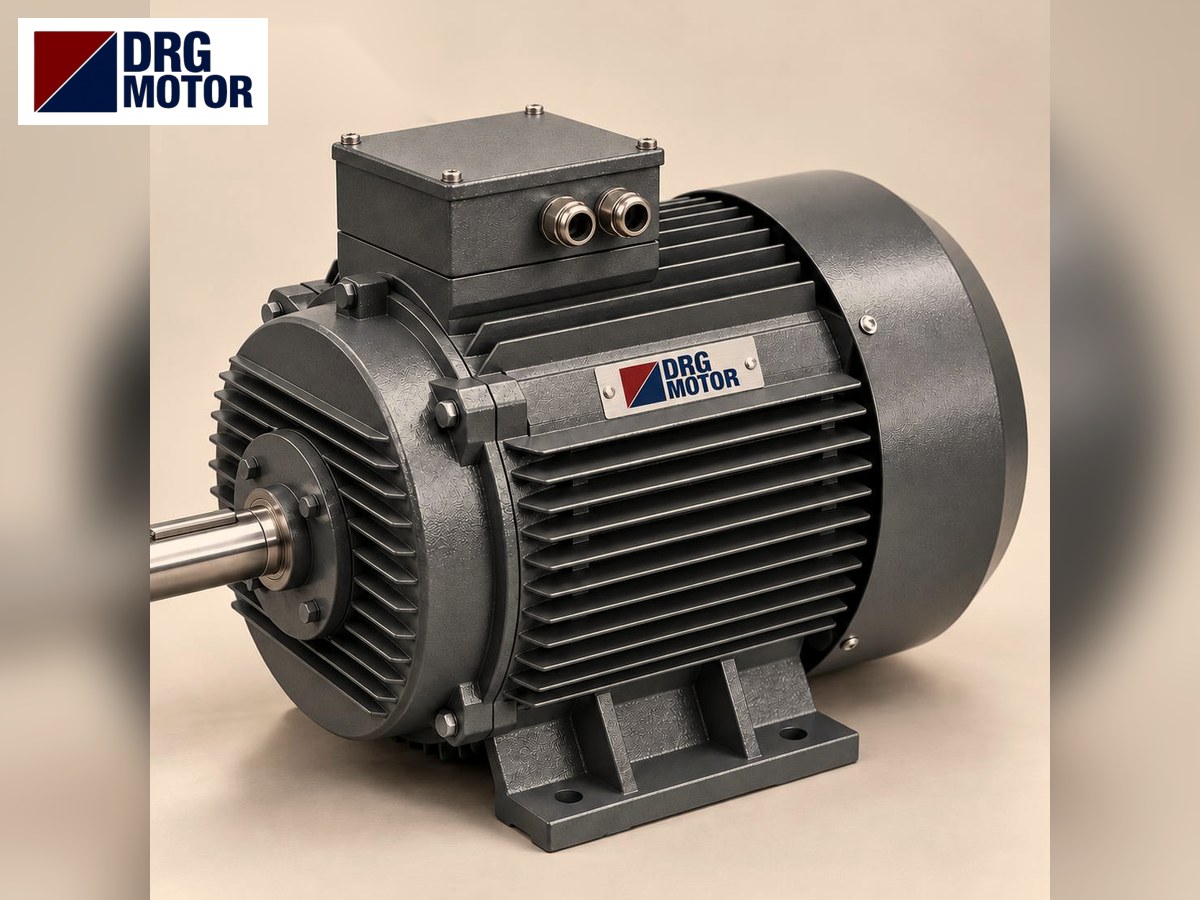
In paper and cardboard recycling the heaviest motor duty is on the pulping side: the pulper rotor beats waste paper with water and separates it into fibres, using one of the most powerful motors in the plant. Document and cardboard shredders, pressure screens, cleaning pumps and conveyor belts also run on their own motors. According to makers’ catalogues, pulper motors range from about 11 kW on small vats to 160 kW on large D-type tanks.
This page deals with the three-phase motor that turns these machines, not with the machines themselves. DRG Motor is a manufacturer, supplier and seller of electric motors. We do not sell pulpers, screens, shredders, gearboxes or drives; you can choose the motor for your machine on our Buy Electric Motors Online page or write to us for a quote.
Which machines in a waste paper line run on electric motors?
Collected paper and cardboard is first sorted, shredded or baled; bales arriving at the paper mill are pulped, screened and cleaned. The motor side of baling has its own page: Recycling Baling Press Motors. For the general motor layout of a paper and pulp mill, see our article electric motor selection in paper and pulp plants; here we focus only on recycling machines.
Collection and sorting side
A waste collection centre has cardboard shredders, packaging perforators and confidential document destruction machines. These turn slow knife shafts through a gearbox or chain, and their power ranges from a few kW to a few tens of kW.
Pulp preparation side
In the pulp preparation area of a paper mill there are pulpers, coarse and fine screens, high and low density cleaners (cyclones), agitators and pulp pumps. Motor powers grow here and running hours are longer; a single pulper rotor may be stronger than all the machines on the collection side together.
Pulper rotor motor
A pulper is a large vat with a bladed rotor in its bottom or side wall. The rotor churns paper mixed with water and frees the fibres; a perforated plate (screen) under it lets fibres through and holds back coarse contaminants such as plastic, wire and tape. In D-type vats the rotor sits on the side, in flat-bottom types on the floor; the motor usually stands outside the vat and is connected to the rotor by belt and pulley or by a gearbox.
Rotor speed and transmission ratio
In one maker’s catalogue the rotor speed drops as the vat grows: 700 rpm at 0.5 m³, 480 rpm at 3 m³, 320 rpm at 10–15 m³. The motor turns at 1000 or 1500 rpm; the gap is bridged by the pulley ratio or a gearbox. Example for a 3 m³ pulper:
| Quantity | Value | Calculation | Meaning |
|---|---|---|---|
| Rotor power | 45 kW | catalogue | 3 m³ pulper |
| Rotor speed | 480 rpm | catalogue | belt/gearbox output |
| Rotor torque | ≈ 895 Nm | 9550 × 45 / 480 | losses excluded |
| Ratio, 4-pole | ≈ 3.09 | 1485 / 480 | DRG-225M-4, 289.4 Nm |
| Ratio, 6-pole | ≈ 2.05 | 985 / 480 | DRG-280S-6, 436.3 Nm |
Even when the ratio changes the torque on the rotor stays the same, because power is the same; what changes is the torque at the motor shaft and the pulley or gearbox size. A 6-pole motor works with a smaller ratio but has a larger frame (280S). You can try pulley diameters with our Pulley-Belt Calculator.
Starting with a full vat
A pulper is emptied after each batch, and the rotor usually keeps running while water and paper are added again. After a power cut, however, the rotor sits in full, thick pulp and the starting torque rises. On our large 4-pole frames the starting torque is 2.0–2.2 times rated torque (for example 2.0 on the DRG-225M-4). Whether a large pulper starts via soft starter or inverter is the machine maker’s decision; we do not supply the drive.
Shredder, document destruction and cardboard shredder motors
Single shaft document shredder
A single bladed rotor cuts against a counter knife; the screen below sets the particle size. It is used for confidential document destruction and at paper collection points. With a slow rotor, a gearbox sits between it and the motor; a control that reverses the rotor and retries after a jam makes the motor change direction often.
Twin shaft paper and cardboard shredder
Two counter-rotating knife shafts turn paper, binders and cardboard into strips. In some series each shaft has its own motor and gearbox, so power is stated per shaft. On one cardboard shredder a slow feed shaft is driven by 1.1 kW and a faster ripper shaft by a 5.5–7.5 kW motor, each through its own chain; scrapers that prevent wrapping keep the shaft load low.
Cardboard perforator
Perforators that turn old boxes into packaging padding come with single-phase motors on small units and a 4 kW three-phase motor on large ones. Single-phase motors are not in our range; send us the nameplate for three-phase versions.
Click to see current electric motor prices and order nowSEE PRICES →
Screening, cleaning and conveying motors
Pressure screen
Pulp is forced through the holes of a cylindrical basket inside a closed housing; a rotor inside the basket keeps the holes from blinding. In one maker’s ten-size series the rotor motor ranges from 22 kW to 400 kW. The part of this band up to 355 kW overlaps our range; anything above is outside it.
Cyclone cleaners and pumps
High and low density cleaners have no moving parts; it is the pump feeding them that does the work. The motor of a cleaner line is therefore the pulp pump motor and is chosen by pump flow and head.
Belts and conveyors
Chain or belt conveyors carrying bales to the pulper, the wire-cutting station and reject screws run on small motors driving through gearboxes. In the wet pulp area, placing the motor away from water spray and closing the terminal box cover and cable gland tightly has a direct effect on service life.
How many kW is a paper recycling motor?
A) Drive powers printed in pulper, screen and shredder catalogues:
| Machine / size | Motor power | Single / total | Note |
|---|---|---|---|
| D-type pulper, 0.5 m³ | 11 kW | Single (rotor) | maker catalogue, smallest |
| D-type pulper, 3 m³ | 45 kW | Single (rotor) | same catalogue, rotor 480 rpm |
| D-type pulper, 15 m³ | 160 kW | Single (rotor) | same catalogue, rotor 320 rpm |
| High consistency pulper, 3–20 m³ | ≤37 – ≤160 kW | Single (rotor) | same catalogue, upper limit |
| Pressure screen, small–large | 22–400 kW | Single (rotor) | second maker, 10 sizes |
| Document shredder, single shaft | 3–18.5 kW | Single motor | third maker series |
| Paper shredder, twin shaft | 2 × 11 – 2 × 132 kW | Per shaft | same series |
| Cardboard shredder, two shafts | 1.1 + 5.5–7.5 kW | Feed + ripper | fourth maker |
| Cardboard perforator (padding) | 4 kW | Single, 3 × 400 V | fifth maker, large type |
Taken together, these paper and board machines span about 1.1 kW at the smallest feed shaft to 400 kW on the biggest screen rotor. The pulper motor grows with vat volume and daily tonnage; on a screen, rotor power rises as the hole or slot size gets smaller and flow increases; on a shredder, cutting width and knife diameter set the power.
B) What we can supply: the 1.1–355 kW band is covered by our 1000, 1500 and 3000 rpm three-phase models. Machines that need more than 355 kW, such as large drum pulpers and the largest pressure screens, are outside our range; at these powers medium voltage motors are often used, and medium voltage motors are not in our range either.
Dust, moisture and explosion risk
Paper dust
Shredding dry paper and cardboard releases fine dust; it collects on the motor’s fan cover and cooling fins and makes the motor run hot. Our motors are IP55; regular cleaning and a layout that does not block air flow are still essential.
Hazardous area classification
Enclosed spaces with heavy dust and dust collection silos may be classified as hazardous areas in the plant’s risk assessment. In such an area an Ex (ATEX) certified motor is required; the standard DRG motor is not sold with this certificate; we have no Ex motor to offer. The zone is defined by the plant’s responsible engineer.
DRG motors: models suited to paper and cardboard recycling
Our models matching pulper, screen and shredder powers (current at 400 V):
| Model | Power / speed | Frame · shaft D×E | Current 400 V |
|---|---|---|---|
| DRG-132S-4 | 5.5 kW / 1460 rpm | 132S cast iron · 38×80 | 10.7 A |
| DRG-160M-4 | 11 kW / 1465 rpm | 160M cast iron · 42×110 | 20.4 A |
| DRG-200L-4 | 30 kW / 1475 rpm | 200L cast iron · 55×110 | 53.8 A |
| DRG-225M-4 | 45 kW / 1485 rpm | 225M cast iron · 60×140 | 80.2 A |
| DRG-280S-6 | 45 kW / 985 rpm | 280S cast iron · 75×140 | 81.6 A |
| DRG-315M-4 | 132 kW / 1488 rpm | 315M cast iron · 85×170 | 224 A |
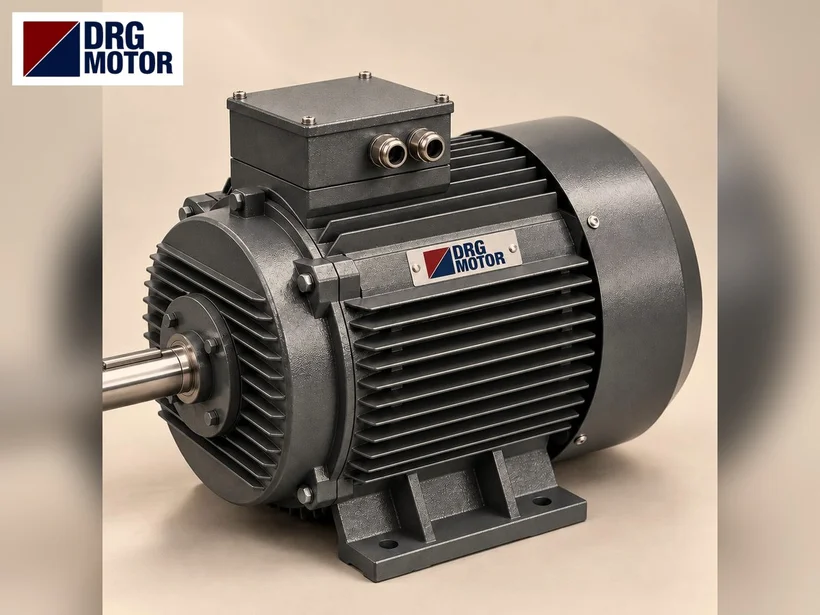
Our motors are three-phase and IP55; up to 3 kW they have 230/400 V windings, from 4 kW 400/690 V. The mounting type (foot B3, flange B5, foot-and-flange B35, vertical variants) is stated in the order. Before ordering a new motor, put the power, speed and voltage on the old nameplate, the frame, shaft diameter, key and mounting dimensions, and the pulley or gearbox connection side by side with the machine maker’s drawing. Until that comparison reaches us, we do not guarantee a fit.
Live price table
For pulper, screen and shredder sizes, the shop feeds this table with current prices:
| Model | Power / speed | Frame · current 400 V | Price |
|---|---|---|---|
| DRG-132M-410 HP | 7.5 kW · 1500 rpm | Cast iron 132M · 14.3 A | $394.89 (€352.66) Details & buy → |
| DRG-160M-415 HP | 11 kW · 1500 rpm | Cast iron 160M · 20.4 A | $568.76 (€507.94) Details & buy → |
| DRG-180M-425 HP | 18.5 kW · 1500 rpm | Cast iron 180M · 33.5 A | $873.49 (€780.08) Details & buy → |
| DRG-200L-440 HP | 30 kW · 1500 rpm | Cast iron 200L · 53.8 A | $1,235.00 (€1,102.93) Details & buy → |
| DRG-225S-450 HP | 37 kW · 1500 rpm | Cast iron 225S · 66.1 A | $1,527.18 (€1,363.87) Details & buy → |
| DRG-225M-460 HP | 45 kW · 1500 rpm | Cast iron 225M · 80.2 A | $1,688.50 (€1,507.94) Details & buy → |
| DRG-280M-675 HP | 55 kW · 1000 rpm | Cast iron 280M · 98.1 A | $2,805.93 (€2,505.87) Details & buy → |
| DRG-250M-475 HP | 55 kW · 1500 rpm | Cast iron 250M · 97.6 A | $2,065.73 (€1,844.82) Details & buy → |
| DRG-280M-4125 HP | 90 kW · 1500 rpm | Cast iron 280M · 155 A | $3,268.56 (€2,919.03) Details & buy → |
| DRG-315M-4180 HP | 132 kW · 1500 rpm | Cast iron 315M · 224 A | $5,621.72 (€5,020.55) Details & buy → |
DRG MOTOR motors are guaranteed against material and manufacturing defects for 2 years from the delivery date (warranty certificate).
Motors in this power range
- DRG-160M-4 – 11 kW – 1465 rpm – 160M cast iron
- DRG-225S-4 – 37 kW – 1485 rpm – 225S cast iron
- DRG-225M-4 – 45 kW – 1485 rpm – 225M cast iron
- DRG-280M-4 – 90 kW – 1486 rpm – 280M cast iron
- DRG-315S-4 – 110 kW – 1488 rpm – 315S cast iron
Click to see current prices and order these motors nowSEE PRICES →
Look at the products, request a price quote: every model is on the Buy Electric Motors Online page. Send the machine type and a photo of the old nameplate via WhatsApp or reach us on +90 (542) 666 11 11.
Frequently asked questions
Should a pulper motor be 4-pole or 6-pole?
Both are used. The choice depends on the pulley or gearbox ratio and the machine maker’s drawing; for the same rotor power a 6-pole motor gives more torque and has a larger frame.
Which motor fits a document destruction machine?
Small single shaft machines use 3–18.5 kW, large twin shaft machines several tens of kW per shaft. The kW and speed on the existing nameplate are the basis, and the gearbox input flange size is checked.
Does a cardboard processing motor burn out in dust?
If the fan cover and fins clog with dust, the motor overheats. Regular cleaning and current monitoring prevent this; in an area declared hazardous an Ex certified motor is required.
Paper recycling motor price: what sets it?
Power, speed and frame decide it; the table above and each product page show today’s figure.
Phone +90 (542) 666 11 11, e-mail [email protected], contact page. For paper recycling motor and cardboard processing motor options, see Buy Electric Motors Online.


