 English
 Le français
 Türkçe

A multi-rip saw splits a board or plank into several strips in one pass, using a number of circular blades spaced along a single arbor, or breaks a cant into several boards. Its heart is the main motor that turns this saw arbor; maker catalogues list 22–55 kW on single-arbor machines and up to 160 kW per arbor on heavy twin-arbor timber lines. Smaller motors drive the feed belt or rollers and lift the pressure unit.
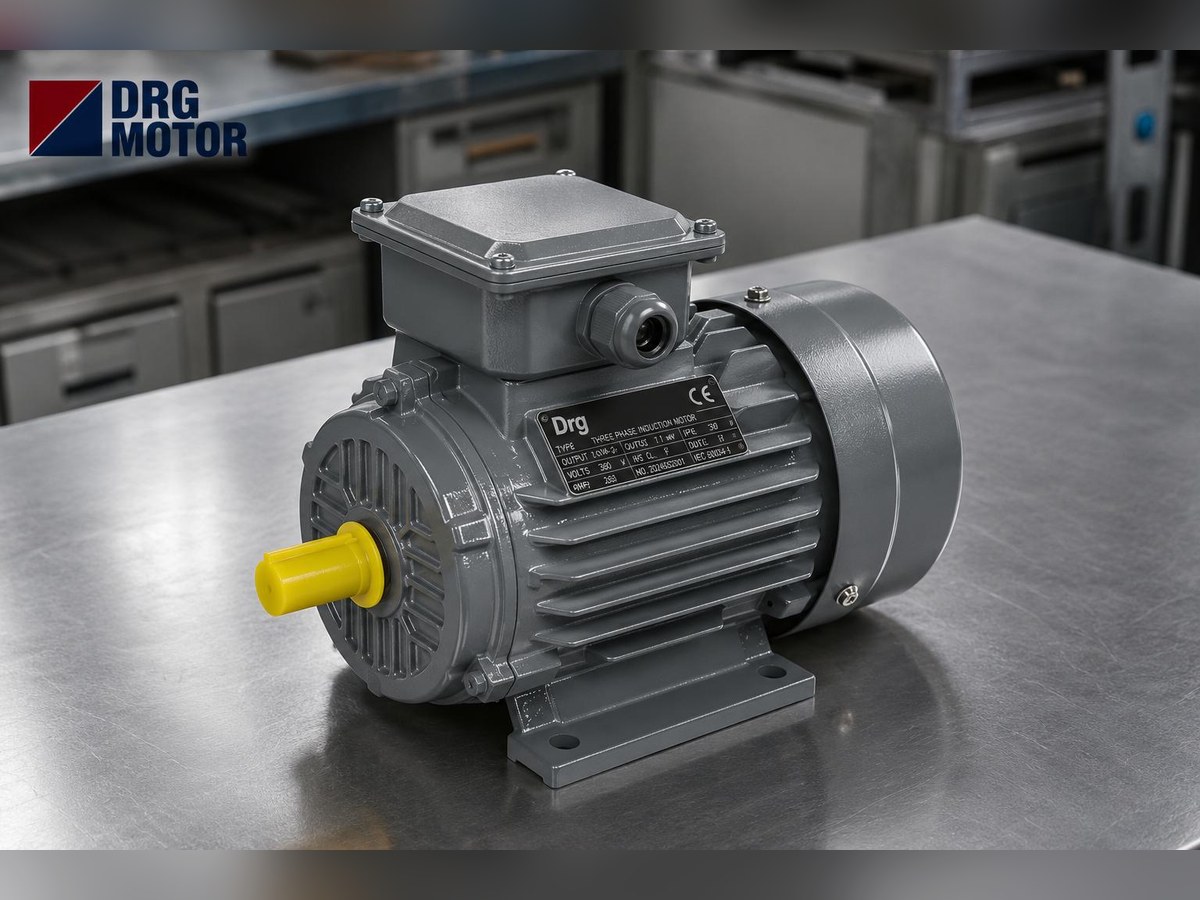
DRG Motor is a manufacturer, supplier and seller of electric motors. We do not sell the ripper or its blades, arbors, pulleys and gearboxes; hydraulic units, drives, spindle motors and servos stay outside our sales too. From us you get the three-phase induction motor for the arbor and for the feed drive; ratings are listed on Buy Electric Motors Online.
How does a multi-rip and timber resaw machine work?
The plank lies on a chain or slat feed track below and is pressed by upper pressure rollers as it travels into the blade pack. Spacers set the gap between blades, and this spacer pattern decides how many pieces come out. Motor load grows with the number of blades, the cutting height and the feed rate together: on the same machine, ripping thin laths with few blades and ripping a thick plank with many blades can differ several times over in load.
Single-arbor machine
All blades sit on one arbor, below or above the work. These machines are common in workshops and in pallet, batten and furniture frame production. Cutting height is less than half the blade diameter; makers quote 70–80 mm with a 350 mm blade and 110 mm with a 405 mm blade.
Top and bottom twin-arbor machine
To rip thick cants, two arbors are used, one cutting from below and one from above, with the two cuts meeting in the middle. Each arbor has its own motor, and the two are started one after the other, never together. Sawmills use this layout to break the rough cants coming from the headrig into boards.
How it differs from a band mill line
The other route in timber breakdown is the band mill, which saws the log with a single thin blade. The band saw cuts wide sections with little waste but makes one cut per pass; the multi-rip makes as many cuts per pass as it has blades, while each blade turns its own kerf of wood into chips. The motors differ too: a band mill uses a 4-pole motor turning a big wheel slowly, while a multi-rip arbor runs at 3,200–4,200 rpm and the motor is usually 2-pole. Band saw machine motors are covered on a separate page of ours.
Arbor motor: speed, belt and torque
Catalogues give arbor speeds of 3,200, 3,800 and 4,200 rpm. These are above the roughly 2,950 rpm of a 2-pole motor, so the motor is usually linked to the arbor by a multi-groove belt whose pulley ratio raises the speed. Reaching the same speed from a 4-pole motor needs more than double the ratio, with higher belt speed and bearing load, which is why the 2-pole solution is more common.
Worked example: a 37 kW single-arbor machine
Consider a machine with an arbor speed of 3,800 rpm, 350 mm blades and a 37 kW main motor. The values use DRG-200L2-2 catalogue data (rated torque: DRG-200L2-2, 119.4 Nm):
| Quantity | Operation | Result | Comment |
|---|---|---|---|
| Belt ratio (speed increase) | 3,800 / 2,960 | ≈ 1.28 | motor pulley larger than arbor pulley |
| Example pulley pair | 250 mm on the motor | ≈ 195 mm on the arbor | 250 / 1.284 |
| Torque at the saw arbor | 9,550 × 37 / 3,800 | ≈ 93 Nm | 119.4 Nm at the motor shaft |
| Rim speed of a 350 mm blade | π × 0.35 × 3,800 / 60 | ≈ 69.6 m/s | checked against the blade’s allowed speed |
| Direct-on-line starting current | 64.0 × 7.6 | ≈ 486 A | a heavy hit on panel and transformer |
| Current in the star step | 486.4 / 3 | ≈ 162 A | the blade pack must start empty |
Our pulley and belt calculator repeats this ratio with your real diameters. If the maximum speed marked on a blade is lower than the arbor speed, that blade must not be used on this machine; repeat the check whenever pulleys are changed.
Click to see current electric motor prices and order nowSEE PRICES →
How many kW is a multi-rip saw motor? Catalogue values
A) Motor ratings given by makers of multi-rip and timber resaw machines:
| Machine layout | Motor power | Single / total | Note |
|---|---|---|---|
| Single arbor, 350 mm blade, 80 mm cut | 30 kW | arbor motor; 1.5 kW feed belt separate | maker data sheet |
| Single arbor, 350 mm blade, 70 mm cut | 37 kW (options 22 / 30 kW) | arbor motor; feed 0.85 / 1.5 kW, pressure lift 0.37 kW | maker catalogue, small model |
| Single arbor, 405 mm blade, 110 mm cut | 45 kW (options 37 / 55 kW) | arbor motor; feed 3 kW | same catalogue, large model |
| Single arbor, 200–350 mm blades | 44 kW | arbor motor; feed motor separate | third maker |
| Top and bottom arbors, 250 mm cut | 2 × 22 to 2 × 55 kW | each arbor with its own motor; feed 1.5 kW | fourth maker |
| Heavy timber line, bottom arbor | 37–160 kW | bottom arbor motor | fifth maker, model series |
| Heavy timber line, top arbor | 37–132 kW | top arbor motor; total is both arbors | same maker |
In this machine group, depending on model, blade diameter and cutting height, single-arbor machines carry about 22–55 kW per arbor and heavy timber lines 37–160 kW main motors, while feed and lift motors fall between 0.37 and 3 kW. On a twin-arbor machine total power is the sum of both arbor motors, with the feed, lift and chip conveying motors on top. Hardwood, deep cuts and fast feed call for the larger motor option on the same frame.
B) Where DRG fits: 22–160 kW arbor motors match our 2-pole cast iron frames from 180M up to 315L, and 0.37–3 kW feed and lift motors our small aluminium or cast iron frames. Every rating in the table lies within our 0.25–355 kW span. What stays outside the range are direct-drive special spindle motors, where arbor and motor are one piece, and pole-changing motors; if your machine has one of these, ask us.
Starting, star-delta and stopping
Starting a heavy blade pack
Blades, spacers and pulley on the arbor form a sizeable rotating mass. From about 30 kW upward, rippers avoid direct starting and use star-delta or a soft starter to spare panel and transformer. Because torque drops in the star step, the machine is started with the feed stopped and no plank touching the blades; the feed motor should only be released once the main motor has switched to delta. For changeover time see our star-delta starting tool.
Kickback, run-down and braking
The main hazard on a multi-rip is a jammed strip being thrown back, which is why these machines carry anti-kickback fingers. The blade pack is also expected to stop quickly after switch-off. That is usually done by an electronic brake module in the panel that sends direct current into the winding. Motors with a mechanical brake are not in the DRG range; if your machine maker insists on a brake motor, tell us and we will look for a way forward together.
Feed, lift and chip motors
The feed belt or rollers are driven by a geared motor and their speed is set by an inverter; catalogues give feed speeds between 2 and 48 m/min. On thick hard planks the feed is slowed to keep main motor current at its limit, and some machines do this automatically by watching that current. Small motors that set the pressure unit and arbor height run only briefly. You can find the gearbox output speed with our gearbox output speed calculator; we do not supply the gearbox or the inverter.
Chip extraction
Since every blade turns a kerf’s width of wood into chips, a multi-rip produces heavy chip volumes; data sheets ask for 3,850–5,300 cubic metres per hour of extraction. The extraction fan has its own motor, sized from duct length, filter and airflow. For those fan motors see our Fan Motors category. Chips stuck on the main motor’s fins spoil cooling too; our motors are IP55, but the motor bay still has to be kept clean.
DRG motors for multi-rip saws
Examples from our 2-pole arbor and 4-pole feed models (current at 400 V):
| Model | Power / speed | Frame · shaft D×E | Current 400 V |
|---|---|---|---|
| DRG-90L-4 | 1.5 kW / 1445 rpm | 90L cast iron · 24×50 | 3.3 A |
| DRG-100L2-4 | 3 kW / 1450 rpm | 100L cast iron · 28×60 | 6.02 A |
| DRG-200L1-2 | 30 kW / 2960 rpm | 200L cast iron · 55×110 | 52.1 A |
| DRG-200L2-2 | 37 kW / 2960 rpm | 200L cast iron · 55×110 | 64 A |
| DRG-225M-2 | 45 kW / 2965 rpm | 225M cast iron · 55×110 | 76.8 A |
| DRG-250M-2 | 55 kW / 2970 rpm | 250M cast iron · 60×140 | 93.5 A |
| DRG-280M-2 | 90 kW / 2975 rpm | 280M cast iron · 65×140 | 152 A |
| DRG-225S-4 | 37 kW / 1485 rpm | 225S cast iron · 60×140 | 66.1 A |
The arbor motor is chosen 2-pole (3,000 rpm class) with a cast iron frame (0.55–355 kW); a 4-pole 1,500 rpm class motor can also be used once the pulley ratio is recalculated. Aluminium frames (0.25–11 kW) suit the feed drives. Every DRG model is a three-phase IEC induction machine, and 6-pole 1,000 rpm versions exist too. On most rippers the arbor motor stands on its feet (B3) on slide rails used to tension the belts; B5, B14, B34 and B35 can be ordered too. Ahead of the swap, copy power, speed, star/delta connection and voltage off the plate, and measure shaft, key, foot hole spacing and pulley hub length. We check these against the machine documents and confirm the model with you; we do not promise in advance that it will fit every machine. Shaft and frame sizes are on our technical drawings page.
Live price table
Prices for motors in arbor and feed ratings are read live from shop data:
| Model | Power / speed | Frame · current 400 V | Price |
|---|---|---|---|
| DRG-90L-42 HP | 1.5 kW · 1500 rpm | Cast iron 90L · 3.3 A | $144.14 (€128.73) Details & buy → |
| DRG-100L2-44 HP | 3 kW · 1500 rpm | Cast iron 100L · 6.02 A | $203.84 (€182.05) Details & buy → |
| DRG-180M-230 HP | 22 kW · 3000 rpm | Cast iron 180M · 38.5 A | $857.53 (€765.83) Details & buy → |
| DRG-200L1-240 HP | 30 kW · 3000 rpm | Cast iron 200L · 52.1 A | $1,273.02 (€1,136.88) Details & buy → |
| DRG-200L2-250 HP | 37 kW · 3000 rpm | Cast iron 200L · 64 A | $1,484.05 (€1,325.35) Details & buy → |
| DRG-225M-260 HP | 45 kW · 3000 rpm | Cast iron 225M · 76.8 A | $1,761.85 (€1,573.44) Details & buy → |
| DRG-250M-275 HP | 55 kW · 3000 rpm | Cast iron 250M · 93.5 A | $2,180.99 (€1,947.76) Details & buy → |
| DRG-280S-2100 HP | 75 kW · 3000 rpm | Cast iron 280S · 127 A | $2,883.93 (€2,575.53) Details & buy → |
DRG MOTOR motors are guaranteed against material and manufacturing defects for 2 years from the delivery date (warranty certificate).
Motors in this power range
- DRG-100L2-4 – 3 kW – 1450 rpm – 100L cast iron
- DRG-200L1-2 – 30 kW – 2960 rpm – 200L cast iron
- DRG-200L2-2 – 37 kW – 2960 rpm – 200L cast iron
- DRG-225M-2 – 45 kW – 2965 rpm – 225M cast iron
- DRG-250M-2 – 55 kW – 2970 rpm – 250M cast iron
Click to see current prices and order these motors nowSEE PRICES →
Browse the products, ask for a quote: all motors suitable for your multi-rip are on Buy Electric Motors Online. Share a photo of the main motor plate, the arbor speed and the pulley diameters on WhatsApp, or ring +90 (542) 666 11 11, and we can narrow the choice quickly.
Frequently asked questions
Is a bigger motor enough to run more blades on a multi-rip?
Not on its own. Arbor diameter, pulley and belt, bearings and the feed system must also suit the new load. Whether the machine accepts more power is for its maker to say, and panel, cable and protection are reselected as well.
Should a timber resaw motor be 2-pole or 4-pole?
It depends on arbor speed and pulley layout. Start from the speed printed on the old motor plate; if the pole count changes, do not run the machine before the pulleys are recalculated.
Why is the feed motor separate and small?
Feed speed follows the cutting load and changes often, a job for a small geared motor and an inverter. The main motor turns at a fixed speed and only powers the cut.
Resaw or multi-rip motor questions: +90 (542) 666 11 11, info@drgmotor.com, or our contact form.


