 English
 Le français
 Türkçe

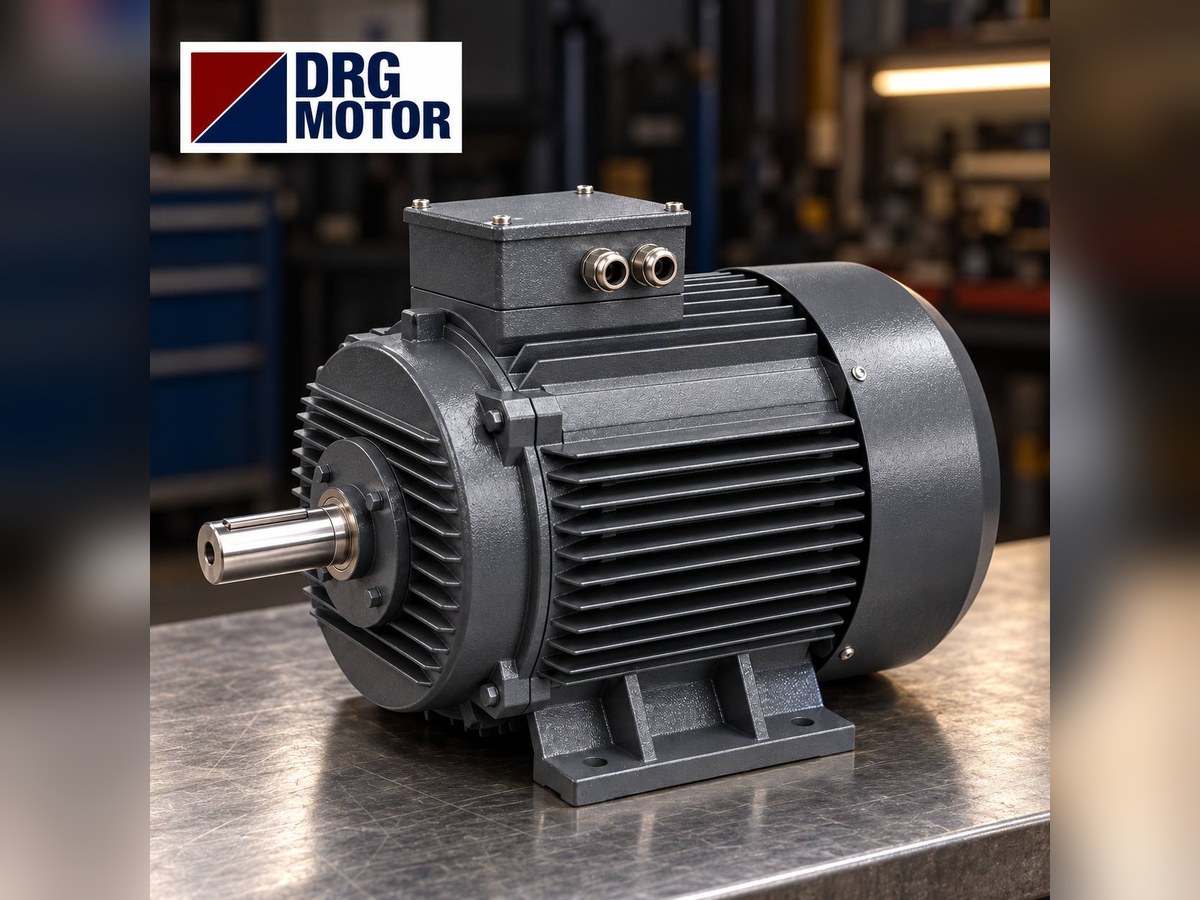
A chemical pump motor is a standard three-phase induction motor that turns the shaft of a process pump through a coupling; resisting fluids such as acids, alkalis, solvents or hot oil is the job of the pump's casing, impeller and seal materials, not of the motor. The motor is chosen from the fluid's density and viscosity, the pump's flow and head, and the environment in which the motor stands. At the same pump and duty point, a liquid with a density of 1,520 kg/m³ needs about 52% more shaft power than water; in the example below this difference moves the motor from 5.5 kW to 7.5 kW. If the area is explosive, an Ex-protected motor is required, and there is no Ex motor in the DRG range.
This page explains how the motor is selected for ISO 5199 and ANSI B73 class process pumps, the power range seen on the market and how responsibilities are divided. You can see suitable motors and current prices among the 120 models on the Buy Electric Motors Online page. Other pump applications: Pump Motors.
What is a process and chemical pump, and where is it used?
By operating principle a process pump is a single-stage, end-suction centrifugal pump. Its installation is horizontal: the pump sits on a base frame with its own bearing housing and the motor is coupled on the same frame. Its purpose is to move corrosive, hot or hazardous liquids in the chemical and process industries. What sets it apart from an ordinary water pump are two families of standards:
- ISO 5199: defines technical requirements for class II centrifugal pumps; dimensions and rating steps mostly follow ISO 2858 [2][3].
- ANSI/ASME B73.1: a horizontal process pump of North American origin with standardised dimensions [1][4]. Its vertical in-line counterpart is B73.2.
One manufacturer's ISO 5199 range reaches 3,300 m³/h flow, 162 m head and -40 to +400 °C fluid temperature at 50 Hz [3]. These limits are far wider than for water pumps and the places of use are just as varied: chemical and petrochemical plants, refinery utilities, pulp and paper, sugar and alcohol plants, electroplating and surface treatment lines, transfer lines ahead of chemical dosing in treatment plants.
How it differs from an end-suction water pump, and how the motor drives it
From outside, a process pump looks like an EN 733 end-suction water pump; both have a volute casing and a horizontal shaft. The difference is in how heavy the design is: ISO 5199 pumps offer a replaceable shaft sleeve and double mechanical seal options [3], and some ranges come in sealless magnetic-drive versions [4]. Centrifugal, end-suction and in-line pump motors are covered on separate pages.
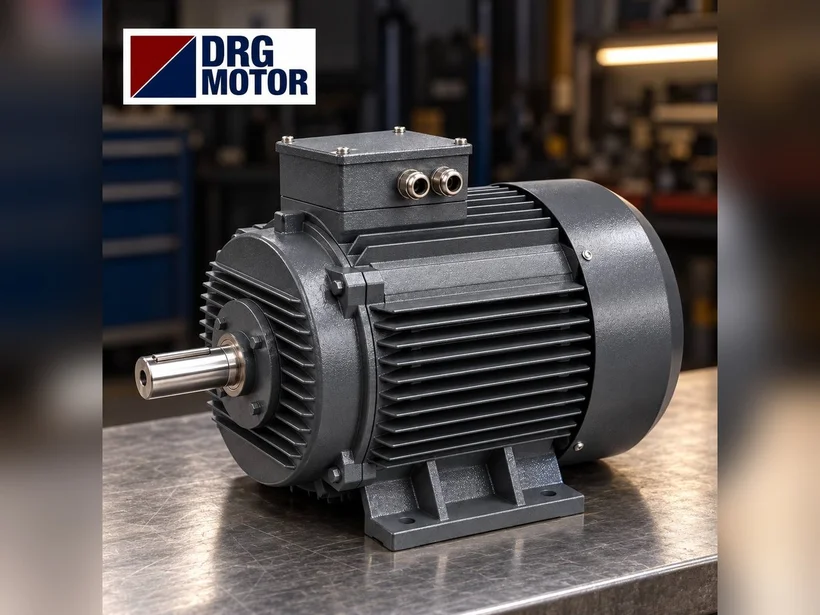
The drive is almost always direct and coupled. Pump and motor share a steel base frame; the motor is a foot-mounted (B3) standard motor connected to the pump shaft by a flexible or spacer coupling [2]. A spacer coupling lets the back of the pump (bearing housing, impeller, seal) be removed without moving the motor; this is called a back pull-out design. For the motor this means that, as long as shaft end, shaft height and foot holes match the same IEC frame, the motor can be changed without touching the pump. Coupling alignment must be checked again after the change. The exact mounting type is taken from the pump manufacturer's drawing.
On speed, process pumps are mostly 2- and 4-pole. ANSI pump performance curves are given at 3500 and 1750 rpm for 60 Hz and at 2850 and 1450 rpm for 50 Hz [1]. For fluids carrying abrasive solids or prone to cavitation a lower speed is preferred; that decision belongs to the pump manufacturer.
Materials belong to the pump, the environment to the motor: the Ex distinction
The most common mistake when choosing a chemical pump is to look for a "chemical-resistant motor". The fluid never touches the motor; all the motor needs to know is the pump's shaft power and speed. Fluid resistance is solved on the pump side: casing and impeller material (cast iron, stainless steel, duplex, special alloys or plastic lining), seal type and gasket material. In one manufacturer's catalogue the material variant is chosen explicitly "on the basis of the liquid to be pumped" [2].
What concerns the motor is the environment around it. Three cases are distinguished:
- Normal industrial environment: clean or slightly dusty pump room, no explosive gas. A standard three-phase motor is suitable.
- Aggressive vapour or frequent washing: acid vapour or chemical washdown affects the motor housing, paint and terminal box. Report this condition before ordering; keeping the motor away from the vapour source and not directing wash water at the terminal box are the first measures.
- Explosive atmosphere (ATEX zone): where solvents, fuels or flammable gases are present, pump and motor must carry the relevant explosion-protection certification. Pump manufacturers offer this version separately [2]. There is no Ex motor in the DRG range; DRG motors are not used in these zones.
The zone classification is set by the plant's explosion protection document; if in doubt, ask the plant's safety or process safety officer before requesting a motor.
Click to see current electric motor prices and order nowSEE PRICES →
How many kW do process pump motors need?
A) Motor power seen in commercial pump models
| Model group / capacity | Motor power | Single / total | Source |
|---|---|---|---|
| Maker A, ISO 5199, smallest | 0.25 kW | Single motor | [2] |
| Maker A, ISO 5199, largest | 355 kW | Single motor | [2] |
| Maker B, ANSI, small power end | up to 30 kW | Single motor | [1] |
| Maker B, ANSI, medium power end | up to 149 kW | Single motor | [1] |
| Maker B, ANSI, largest group | up to 261 kW | Single motor | [1] |
In this pump group, motor options of about 0.25–355 kW are seen depending on the manufacturer's model and capacity [1][2]. Each pump in the table has a single motor. The values in the ANSI rows are the highest power that bearing group can carry; pumps with small impellers in the same group run at much lower power. Power rises in direct proportion to the fluid's density, together with flow and head. According to one manufacturer's catalogue, a liquid with a specific gravity of 1.2 needs 20% more power in the same pump, while flow, head and pump efficiency stay unchanged [2]. Viscosity acts in a more complex way: power consumption rises while head, flow and pump efficiency fall [2]. So carrying a pump selection made for water straight over to a thick fluid leaves the motor undersized.
B) Motors with a match in the DRG range
The whole 0.25–355 kW range overlaps with DRG's 0.25–355 kW, 1500 and 3000 rpm range. The part that does not overlap is about protection, not power: pumps that need an Ex-certified motor for explosive atmospheres are outside the DRG range. ANSI pumps from North America may come with NEMA-dimensioned 60 Hz motors; in that case shaft, feet and coupling fit are checked separately when moving to an IEC motor.
Worked example: how does a dense liquid enlarge the motor?
Shaft power is found from P = ρ·g·Q·H / η_pump (ρ kg/m³, Q m³/s, H m, P W). A process pump will deliver 25 m³/h of liquid at 30 m head, pump efficiency 0.58, 2-pole.
| Fluid | Density | Shaft power | Motor |
|---|---|---|---|
| Water | 1,000 kg/m³ | ≈ 3.52 kW | 5.5 kW |
| Dense solution | 1,520 kg/m³ | ≈ 5.36 kW | 7.5 kW |
For motor power, one manufacturer's catalogue gives a safety margin table according to ISO 5199: if the required pump power is up to 4.3 kW a 5.5 kW motor is chosen, up to 6.1 kW a 7.5 kW motor [2]. So with water DRG-132S1-2 (5.5 kW, 2930 rpm, 10.1 A at 400 V) is enough, while the dense liquid needs DRG-132S2-2 (7.5 kW, 2930 rpm, 13.7 A at 400 V). The calculation assumes viscosity close to water; for a viscous fluid the pump manufacturer's corrected curve should be used. If the pump is commissioned on water and then switched to the dense liquid, the motor is chosen for the heavy fluid. You can do the same calculation with your own values in the Pump & Fan Motor Power calculator.
Before asking for a motor for a chemical pump, gather the following:
- Pump label or data sheet: flow, head, speed; ISO or ANSI.
- The fluid's density, its viscosity at operating temperature and the temperature.
- The highest shaft power given by the pump manufacturer (at the maximum-flow end of the operating range).
- Old motor's nameplate: kW, rpm, IEC or NEMA frame, shaft diameter, voltage and frequency.
- The zone where the motor stands: is there an explosive atmosphere classification (if so, Ex is required)?
- Environment: acid vapour, washdown, open area or closed pump room.
- Flow control: valve or inverter; starting method.
Matching DRG motors to process pumps
DRG Motor is a manufacturer, supplier and seller of electric motors. Our range covers 0.25–11 kW in aluminium frames and 0.55–355 kW in cast iron; 1000, 1500 and 3000 rpm; 3-phase, 230/400 V or 400/690 V; mounting B3, B5, B14 and B35 (with an order note). For base-mounted, coupled ISO 5199 pumps outside explosive atmospheres, a foot-mounted B3 motor is the direct match. Example models for frequently seen powers:
| Model | Power / speed | Frame | Current 400 V |
|---|---|---|---|
| DRG-132S1-2 | 5.5 kW / 2930 rpm | 132S cast iron | 10.1 A |
| DRG-132S2-2 | 7.5 kW / 2930 rpm | 132S cast iron | 13.7 A |
| DRG-160M1-2 | 11 kW / 2945 rpm | 160M cast iron | 19.6 A |
| DRG-180M-2 | 22 kW / 2955 rpm | 180M cast iron | 38.5 A |
| DRG-132M-4 | 7.5 kW / 1460 rpm | 132M cast iron | 14.3 A |
| DRG-160L-4 | 15 kW / 1465 rpm | 160L cast iron | 27.3 A |
In a process pump the reason a motor burns out is often not the motor but a changed fluid: a product whose density or viscosity has risen raises the current. Before changing the motor, measure the current and check the pump's duty point with the current fluid. Our article on electric motor supply for pumps can also help. DRG MOTOR motors are guaranteed against material and manufacturing defects for 2 years from the delivery date (warranty certificate).
| Model | Power / speed | Frame · current 400 V | Price |
|---|---|---|---|
| DRG-112M-25.5 HP | 4 kW · 3000 rpm | Cast iron 112M · 7.45 A | $225.65 (€201.52) Details & buy → |
| DRG-132S-47.5 HP | 5.5 kW · 1500 rpm | Cast iron 132S · 10.7 A | $342.01 (€305.44) Details & buy → |
| DRG-132S1-27.5 HP | 5.5 kW · 3000 rpm | Cast iron 132S · 10.1 A | $338.72 (€302.50) Details & buy → |
| DRG-132M-410 HP | 7.5 kW · 1500 rpm | Cast iron 132M · 14.3 A | $394.89 (€352.66) Details & buy → |
| DRG-132S2-210 HP | 7.5 kW · 3000 rpm | Cast iron 132S · 13.7 A | $369.43 (€329.92) Details & buy → |
| DRG-160M-415 HP | 11 kW · 1500 rpm | Cast iron 160M · 20.4 A | $568.76 (€507.94) Details & buy → |
| DRG-160M1-215 HP | 11 kW · 3000 rpm | Cast iron 160M · 19.6 A | $527.95 (€471.49) Details & buy → |
| DRG-180M-230 HP | 22 kW · 3000 rpm | Cast iron 180M · 38.5 A | $857.53 (€765.83) Details & buy → |
| DRG-200L-440 HP | 30 kW · 1500 rpm | Cast iron 200L · 53.8 A | $1,235.00 (€1,102.93) Details & buy → |
DRG motors for process and chemical pumps
- DRG-132S1-2 – 5.5 kW – 2930 rpm – 132S cast iron
- DRG-132S2-2 – 7.5 kW – 2930 rpm – 132S cast iron
- DRG-160M1-2 – 11 kW – 2945 rpm – 160M cast iron
- DRG-180M-2 – 22 kW – 2955 rpm – 180M cast iron
- DRG-132M-4 – 7.5 kW – 1460 rpm – 132M cast iron
- DRG-160L-4 – 15 kW – 1465 rpm – 160L cast iron
Click to see current prices and order these motors nowSEE PRICES →
Chemical pump motor: FAQ
Does a chemical pump need a special motor?
Not because of the fluid; chemical resistance comes from the pump's materials. A special motor is needed because of the environment: in an explosive zone an Ex-certified motor is mandatory, and that motor is not in the DRG range.
Why is the motor power for an acid pump higher than for water?
Shaft power is directly proportional to density. A liquid with a specific gravity of 1.52 needs about 52% more power than water at the same flow and head; if viscosity is also high, the difference grows further.
Can I replace the NEMA motor of an ANSI pump with an IEC motor?
Usually yes, but shaft diameter, shaft height and foot dimensions differ. Check the coupling hub, base frame holes and, if needed, an adapter plate, and allow for the fact that speeds given for 60 Hz drop on a 50 Hz network.
Does motor selection change for a magnetic-drive pump?
The method is the same: the motor is chosen from the shaft power and speed given by the pump manufacturer. The magnetic coupling's own losses and starting behaviour appear in the pump manufacturer's data.
Send us the pump data sheet, the fluid details and the old motor's nameplate, and we will confirm the right DRG model together. Phone +90 (542) 666 11 11, e-mail [email protected], contact page. For all models and current prices, visit Buy Electric Motors Online.
Sources
- Goulds Pumps (ITT) – 3196 i-FRAME ANSI Process Pump (broşür) – ANSI B73.1 process pump; maximum power per power end STi 30 kW, LTi 149 kW, i-17 261 kW; 50 Hz curves at 2850 and 1450 rpm.
- Grundfos – NBG, NBGE, NKG, NKGE Data booklet, 50 Hz – NKG pumps comply with ISO 5199; motor sizes 0.25–355 kW; long-coupled with B3 (IM 1001) standard motor on common base frame; ISO 5199 safety margin table; SG 1.2 needs 20% more power; ATEX on request.
- KSB – MegaCPK Standardised Chemical Pumps (tip serisi kitapçığı) – ISO 5199 technical requirements, ISO 2858 dimensions; at 50 Hz flow ≤ 3300 m³/h, head ≤ 162 m, fluid temperature -40 to +400 °C.
- Ruhrpumpen – Industrial Pumps Catalog 2024 – rows for ISO 2858/5199 process pump, ANSI B73.1 process pump and sealless magnetic-drive process pump.


