 English
 Le français
 Türkçe

In a food factory a conveyor does more than move packs; it cools bread from the oven in a spiral tower, carries burgers around a drum in a spiral freezer, lifts washed vegetables to the cutter on an elevator and passes packs through a metal detector. Motors on these lines are mostly small and geared: maker data sheets show 0.37–2.2 kW for belts and elevators and 0.55–2.2 kW for spiral drum drives. What decides the motor is less its power than the belt speed, which sets how long the product stays on the line.
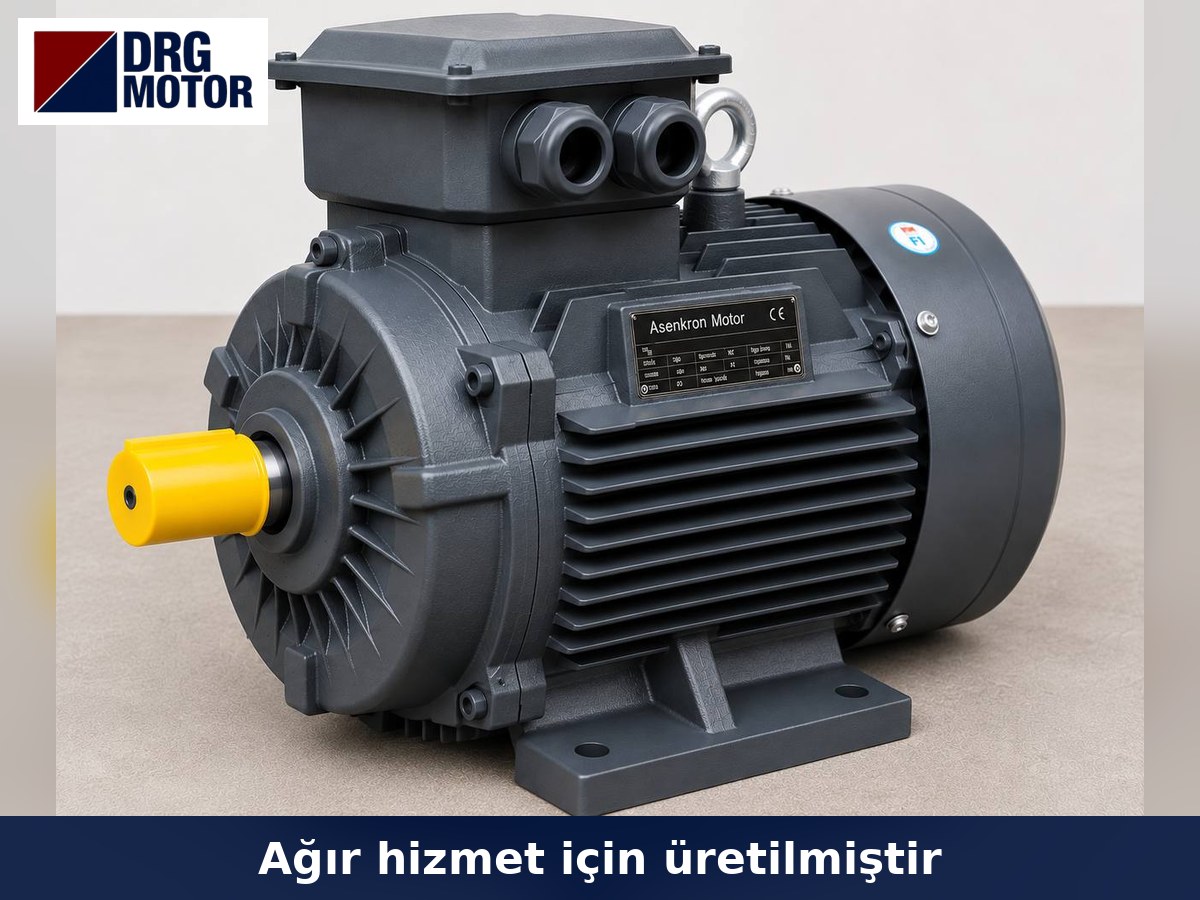
DRG Motor is a manufacturer, supplier and seller of electric motors. We do not sell the conveyor, the belt or modular chain, spiral towers, gearboxes or inverters; servo and stepper motors used on positioning axes are not in our range either. For the three-phase induction motors that turn belts, drums and elevators, see Buy Electric Motors Online.
Which conveyors are found on a food production line?
Process conveyors carry the product itself and are often part of a process step: cooling, freezing, drying, washing or inspection. Bottle and can conveyors on a filling line instead move packaging from machine to machine; bottle chains on fillers are handled in a separate filling line conveyor motor guide, and case-carrying roller lines in our roller conveyor motor article. This page deals with process belts in contact with the product.
Spiral cooling and freezing towers
In a spiral the belt climbs or descends tier by tier around a rotating drum; the drum drags the belt by friction, and a separate pull motor at the top or outfeed keeps belt tension. On the first maker’s bread cooling spiral the main motor is 0.55 kW and the top pull motor 0.37 kW. On the second maker’s 13-tier freezer the drum drive is 3 hp and the outfeed belt 1.5 hp; the belt runs at 30 ft/min (about 9.14 m/min) and takes the product through in 21 minutes. In the third maker’s series capacity rises from 250 to 1,000 kg/h while the belt motor stays at 2.2 kW; what grows is the refrigeration compressor (37–150 kW), which is not a conveyor motor.
Flat, incline and cleated belts
On the fourth maker’s heavy-duty belt the motor grows with speed: 0.75 kW at 6 m/min, 1.5 kW at 12 and 18 m/min, 1.5–2.2 kW at 72 m/min. The fifth maker’s 400 mm L-shape cleated belt lifts product about 2.65 m at 15 m/min on 0.75 kW. On a small PU belt with metal detector the motor is 0.4 kW, while the spare parts list of the same manual says 0.75 kW; go by the plate when replacing. For motors given at a non-standard rating such as 0.4 kW, the next standard rating (0.55 kW) is chosen.
Washing elevators and bucket transport
On fruit and vegetable washing lines the product leaves the tank on a perforated belt or cleated elevator; on the seventh maker’s line the elevator motor is 0.37–0.55 kW. Because the elevator motor sits just above the water, its terminal box entry should face down and a splash cover should protect it. Our motors are IP55. A stainless housing for hose-down or permanently wet duty is not in our range, so check with us first. Single-phase motors on small plug-in belts are outside our range as well.
How many kW is a food conveyor motor? Catalogue values
A) Motor ratings printed in process conveyor data sheets:
| Line / conveyor | Motor power | Single / total | Note |
|---|---|---|---|
| Bread cooling spiral, 8–27 tiers: main drive | 0.55 kW | induction, single motor | first maker |
| Same spiral: top pull motor | 0.37 kW | single motor; total 0.92 kW | first maker |
| Spiral freezer, 13 tiers, drum about 3.7 m dia: drum drive | 3 hp (about 2.2 kW) | gear ratio 126.75 | second maker |
| Same freezer: outfeed belt | 1.5 hp (about 1.1 kW) | single motor | second maker |
| Spiral freezer series, 250–1,000 kg/h: belt motor | 2.2 kW | same on every model | third maker |
| Heavy-duty belt conveyor, 600–1,200 mm | 0.75–2.2 kW | by speed | fourth maker |
| L-shape cleated incline belt, 400 mm, 15 m/min | 0.75 kW | single motor | fifth maker |
| PU belt with metal detector, 1.3–8 m/min | 0.4 kW (0.75 kW in spare list) | geared motor | sixth maker |
| Fruit and vegetable washing-milling line: elevator | 0.37–0.55 kW | single motor | seventh maker |
Depending on model and speed, these lines use roughly 0.37–2.2 kW for belts and elevators, 0.55–2.2 kW for spiral drum drives and 0.37–1.1 kW for pull and outfeed belts. Freezer compressors and fans are not included in these values.
B) Where DRG fits: from DRG-712-4 at 0.37 kW to DRG-100L1-4 at 2.2 kW, every 4-pole rating in the table has a counterpart, while slow belts can take 6-pole 80–90 frames. Belt motors under 0.25 kW fall below our smallest frame, and positioning axes driven by servo or stepper units are left to the line builder.
Click to see current electric motor prices and order nowSEE PRICES →
Worked example: dwell time and belt speed in a spiral freezer
The second maker’s data sheet gives the belt path length: 9.14 m/min × 21 min ≈ 192 m. If the product must stay longer or shorter in the spiral, belt speed follows from that length; the drum gearbox ratio stays fixed and the data sheet speed is assumed to match 50 Hz:
| Required dwell | Belt speed | Ratio to data sheet | Drum motor (example) |
|---|---|---|---|
| 21 min (data sheet) | 9.14 m/min | 1.00 | 50 Hz |
| 25 min | about 7.68 m/min | about 0.84 | about 42 Hz |
| 30 min | about 6.40 m/min | about 0.70 | about 35 Hz |
| 18 min | about 10.7 m/min | about 1.17 | about 58 Hz, not advised |
Thicker burgers or product entering warmer need a longer dwell; the belt is slowed and capacity drops by the same ratio. Between 35 and 42 Hz the motor runs comfortably at constant torque; above 50 Hz torque falls, which is not advised since belt tension in a spiral is already high. If very slow running becomes routine, changing the gearbox ratio helps the motor stay cool; the gearbox output speed calculator turns a target belt speed into a ratio.
Line motors and currents
Matching the data sheet ratings with our range (rated torque: DRG-100L1-4, 14.5 Nm):
| Conveyor | DRG equivalent | Rated current (400 V) | Note |
|---|---|---|---|
| Spiral drum drive, 2.2 kW | DRG-100L1-4 | 4.52 A | Is/In = 7.6 |
| Spiral outfeed belt, 1.1 kW | DRG-90S-4 | 2.48 A | geared |
| Cleated incline belt, 0.75 kW | DRG-802-4 | 1.75 A | starts loaded |
| Cooling spiral main drive, 0.55 kW | DRG-801-4 | 1.31 A | top pull 0.37 kW: DRG-712-4 |
The fourth maker’s table follows the same logic: doubling speed from 6 to 12 m/min doubles the motor from 0.75 to 1.5 kW, because power is pull force times speed. A cleated incline belt starts loaded; use an inverter ramp rather than star-delta. The star-delta tool shows why DOL, star-delta and soft start behave differently on a loaded belt.
DRG motors for food production line conveyors
Our models in belt, elevator and spiral drive sizes, with 400 V current:
| Model | Power / speed | Frame · shaft D×E | Current 400 V |
|---|---|---|---|
| DRG-712-4 | 0.37 kW / 1340 rpm | 71 aluminium · 14×30 | 0.92 A |
| DRG-801-4 | 0.55 kW / 1400 rpm | 80 cast iron · 19×40 | 1.31 A |
| DRG-802-4 | 0.75 kW / 1420 rpm | 80 cast iron · 19×40 | 1.75 A |
| DRG-90S-4 | 1.1 kW / 1445 rpm | 90S cast iron · 24×50 | 2.48 A |
| DRG-90L-4 | 1.5 kW / 1445 rpm | 90L cast iron · 24×50 | 3.3 A |
| DRG-100L1-4 | 2.2 kW / 1450 rpm | 100L cast iron · 28×60 | 4.52 A |
| DRG-802-6 | 0.55 kW / 890 rpm | 80 cast iron · 19×40 | 1.43 A |
| DRG-90L-6 | 1.1 kW / 945 rpm | 90L cast iron · 24×50 | 2.69 A |
On process belts the motor is mostly flanged with B5 or B14 to a worm or helical gearbox; a spiral drum turns through its own reducer and chain. These ratings fall on our aluminium frames; on slow, heavy belts a 6-pole motor reduces the gearbox ratio needed. When replacing, write down the removed motor’s plate (it may carry 60 Hz and hp values), flange type and size P, shaft diameter and key; with those we check the line documents and confirm the swap together, never without measurements.
B5 dimensions for geared belt motors
B5 flange values of small frames seen on process conveyors, mm:
| Frame | Shaft D×E | Flange P / M / N | Hole S |
|---|---|---|---|
| 71 | 14×30 | 160 / 130 / 110 | 10 |
| 80 | 19×40 | 200 / 165 / 130 | 12 |
| 90S/90L | 24×50 | 200 / 165 / 130 | 12 |
| 100L | 28×60 | 250 / 215 / 180 | 14.5 |
The shaft entering the gearbox input must keep D × E and spigot N of the old motor. For the difference between B5 and B14 see our flange motor selection article.
Live price table
Prices of our models in process conveyor sizes are pulled live from the shop:
| Model | Power / speed | Frame · current 400 V | Price |
|---|---|---|---|
| DRG-711-40.37 HP | 0.25 kW · 1500 rpm | Aluminium 71 · 0.66 A | $73.16 (€65.33) Details & buy → |
| DRG-712-40.5 HP | 0.37 kW · 1500 rpm | Aluminium 71 · 0.92 A | $76.76 (€68.55) Details & buy → |
| DRG-802-60.75 HP | 0.55 kW · 1000 rpm | Cast iron 80 · 1.43 A | $106.98 (€95.54) Details & buy → |
| DRG-801-40.75 HP | 0.55 kW · 1500 rpm | Cast iron 80 · 1.31 A | $91.72 (€81.91) Details & buy → |
| DRG-802-41 HP | 0.75 kW · 1500 rpm | Cast iron 80 · 1.75 A | $101.93 (€91.03) Details & buy → |
| DRG-90S-41.5 HP | 1.1 kW · 1500 rpm | Cast iron 90S · 2.48 A | $124.09 (€110.82) Details & buy → |
| DRG-90L-42 HP | 1.5 kW · 1500 rpm | Cast iron 90L · 3.3 A | $144.14 (€128.73) Details & buy → |
| DRG-100L1-43 HP | 2.2 kW · 1500 rpm | Cast iron 100L · 4.52 A | $188.32 (€168.18) Details & buy → |
DRG MOTOR motors are guaranteed against material and manufacturing defects for 2 years from the delivery date (warranty certificate).
Motors in this power range
- DRG-801-4 – 0.55 kW – 1400 rpm – 80 cast iron
- DRG-802-4 – 0.75 kW – 1420 rpm – 80 cast iron
- DRG-90L-4 – 1.5 kW – 1445 rpm – 90L cast iron
- DRG-100L1-4 – 2.2 kW – 1450 rpm – 100L cast iron
- DRG-802-6 – 0.55 kW – 890 rpm – 80 cast iron
Click to see current prices and order these motors nowSEE PRICES →
Browse the products, ask for a quote: suitable motors for the belts of your food line are on Buy Electric Motors Online. Spiral, incline, flat belt or elevator? Tell us which, add the belt speed in m/min and a plate photo on WhatsApp, or phone +90 (542) 666 11 11.
Frequently asked questions
Why does a spiral freezer drum motor struggle?
An iced drum and dirty slide rails raise friction, and a mismatch between pull motor and drum speed over-tensions the belt. After defrost and cleaning, compare the measured current with the rated current on the plate.
Should a conveyor motor be 4-pole or 6-pole?
Keep the old motor’s speed; if speed changes, the gearbox ratio must change too, otherwise belt speed and dwell time change.
Where is the food conveyor motor price shown?
Every belt-size motor on this page has its figure in the live table, fed directly by our online shop.
Questions: +90 (542) 666 11 11 · info@drgmotor.com · contact page.


