 English
 Le français
 Türkçe

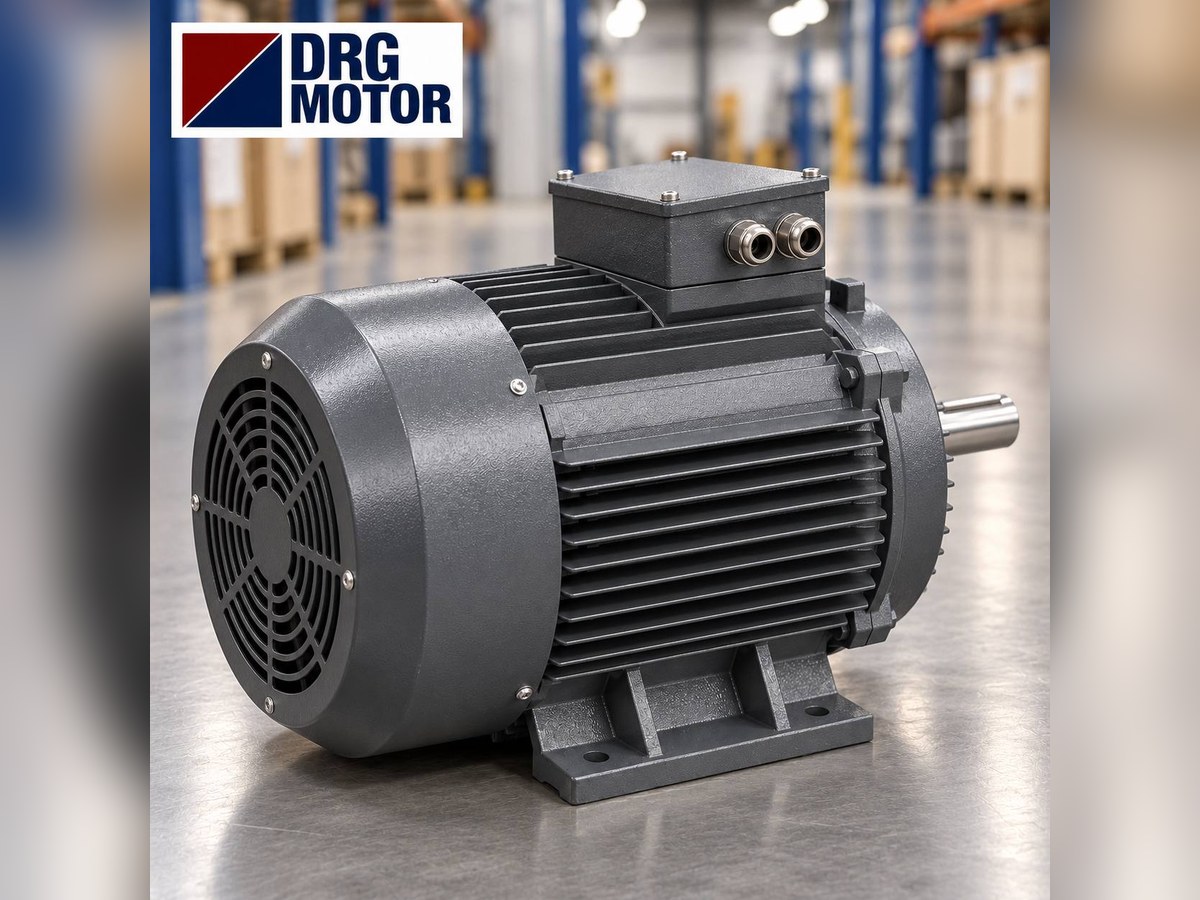
Agricultural augers and conveyors move grain horizontally or on an incline after harvest: the unloading auger that draws grain from the bottom of a bin, the sweep auger that gathers the last grain left on the bin floor, long tube augers that fill trailers and trucks, and chain or belt conveyors at larger sites. In each one the electric motor turns the auger shaft or the conveyor's drive sprocket through a belt or gearbox. In manufacturer catalogues the motor of this equipment is roughly 1.1–18.6 kW on augers and 1.5–45 kW on chain and belt grain conveyors.
This page covers transport equipment at farm and grain-store scale; the general power formula is explained in our article on auger motor selection: kW and speed, so here the focus is on how to read catalogue tables. Feed-mill augers have their own page (Feed Auger and Conveying System Electric Motors), and quarry belts sit in the stone crushing category. For products and the current list, see Buy Electric Motors Online.
From bin to trailer: which equipment moves the grain?
In the post-harvest chain the elevator lifts grain upwards; all remaining horizontal and inclined transport is the job of augers and conveyors. The same farm can have four different tasks, each with its own motor requirement.
Bin unloading auger
In flat-bottom bins, grain is taken out through the centre outlet in the floor and an auger in a channel set into the floor. The auger is driven from a power head outside, beside the bin, so the motor stays out of the dust and damp inside. The end of the unloading auger usually connects to an elevator boot or a loading auger.
Bin floor sweep auger
When grain stops flowing out by itself, a cone-shaped pile remains on the bin floor. The sweep auger turns across the floor and drags this pile to the centre. According to one manufacturer's manual, the motor sits on the power head outside the bin and one motor can drive both the unloading auger and the sweep. Nobody should enter the bin while the sweep auger is running; these augers are known to cause fatal accidents.
Trailer and truck loading auger
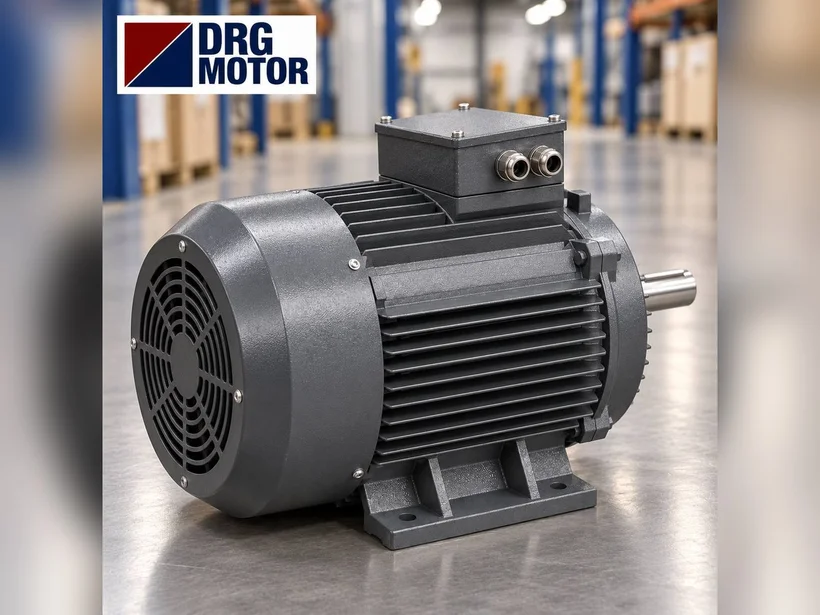
Long tube augers are mounted on a wheeled frame at an angle; they move grain from bin to trailer, trailer to bin or between two bins. Length can range from 8 m to over 20 m, and the steeper the angle, the less grain the same tube carries. The motor sits on a stand beside the drive box at the tube end and is belt-connected.
Chain and belt grain conveyors
In large silo groups, chain (drag) conveyors are used on long runs from the intake pit to the elevator and across the top of the silos; the slow chain speed carries grain without breaking it. Belt conveyors are preferred for seed and breakage-sensitive crops, and in portable form for truck unloading.
How many kW is an agricultural auger or conveyor motor?
A) Power values in manufacturer catalogues
| Equipment / size | Motor power | Single or total | Note |
|---|---|---|---|
| Tube auger 100–150 mm, ≤12.5 m | 1.1–5.5 kW | Single motor | Belt or geared drive |
| Fixed auger 130–300 mm, 10–70 t/h | 1.1–15 kW | Single motor | Length 1–12 m |
| Hopper auger 200 mm, 30 t/h | 5.5–9 kW | Single motor | Length 6–14 m |
| Loading auger 152 mm, 8–19 m | 2.2–5.6 kW | Single motor | 3–7.5 HP in catalogue |
| Loading auger 330 mm, 9.5–12.5 m | 14.9–18.6 kW | Single motor | 20–25 HP in catalogue |
| Bin sweep auger, 7–28 m bin | 1.5–5.6 kW | Single motor | Motor outside the bin |
| Chain conveyor 28–251 t/h | 1.5–45 kW | Single motor | Length up to 70–100 m |
| Belt conveyor 600 mm, 6–14 m | 3–5.5 kW | Single motor | Hollow-shaft geared motor |
| Portable belt conveyor | 9.3–11.2 kW | Single motor | 12.5–15 HP with dry wheat |
On farm and store-scale augers, motors of roughly 1.1–18.6 kW are seen depending on maker, diameter and length; on chain conveyors this rises with capacity and length up to 45 kW. Each row of the table is the single motor of one machine. In a silo group, the unloading, sweep, loading and conveyor motors do not all run together; adding them up gives the site figure, not the rating of any single auger. Horsepower ratings from US catalogues appear here in kW (× 0.746).
B) The match in the DRG range
DRG Motor is an electric motor manufacturer, supplier and seller. DRG motors that suit auger and conveyor drives are three-phase, offered in 2, 4 and 6-pole versions, in a light aluminium frame up to 11 kW and a cast iron frame up to 355 kW. Lower ratings are wound 230/400 V and higher ones 400/690 V; foot or flange mounting is noted when ordering. All of the 1.1–45 kW values in the table are covered by these steps; for portable augers an aluminium frame up to 11 kW can also be considered because it is lighter.
| Model | Power / speed | Frame · current 400 V | Price |
|---|---|---|---|
| DRG-90L-42 HP | 1.5 kW · 1500 rpm | Cast iron 90L · 3.3 A | $144.14 (€128.73) Details & buy → |
| DRG-100L1-43 HP | 2.2 kW · 1500 rpm | Cast iron 100L · 4.52 A | $188.32 (€168.18) Details & buy → |
| DRG-100L2-44 HP | 3 kW · 1500 rpm | Cast iron 100L · 6.02 A | $203.84 (€182.05) Details & buy → |
| DRG-112M-45.5 HP | 4 kW · 1500 rpm | Cast iron 112M · 7.95 A | $254.38 (€227.18) Details & buy → |
| DRG-132S-47.5 HP | 5.5 kW · 1500 rpm | Cast iron 132S · 10.7 A | $342.01 (€305.44) Details & buy → |
| DRG-132M-410 HP | 7.5 kW · 1500 rpm | Cast iron 132M · 14.3 A | $394.89 (€352.66) Details & buy → |
| DRG-160M-415 HP | 11 kW · 1500 rpm | Cast iron 160M · 20.4 A | $568.76 (€507.94) Details & buy → |
| DRG-160L-420 HP | 15 kW · 1500 rpm | Cast iron 160L · 27.3 A | $678.13 (€605.61) Details & buy → |
| DRG-180M-425 HP | 18.5 kW · 1500 rpm | Cast iron 180M · 33.5 A | $873.49 (€780.08) Details & buy → |
| DRG-180L-430 HP | 22 kW · 1500 rpm | Cast iron 180L · 39.7 A | $919.45 (€821.13) Details & buy → |
Click to see current electric motor prices and order nowSEE PRICES →
Choosing a motor from a catalogue table: three examples
Agricultural equipment makers often give power not by formula but in tables prepared by length and capacity. Reading the table correctly gives a more reliable result than calculating.
Equivalent length on a chain conveyor
One manufacturer's table for its 60 t/h angled chain conveyor gives motor power by the conveyor's equivalent length. Each angle section counts as 10 m of straight conveyor. Example: a 30 m straight run plus one angle section makes 40 m equivalent length, and the table gives 5.5 kW.
| Equivalent length (60 t/h type) | Motor power | Example DRG model | Note |
|---|---|---|---|
| up to 11 m | 2.2 kW | DRG-100L1-4 | Short transfer |
| 11.1–17 m | 3 kW | DRG-100L2-4 | – |
| 17.1–26 m | 4 kW | DRG-112M-4 | – |
| 26.1–41 m | 5.5 kW | DRG-132S-4 | The 40 m example falls here |
| 41.1–50 m | 7.5 kW | DRG-132M-4 | Longest length of the type |
In the same table these limits are shorter for the 80 t/h type; 4 kW, for example, is only enough up to 16 m. As capacity rises, the same length needs the next motor up.
Length steps on a hopper auger
Another catalogue lists a 200 mm, 30 t/h hopper auger with a 5.5 kW motor at 6–9 m, 7.5 kW at 10–12 m and 9 kW at 12–14 m. 9 kW is not a standard IEC power step. In that case either ask for the nameplate of the motor the maker uses or choose the next standard power, 11 kW (DRG-160M-4); a 7.5 kW motor will struggle on the extended auger.
Sweep auger pulley and 50 Hz
A North American manual specifies the 6-inch sweep auger with a 1750 rpm motor and a 76 mm (3 inch) pulley for 328 rpm auger speed; 2 HP (1.49 kW) is recommended for bins of 7–11 m diameter. On a 50 Hz supply in Turkey, a 4-pole 1.5 kW motor (DRG-90L-4) turns at 1445 rpm. To keep the same auger speed the motor pulley must be 76 × 1750 / 1445 ≈ 92 mm. If the pulley is not changed the auger turns at about 271 rpm and capacity falls. Other pulley sizes can be tried on the gearbox output speed and torque page.
Choosing a motor for portable augers
Wheeled loading augers and portable belt conveyors are moved from bin to bin on the farm. Several points that are not considered on fixed installations come to the fore in motor selection.
- The motor often does not come with the machine: Some makers configure a portable auger for an 11 kW (15 HP) electric motor and sell it without the motor. In that case motor power, speed, shaft diameter and pulley size are taken from the maker's data sheet.
- PTO versus electric: One catalogue asks for 40–50 HP at the tractor PTO for a 330 mm auger, but lists 20–25 HP for the electric drive. The difference arises because tractor power also covers transmission losses and the tractor's own reserve; the electric motor is not chosen equal to tractor power, the auger's electric table is used. Switching to electric makes sense when the auger works at a fixed point near a suitable socket.
- Cable and voltage drop: A portable machine is often fed by a long extension cable. A cross-section that looks enough for a 5.5 kW motor (DRG-132S-4, 10.7 A at 400 V) can drop too much voltage at start on 50–80 m of cable. Confirm it with the motor cable size calculator.
- Weight and mounting: The motor is foot-mounted (B3) on the stand at the lower end of the auger, with a slide base to tension the belt. An aluminium frame is a lighter option up to 11 kW.
- Direction of rotation: Phase sequence can change at every new socket. An auger turning backwards pushes grain back and floods the hopper; check direction at first start with the auger empty and, if needed, have a qualified electrician swap two phases in the plug.
Belt drive or geared?
In one maker's tube auger series, belt-driven types use 1.5–5.5 kW motors at 720–1040 rpm auger speed, while geared types use 1.1–4 kW at 373 rpm. With a belt drive, speed can be adjusted by changing pulleys and the motor is a standard foot-mounted type; with a geared drive the motor is flanged and has to fit the gearbox input.
Checklist when buying an auger or conveyor motor
- Type and size of the equipment: tube diameter, length, incline; for conveyors, capacity, equivalent length and number of corners.
- Product to be moved: tables are based on dry wheat. Wet maize, sunflower or broken grain change the power; check which product the maker's table was prepared for.
- Old motor's nameplate: power, speed, voltage and frequency. On imported equipment, a pulley size given for 60 Hz is recalculated for 50 Hz.
- Drive: belt and pulley, or a flanged gearbox? If flanged, the B5 or B14 size and shaft diameter.
- Loaded start: bin unloading and sweep augers start buried in grain. DRG motors of 3 kW and below are wound 230/400 V and connected in star on 400 V, so they cannot be started in star-delta; direct-on-line or an inverter is used. Starting methods are compared on our star-delta page.
- Interlocks: the sweep auger should only engage while the unloading auger runs; a conveyor line should start in reverse order of flow.
DRG models for agricultural augers and conveyors
These 4-pole cast iron motors were picked for the span from a small tube auger up to a long chain conveyor. For portable augers, aluminium-frame versions of the same power are also available in the shop.
| Model | Power / speed | Frame | Current 400 V |
|---|---|---|---|
| DRG-90S-4 | 1.1 kW / 1445 rpm | 90S cast iron | 2.48 A |
| DRG-100L1-4 | 2.2 kW / 1450 rpm | 100L cast iron | 4.52 A |
| DRG-112M-4 | 4 kW / 1450 rpm | 112M cast iron | 7.95 A |
| DRG-132S-4 | 5.5 kW / 1460 rpm | 132S cast iron | 10.7 A |
| DRG-160M-4 | 11 kW / 1465 rpm | 160M cast iron | 20.4 A |
| DRG-160L-4 | 15 kW / 1465 rpm | 160L cast iron | 27.3 A |
DRG MOTOR motors are guaranteed against material and manufacturing defects for 2 years from the date of delivery (warranty certificate). The motors of bucket elevators fed by these augers are covered on the Agricultural Elevator Electric Motors page, and dryer loading and discharge augers on the Grain Dryer Electric Motors page. For irrigation pumps, see the Pump Motors category.
Motors in this power range
- DRG-90L-4 – 1.5 kW – 1445 rpm – 90L cast iron
- DRG-100L2-4 – 3 kW – 1450 rpm – 100L cast iron
- DRG-132M-4 – 7.5 kW – 1460 rpm – 132M cast iron
- DRG-160M-4 – 11 kW – 1465 rpm – 160M cast iron
- DRG-180M-4 – 18.5 kW – 1470 rpm – 180M cast iron
Click to see current prices and order these motors nowSEE PRICES →
Frequently asked questions about agricultural auger motors
What kW motor goes on a trailer-filling auger?
It depends on tube diameter and length. In manufacturer catalogues, 152 mm augers of 8–12 m run on 2.2 kW, rising to 5.6 kW at 19 m. Large 330 mm augers need 15–19 kW.
How many kW should a bin sweep auger motor be?
It changes with bin diameter. One manual recommends 1.5 kW for bins of 7–11 m, 2.2 kW for 12–18 m and 3.7 kW for 19–23 m. On larger sweep types, 5.6 kW is seen for a 28 m bin.
Why will the auger motor not start with a full auger?
Grain packed on the bin floor, damp lumpy grain or rotation in the wrong direction are the commonest causes. Star-delta cuts torque to about one third, often too little for an auger packed with grain. Clear the mechanical jam first, then look at the starting method.
How many amps does an 11 kW chain conveyor motor draw?
According to its nameplate the 4-pole DRG-160M-4 takes 20.4 A at 400 V; its starting current ratio Is/In is 7.7.
Send us the auger or conveyor dimensions, the old motor's nameplate and the drive arrangement; we will choose the right motor together. Phone +90 (542) 666 11 11, e-mail [email protected], contact page. The motor you choose can be ordered from Buy Electric Motors Online.


