 English
 Le français
 Türkçe

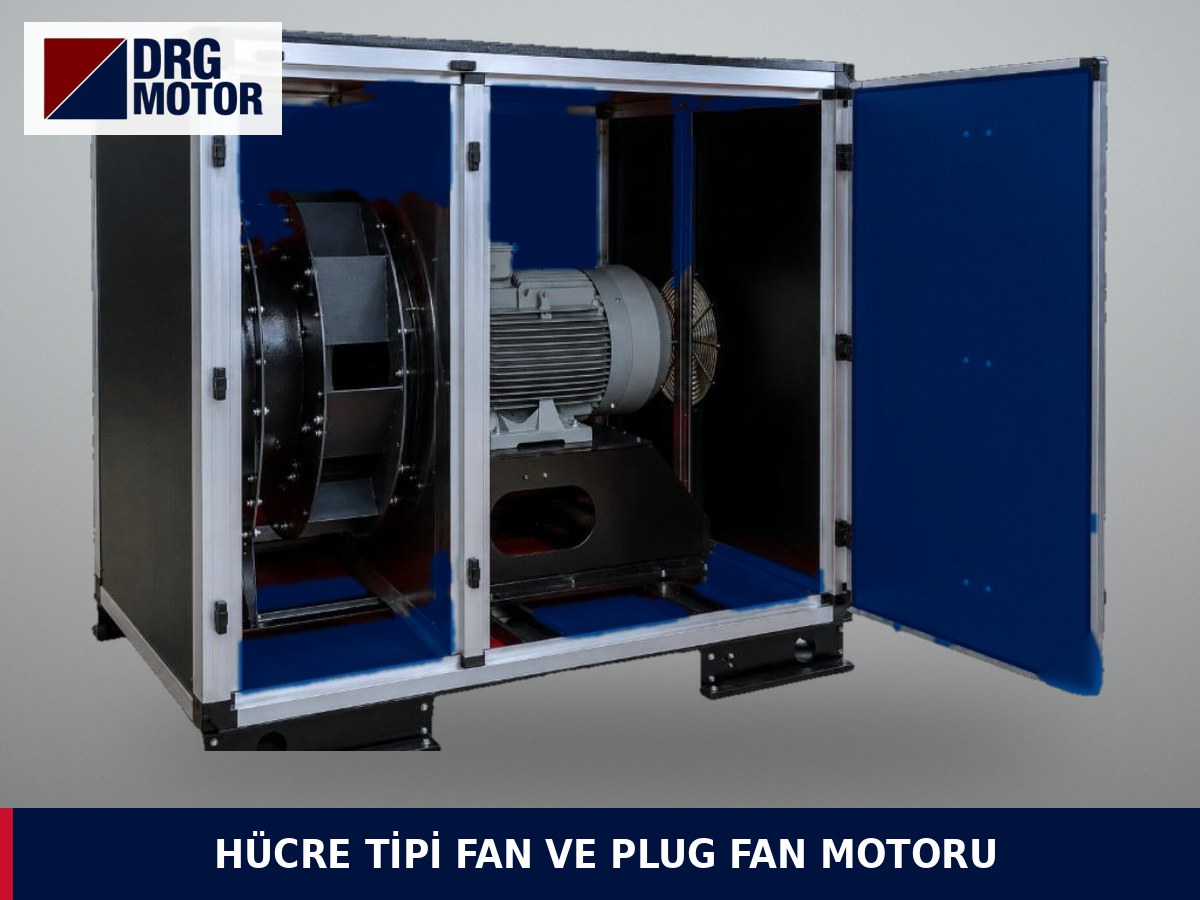
A cabinet (cell-type) fan is a centrifugal fan installed inside a sheet-metal cabinet; inside the cabinet there is either a double-inlet scroll fan, usually belt driven, or a housing-less plug (plenum) fan. What drives the motor selection is not the cabinet but this arrangement: on a plug fan the impeller is fitted directly onto the motor shaft, so the motor both carries the impeller and sets the speed; on a scroll-type cabinet fan the motor usually sits on its own slide rail in a corner of the cabinet and turns the fan through belts and pulleys. In both cases the motor is a standard three-phase induction motor; there is no separate motor type called a "plug fan motor".
This article explains how to recognise which type of fan sits inside an exhaust cabinet or an air handling unit, which loads the impeller-to-motor connection puts on the motor, and how motor power differs between two arrangements doing the same air duty. Removing the motor, connecting the terminal box and setting the inverter are live electrical tasks; they must be done by a qualified electrician. Once you know the right frame and speed, you can compare models among the 120 motors on our Buy Electric Motors Online page.
General fan motor selection is covered on our Fan Motors page, and the kW and speed a scroll-type centrifugal fan needs is covered in our centrifugal fan motor article.
Is a cabinet fan the same thing as a plug fan?
No. "Cabinet fan" is a housing and installation term: it says the fan is mounted inside a cabinet, often lined with acoustic panels. "Centrifugal" describes the operating principle: air enters the impeller axially and is thrown outwards. A plug fan sits where the two groups meet; it is a backward-curved centrifugal impeller, but it has no scroll and discharges straight into the cabinet (the plenum). Manufacturers use these terms differently: some catalogues call every cabinet-mounted fan a "cell-type" fan, some keep the name for scroll-type exhaust cabinets, and some sell the plug fan module as a "plenum fan". Look inside the cabinet, not at the label.
| Term | What it describes | Motor connection |
|---|---|---|
| Cabinet (cell-type) fan | Housing / installation | Depends on the fan inside |
| Plug / plenum fan | Housing-less centrifugal wheel | Impeller directly on motor shaft |
| Double-inlet scroll fan | Centrifugal fan with volute | Mostly belt and pulley |
| EC plug fan | Fan + integrated motor | Motor is part of the fan |
The last row matters: some plug fans come with EC (electronically commutated) motors whose drive is built into the motor, or with external-rotor integrated motors. In that case the motor is not a part you replace on its own; after a failure the fan manufacturer’s spare is used. DRG does not sell such integrated motors; DRG motors are for fans whose impeller fits on a standard IEC shaft or which are belt driven.
On a plug fan the impeller sits on the motor shaft: bearings, balance and base
On a plug fan the motor stops being a separate drive element and becomes the load-carrying part of the fan. The impeller hub is fixed to the motor shaft with a key and a clamping washer; the impeller hangs at the shaft end, in front of the motor’s drive-end bearing. This arrangement puts three loads on the motor.
Overhung impeller weight and bearings
One manufacturer’s catalogue gives plug fan impeller weights of 23.5 kg at 570 mm diameter and 191 kg at 1400 mm [1]. This mass creates a radial force at the shaft end, carried by the drive-end bearing. On a belt-driven motor this force can be adjusted through belt tension; on a plug fan it comes from the impeller weight and cannot be adjusted. That is why the fan manufacturer states in the catalogue which IEC frame may be fitted to each impeller size. When buying a replacement, keep the old motor’s frame size (e.g. 132S), shaft diameter (38 mm on frame 132S) and bearing type (6208-ZZ-C3 for DRG-132S-4) unchanged; dropping to a smaller frame overloads the shaft and bearings.
Balance and speed limit
Because the plug fan impeller turns with the motor shaft, the impeller balance and the rotor balance add up in the same vibration. When the impeller is moved to a new motor, the assembly should be checked again as a whole. Each impeller has a maximum speed in the catalogue; the motor selection must stay below it. If the inverter is to run above 50 Hz, the limit is set by the fan manufacturer, not by the motor supplier.
Base and mounting type
On horizontal-shaft plug fans the motor is mostly foot-mounted (B3) on a motor base; impeller, inlet cone and base form a module aligned at the factory. The exact mounting type is taken from the fan manufacturer’s drawing. Mounting the fan in the cabinet (anti-vibration mounts, flexible connections) and the motor’s IEC mounting type are separate matters; changing one does not change the other.
Click to see current electric motor prices and order nowSEE PRICES →
Belt and pulley on a scroll-type cabinet fan: the motor outside the airstream
In the older and still common type of exhaust cabinet there is a double-inlet scroll fan with forward- or backward-curved blades. The fan turns on its own bearing-mounted shaft; the motor stands on a tensioning slide beside or below the fan and is connected by belts. The motor is inside the cabinet, but in most layouts it is not directly in the airstream.
- Speed comes from the pulleys: a 4-pole motor at 1460 rpm can drive the fan at 1800 rpm or at 900 rpm depending on the pulley ratio. If the pulleys stay in place, the new motor’s speed must match the old one.
- Radial load comes from belt tension: an over-tensioned belt wears the drive-end bearing; keeping the pulley as far inboard on the shaft as possible reduces this load.
- There is a drive loss: the belt always consumes some power, and the motor has to cover it.
- With the motor outside the airstream it is less affected by the cabinet air.
Same air duty, two arrangements: how motor power and speed change
Fan shaft power is Pshaft = Q·Δp / ηfan (Q in m³/s, Δp in Pa, P in W). Motor power = Pshaft / ηdrive + margin. Assume an exhaust cabinet must deliver 14,000 m³/h at 750 Pa total pressure, with the fan running at 1800 rpm. 14,000 m³/h equals 3.89 m³/s.
| Item | Plug fan | Scroll + belt |
|---|---|---|
| Fan efficiency (assumed) | 0.65 | 0.60 |
| Fan shaft power | ≈ 4.5 kW | ≈ 4.9 kW |
| Drive factor | None (direct) | 0.95 (belt) |
| Requirement with margin | ≈ 4.9 kW | ≈ 5.6 kW |
| How the speed is reached | Inverter, ≈ 62 Hz | Pulley ratio ≈ 1.23 |
On the belt-driven version, the 5.6 kW requirement is met by a 4-pole 7.5 kW motor with a 1.23 pulley ratio. The plug fan is more delicate: without pulleys the fan speed is the motor speed, and torque at impeller speed matters more than kW. At 1800 rpm, 4.5 kW of shaft power needs about 23.8 Nm.
- 2-pole 7.5 kW (DRG-132S2-2): rated torque 24.4 Nm. Reaching 1800 rpm means dropping to about 31 Hz; about 98% of the motor torque is used and the motor’s own cooling fan slows down too. No headroom, not suitable.
- 4-pole 5.5 kW (DRG-132S-4): rated torque 36 Nm at 1460 rpm. Reaching 1800 rpm needs about 62 Hz; in this range the usable torque falls to about 29.2 Nm and the load is about 82% of it. It is a suitable choice if the fan manufacturer confirms that the impeller and motor may run at this speed.
This example shows why, on a plug fan, the motor is selected together with the fan: at the same kW, two pole numbers give very different results at impeller speed. When speed is set by an inverter, power changes with the cube of speed; the calculation is in our affinity laws article. To try your own values, use the Pump & Fan Motor Power calculator.
Fan wall (multiple plug fans)
Large units may use four, six or more small plug fans side by side in one cross-section instead of a single large fan. For the motor this means smaller frames, higher speeds and a choice between one inverter per fan or a shared inverter. When replacing motors, all fans must stay on the same model and speed; otherwise parallel fans do not share the load equally.
What information is needed to select the motor?
Selecting the fan, the fan curve, the impeller and the cabinet design is the job of the fan manufacturer or the design engineer. The motor supplier’s job is to provide a motor suited to the given shaft power, speed, mounting and ambient conditions. With that split clear, the motor needs the following:
- Fan type: plug, scroll or EC integrated (if EC, the motor is not bought separately).
- Operating point: airflow (m³/h) and total or static pressure (Pa).
- Fan shaft power and impeller speed; for plug fans, the impeller’s maximum speed.
- Old motor nameplate: kW, rpm, frame size, voltage, current.
- Shaft diameter and length, key size; for plug fans, the impeller hub bore.
- Mounting type: B3, B5, B14 or B35 and base hole dimensions.
- Whether there is an inverter and in which frequency range it runs.
- Cabinet air temperature and humidity; whether the motor is in or out of the airstream.
- For belt drives, pulley diameters and belt type.
There is no fixed figure for the power range: motor power changes with impeller diameter, airflow, pressure, blade design, speed, system resistance, air density and drive loss. As a guide: in one manufacturer’s catalogue an AHU-type plug fan range is offered with IEC induction motors up to 37 kW [2]; the same manufacturer’s earlier plug fan catalogue lists three-phase inverters recommended with the fans covering 0.55–11 kW of motor power [1].
| Model | Power / speed | Frame · current 400 V | Price |
|---|---|---|---|
| DRG-112M-45.5 HP | 4 kW · 1500 rpm | Cast iron 112M · 7.95 A | $254.38 (€227.18) Details & buy → |
| DRG-132S-47.5 HP | 5.5 kW · 1500 rpm | Cast iron 132S · 10.7 A | $342.01 (€305.44) Details & buy → |
| DRG-132M-410 HP | 7.5 kW · 1500 rpm | Cast iron 132M · 14.3 A | $394.89 (€352.66) Details & buy → |
| DRG-132S2-210 HP | 7.5 kW · 3000 rpm | Cast iron 132S · 13.7 A | $369.43 (€329.92) Details & buy → |
| DRG-160M-415 HP | 11 kW · 1500 rpm | Cast iron 160M · 20.4 A | $568.76 (€507.94) Details & buy → |
| DRG-160L-420 HP | 15 kW · 1500 rpm | Cast iron 160L · 27.3 A | $678.13 (€605.61) Details & buy → |
| DRG-180L-430 HP | 22 kW · 1500 rpm | Cast iron 180L · 39.7 A | $919.45 (€821.13) Details & buy → |
| DRG-200L-440 HP | 30 kW · 1500 rpm | Cast iron 200L · 53.8 A | $1,235.00 (€1,102.93) Details & buy → |
| DRG-225S-450 HP | 37 kW · 1500 rpm | Cast iron 225S · 66.1 A | $1,527.18 (€1,363.87) Details & buy → |
Matching with DRG motors
DRG Motor is a manufacturer, supplier and seller of electric motors. Our range covers 0.25–11 kW in aluminium frames and 0.55–355 kW in cast iron frames; 1000, 1500 and 3000 rpm; 3-phase, 230/400 V or 400/690 V. B3, B5, B14 and B35 mounting is specified with an order note. This range does not mean every fan power on the market is a DRG product; the right model is chosen from the fan’s operating point. Models in the powers most often found on cabinet and plug fans are shown in the table above with short specifications and current prices.
When buying a motor for a plug fan, check the model’s frame size and shaft diameter: the same IEC frame as the old motor fits the impeller hub and the base directly. For dimension checks, use our technical drawings page. DRG MOTOR motors are guaranteed against material and manufacturing defects for 2 years from the delivery date (warranty certificate).
DRG motors for plug and cabinet fans
- DRG-132S-4 – 5.5 kW – 1460 rpm – 132S aluminium
- DRG-132M-4 – 7.5 kW – 1460 rpm – 132M aluminium
- DRG-132S-4 – 5.5 kW – 1460 rpm – 132S cast iron
- DRG-160M-4 – 11 kW – 1465 rpm – 160M cast iron
Click to see current prices and order these motors nowSEE PRICES →
Plug fan motor: frequently asked questions
What is a plug fan?
A backward-curved centrifugal fan without a scroll housing. The impeller sits directly on the motor shaft and discharges into the cabinet; it is common in air handling units and exhaust cabinets.
How many kW should a cabinet fan motor be?
There is no fixed value. Shaft power is calculated from airflow, pressure and fan efficiency; for belt drives, drive loss and margin are added. In our example, 14,000 m³/h at 750 Pa required about 4.9 kW for the plug fan and about 5.6 kW for the belt-driven version.
Can a standard motor replace a plug fan motor?
Yes, if the impeller fits a standard IEC shaft; frame size, shaft diameter, speed and mounting type must be kept. If the motor is an EC or external-rotor integrated type, no separate motor is fitted and the fan manufacturer’s spare is needed.
2-pole or 4-pole motor for a plug fan?
Look at the impeller speed. If the required speed is close to a 4-pole motor’s rated speed, the 4-pole motor handles the impeller torque more comfortably. The choice is made together with the fan manufacturer’s maximum speed and the inverter frequency range.
Send your fan label and a photo of the old motor’s nameplate via WhatsApp to +90 (542) 666 11 11 or to [email protected]; other channels are on our contact page. All models and current prices are on the Buy Electric Motors Online page.
Sources
- Nicotra Gebhardt – RLM Plug Fans technical catalogue (2013, PDF) – impeller weights; inverter sets 0.55–11 kW
- Nicotra Gebhardt – RLM Evo plug fan – IEC induction motors up to 37 kW


