 English
 Le français
 Türkçe

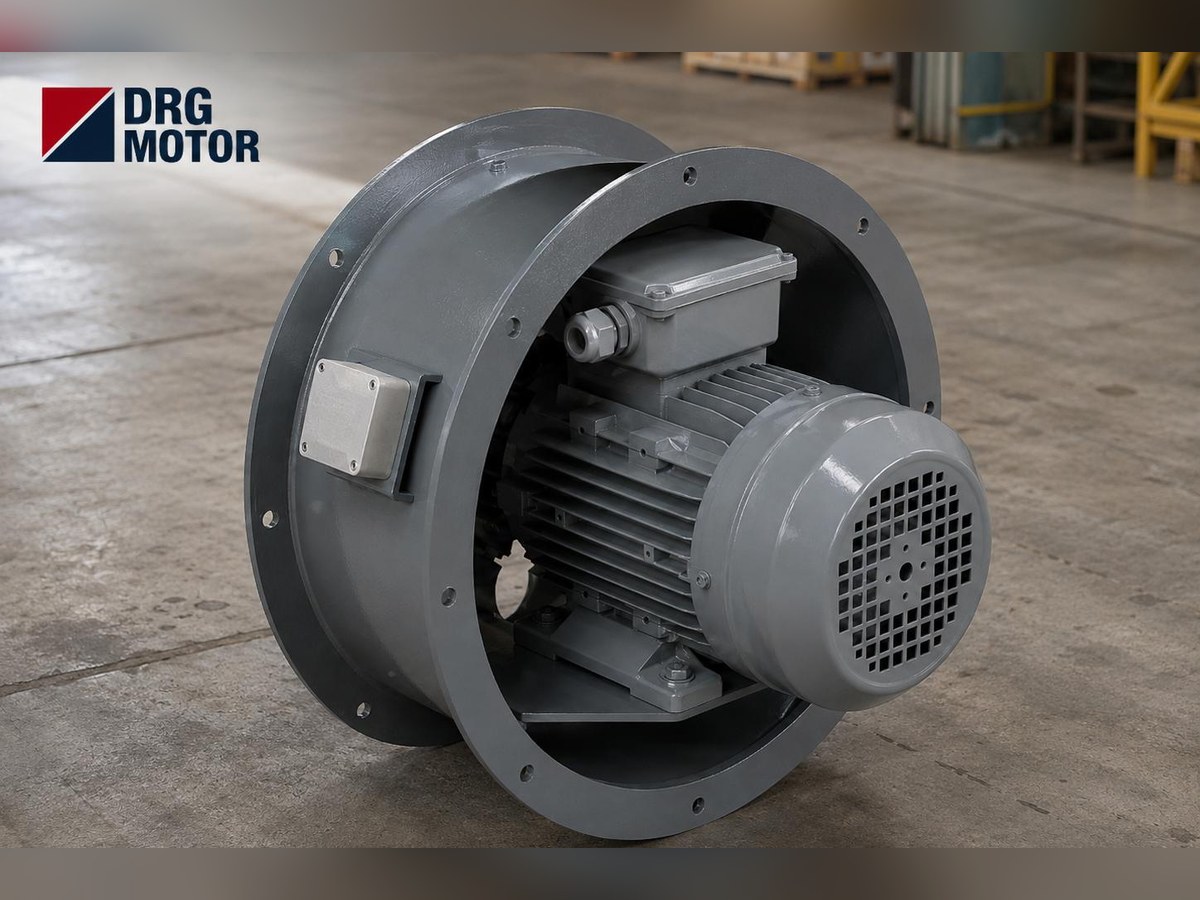
Heat in a nut roaster comes from a burner or from heating elements, never from the electric motor. The motor turns the drum, spins the fan pushing hot air through the product, exhausts the steam, moves the mesh belt in a belt oven and stirs roasted hazelnuts, peanuts or chickpeas in the cooling tray. Maker catalogues give 0.75–15 kW for the drum drive, 0.25–0.55 kW for the moisture exhaust fan and around 8–10 kW for all electrical components of a machine; on large continuous lines the total reaches 80 kW.
DRG Motor is a manufacturer, supplier and seller of electric motors. We do not sell the roasting machine, the burner, the heating elements, machine parts such as drums and belts, gearboxes or inverters. We supply three-phase induction motors for drum, fan and belt drives on these machines; models are on Buy Electric Motors Online.
Motor-driven sections of a roaster
Batch and continuous roasters do the same job in different layouts. Either way, the heating section and the motors are kept apart: the motor sits outside the hot zone, beside or below the casing.
Rotary drum roaster
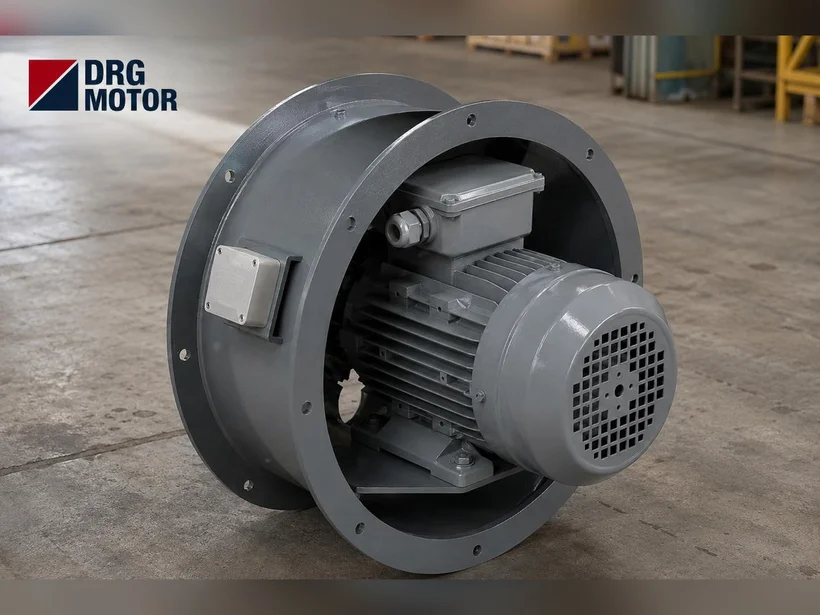
The drum turns slowly on a horizontal axis and inner flights keep the product moving. The motor drives the drum through a gearbox or chain; heat comes from below or inside the drum. In one maker’s series the motor rating climbs in 1.1 kW steps up to 5.5 kW as models grow; the electric heating power of the same models is 18–75 kW and must not be confused with motor power.
Hot-air fan and moisture exhaust fan
Hot-air circulation machines have a small moisture (steam) exhaust fan next to the main motor; in one catalogue this fan is 250–550 W. The burner’s own combustion air fan is part of the burner; follow the burner maker’s instructions when replacing it. For circulation fans in drying ovens, see our drying oven fan motor article, where fan load in hot air is covered in detail.
Cooling tray and belt roasting
Roasted product comes out hot and is cooled straight away so roasting stops. In the cooling tray a stirrer turns the product while a fan blows or draws air from below. In belt ovens the product rides a stainless mesh belt through chambers; one model lines up two roasting chambers, a rest chamber and a cooling chamber, with circulation fans and belt motor running in sync.
How many kW is a roasting machine motor? Catalogue values
A) Motor ratings published by makers of drum, hot-air and belt roasters:
| Machine / model group | Motor power | Single / total | Note |
|---|---|---|---|
| Rotary drum roaster, 100 kg/h | 0.75 kW | drum drive motor | first maker |
| Rotary drum roaster, 80–120 kg/h | 1.1 kW | motor power (heating separate) | second maker |
| Same series, 500–650 kg/h large model | 5.5 kW | motor power (heating separate) | second maker |
| Hot-air circulation roaster, ~25 kg batch | 2.2 kW + 0.25 kW | main motor + moisture exhaust fan | third maker |
| Same series, medium factory model | 7.5 kW + 0.37 kW | main motor + moisture exhaust fan | third maker |
| Same series, largest model | 15 kW + 0.55 kW | main motor + moisture exhaust fan | third maker |
| Batch roasting oven, in-shell hazelnut 375–500 kg/h | 9.28 kW | total electrical power | fourth maker |
| Belt roasting oven, 140 kg/h (2 roasting + rest + cooling rooms) | 8 kW | total electrical components | fifth maker |
| Continuous belt roaster, 200 kg/h | 10 kW | total drive power | sixth maker |
| Continuous belt roaster, 5 t/h | 80 kW | total drive power | sixth maker |
In this machine group a single drum or main drive motor takes roughly 0.75–15 kW and a moisture exhaust fan 0.25–0.55 kW. The 8 kW, 9.28 kW, 10 kW and 80 kW values in the table are not single motors; they add up several fans, the belt motor and the control system. Heating power (elements or burner) is outside this table.
B) Where DRG fits: every rating from the 0.25 kW exhaust fan to the 15 kW main motor is in our range; small sizes in aluminium, larger ones in cast iron. The 80 kW total of the 5 t/h belt line can be met from the same range once the individual motors are known.
Click to see current electric motor prices and order nowSEE PRICES →
Worked example: drum speed and gearbox ratio
A small drum roaster’s data sheet gives a drum speed of 28 rpm. For a 1.1 kW drum motor, let us work out the ratio and torque needed with two pole counts:
| Option | Operation | Result | Comment |
|---|---|---|---|
| 4-pole motor, DRG-90S-4 (1,445 rpm) | 1,445 / 28 | ratio about 51.6 | high ratio for one stage |
| 6-pole motor, DRG-90L-6 (945 rpm) | 945 / 28 | ratio about 33.8 | smaller gearbox ratio |
| Torque at the drum shaft, 1.1 kW | 9,550 × 1.1 / 28 | about 375 Nm | gearbox losses excluded |
| Torque at the motor shaft, DRG-90S-4 | 9,550 × 1.1 / 1,445 | about 7.3 Nm | catalogue value 7.27 Nm |
The drum shaft sees about 50 times the torque at the motor shaft, so gearbox and chain strength matter as much as motor power. A 6-pole motor gives the same drum speed with a lower-ratio gearbox; try ratio and output torque with our gearbox calculator.
Starting with a full drum
After a power cut or fault the drum stops full of product. On restart the motor lifts that weight as it accelerates. The catalogue starting torque ratio (2.3 for DRG-90S-4) covers this moment; on large drums a soft start through an inverter is still preferred. Inverters are not in our range.
Heat, oil vapour and motor position
Motor outside the hot zone
The roasting chamber and drum surface are very hot. The motor should stay outside the product-contact area and the hot zone, in a closed drive bay or under the frame, and no hot-air duct should run over it. If a fan motor is bolted to the oven casing, heat can travel into its shaft and bearings. Tell us the ambient temperature around the motor; we choose to that value.
Oil vapour, salt and cleaning
Roasting gives off oil vapour and fine husk dust; salted roasting adds salt dust. Together they form a sticky film on the fan cowl that hampers cooling. Our IP55 motors suit a dusty room, provided the cowl is cleaned regularly. Stainless washdown housings for a wet-cleaned roaster section are something we cannot offer; call us to discuss.
Motors outside our range
Small roasters often carry a single-phase motor, which we do not supply; brake motors, servo motors and pole-changing two-speed designs are equally outside our range. Where belt speed must change, a standard motor with an inverter is used; the inverter is sourced separately.
DRG motors for roasting machines
Models matching catalogue ratings from exhaust fan to main drive (current at 400 V):
| Model | Power / speed | Frame · shaft D×E | Current 400 V |
|---|---|---|---|
| DRG-711-4 | 0.25 kW / 1340 rpm | 71 aluminium · 14×30 | 0.66 A |
| DRG-802-4 | 0.75 kW / 1420 rpm | 80 cast iron · 19×40 | 1.75 A |
| DRG-90S-4 | 1.1 kW / 1445 rpm | 90S cast iron · 24×50 | 2.48 A |
| DRG-90L-6 | 1.1 kW / 945 rpm | 90L cast iron · 24×50 | 2.69 A |
| DRG-100L1-4 | 2.2 kW / 1450 rpm | 100L cast iron · 28×60 | 4.52 A |
| DRG-132S-4 | 5.5 kW / 1460 rpm | 132S cast iron · 38×80 | 10.7 A |
| DRG-160M-4 | 11 kW / 1465 rpm | 160M cast iron · 42×110 | 20.4 A |
| DRG-160L-4 | 15 kW / 1465 rpm | 160L cast iron · 42×110 | 27.3 A |
On drum and belt drives the gearbox motor is usually flange-mounted (B5 or B14); fan motors are foot (B3) or flange types. Speeds of 1000, 1500 and 3000 rpm are available, and roaster drives may take foot, flange, foot-and-flange or vertical mounting. Send us the old motor’s plate, shaft diameter and key, flange size and gearbox input bore; we check against these and the machine manual, and promise no fit before seeing the figures.
If roasted sesame or hazelnut is then ground in a stone mill, that mill’s motor carries a different load; our tahini mill motor article explains it.
Live price table
Current prices of models matching drum, belt and fan ratings on roasters:
| Model | Power / speed | Frame · current 400 V | Price |
|---|---|---|---|
| DRG-711-40.37 HP | 0.25 kW · 1500 rpm | Aluminium 71 · 0.66 A | $73.16 (€65.33) Details & buy → |
| DRG-802-41 HP | 0.75 kW · 1500 rpm | Cast iron 80 · 1.75 A | $101.93 (€91.03) Details & buy → |
| DRG-90S-41.5 HP | 1.1 kW · 1500 rpm | Cast iron 90S · 2.48 A | $124.09 (€110.82) Details & buy → |
| DRG-100L1-43 HP | 2.2 kW · 1500 rpm | Cast iron 100L · 4.52 A | $188.32 (€168.18) Details & buy → |
| DRG-112M-45.5 HP | 4 kW · 1500 rpm | Cast iron 112M · 7.95 A | $254.38 (€227.18) Details & buy → |
| DRG-132S-47.5 HP | 5.5 kW · 1500 rpm | Cast iron 132S · 10.7 A | $342.01 (€305.44) Details & buy → |
| DRG-132M-410 HP | 7.5 kW · 1500 rpm | Cast iron 132M · 14.3 A | $394.89 (€352.66) Details & buy → |
| DRG-160M-415 HP | 11 kW · 1500 rpm | Cast iron 160M · 20.4 A | $568.76 (€507.94) Details & buy → |
| DRG-160L-420 HP | 15 kW · 1500 rpm | Cast iron 160L · 27.3 A | $678.13 (€605.61) Details & buy → |
DRG MOTOR motors are guaranteed against material and manufacturing defects for 2 years from the delivery date (warranty certificate).
Motors in this power range
- DRG-90S-4 – 1.1 kW – 1445 rpm – 90S cast iron
- DRG-100L1-4 – 2.2 kW – 1450 rpm – 100L cast iron
- DRG-132S-4 – 5.5 kW – 1460 rpm – 132S cast iron
- DRG-160M-4 – 11 kW – 1465 rpm – 160M cast iron
- DRG-160L-4 – 15 kW – 1465 rpm – 160L cast iron
Click to see current prices and order these motors nowSEE PRICES →
Browse the products, ask for a quote: motors for your roaster are on Buy Electric Motors Online. Post the drum or fan motor plate on WhatsApp with the ambient temperature, or call +90 (542) 666 11 11.
Frequently asked questions
How many kW is a hazelnut roaster motor?
Small drum models show 0.75–1.1 kW drum motors; large hot-air models go up to a 15 kW main motor. The exact value depends on capacity.
Is the heating power of a roaster its motor power?
No. Figures such as 18–75 kW are element or burner power. Motor power is listed on a separate line in catalogues.
What changes the price of a roaster motor?
Rating, speed and frame; live figures are in the table above.
For questions: +90 (542) 666 11 11 · info@drgmotor.com · contact.


