 English
 Le français
 Türkçe

In most cases, no. When a crusher chokes and stops, the motor is usually not the cause of the problem but the part that reveals its effect; a bigger motor does not eliminate the choking, it only forces the crusher harder. The cause of the choking should be found first; upsizing the motor should only be considered if measurements show a lasting power shortfall and the crusher manufacturer allows it.
Common causes of choking
- Excessive or uneven feed: If the feeder speed is higher than the crusher can process, the crushing chamber fills up.
- Wet, clayey or fine material: The fines smear in the jaw or plate gap; without pre-screening, discharge slows down.
- Setting and wear: If the discharge gap is set too narrow, or the jaws are worn and their profile is lost, material packs in.
- Belt slip: With slack belts the crusher speed drops and crushing energy falls; the crusher may slow down while the motor keeps turning.
- Discharge side: If the conveyor underneath has stopped or is overloaded, the crusher outlet chokes.
Risks of a bigger motor
The crusher's shaft, eccentric, bearings and body are designed for a certain power. A motor capable of more torque can transmit forces above the design level to these parts during a jam; the failure then appears as a broken shaft or bearing damage rather than in the motor. A bigger motor frame also changes the baseframe, pulley, cabling and protection arrangement. For example, in the 1500 rpm class, going from 110 kW to 132 kW does not change the frame number in DRG records (both are 315 frame), but the overall length increases; going from 90 kW to 110 kW, the frame moves up from 280 to 315.
What should be measured before deciding?
Record the current while the crusher runs with normal feed: if the average load is clearly below the nameplate value, the motor is adequate and the problem lies in the feed or the setting. If the current stays at the limit even in normal production and the crusher manufacturer specifies a higher power, a motor change is assessed. Interpreting the current measurement and the protection arrangement depends on the assessment of qualified electrical personnel.
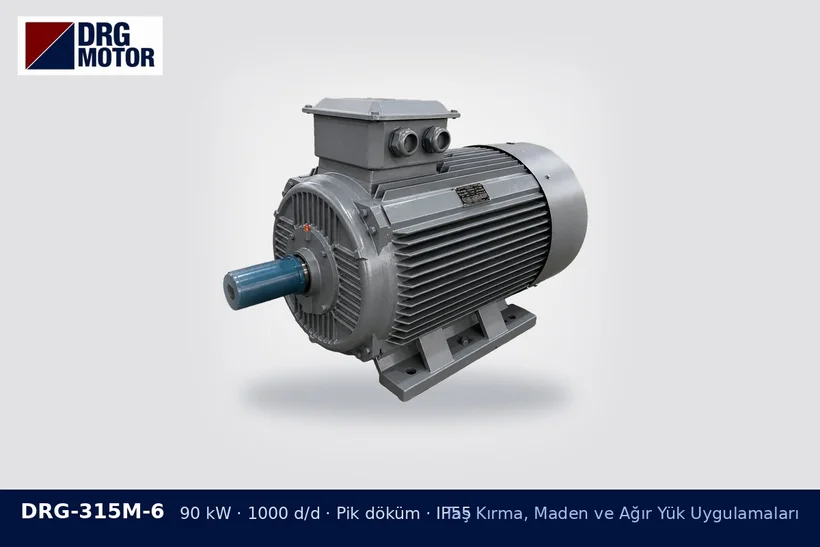
If a power increase is genuinely needed, you can review the options on the stone crushing plant motors page and in product records such as the 132 kW 315M cast iron model.