 English
 Le français
 Türkçe

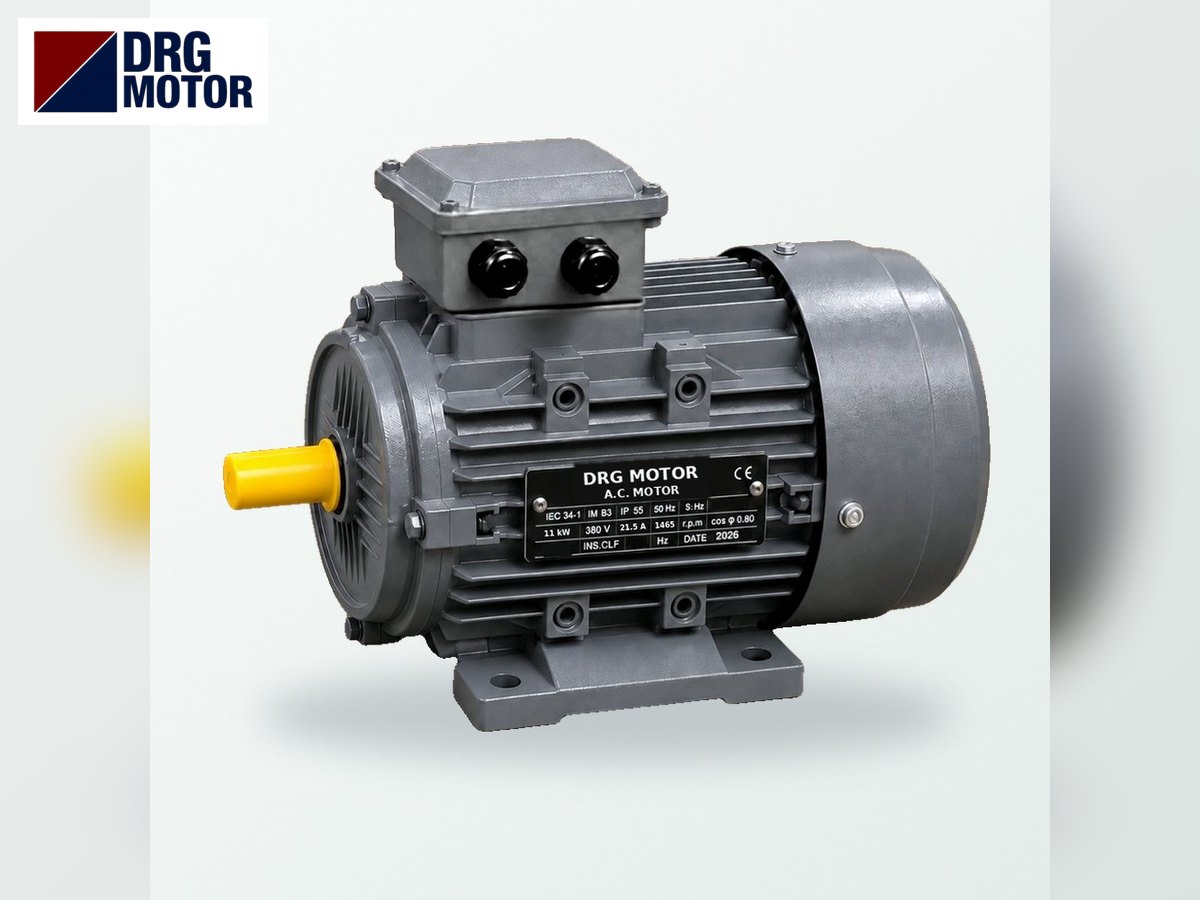
In a carpet cleaning plant the electric motor works in four machines: in the automatic washer it turns the brushes and the belt that carries the rug, in the spin dryer (centrifuge) it turns the drum, in the duster it drives the beater shaft, belt and suction fan, and in the rolling-packing machine it turns the roller that rolls up the rug. The drum motor is the largest; brush motors are the most numerous. Start time and braking of the spin motor are worked out in our article on the carpet spin dryer motor, brush speed and gearbox ratio in the article on the carpet washing brush motor; here we look at the whole plant.
DRG Motor is a manufacturer, supplier and seller of electric motors. We do not sell the washer or spin dryer itself, brushes, gearboxes, brake units, suction turbines or speed drives; we supply the three-phase asynchronous motor fitted to the machines. The Aluminium Housing Electric Motors category groups the frames used on these machines; orders are placed on the Buy Electric Motors Online page.
Which motor does which job in a carpet plant?
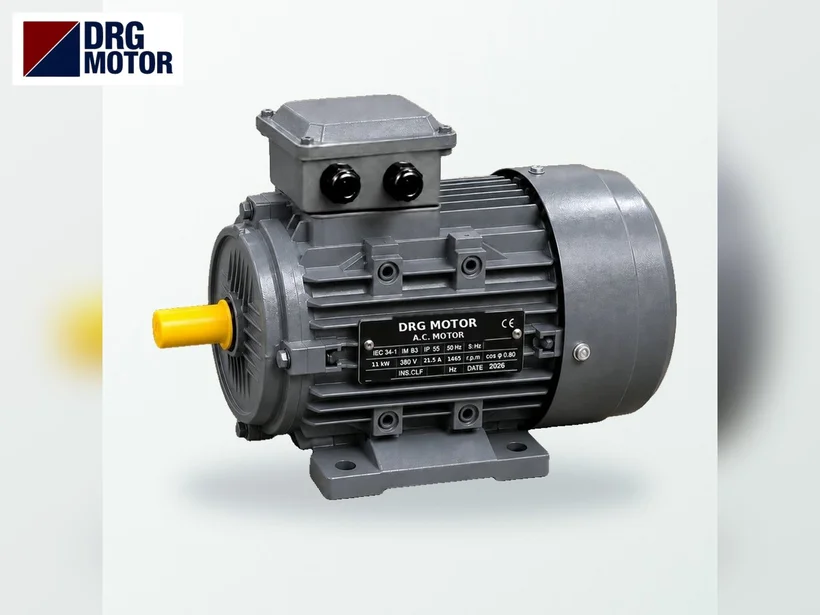
Automatic washer: brushes and belt
The rug passes slowly through the machine on a rubber belt; disc brushes turning on a vertical axis work on top, a cylinder brush in the middle and squeegee rollers at the end. Each brush has its own motor, standing upright on a gear unit and turning the brush at around two hundred revolutions per minute. The motor pulling the belt runs very slowly through its own gearbox and works in both directions: when a rug snags, the operator backs the belt up. On most machines the brushes hang from a carriage that moves back and forth.
Spin dryer: the drum
The wet rug, rolled up, goes into a horizontal drum; a single motor brings the drum through a belt to over a thousand revolutions per minute. The load is heaviest at start: the inertia of a full drum calls for a long run-up, and the load falls as water leaves.
Dusting and rolling-packing
Before washing, dust is removed by passing the rug under a shaft carrying metal or strap beaters; the dust that falls is drawn into a bag by a fan. Once dry, the rug is brushed, rolled on a roller and wrapped in film.
How tasks split between motors
On the washer the brush motors and the belt motor are independent: brush speed is set for the type of rug, belt speed for how dirty it is. That is why replacing both with the same gearbox ratio is a mistake. On the duster, too, three motors carry three separate loads: the belt pulls the rug, the beater strikes, the fan sucks up dust. The suction fan runs on a 2-pole motor at high speed, the others on 4-pole motors.
The real advantage of aluminium housings on carpet machines
Brush motors ride on a moving carriage; every kilo attached to it loads the carriage drive and its slides. With up to ten brush motors on one machine, a light aluminium housing pays off directly here. A compact housing also slips more easily into narrow, vertical brush seats, and removing or refitting it is a one-person job. On spin dryers the drum rests on air bellows and in some designs the motor is fixed to that sprung frame; there too a light motor eases the suspension.
Where cast iron is stronger is just as clear: a drum loaded off-balance produces violent vibration, and on frames that take hard shocks a cast iron housing may be preferred. A spin drive larger than 11 kW goes beyond our aluminium models and is outside our aluminium range; for those spinners look at the cast iron general purpose motors instead. Feet may be fixed or removable; B3, B5, B14 and B35 versions appear in the catalogue.
Motor power on carpet machines: from maker sheets
A) Values given in carpet cleaning equipment catalogues:
| Machine / section | Motor power | Number / speed | Note |
|---|---|---|---|
| Automatic washer, disc brush | 1.1 kW | 4–5 brushes, brush 200 rpm | machine total 7.5–8.5 kW |
| Large washing line, brush | 1.1 kW | 10 brushes; motor 1400 rpm | machine total 18 kW |
| Spin dryer drum, 2.7–3.7 m | 5.5 kW | single motor, 1400 → 1200 rpm | 3 × 380 V |
| Spin dryer drum, 4.2 m | 7.5–11 kW | single motor | several makers |
| Automatic duster | 0.75 / 1.1 / 2.2 kW | belt / beater / suction | 4 kW in total |
| Rug rolling and packing | 0.75 / 1.1 kW | belt / brush | 2 kW in total |
| Walk-behind duster | 1.1 kW | single motor | 220 V single-phase |
Brush, belt and packing motors stay at 0.75–1.1 kW; the suction fan reaches 2.2 kW and the spin drum 5.5–11 kW. These figures come from sample machines; the exact value is the plate on your own machine.
B) Overlap with the DRG aluminium range: 0.75 kW sits in frame 80 and 1.1 kW in frame 90S; the 2-pole 90L for a 2.2 kW suction fan; frames 132S, 132M and 160M for 5.5–11 kW spin motors. Outside our range: small 220 V single-phase hand machines, brush units whose motor and gearing are built as one piece, brake motors and drum motors above 11 kW.
Click to see current electric motor prices and order nowSEE PRICES →
Dimensions checked on replacement
Power, speed and voltage
Plate power and pole count are kept. Brush and belt motors are 4-pole; the duster fan may be 2-pole. A motor showing 230/400 V on its voltage line is 3 kW or smaller and is connected in star on a 400 V line; our spin motors of 5.5 kW and above are 400/690 V and run in delta.
Mounting, shaft and flange
A disc brush motor stands upright and is flanged to its gear unit; so check flange and spigot diameters plus shaft size, and order the motor as a vertical-mount version. Belt and spin motors are usually foot-mounted; foot hole spacing and shaft height (frame number) must match the old one.
Pulley, coupling and gearbox
The spin drum turns via a belt, so drum speed is set by motor speed and pulley ratio together. One catalogue gives 1400 rpm at the motor and 1200 rpm at the drum; if the new motor’s nominal speed is higher, the drum turns a little faster on the same pulleys:
| New motor | Nominal speed | Drum speed (same pulleys) | Instead of a 150 mm pulley |
|---|---|---|---|
| DRG-132S-4 · 5.5 kW | 1460 rpm | 1251 rpm | 143.8 mm |
| DRG-160M-4 · 11 kW | 1465 rpm | 1256 rpm | 143.3 mm |
The drum’s maximum permitted speed comes from the machine maker; if you are close to it, reduce the motor pulley to the diameter in the table or cap the speed with a drive. Your own pulley sizes can be checked in the belt drive calculator. The brush side shifts in a similar way: with a 1400 rpm motor and a 200 rpm brush the ratio is 7; the 1445 rpm DRG-90S-4 turns the brush at about 206 rpm through the same ratio, a difference of no practical weight.
Starting, braking, moisture and dust
Starting load and stop-start
The spin drum starts full and runs up again on every cycle; dozens of cycles a day decide how hot the winding gets. Our 7.5 kW model has a starting torque twice its rated torque; with a long run-up, the overload relay must be of a class suited to heavy starting. The star-delta starting page lays out the options for this case. The belt motor, on the other hand, reverses often; switching it backwards before it has stopped strains belt and gears.
Need for a brake
For lid safety the drum may have to stop quickly. Brake motors are not in our range. The need is met either by the machine’s own band or shoe brake or by a speed drive with a braking resistor; a standard motor can be used in both arrangements. DRG does not supply drives.
Water, foam and the IP55 limit
IP55 means the motor is protected against harmful dust build-up and against low-pressure water sprayed from any direction. A pressure-washer lance, steam and submerging the motor are outside that protection. On the washer, keep motors above the splash line or under a cover, turn the terminal box and cable entry downwards, and leave the drain holes under the housing open; if foam dries and clogs the fan cowl, the motor cannot cool. On the duster the same danger comes from dust: clean the grille of the fan cowl regularly.
Small single-phase machines
Walk-behind dusters and some small rolling tables come with a 220 V single-phase motor; we have no single-phase motor to offer. If the plant has three phases, a three-phase model can replace it; without them, the spare is ordered from the machine builder after reading its motor data and fixing sizes.
Information to send for a motor replacement
- Which machine and which task the motor serves (brush, belt, drum, beater, fan, rolling).
- Plate photo: kW, speed, voltage, current.
- Mounting: foot, flange or vertical; flange and shaft dimensions.
- Pulley diameters or gearbox input size.
- Brake or speed drive fitted; three phases available in the plant.
- Daily running time and number of spin cycles.
DRG aluminium housing motors for carpet machines
Models matching brush, belt, suction and drum duties (values from our product records):
| Model | Power / speed | Frame · torque | Current 400 V |
|---|---|---|---|
| DRG-802-4 | 0.75 kW · 1500 → 1420 rpm | 80 aluminium · 5.04 Nm | 1.75 A |
| DRG-90S-4 | 1.1 kW · 1500 → 1445 rpm | 90S aluminium · 7.27 Nm | 2.48 A |
| DRG-90L-2 | 2.2 kW · 3000 → 2895 rpm | 90L aluminium · 7.26 Nm | 4.35 A |
| DRG-100L2-4 | 3 kW · 1500 → 1450 rpm | 100L aluminium · 19.8 Nm | 6.02 A |
| DRG-132S-4 | 5.5 kW · 1500 → 1460 rpm | 132S aluminium · 36 Nm | 10.7 A |
| DRG-132M-4 | 7.5 kW · 1500 → 1460 rpm | 132M aluminium · 49.1 Nm | 14.3 A |
| DRG-160M-4 | 11 kW · 1500 → 1465 rpm | 160M aluminium · 71.7 Nm | 20.4 A |
Live prices are pulled from the shop:
| Model | Power / speed | Frame · current 400 V | Price |
|---|---|---|---|
| DRG-802-41 HP | 0.75 kW · 1500 rpm | Aluminium 80 · 1.75 A | $97.30 (€86.90) Details & buy → |
| DRG-90S-41.5 HP | 1.1 kW · 1500 rpm | Aluminium 90S · 2.48 A | $118.44 (€105.78) Details & buy → |
| DRG-90L-23 HP | 2.2 kW · 3000 rpm | Aluminium 90L · 4.35 A | $147.43 (€131.66) Details & buy → |
| DRG-100L2-44 HP | 3 kW · 1500 rpm | Aluminium 100L · 6.02 A | $194.58 (€173.77) Details & buy → |
| DRG-132S-47.5 HP | 5.5 kW · 1500 rpm | Aluminium 132S · 10.7 A | $326.47 (€291.56) Details & buy → |
| DRG-132M-410 HP | 7.5 kW · 1500 rpm | Aluminium 132M · 14.3 A | $376.94 (€336.63) Details & buy → |
| DRG-160M-415 HP | 11 kW · 1500 rpm | Aluminium 160M · 20.4 A | $542.91 (€484.85) Details & buy → |
DRG MOTOR motors are guaranteed against material and manufacturing defects for 2 years from the delivery date (warranty certificate).
Motors in this power range
- DRG-90S-4 – 1.1 kW – 1445 rpm – 90S aluminium
- DRG-132S-4 – 5.5 kW – 1460 rpm – 132S aluminium
- DRG-160M-4 – 11 kW – 1465 rpm – 160M aluminium
Click to see current prices and order these motors nowSEE PRICES →
Browse the products, ask for a quote: all models are on the Buy Electric Motors Online page. Write down the motor’s job on the machine and send a photo of its plate to our WhatsApp line; we will confirm power, speed, pulley and flange together. Phone: +90 (542) 666 11 11.
Frequently asked questions
Should all brush motors on a carpet washer be replaced together?
No. The brush motors are independent; only the faulty one is replaced.
The spin motor is new; why does the drum shake more?
If the new motor runs slightly faster, drum speed rises and the out-of-balance force grows with the square of speed. Check the pulley ratio against the table above, and make sure the motor foot bolts and belt alignment are right.
Why does the duster fan motor heat up quickly?
When the dust bag fills or the fan cowl clogs with dust, the motor’s cooling air drops. Clean the bag and the cowl grille, then compare the current drawn with the plate value.
For questions: +90 (542) 666 11 11 · info@drgmotor.com · contact.


