 English
 Le français
 Türkçe

In a bulgur mill, the electric motor drives the stones or toothed rolls that break cooked, dried wheat, spins the rotor that strips the bran and drives the sifter that grades the cracked grain. Bulgur is not flour: the wheat is first boiled, dried, lightly tempered and dehulled, and only then cracked into coarse, medium or fine grain. A bulgur line therefore has no long roll passages as in a flour mill; it has a few heavy crackers, a huller and sifters. Maker catalogues for these machines list values from a 0.75 kW moisture tower motor up to a 55 kW huller motor.
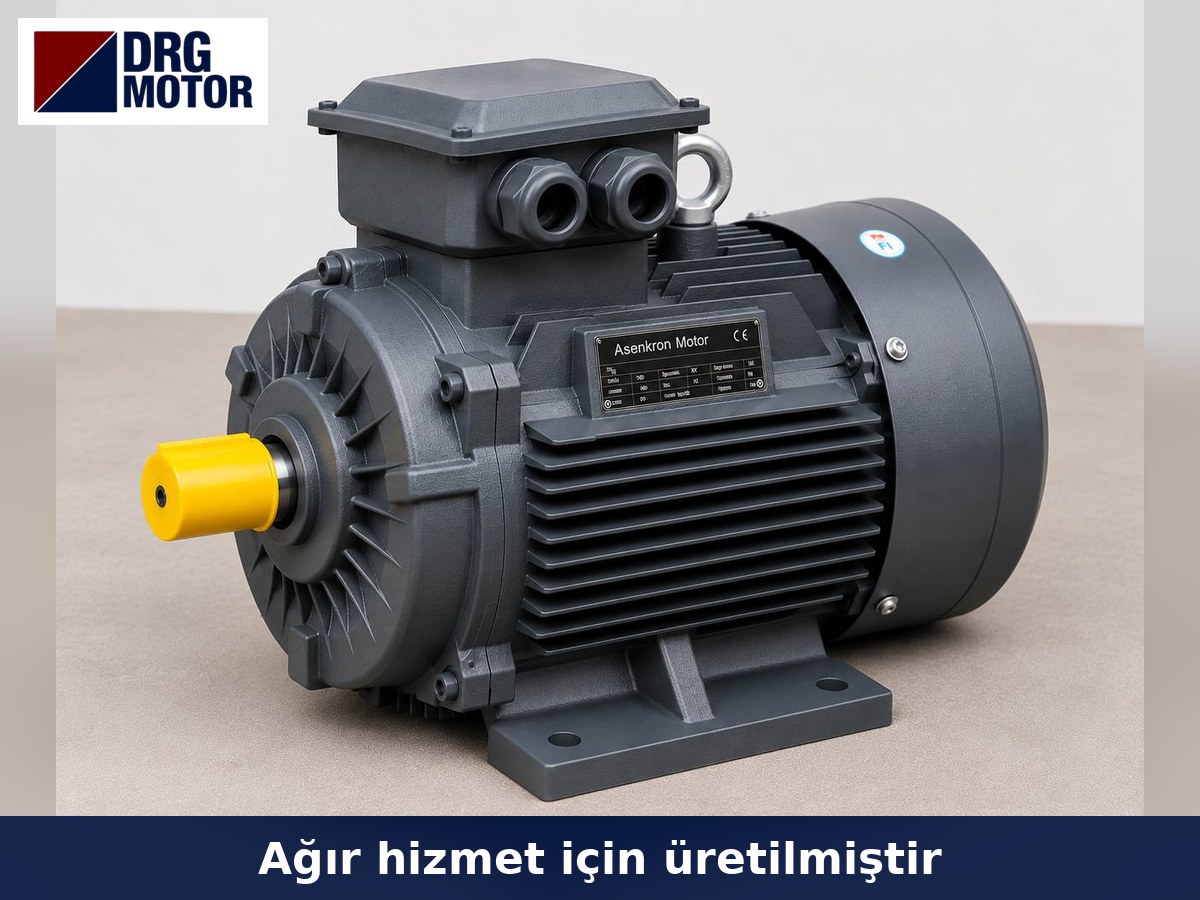
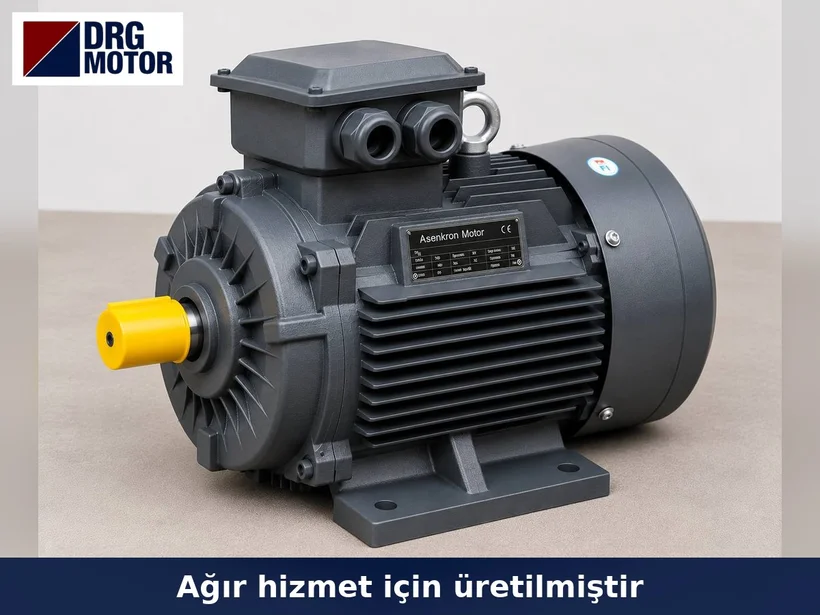
DRG Motor is a manufacturer, supplier and seller of electric motors. We do not sell the bulgur machine, cracking stones, rolls, gearboxes or inverters, nor blades, screen cloth or dies. Our part in the bulgur line is the three-phase induction motor itself, fitted to cracker or huller; models are listed on Buy Electric Motors Online.
From boiling to bagging: where do motors work in a bulgur line?
The usual sequence is boiling → drying → tempering → dehulling → cracking → sieving → packing. In cooking vessels and drying towers the motor mostly turns a screw, a fan or a pump; the real load sits in the hulling and cracking machines.
Tempering, moisture tower and dehulling
The dried wheat is tempered by wetting its surface so that the bran softens. In one catalogue’s moisture control tower, air warmed by steam radiators passes through the grain and a single 0.75 kW motor runs the unit. Dehulling is the hungriest job of the line: in vertical hullers an abrasive or paddle rotor rubs the grain against a screen jacket and aspiration pulls the bran away. Small stone-mill plants do the same work in batches in a drum impact machine, with a fan on top blowing the bran out.
Cracking: stones, rolls and cutting
In a stone cracker, the gap between two grooved stones set one above the other decides how many pieces each kernel breaks into; a handwheel changes the gap. In a roller cracker two toothed rolls turn towards each other and each roll has its own motor. A bulgur cutting machine cuts the kernel instead of cracking it; one catalogue states that cut size is set with an inverter.
Sieving and pre-packing
The cracked product is split on a square sifter or plansifter-type sieve into pilaf grade, fine grade for köfte and flour. The sifter motor turns an eccentric mass through a belt; the motor itself does not create the vibration. Screws, an elevator and the packing machine follow.
Motor power in bulgur machines: catalogue values
A) Motor ratings published by makers of bulgur cracking, hulling, sieving and auxiliary machines:
| Machine / model group | Motor power | Single / total | Note |
|---|---|---|---|
| Horizontal tempered stone cracker (two grooved emery stones), ~600 kg/h | 37 kW | single motor | first maker’s catalogue |
| Roller bulgur cracker, 5 t/h | 2 × 15 kW | per roll; total 30 kW | first maker |
| Roller bulgur cracker, 7 t/h | 2 × 18.5 kW | per roll; total 37 kW | first maker |
| Vertical huller, wheat ~2 t/h | 22–37 kW | single motor, optional sizes | first maker |
| Vertical huller, wheat/barley ~3 t/h | 55 kW | single motor | first maker |
| Bulgur cutting machine, 1–2 t/h | 1.5 kW | single motor, with inverter | first maker |
| Square sifter (4/6/8 sections), 5–10 t/h | 3 / 4 / 5.5 kW | single motor | first maker |
| Moisture control tower, 1–5 t/h | 0.75 kW | single motor | first maker |
| Stone cracking, winnowing and sieving machine (60 cm) | 11 kW | machine total | second maker |
| Small stone-mill bulgur plant, 400–600 kg/h wheat | 35 kW | plant total | second maker |
Across bulgur crackers, hullers and their auxiliaries, catalogue ratings run from about 0.75 kW up to 55 kW. On a roller cracker the power is split between two motors; the table gives the per-roll rating and the machine total separately. The last two rows are not single motors: one is a machine’s electrical demand, the other a whole small plant’s. Output in t/h and target grain size change the motor rating even within one machine type.
B) Where DRG fits: the whole 0.75–55 kW span is covered by our 4-pole cast iron 80 to 250M frames, with 6-pole and 2-pole equivalents of the same ratings also in the range. None of the catalogues we checked listed a bulgur machine motor outside this span.
Click to see current electric motor prices and order nowSEE PRICES →
Worked example: power per tonne and roll start
Dividing catalogue power by capacity lets us compare cracker types. This is not a measured energy figure; it is only installed motor power relative to output:
| Cracker | Operation | Motor power per tonne | Comment |
|---|---|---|---|
| Stone cracker, 37 kW / 0.6 t/h | 37 / 0.6 | about 62 kWh/t | small output, heavy stone |
| Roller cracker, 30 kW / 5 t/h | 30 / 5 | 6 kWh/t | both rolls together |
| Roller cracker, 37 kW / 7 t/h | 37 / 7 | about 5.3 kWh/t | larger model |
| Cutting machine, 1.5 kW / 1 t/h | 1.5 / 1 | 1.5 kWh/t | cutting differs from cracking |
The stone cracker needs a far larger motor for a small output, because turning the heavy stone and crushing trapped kernels both take torque. The roller cracker passes several times more product with the same power.
Bringing in the two motors of a roller cracker
Take the 18.5 kW motors of the 7 t/h roller cracker as DRG-180M-4 from our range (rated torque: DRG-180M-4, 120.2 Nm):
| Case | Operation | Current (400 V) | Note |
|---|---|---|---|
| Both roll motors running (DRG-180M-4) | 2 × 33.5 | 67 A | rated current |
| One roll motor, direct-on-line start | 33.5 × 7.8 | about 261 A | Is/In = 7.8 |
| Both rolls started DOL together | 2 × 261.3 | about 523 A | case to avoid |
| One roll, star-delta start | 261.3 / 3 | about 87 A | star step |
| 2nd roll star-delta while 1st runs | 33.5 + 87.1 | about 121 A | sequential switching |
A short delay between roll one and roll two, each brought up in star-delta, keeps the mill’s supply far steadier. Stone crackers and hullers may face a loaded start: if the machine is restarted full of grain after a stop, starting torque becomes decisive. To choose the method, see our star-delta tool.
Belts, speed and site conditions
Belt drive and speed
On crackers the motor usually stands on feet (B3) and turns the roll or stone shaft through V-belts; roll and stone speed are set by pulley ratio. Keep the pole count of the original cracker motor and the existing pulleys go straight back on. If you must change pulley diameters, use our pulley and belt calculator. Small geared motors on sifter and screw drives may be flange-mounted (B5 or B14).
Dust, steam and motor position
A bulgur line has two climates: steam and condensation on the cooking and tempering side, fine flour dust on the cracking and sieving side. The motor sits outside the product-contact area, on the machine frame or behind a closed belt guard, and is never hosed directly during cleaning. Our IP55 motors suit the dusty side, yet the flour layer on the fan cowl must be cleaned regularly. If a wet zone calls for a washdown motor with a stainless-steel housing, that is outside our range; talk to us. A silo or filter classified as an explosive dust zone needs an Ex motor; our standard motors are not sold with that documentation.
Items outside our range
The single-phase motors common on household and small workshop bulgur machines, as well as brake motors, pole-changing two-speed motors and servo motors are outside our range. Where the bulgur sifter or a feeder is shaken by vibration motors, we handle that as its own product family, quoted directly and not sold in the shop; see our vibration motors page.
DRG motors for bulgur machines
Our 4-pole models matching catalogue ratings from moisture tower to huller (current at 400 V):
| Model | Power / speed | Frame · shaft D×E | Current 400 V |
|---|---|---|---|
| DRG-802-4 | 0.75 kW / 1420 rpm | 80 cast iron · 19×40 | 1.75 A |
| DRG-90L-4 | 1.5 kW / 1445 rpm | 90L cast iron · 24×50 | 3.3 A |
| DRG-132S-4 | 5.5 kW / 1460 rpm | 132S cast iron · 38×80 | 10.7 A |
| DRG-160M-4 | 11 kW / 1465 rpm | 160M cast iron · 42×110 | 20.4 A |
| DRG-180M-4 | 18.5 kW / 1470 rpm | 180M cast iron · 48×110 | 33.5 A |
| DRG-180L-4 | 22 kW / 1470 rpm | 180L cast iron · 48×110 | 39.7 A |
| DRG-225S-4 | 37 kW / 1485 rpm | 225S cast iron · 60×140 | 66.1 A |
| DRG-250M-4 | 55 kW / 1485 rpm | 250M cast iron · 65×140 | 97.6 A |
In our catalogue the aluminium series stops at 11 kW and cast iron climbs to 355 kW (smallest sizes 0.25 and 0.55 kW respectively); 2, 4 and 6 poles are offered, with B3, B5, B14, B34, B35 and vertical mountings. Before the old cracker motor comes off, write down its plate kW, rpm, voltage, star or delta wiring, shaft and key, foot or flange size and the pulley it carries. We check the fit together with you against the machine documentation; no bulgur motor is promised as a fit before we see its measurements.
Motors of flour mill roller stands are a separate subject; for power by passage see Roller Mill Electric Motors, and for spare roll motors our roller mill motor article.
Live price table
Prices of models matching bulgur line ratings are pulled live from the shop:
| Model | Power / speed | Frame · current 400 V | Price |
|---|---|---|---|
| DRG-802-41 HP | 0.75 kW · 1500 rpm | Cast iron 80 · 1.75 A | $101.93 (€91.03) Details & buy → |
| DRG-90L-42 HP | 1.5 kW · 1500 rpm | Cast iron 90L · 3.3 A | $144.14 (€128.73) Details & buy → |
| DRG-100L2-44 HP | 3 kW · 1500 rpm | Cast iron 100L · 6.02 A | $203.84 (€182.05) Details & buy → |
| DRG-132S-47.5 HP | 5.5 kW · 1500 rpm | Cast iron 132S · 10.7 A | $342.01 (€305.44) Details & buy → |
| DRG-160L-420 HP | 15 kW · 1500 rpm | Cast iron 160L · 27.3 A | $678.13 (€605.61) Details & buy → |
| DRG-180M-425 HP | 18.5 kW · 1500 rpm | Cast iron 180M · 33.5 A | $873.49 (€780.08) Details & buy → |
| DRG-180L-430 HP | 22 kW · 1500 rpm | Cast iron 180L · 39.7 A | $919.45 (€821.13) Details & buy → |
| DRG-225S-450 HP | 37 kW · 1500 rpm | Cast iron 225S · 66.1 A | $1,527.18 (€1,363.87) Details & buy → |
| DRG-250M-475 HP | 55 kW · 1500 rpm | Cast iron 250M · 97.6 A | $2,065.73 (€1,844.82) Details & buy → |
DRG MOTOR motors are guaranteed against material and manufacturing defects for 2 years from the delivery date (warranty certificate).
Motors in this power range
- DRG-90L-4 – 1.5 kW – 1445 rpm – 90L cast iron
- DRG-132S-4 – 5.5 kW – 1460 rpm – 132S cast iron
- DRG-180M-4 – 18.5 kW – 1470 rpm – 180M cast iron
- DRG-225S-4 – 37 kW – 1485 rpm – 225S cast iron
- DRG-250M-4 – 55 kW – 1485 rpm – 250M cast iron
Click to see current prices and order these motors nowSEE PRICES →
Browse the motors, get a quote: suitable motors for your bulgur cracker or huller are on Buy Electric Motors Online. Send a photo of the old motor plate and the pulley side via WhatsApp, or give us the machine capacity and cracking type by phone at +90 (542) 666 11 11.
Frequently asked questions
How many kW is a bulgur stone motor?
One catalogue gives 37 kW for a horizontal stone cracker of about 600 kg/h. Smaller stone machines take less; the exact value depends on stone diameter and output.
Can both motors of a roller cracker start together?
They can, but a joint direct-on-line start hits the supply about twice as hard. Sequential switching and star-delta give a calmer start.
What does the price of a bulgur mill motor depend on?
It follows kW, poles and frame; the bulgur price table on this page reads the shop live.
For questions, reach us at +90 (542) 666 11 11 · info@drgmotor.com · contact.


