 English
 Le français
 Türkçe

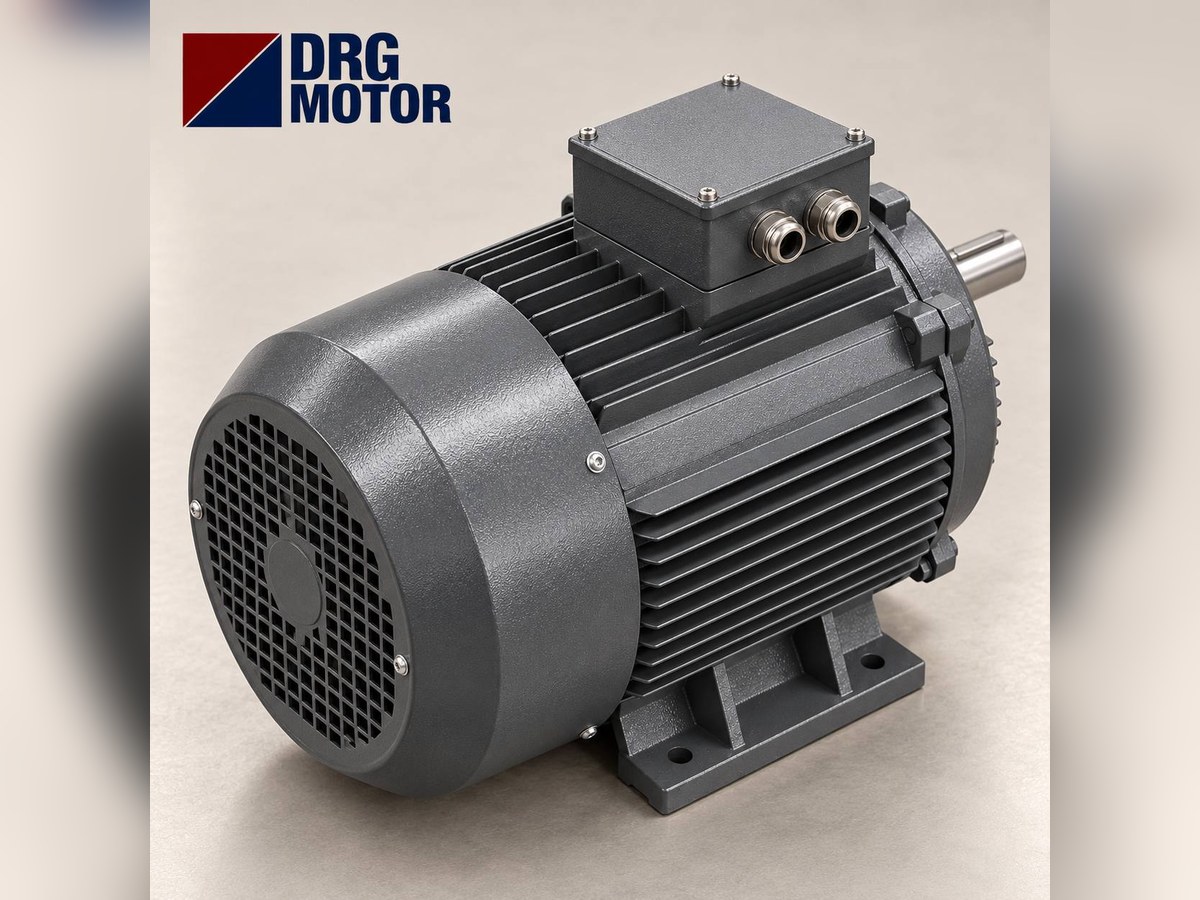
A feed grinding and milling machine motor is the electric motor that turns the rotor of a hammer mill or the rolls of a roller mill to reduce grain and meal to the required particle size. In a hammer mill the motor is usually coupled directly to the rotor and the rotor turns at motor speed; in a roller mill the rolls are driven more slowly through belts or gears. Manufacturer catalogues show motors from 5.5 kW on farm-type mills up to 450 kW on large industrial mills.
This page focuses on the grinding section of a feed mill: mill types, how screen size affects motor load, the auxiliary motors of the grinding line and the matching DRG motors. Converting capacity to kW and hammer tip speed are covered in our article on feed grinder and mixer motors, and rotor inertia and run-up time in a separate hammer mill post; they are not repeated here. For the whole feed line see our Feed Machine Electric Motors main page, and for models the Buy Electric Motors Online page.
Types of feed grinding machine and the motor's job
Hammer mill
The most common grinder in the feed industry. Free-swinging hammers hung on pins break the grain by impact and keep it in the chamber until it is small enough to pass the screen. Industrial mills have a wide chamber and a rotor diameter above one metre; teardrop and wide-chamber designs are sub-types of this group. The motor's job is to hold the rotor at constant speed: if speed falls, hammer tip speed drops and the product gets coarser.
Fan and self-conveying farm mills
In the small mills used on farms the rotor also works like a fan, blowing the ground product through a pipe to a bin or cyclone. Here the motor does both grinding and conveying; the longer the pipe and the more bends it has, the higher the motor load. One manufacturer states that this type can convey the product up to 12 m after the mill.
Roller mill
Grain passing between two or more corrugated rolls is crushed. It is used for coarse cracking in ruminant feed, rolling maize and barley, and crumbling after pelleting. Roll pairs are driven by a single motor through belts or by a separate motor for each pair; the feed roll has its own small motor. It uses less energy per tonne than a hammer mill but is not suited to fine grinding.
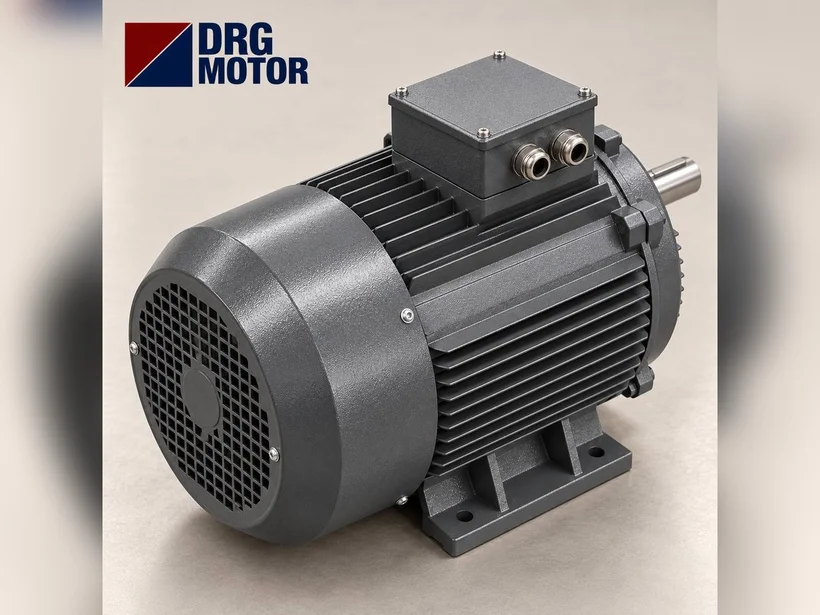
Motor power on feed grinders: catalogue values
A) Motor powers seen on models on the market
| Model group | Motor power | Single or total | Note |
|---|---|---|---|
| Farm fan mill, small | 5.5 / 7.5 kW | Single motor | Manufacturer catalogue, 3000 rpm |
| Farm fan mill, large | 11 / 15 kW | Single motor | Same catalogue |
| Self-conveying mill | 11–45 kW | Single motor | Manufacturer catalogue, 3000 rpm |
| Medium mill, 3–7 t/h | 22–45 kW | Single motor | Manufacturer catalogue, shaft 2980 rpm |
| Industrial mill, 1320 mm rotor | 75–355 kW | Single motor | Manufacturer catalogue |
| Aspiration fan of the same mill | 11–30 kW | Separate motor | Same catalogue line |
| Large multi-chamber mill | 55–450 kW | Single motor | Manufacturer catalogue, 1500 rpm |
| Roller mill (roll pair) | 30–300 hp maximum | Per model | Manufacturer catalogue |
This machine group shows motor options of roughly 5.5–450 kW depending on manufacturer model and capacity. The mill motor and the aspiration fan are on separate rows in the table: an industrial mill with a 250 kW main motor may also have a 30 kW fan motor, and the power of the grinding section is the sum of the two. For roller mills the catalogue gives only the maximum power; the exact value is chosen by roll length and the number of pairs.
Power grows with capacity (t/h), but even at the same capacity it changes with grain type, moisture and required fineness. One catalogue, for example, gives capacity for maize at 13 percent moisture and a 3 mm screen; with a finer screen the same motor handles fewer tonnes.
B) Matching motors in the DRG range
DRG Motor is a manufacturer, supplier and seller of electric motors. For feed grinders our range has 2-pole (3000 rpm) and 4-pole (1500 rpm) cast iron motors up to 355 kW, with light aluminium housings also offered below 11 kW for small farm mills. On a 400 V network, models from 4 kW upwards are connected in delta with a 400/690 V winding. Motors up to 355 kW for farm mills and for medium and large industrial mills are inside this range. Multi-chamber mill motors above 355 kW are outside the DRG range.
Click to see current electric motor prices and order nowSEE PRICES →
How screen size relates to power
In a hammer mill the product circulates in the chamber until it is small enough to pass the screen hole. The smaller the hole, the longer the grain stays, the more impacts it takes and the more energy per tonne the motor uses. In research carried out on two commercial-scale mills, 2.3, 3.9 and 6.3 mm screens were tested and the mill motor load was measured to fall as the screen hole got larger. The same study showed that motor load rose when tip speed was increased.
Setting the feed rate from mill current
In feed mills the feeder is adjusted automatically according to the mill motor current. The feeder inverter speeds up or slows down to hold the mill motor at a set fraction of its rated current. Example: the 55 kW DRG-250M-2 has a rated current of 93.5 A at 400 V. If a target load of 85 percent is chosen, feed is regulated so that the motor current is about 79 A. With a finer screen, fewer tonnes pass at the same current and the feeder corrects this by itself. The current target should not be set above the rated value.
Signs of screen and hammer condition
| Situation | Motor load | Action | Note |
|---|---|---|---|
| Screen hole made smaller | Rises | Reduce feed rate | Measured in research |
| Screen hole made larger | Falls | Capacity may rise | Same research |
| Screen torn or holed | Drops, coarse product | Replace screen | Not a motor fault |
| Hammers worn | Rises per tonne | Turn the hammers | Watch the current |
Auxiliary motors on the grinding line
A feed mill does not run on a single motor. Above the mill is a feeder that spreads grain evenly across the full width of the chamber; it is usually a small inverter-driven geared motor. The magnet and stone trap below the feeder have no motor, but if their maintenance is neglected foreign objects reach the hammers and the motor sees a sudden shock load.
Below the mill sits the aspiration system that pulls the ground product out together with the chamber air: a fan, a filter and a rotary valve (airlock) under the filter. If aspiration stops, the screen blinds, the product heats up and the mill motor current rises. The start sequence is therefore: discharge screw and aspiration first, then the mill motor, the feeder last. Stopping is the reverse.
The fan and rotary valve motors are selected separately; they belong to our Feed Dosing and Feed Screw Conveyor pages.
2-pole or 4-pole? Speed by rotor diameter
Direct coupling of a 2-pole motor is common on small and medium feed mills. Manufacturer catalogues for farm and medium mills state “electric motor 3000 rpm” and a shaft speed of 2980 rpm. As rotor diameter grows, peripheral speed at the same rpm becomes very high, so for rotors above one metre catalogues specify a 1500 rpm motor:
- 560 mm rotor at 2960 rpm: peripheral speed about 87 m/s.
- 1111 mm rotor at 1485 rpm: about 86 m/s.
- 1328 mm rotor at 1485 rpm: about 103 m/s.
So a large-rotor mill reaches with a 4-pole motor the speed that a small-rotor mill reaches with a 2-pole motor. When replacing the motor on an existing mill, the pole number is not changed: fitting a 2-pole motor on a 4-pole mill is dangerous for the rotor and hammer pins. Tip speed can be adjusted with an inverter, but the upper speed limit is set by the mill manufacturer.
Mounting, shaft and coupling
On direct-coupled mills the motor is usually foot-mounted (B3) on a common base frame, and the rotor shaft is joined to the motor shaft by a flexible coupling. On farm mills the rotor is often fitted straight onto the motor shaft and the motor is flange-mounted (B5); shaft diameter and length must then match exactly. For example, the 2-pole 55 kW DRG-250M-2 comes with a 60 mm shaft and a 140 mm shaft length. The exact mounting type and shaft size come from the mill manufacturer's drawing.
DRG models and prices for feed grinding machines
Values in the table come from the store data:
| Model | Power / speed | Frame | Current 400 V |
|---|---|---|---|
| DRG-132S2-2 | 7.5 kW / 2930 rpm | 132S cast iron | 13.7 A |
| DRG-160M2-2 | 15 kW / 2945 rpm | 160M cast iron | 26.5 A |
| DRG-180M-2 | 22 kW / 2955 rpm | 180M cast iron | 38.5 A |
| DRG-200L2-2 | 37 kW / 2960 rpm | 200L cast iron | 64 A |
| DRG-225M-2 | 45 kW / 2965 rpm | 225M cast iron | 76.8 A |
| DRG-250M-2 | 55 kW / 2970 rpm | 250M cast iron | 93.5 A |
| DRG-280S-4 | 75 kW / 1486 rpm | 280S cast iron | 129 A |
| DRG-315M-4 | 132 kW / 1488 rpm | 315M cast iron | 224 A |
The two 4-pole models in the table are for industrial mills with rotors above one metre. In roller mills roll speed is reduced by belt, so 4-pole motors are mostly used; you can find the pulley ratio with the pulley and belt calculator.
Feed grinder motor price: live table
| Model | Power / speed | Frame · current 400 V | Price |
|---|---|---|---|
| DRG-132S2-210 HP | 7.5 kW · 3000 rpm | Cast iron 132S · 13.7 A | $369.43 (€329.92) Details & buy → |
| DRG-160M1-215 HP | 11 kW · 3000 rpm | Cast iron 160M · 19.6 A | $527.95 (€471.49) Details & buy → |
| DRG-160M2-220 HP | 15 kW · 3000 rpm | Cast iron 160M · 26.5 A | $570.23 (€509.25) Details & buy → |
| DRG-180M-230 HP | 22 kW · 3000 rpm | Cast iron 180M · 38.5 A | $857.53 (€765.83) Details & buy → |
| DRG-200L1-240 HP | 30 kW · 3000 rpm | Cast iron 200L · 52.1 A | $1,273.02 (€1,136.88) Details & buy → |
| DRG-200L2-250 HP | 37 kW · 3000 rpm | Cast iron 200L · 64 A | $1,484.05 (€1,325.35) Details & buy → |
| DRG-225M-260 HP | 45 kW · 3000 rpm | Cast iron 225M · 76.8 A | $1,761.85 (€1,573.44) Details & buy → |
| DRG-250M-275 HP | 55 kW · 3000 rpm | Cast iron 250M · 93.5 A | $2,180.99 (€1,947.76) Details & buy → |
| DRG-280S-4100 HP | 75 kW · 1500 rpm | Cast iron 280S · 129 A | $2,916.93 (€2,605.00) Details & buy → |
| DRG-315M-4180 HP | 132 kW · 1500 rpm | Cast iron 315M · 224 A | $5,621.72 (€5,020.55) Details & buy → |
DRG MOTOR motors are guaranteed against material and manufacturing defects for 2 years from the delivery date (warranty certificate).
Motors in this power range
- DRG-160M1-2 – 11 kW – 2945 rpm – 160M cast iron
- DRG-160M2-2 – 15 kW – 2945 rpm – 160M cast iron
- DRG-200L1-2 – 30 kW – 2960 rpm – 200L cast iron
- DRG-225M-2 – 45 kW – 2965 rpm – 225M cast iron
- DRG-250M-2 – 55 kW – 2970 rpm – 250M cast iron
- DRG-315M-4 – 132 kW – 1488 rpm – 315M cast iron
Click to see current prices and order these motors nowSEE PRICES →
Questions about feed grinder motors
Why does a feed mill motor run very hot?
The most frequent causes are a blinded screen, aspiration that is not working and dust built up on the fan cover. These raise the current or cut off cooling. Check the feed current target first, then the aspiration fan and the motor's cooling paths.
What motor speed is used on a roller mill?
Because the rolls turn slowly, a 4-pole motor with a belt or gear drive is usually used. The number of pairs and roll length decide power; take the value from the machine nameplate.
In what order should the mill motor be started?
Discharge and aspiration first, then the mill, the feeder last. When stopping, the feeder stops first and the motor is switched off once the mill has emptied.
Where is the feed mill motor price list?
Current figures load into the table above directly from our shop; the full range of ratings sits on the shop page.
Send us the mill nameplate, rotor diameter and old motor label and we will determine the right model together. Phone +90 (542) 666 11 11, e-mail [email protected], contact page. For all models see Buy Electric Motors Online.


