 English
 Le français
 Türkçe

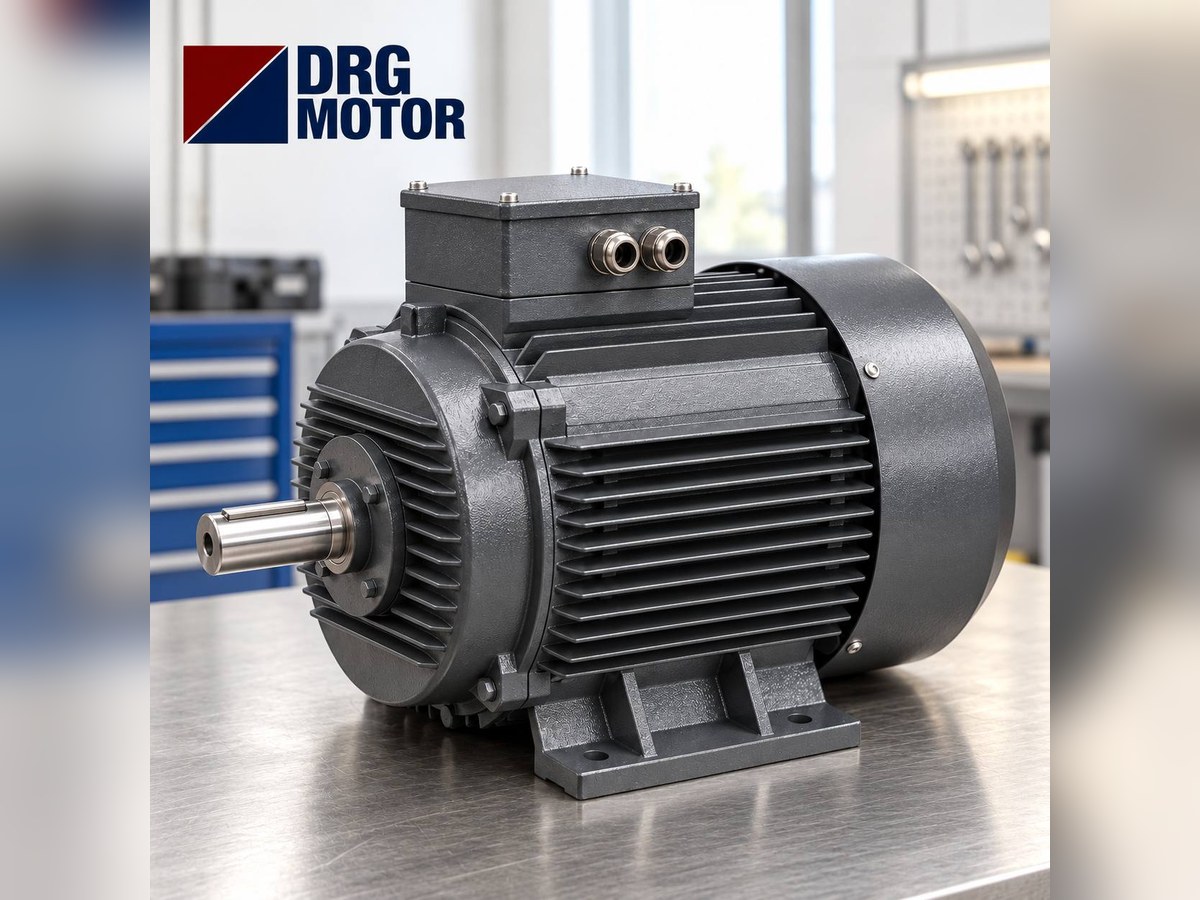
A booster pump motor is the three-phase motor that drives each pump in a pressure booster set, and it is sized not on the set total but on the flow and head of a single pump. In building and industrial sets the motor per pump is mostly in the 0.37–30 kW range, 2-pole, flange-mounted on top of a vertical multistage pump [1]. Because a set can have two to six pumps, installed power is multiplied by the number of pumps; but a burnt-out motor is replaced by one motor of the same rating.
This page explains how a multi-pump booster set works, the tank and control arrangement that decide how often the motor starts and stops, what happens to the motor in inverter sets, the motor power per pump in commercial sets and the DRG match. Matching motors with live prices are listed among the 120 models on Buy Electric Motors Online. Overview: Pump Motors.
What is a booster set and what does the motor do in it?
Booster is the name of an application: raising water to the required pressure where mains pressure is not enough. By operating principle the pumps inside are centrifugal pumps; most are vertical multistage pumps, while small domestic units may use horizontal multistage or self-priming pumps. A typical set consists of 2–6 pumps on common suction and discharge manifolds, one motor per pump, a pressure sensor or switch, a diaphragm pressure tank and a control panel.
The motor's job is simple, but its load varies. With low consumption one pump runs; as consumption rises the panel brings in a second and third pump (cascade). At night demand falls almost to zero and the pumps stop; the tank covers small draws. Each motor therefore starts and stops many times a day. That is the biggest difference between a booster motor and the motor of a single-stage industrial pump.
Where is it used?
- Domestic water pressure in apartment blocks, housing estates, hotels and hospitals.
- Process and cleaning water lines in factories.
- Drip line pressure in irrigation and greenhouse systems.
- Water distribution split into pressure zones in tall buildings.
Fire pump sets also boost pressure, but they follow separate rules and are a separate topic. For the choice between single-phase and three-phase motors see single-phase or three-phase for a booster, and for why motors burn out and the effect of frequent cycling see why booster pump motors burn out; this page focuses on motor selection in multi-pump sets.
Fixed-speed set or inverter set: the difference for the motor
The set's control arrangement decides which motor can be fitted.
- Fixed-speed (mains-operated) set: Each pump is connected to the supply direct-on-line or star-delta and runs at full speed. Pressure is kept between two values by switching pumps on and off. In one manufacturer's catalogue these sets have 0.37–30 kW per pump, 45 kW on request [1]. A standard IEC motor is used one-for-one here.
- Set with motor-integrated drive: Each pump's motor forms one unit with its own frequency converter; the same catalogue gives 0.37–22 kW per pump for this version [1]. When such a motor fails a standard motor can be fitted, but speed control is lost; this should not be done without changing the panel.
- Set with a separate inverter in the panel: The motor is standard and the frequency converter sits in the panel. A local manufacturer's booster panel works with induction motors over a 0.75–18.5 kW power range [2]. In this arrangement a burnt-out motor is replaced by a standard IEC motor, and the motor current in the inverter parameters is updated from the new nameplate.
In an inverter set, one pump runs speed-controlled while the others cut in at fixed speed, or all of them are speed-controlled. The number of motor starts falls and starts become softer; that is the main gain for motor life.
Start frequency and the pressure tank: who protects the motor?
In a fixed-speed set the motor draws several times its rated current at each start and the winding heats up. Set controllers therefore limit starts/stops per hour: in one manufacturer's panel this is an adjustable function, and the panel delays stops so as not to exceed the allowed number [1]. Tank volume depends on this number as well. We ran the fixed-speed set formula from the same catalogue: with 9 m³/h per pump, 5 bar setpoint and the same ratios, about 142 litres of tank are needed for 100 starts per hour, 237 litres for 60 and 475 litres for 30 [1].
The upshot: the smaller the tank, or the lower its pre-charge, the more often the motor starts. Check the tank pre-charge and diaphragm before replacing the motor; otherwise the new motor will overheat for the same reason. Inverter sets can work with much smaller tanks; in the same catalogue the recommended tank for these sets is 8–180 litres depending on pump size, against 80–1,500 litres for the fixed-speed version [1].
Click to see current electric motor prices and order nowSEE PRICES →
Motor power per pump: commercial sets
A) Motor power in booster sets on the market
| Model group / capacity | Motor power | Single / total | Source |
|---|---|---|---|
| Maker A, integrated-drive set | 0.37–22 kW | Per pump | [1] |
| Maker A, fixed-speed set | 0.37–30 kW | Per pump | [1] |
| Maker A, fixed-speed (on request) | up to 45 kW | Per pump | [1] |
| Maker B, inverter booster panel | 0.75–18.5 kW | Motor per panel | [2] |
| Maker A, 6-pump set | 6 × pump power | Set total | [1] |
In this equipment group, motor options of roughly 0.37–45 kW per pump are seen depending on the manufacturer's model and capacity [1][2]. Power per pump grows with the flow of one pump (m³/h) and with the set's head; in a taller building or with a higher setpoint, the motor grows at the same flow. The installed power of the set is multiplied by the number of pumps, but it is not the rating of a motor: a 3 × 7.5 kW set is 22.5 kW installed, yet each motor is 7.5 kW.
B) Where the DRG range covers these sets
The part of range A that overlaps DRG's 0.25–355 kW, 1000/1500/3000 rpm range is 0.37–45 kW; the whole range lies inside. Booster pumps are 2-pole, and 2-pole motors in the DRG range start at 0.25 kW. Pumps with motor-integrated drives, single-phase domestic boosters and close-coupled motors with pump-specific shafts are outside the DRG range.
Worked example: a three-pump apartment set
For shaft power per pump we use P = ρ·g·Q·H / η_pump; with Q in m³/s, H in m, ρ in kg/m³ and g = 9.81 m/s², the result is in W. Example: a set with 2 duty + 1 standby pump is planned for a housing estate with 18 m³/h peak demand. Flow per pump is 9 m³/h, and the total head needed for adequate pressure at the top-floor tap is 62 m. With an assumed pump efficiency of 0.60, P = 1000 × 9.81 × (9/3600) × 62 / 0.60 ≈ 2.5 kW. With a 10% margin the need is about 2.8 kW; the standard rating is a 3 kW 2-pole motor. Installed power is 3 × 3 = 9 kW; at peak two motors run and the standby motor rotates into service.
If two floors are later added to the same estate and the head rises to 75 m, shaft power goes to about 3.1 kW, or 3.4 kW with margin, and the motor moves up to 4 kW. The pump usually gains a stage or two as well; the choice is made together with the pump manufacturer. You can use the Pump & Fan Motor Power calculator for your own values.
| Model | Power / speed | Frame · current 400 V | Price |
|---|---|---|---|
| DRG-711-20.5 HP | 0.37 kW · 3000 rpm | Aluminium 71 · 0.89 A | $74.44 (€66.48) Details & buy → |
| DRG-712-20.75 HP | 0.55 kW · 3000 rpm | Cast iron 71 · 1.24 A | $82.24 (€73.45) Details & buy → |
| DRG-801-21 HP | 0.75 kW · 3000 rpm | Cast iron 80 · 1.64 A | $87.39 (€78.04) Details & buy → |
| DRG-802-21.5 HP | 1.1 kW · 3000 rpm | Cast iron 80 · 2.31 A | $96.26 (€85.96) Details & buy → |
| DRG-90S-22 HP | 1.5 kW · 3000 rpm | Cast iron 90S · 3.06 A | $119.41 (€106.64) Details & buy → |
| DRG-90L-23 HP | 2.2 kW · 3000 rpm | Cast iron 90L · 4.35 A | $154.45 (€137.93) Details & buy → |
| DRG-100L-24 HP | 3 kW · 3000 rpm | Cast iron 100L · 5.71 A | $177.89 (€158.87) Details & buy → |
| DRG-112M-25.5 HP | 4 kW · 3000 rpm | Cast iron 112M · 7.45 A | $225.65 (€201.52) Details & buy → |
| DRG-132S1-27.5 HP | 5.5 kW · 3000 rpm | Cast iron 132S · 10.1 A | $338.72 (€302.50) Details & buy → |
Checklist for replacing a booster motor
The set's pressure and flow come from the pump, not from the motor; the motor's task is to give the same shaft power at the same speed. Before replacing a motor in the set:
- Old motor nameplate: kW, speed (2-pole), voltage (230/400 V or 400/690 V), IEC frame.
- Flange: on a vertical set, small flange (V18) or large flange (V1); one manufacturer draws the line between 4 kW and 5.5 kW [1]. Shaft diameter and length, coupling key.
- Other motors in the set: all the same rating? The new motor should match so the cascade order is not upset.
- Panel: direct-on-line, star-delta or inverter; overload setting and inverter motor parameters.
- Pressure tank pre-charge and diaphragm, starts-per-hour setting.
- Dry-running protection: is the level switch or suction pressure switch working?
- Environment: humidity and condensation in the pump room; motor protection rating and terminal box gasket.
Voltage note: one pump catalogue lists motors up to 1.5 kW at 3×220-240/380-415 V and 7.5 kW and above at 380-415/660-690 V [3]. In the DRG range motors up to 3 kW are 230/400 V and 4 kW and above are 400/690 V. A set with star-delta panels needs 400/690 V motors; motors of 3 kW and below are started direct-on-line. Details: star-delta starting. On a vertical set the motor must be ordered as suitable for vertical mounting and the axial load confirmed with the pump manufacturer. The exact flange type is taken from the pump manufacturer's drawing. Leave the electrical work to a qualified electrician.
Matching with DRG motors
DRG Motor is a manufacturer, supplier and seller of electric motors. Our range covers 0.25–11 kW in aluminium frames and 0.55–355 kW in cast iron; 1000, 1500 and 3000 rpm; 3-phase, 230/400 V or 400/690 V; mounting B3, B5, B14 and B35 (specified with the order). For booster sets the relevant part is the 2-pole 3000 rpm class. The table below shows ratings often seen in building sets.
| Model | Power / speed | Frame | Current 400 V |
|---|---|---|---|
| DRG-90S-2 | 1.5 kW – 2895 rpm | 90S cast iron | 3.06 A |
| DRG-90L-2 | 2.2 kW – 2895 rpm | 90L cast iron | 4.35 A |
| DRG-100L-2 | 3 kW – 2895 rpm | 100L cast iron | 5.71 A |
| DRG-112M-2 | 4 kW – 2905 rpm | 112M cast iron | 7.45 A |
| DRG-132S1-2 | 5.5 kW – 2930 rpm | 132S cast iron | 10.1 A |
For the 3 kW need in the example, DRG-100L-2 (2895 rpm, 5.71 A at 400 V) fits; for the 4 kW need after the extra floors, DRG-112M-2 (400/690 V, 7.45 A at 400 V). DRG MOTOR motors are guaranteed against material and manufacturing defects for 2 years from the delivery date (warranty certificate).
DRG motors for booster sets
- DRG-802-2 – 1.1 kW – 2880 rpm – 80 cast iron
- DRG-90S-2 – 1.5 kW – 2895 rpm – 90S cast iron
- DRG-90L-2 – 2.2 kW – 2895 rpm – 90L cast iron
- DRG-100L-2 – 3 kW – 2895 rpm – 100L cast iron
- DRG-112M-2 – 4 kW – 2905 rpm – 112M cast iron
- DRG-132S1-2 – 5.5 kW – 2930 rpm – 132S cast iron
Click to see current prices and order these motors nowSEE PRICES →
Booster pump motor: frequently asked questions
What kW should a booster pump motor be?
It is calculated from one pump's flow and head: 3 kW for 9 m³/h and 62 m in the example. In commercial sets the motor per pump is mostly 0.37–30 kW.
If one motor burns out in a three-pump booster, do all of them need replacing?
No. Only the burnt-out motor is replaced with one of the same power, speed and flange. But if the cause (tank pre-charge, dry running, phase loss) is not found, the other motors are at risk too.
Can a standard motor be fitted to an inverter booster?
Yes if the inverter is in the panel; the motor parameters are entered from the new nameplate. If the inverter is on the motor (integrated), a standard motor removes speed control and should not be fitted without changing the panel.
How many amps does a 3 kW booster motor draw?
The 2-pole DRG-100L-2 draws 5.71 A at 400 V and 6.02 A at 380 V.
Send us the number of pumps in the set, the pump nameplate and the old motor's nameplate; we will match it to a DRG model. Phone +90 (542) 666 11 11, e-mail [email protected], contact page. For all models and current prices, see Buy Electric Motors Online.
Sources
- Grundfos – Hydro MPC Data Booklet (booster sets with 2 to 6 pumps) – sets with 2–6 pumps; motor per pump 0.37–22 kW (integrated drive), 0.37–30 kW (mains-operated), 45 kW on request; V18 up to 4 kW, V1 from 5.5 kW; starts-per-hour limit and tank volume formula.
- Masdaf – Ürün kataloğu (frekans kontrollü pano) – frequency-controlled panel for booster sets: power range 0.75–18.5 kW, compatible with induction and PMSM motors, 380 V input.
- Grundfos – CR, CRI, CRN Data Booklet, 50 Hz – vertical multistage pumps used in booster sets; 2-pole standard motor, 0.37–1.5 kW 3×220-240/380-415 V, from 7.5 kW 380-415/660-690 V.


