 English
 Le français
 Türkçe

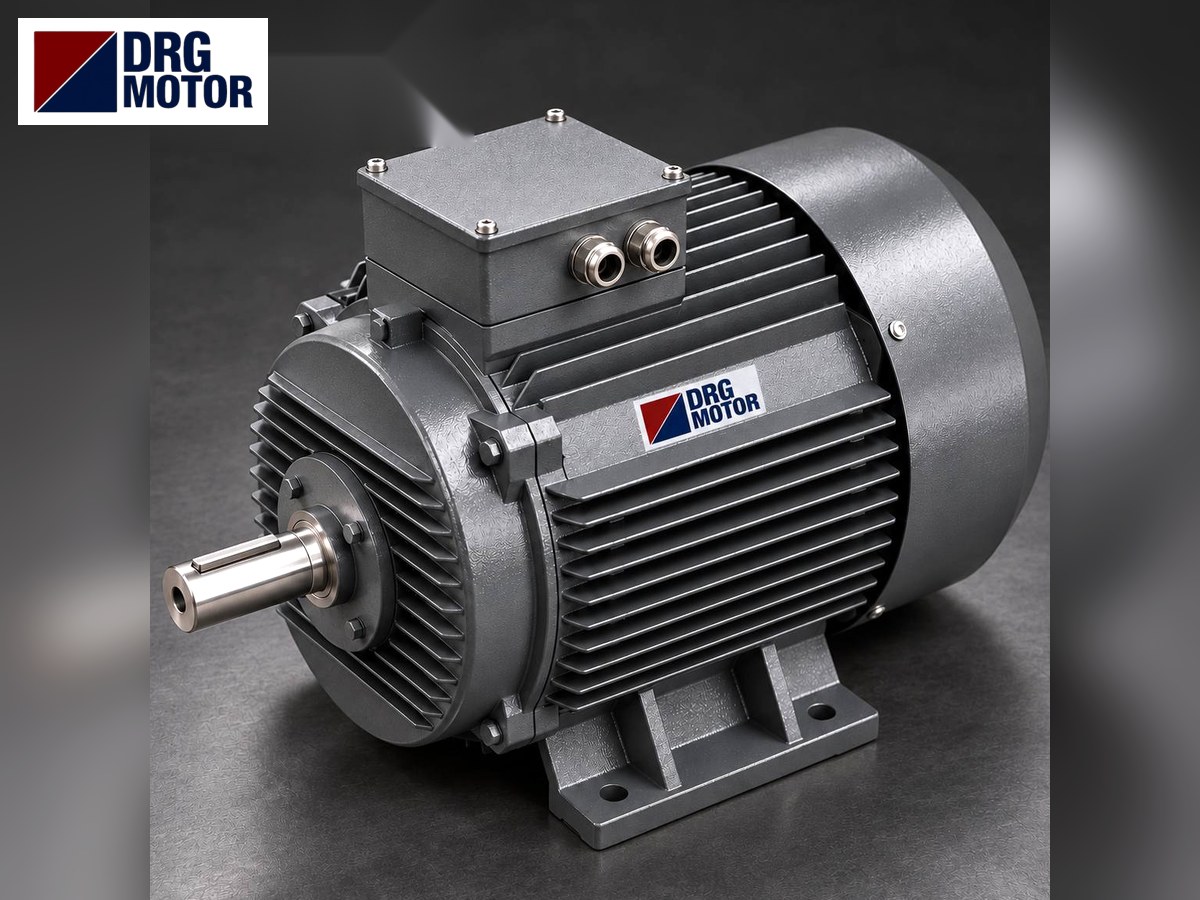
In a glass recycling plant, electric motors turn the crusher, the rolls, the screens, the magnet belt, the sorting line belts and the dryer drum. The largest motor is usually on the crusher; in makers’ data sheets glass crusher motors range from 1.5 kW on small bottle crushers up to 110 kW on large crushers producing glass powder. The required power depends less on capacity than on the glass size you want.
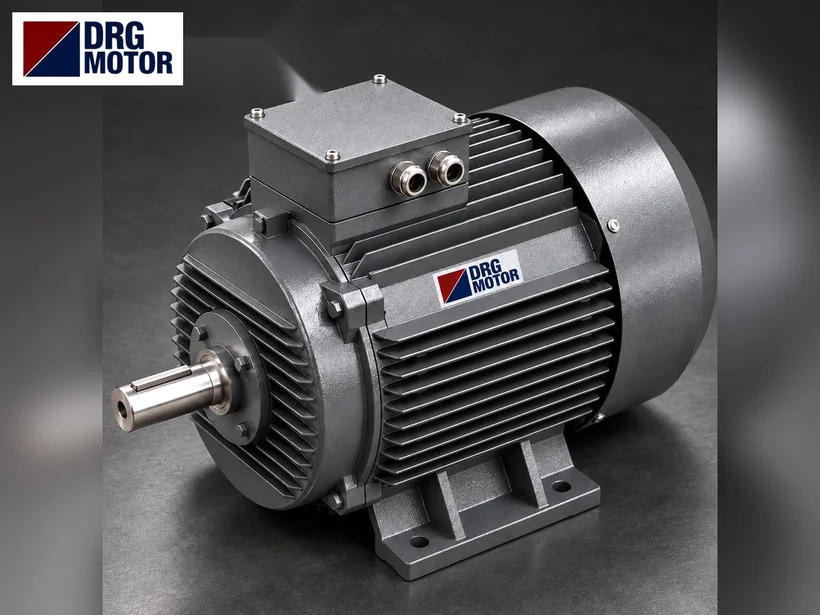
What is described here is the three-phase motor fitted to these machines. DRG Motor is a manufacturer, supplier and seller of electric motors. We do not sell crushers, screens, sorting machines, gearboxes or drives. Suitable motors are on our Buy Electric Motors Online page.
Glass recycling line: which motor on which machine?
Collected bottles and jars are tipped into a receiving hopper and taken into the line by belt. The crusher brings the glass down to a sortable size; the magnetic separator removes metal caps, the screen splits fine and coarse fractions, and the optical sorter removes ceramics, stone, porcelain and coloured glass. The broken glass (cullet) is dried if needed, kept apart by colour and sent to the glassworks furnace.
Crushers
In a hammer glass crusher, swinging or flexible hammers break the bottle; in a double roll crusher the gap between two cylinders limits the particle size and each roll has its own motor. The roll type produces less fine dust and brings bottle necks and thick bottoms to a size suitable for sorting.
Separation and sorting machines
A small motor drives the overband magnet belt through a gearbox. On rotary screens (trommels) a motor and gearbox turn the drive rollers; a fan inside the drum may remove paper labels. Optical sorting itself works with cameras, air valves and a compressor; on the motor side only the feed belt and the vibratory feeder remain.
Conveyor and dryer
Glass is a heavy, sharp load: belt conveyors and bucket elevators turn slowly, the motor speed being cut by a gearbox. For rotary drum dryers, one maker states that chain and sprocket drives are used with motors up to 55 kW on small and medium drums, and that larger drums move to gear and pinion drives; in both, the motor speed is reduced by a gearbox.
Why is glass crushing different from stone crushing?
Both use crushers, but the load on the motor is not the same. A machine crushing quarry rock breaks large, hard blocks in the first stage and may run on hundreds of kW; see our Hammer Crusher Motor page for details. Glass, on the other hand, is brittle: a bottle shatters with little energy, so coarse glass crushing is done with a far smaller motor than stone.
Brittle but abrasive
Glass breaks easily, but its sharp-edged pieces wear hammers, liner plates and screen surfaces quickly. A worn hammer gets shorter and its tip speed drops; the machine holds the glass longer to reach the same fineness and motor current rises. Raising power without measuring wear does not solve the problem; first review the hammer and screen change interval.
Foreign matter and sudden load
Waste glass streams contain metal caps, corks, ceramics and sometimes stone. These cause sudden torque peaks in the crusher. With a belt drive the belt absorbs part of the shock; with a direct coupling the full load reaches the shaft and bearing. That is why magnetic and manual sorting before the crusher also matters for motor life.
How does output size set motor power?
Even at the same tonnage the power of glass crushers varies widely, because coarse cullet for the furnace and sand or powder sized glass do not need the same energy. Dividing power by capacity from makers’ data sheets gives this picture:
| Machine | Power / capacity | kW per t/h | Output |
|---|---|---|---|
| Hammer cullet crusher | 7.5 kW / 25 t/h | ≈ 0.3 kW | coarse cullet for furnace |
| Double roll crusher | 15 kW / 15 t/h | ≈ 1.0 kW | 5–15 mm, to sorting |
| Auto-feed crusher | 22 kW / 5 t/h | ≈ 4.4 kW | sand size |
| Bottle crusher line | 15 kW / 2 t/h | ≈ 7.5 kW | glass powder |
Power per tonne is small for coarse cullet; as glass is brought down to sand size, the motor power needed for the same tonnage rises several times. When choosing a motor, ask the machine maker for output size and screen opening as well as hourly tonnage. Enlarging the motor by looking only at tonnage can create torque beyond the crusher’s mechanical limit.
Change the setting, the current changes
Narrowing the gap on a roll crusher, or reducing the screen opening on a hammer crusher, increases motor load. After a setting change measure motor current at full load; if it stays above the nameplate current, undo the setting or discuss a power increase with the machine maker.
Click to see current electric motor prices and order nowSEE PRICES →
How many kW is a glass recycling motor?
A) Motor powers seen in makers’ data sheets:
| Machine / capacity | Motor power | Single / total | Note |
|---|---|---|---|
| Compact bottle crusher, 300 kg/h | 1.5 kW | Single motor | maker data sheet, smallest |
| Auto-feed crusher, 2 t/h | 5.5 kW | Single motor | same maker |
| Auto-feed crusher, 5 t/h | 22 kW | Single motor | same maker, large |
| Hammer cullet crusher, 7.5–25 t/h | 3 / 5.5 / 7.5 kW | Installed power | second maker |
| Bottle crusher line, 2 t/h | 15 kW + 2 × 1.5 kW | Crusher + 2 belts | third maker |
| Double roll crusher, 2–6 t/h | 2 × 5.5 kW | Per roll | fourth maker |
| Double roll crusher, 5–15 t/h | 2 × 7.5 kW | Per roll | same maker |
| Crusher for glass powder, 5–80 t/h | 30–110 kW | Single motor | fifth maker, 4 sizes |
| Overband magnet belt | 2.2 kW | Geared | sixth maker |
From the compact bottle crusher to the glass powder crusher, these data sheets cover motors from 1.5 kW up to 110 kW. On double roll crushers power is stated per roll and the total is twice that; the infeed and outfeed belts of bottle crusher lines are separate motors and are not added to the crusher power.
B) Our share of that range: the whole 1.5–110 kW band is covered by our aluminium and cast iron frame models at 1000, 1500 and 3000 rpm. The 220 V single-phase motors used on some small bottle crushers are not in our range.
Glass dust, seals and motor care
Where does dust enter the motor?
Glass dust is a fine, hard abrasive. It most often enters through the shaft seal, terminal box gasket and cable gland; dust collecting on the fan cover also cuts off cooling air. Our motors are IP55; placing them out of the dust stream rather than next to the crusher mouth, and keeping the crusher’s dust extraction running, matters as much as the protection class.
Bearing and belt
On belt-driven crushers, over-tensioning the belt passes the shock to the motor’s front bearing. Keep belt tension at the machine maker’s value and check pulley alignment after every hammer change. Our Pulley-Belt Calculator can be used for the pulley ratio.
Vibrating screens and feeders
Vibrating screens grading glass sand and vibratory chutes feeding optical sorters mostly run on vibration motors. A vibration motor is a separate product group from the standard induction motor; tell us what you need. See our article on vibration motors for details.
Speed and drive: crusher, rolls and belts
On hammer glass crushers the motor usually turns the rotor by belt; because pulleys fix the rotor speed, a 4-pole 1500 rpm motor is the usual choice. In one series of crushers for glass powder the rotor speed falls from 1440 rpm on the small size to 720 rpm on the large one; as speed drops on the larger frame, the transmission between motor and rotor changes too. Roll crushers run at low peripheral speed; each roll turns with its own motor and gearbox, and the control has separate overload protection so that each motor can stop independently. Conveyors and trommel drives also turn slowly from a gearbox output; here the motor speed is part of the gearbox ratio.
DRG motors: models suited to glass crushing and screening plants
Our models matching crusher, roll and auxiliary machine powers (current at 400 V):
| Model | Power / speed | Frame · shaft D×E | Current 400 V |
|---|---|---|---|
| DRG-90L-4 | 1.5 kW / 1445 rpm | 90L cast iron · 24×50 | 3.3 A |
| DRG-132S-4 | 5.5 kW / 1460 rpm | 132S cast iron · 38×80 | 10.7 A |
| DRG-132M-4 | 7.5 kW / 1460 rpm | 132M cast iron · 38×80 | 14.3 A |
| DRG-132M2-6 | 5.5 kW / 968 rpm | 132M cast iron · 38×80 | 12 A |
| DRG-160L-4 | 15 kW / 1465 rpm | 160L cast iron · 42×110 | 27.3 A |
| DRG-200L-4 | 30 kW / 1475 rpm | 200L cast iron · 55×110 | 53.8 A |
Our motors are three-phase and IP55; tell us B3 feet, B5 flange or B35 feet and flange when ordering. Send us the crusher maker’s drawing and the old nameplate: we compare power, speed, voltage and connection, frame and mounting, shaft and key, flange, and the pulley or gearbox side before saying yes. An unchecked swap gets no fit guarantee from us.
Live price table
For crusher, roll and screen motor sizes, today’s shop prices appear here:
| Model | Power / speed | Frame · current 400 V | Price |
|---|---|---|---|
| DRG-90L-42 HP | 1.5 kW · 1500 rpm | Cast iron 90L · 3.3 A | $144.14 (€128.73) Details & buy → |
| DRG-100L2-44 HP | 3 kW · 1500 rpm | Cast iron 100L · 6.02 A | $203.84 (€182.05) Details & buy → |
| DRG-112M-45.5 HP | 4 kW · 1500 rpm | Cast iron 112M · 7.95 A | $254.38 (€227.18) Details & buy → |
| DRG-132M2-67.5 HP | 5.5 kW · 1000 rpm | Cast iron 132M · 12 A | $423.04 (€377.80) Details & buy → |
| DRG-132S-47.5 HP | 5.5 kW · 1500 rpm | Cast iron 132S · 10.7 A | $342.01 (€305.44) Details & buy → |
| DRG-160M-610 HP | 7.5 kW · 1000 rpm | Cast iron 160M · 15.4 A | $579.49 (€517.52) Details & buy → |
| DRG-132M-410 HP | 7.5 kW · 1500 rpm | Cast iron 132M · 14.3 A | $394.89 (€352.66) Details & buy → |
| DRG-160L-420 HP | 15 kW · 1500 rpm | Cast iron 160L · 27.3 A | $678.13 (€605.61) Details & buy → |
| DRG-180L-430 HP | 22 kW · 1500 rpm | Cast iron 180L · 39.7 A | $919.45 (€821.13) Details & buy → |
| DRG-200L-440 HP | 30 kW · 1500 rpm | Cast iron 200L · 53.8 A | $1,235.00 (€1,102.93) Details & buy → |
DRG MOTOR motors are guaranteed against material and manufacturing defects for 2 years from the delivery date (warranty certificate).
Motors in this power range
- DRG-100L1-4 – 2.2 kW – 1450 rpm – 100L cast iron
- DRG-112M-4 – 4 kW – 1450 rpm – 112M cast iron
- DRG-160M-6 – 7.5 kW – 970 rpm – 160M cast iron
- DRG-180L-4 – 22 kW – 1470 rpm – 180L cast iron
- DRG-280S-4 – 75 kW – 1486 rpm – 280S cast iron
Click to see current prices and order these motors nowSEE PRICES →
Review the models, get a quote: all motors are on the Buy Electric Motors Online page. Send your crusher type, hourly capacity and the old motor nameplate via WhatsApp or call +90 (542) 666 11 11.
Frequently asked questions
What speed should a glass crushing machine motor have?
Belt-driven hammer crushers mostly use 1500 rpm motors and the rotor speed is set by pulleys. On roll crushers and conveyors the motor works through a gearbox, so speed is chosen together with the gearbox ratio.
Can a glass screening plant motor be the same as the crusher motor?
Power and speed differ. Trommel and belt drives use motors of a few kW coupled to a gearbox; vibrating screens often use vibration motors.
Why does a glass processing machine motor fail early?
The most frequent cause is glass dust entering through the gasket and shaft seal, and a fan cover clogged with dust. The second is running for long periods with worn hammers; current rises and the motor overheats.
Glass recycling motor price: where is it shown?
It follows power, speed and frame; the live table on this page and each product page carry the current figure.
Phone +90 (542) 666 11 11, e-mail [email protected], contact page. For glass crushing machine motor and glass screening plant motor options, see Buy Electric Motors Online.


