 English
 Le français
 Türkçe

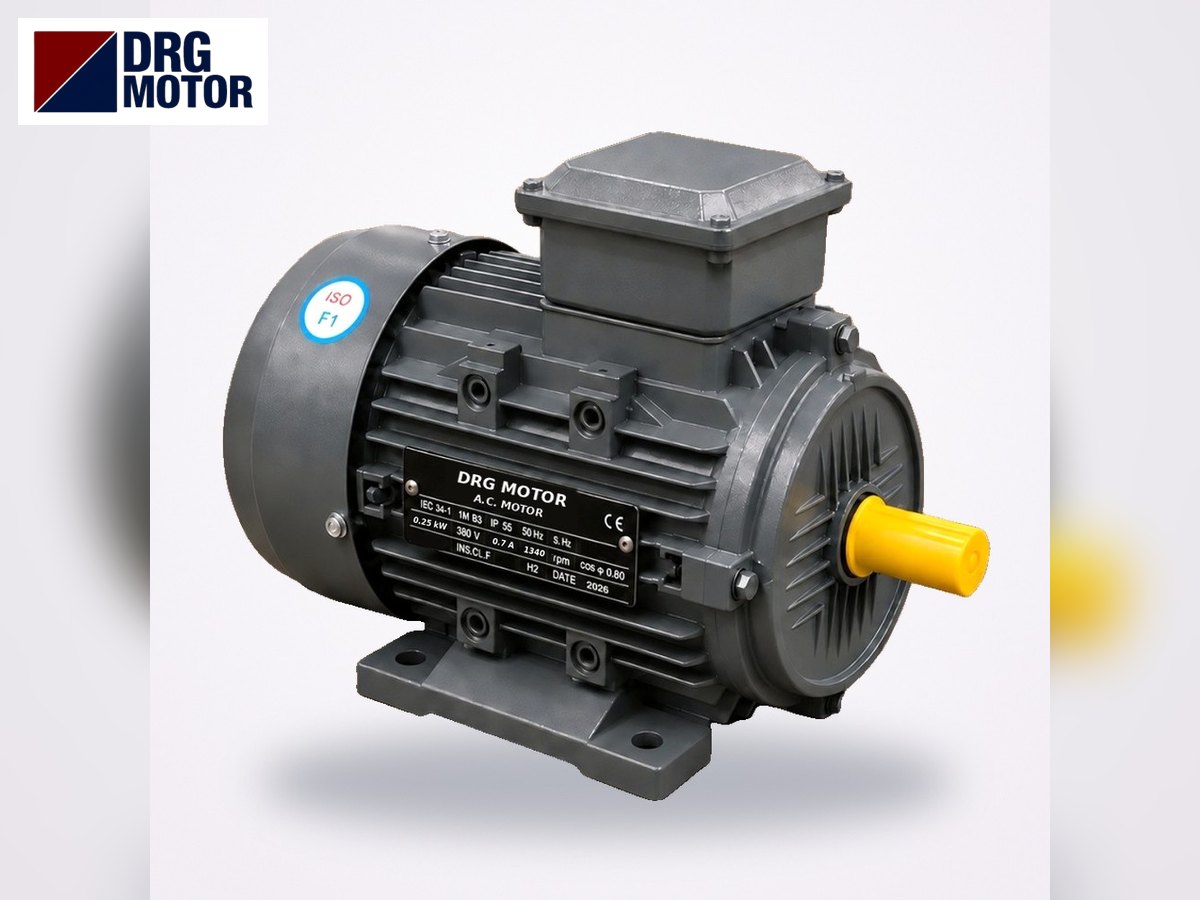
On a shrink wrapping machine, heat shrinks the film around the product; the electric motor does not make the heat, it moves things. Motors on a shrink line do four jobs: they turn the conveyor that carries the product through the tunnel, spin the fan that circulates hot air inside the tunnel, unwind or rewind the film reel, and run the fan that cools the pack at the exit. At the L-sealing station the jaw is usually lowered by an air cylinder. Below, each station is taken in turn: what drives it, and whether a standard aluminium motor from us fits there.
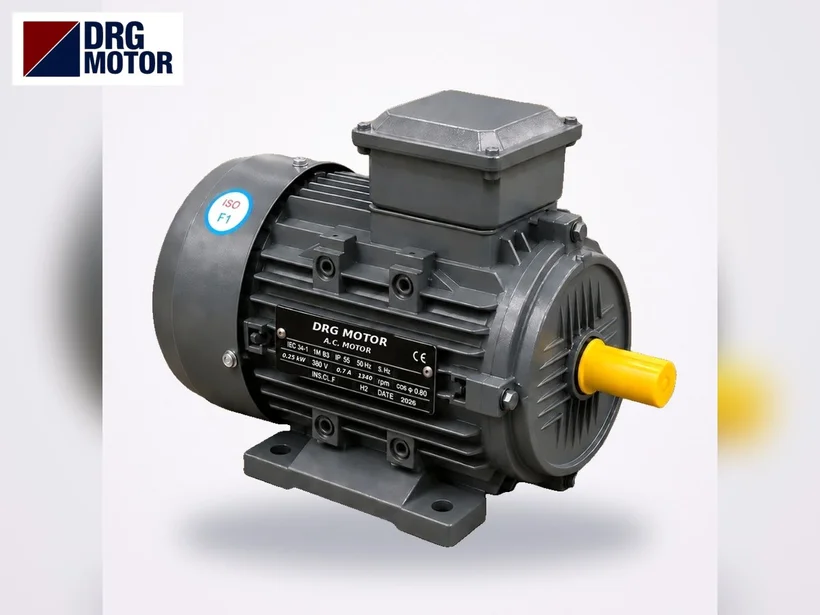
DRG Motor is a manufacturer, supplier and seller of electric motors. We do not sell the shrink machine or tunnel, heater elements, fan impellers, gearboxes, servo systems or speed drives; we supply the standard three-phase asynchronous motor. The small frames used on wrappers are grouped under aluminium housing motors; ordering is done through Buy Electric Motors Online.
Which section of a shrink line does the motor drive?
L-sealing and closing station
The product enters between two layers of film and an L-shaped hot jaw cuts and welds it. On a semi-automatic machine the operator lowers the jaw, on an automatic one a pneumatic cylinder does. The motor at this station only turns the infeed belt and the waste film rewinder; both are under a few hundred watts.
Tunnel conveyor
The silicone-sleeved roller chain or wire mesh belt that carries the pack through the tunnel is turned by a motor coupled to a gearbox. Belt speed sets how long the film stays in the tunnel, so it is adjusted with an inverter. The conveyor motor sits at the side of the tunnel, outside the hot chamber.
Circulation fan
Heater elements inside the tunnel warm the air and the fan drives it around the pack. Small tunnels have a single fan; long tunnels running PE film have separate fans above and below.
Film unwinder, rewinder and cooling fan
On sleeve wrappers, motorised unwinders release the lower and upper film reels; when the product leaves the tunnel a cooling fan sets the film. These motors are outside the hot zone and work in normal room conditions.
Temperature: where should the motor sit?
Inside the tunnel the air reaches 150–250 °C, while DRG motors are built for an ambient of −15…+40 °C. So no motor is ever placed inside the hot volume. The fan motor bolts to the outside of the tunnel wall and an extended shaft reaches the impeller; an insulating collar seals the wall opening, and a finned disc on the shaft sheds heat before it can creep back into the motor bearings. That arrangement is the machine maker’s design; the motor itself is standard. How shaft heat is handled is explained in detail on our High-Temperature Fan Motors page.
On a fully enclosed tunnel the motor compartment can warm up too. If hot air collects behind the motor cover, leave a ventilation opening; the air passing over the motor surface must not exceed 40 °C. Letting the fan spin on for a while after the tunnel is switched off (cool-down cycle) protects shaft and bearings, and the motor must stay powered during that time.
What does an aluminium housing do on a shrink machine?
Motors on shrink machines are small and hang on the tunnel body, a side panel or a bracket. A light aluminium housing brings three gains here: it loads the thin sheet-metal tunnel body and fan bracket less, the machine is lighter when moved, and the motor can be removed and refitted by one person. The compact housing also fits the narrow side compartment found on most machines. Applications with heavy knocks, severe vibration or high power suit a cast iron housing better; such loads are rare on shrink lines. Big pallet shrink hoods needing more than 11 kW per drive are better served by the cast iron general purpose range.
Click to see current electric motor prices and order nowSEE PRICES →
How many kW are shrink tunnel motors? Values from maker sheets
A) Motor values given in tunnel catalogues:
| Machine / section | Motor power | Number / speed | Note |
|---|---|---|---|
| Small bench tunnel | 25 W | conveyor, single motor | 220 V single-phase; heater separate |
| Mid tunnel, 1200 mm chamber | 1/2 HP + 2 × 1/4 HP | geared conveyor + top/bottom fan | heater 13.5 kW |
| Long tunnel, 1500 mm chamber | 120 W + 2 × 750 W | conveyor 1:25; fan 1400 rpm | total ≤19 kW |
| Tunnel, 1000–1800 mm chamber | 400 W | conveyor, inverter 10–40 m/min | total 9.5–18 kW |
| Tunnel, 1220 mm chamber | 1 HP | circulation fan | heater 15 kW |
| Compact tunnel | 40 W + 1/2 HP | conveyor + fan | heater 9 kW |
Most of the total power in the table belongs to the heater elements; the motors’ share is small. Conveyors take 25–400 W, fans 1/4 HP to 1 HP (about 0.19–0.75 kW). Treat them as examples and go by the rating plate of the wrapper in front of you.
B) Overlap with the DRG range: our aluminium range starts at 0.25 kW. For fan and conveyor motors of 1/4 HP and up, our 0.25–0.75 kW models in frames 71 and 80 suit; for large tunnel fans, the 1.1 kW model in frame 90S. Outside our range: small 25–120 W gear motors, 24 V DC motors, 220 V single-phase motors, units with motor and gearbox in one housing, and the servo motors used on film pull and cutting axes of automatic machines.
What is checked when choosing a conveyor or fan motor
Power, speed and voltage
The old motor’s plate power and pole count are kept; conveyor and circulation fans are usually 4-pole, a cooling fan may be 2-pole. All models on this page are wound for 230/400 V: star on a 400 V line, delta on the 230 V three-phase output of a drive fed from single phase. If the plate shows HP, 1 HP is about 0.746 kW and corresponds to a 0.75 kW motor.
Frame, shaft and flange
On a fan motor, shaft diameter, shaft length and key must fit the fan hub; on designs with an extension shaft, the coupling or hub bore is checked. Conveyor motors are often joined to the gearbox with a small B14 flange or a B5 flange; flange type and spigot diameter are measured on the old motor. For foot mounting, frame number (shaft height) and foot hole spacing must match.
Coupling, belt and gearbox
On the conveyor the motor connects directly to the gearbox; on the fan, directly to the impeller or through a belt. As long as the gearbox ratio stays the same, the new motor’s nominal speed sets belt speed. A sample calculation (80 mm sprocket pitch diameter assumed, ratio 1:25 from a catalogue):
| Step | Value | How it was found | Note |
|---|---|---|---|
| Motor speed | 1340 rpm | product record, DRG-711-4 | 50 Hz |
| Gearbox output | 53.6 rpm | 1340 / 25 | ratio from catalogue |
| Belt speed, 50 Hz | 13.5 m/min | π × 0.08 m × speed | sprocket size assumed |
| Belt speed, 30 Hz | ≈ 8.1 m/min | proportional to frequency | drive setting |
Both figures sit inside the 0–30 m/min belt speed range quoted in tunnel catalogues. Belt speed depends on the machine design; the real value is the machine maker’s data.
Speed control, stop-start, dust and moisture
Speed control with an inverter
Conveyor speed keeps changing with film gauge and product, and an inverter does that job. DRG does not supply drives; our standard motors can run on one. At low frequency the motor’s own fan slows, so on a conveyor that runs very slowly for long periods watch motor temperature and apply the drive maker’s minimum speed if needed.
Stop-start and hot standby
When the line stops the conveyor stops but the fan keeps turning; if the belt stood still for long, rollers inside the tunnel could be damaged by heat, so many machines keep the belt creeping. The conveyor motor therefore does not start many times an hour; its real duty is steady, light and long running.
Dust, moisture and the IP55 limit
The shrink area is usually dry, but on beverage and food lines the floor is washed. An IP55 rating keeps out dust and copes with a gentle hose from any side, yet a pressure-wash lance, steam cleaning or standing in water lie beyond it. If the underside of the line is hosed at high pressure, keep the motor away from the jet, point the terminal box and cable entry down, and keep drain holes open. If film trimmings and dust block the fan cowl grille, the motor cannot cool.
Small single-phase tunnels
Most small bench tunnels are fed from 220 V single phase and their conveyor motor is a few tens of watts; such motors are not in our range. When a motor is replaced on a three-phase tunnel, the models above can be used; a single-phase wrapper needs the original maker’s motor sheet and fixing sizes instead.
Information needed for a motor replacement
- The motor’s job: conveyor, circulation fan, cooling fan, film unwinder.
- Plate photo: kW or HP, speed, voltage, frequency.
- Gearbox ratio and input flange, or fan hub size.
- Shaft diameter and length, flange type, foot hole spacing.
- Tunnel temperature and ambient temperature in the motor compartment.
- Speed drive fitted or not; three-phase supply or not.
- Daily running time and how often the line stops.
DRG aluminium housing motors for shrink machines
Models suited to conveyor, circulation and cooling fans (values from our product records):
| Model | Power / speed | Frame · torque | Current 400 V |
|---|---|---|---|
| DRG-711-4 | 0.25 kW · 1500 → 1340 rpm | 71 aluminium · 1.78 Nm | 0.66 A |
| DRG-712-4 | 0.37 kW · 1500 → 1340 rpm | 71 aluminium · 2.64 Nm | 0.92 A |
| DRG-801-4 | 0.55 kW · 1500 → 1400 rpm | 80 aluminium · 3.75 Nm | 1.31 A |
| DRG-802-4 | 0.75 kW · 1500 → 1420 rpm | 80 aluminium · 5.04 Nm | 1.75 A |
| DRG-801-2 | 0.75 kW · 3000 → 2880 rpm | 80 aluminium · 2.49 Nm | 1.64 A |
| DRG-90S-4 | 1.1 kW · 1500 → 1445 rpm | 90S aluminium · 7.27 Nm | 2.48 A |
Live prices for these models come from the shop:
| Model | Power / speed | Frame · current 400 V | Price |
|---|---|---|---|
| DRG-711-40.37 HP | 0.25 kW · 1500 rpm | Aluminium 71 · 0.66 A | $73.16 (€65.33) Details & buy → |
| DRG-712-40.5 HP | 0.37 kW · 1500 rpm | Aluminium 71 · 0.92 A | $76.76 (€68.55) Details & buy → |
| DRG-801-40.75 HP | 0.55 kW · 1500 rpm | Aluminium 80 · 1.31 A | $87.55 (€78.19) Details & buy → |
| DRG-802-41 HP | 0.75 kW · 1500 rpm | Aluminium 80 · 1.75 A | $97.30 (€86.90) Details & buy → |
| DRG-801-21 HP | 0.75 kW · 3000 rpm | Aluminium 80 · 1.64 A | $83.41 (€74.49) Details & buy → |
| DRG-90S-41.5 HP | 1.1 kW · 1500 rpm | Aluminium 90S · 2.48 A | $118.44 (€105.78) Details & buy → |
DRG MOTOR motors are guaranteed against material and manufacturing defects for 2 years from the delivery date (warranty certificate).
Motors in this power range
- DRG-711-4 – 0.25 kW – 1340 rpm – 71 aluminium
- DRG-802-4 – 0.75 kW – 1420 rpm – 80 aluminium
- DRG-90S-4 – 1.1 kW – 1445 rpm – 90S aluminium
Click to see current prices and order these motors nowSEE PRICES →
Browse the products, ask for a quote: all models are on the Buy Electric Motors Online page. Tell us what the motor does in the tunnel and send a plate photo to our WhatsApp line; we will check power, speed, shaft and flange together. Phone: +90 (542) 666 11 11.
Frequently asked questions
Why does the shrink tunnel fan motor fail quickly?
Most often the heat comes through the shaft and the motor compartment. Check the cooling wheel on the shaft, the heat barrier and the compartment ventilation; let the fan finish its cool-down cycle when the tunnel is switched off.
Can a 2-pole motor make the shrink conveyor faster?
It should not be fitted. The gearbox input speed limit may be exceeded and speed control becomes coarse. Speed is changed with the inverter or the gearbox ratio.
Is one motor model enough for both the tunnel fan and the conveyor?
If the ratings match, yes, but the connections differ: the fan motor carries the impeller directly, the conveyor motor is flanged to the gearbox. Mounting type and shaft size are checked separately for each.
For questions: +90 (542) 666 11 11 · info@drgmotor.com · contact.


