 English
 Le français
 Türkçe

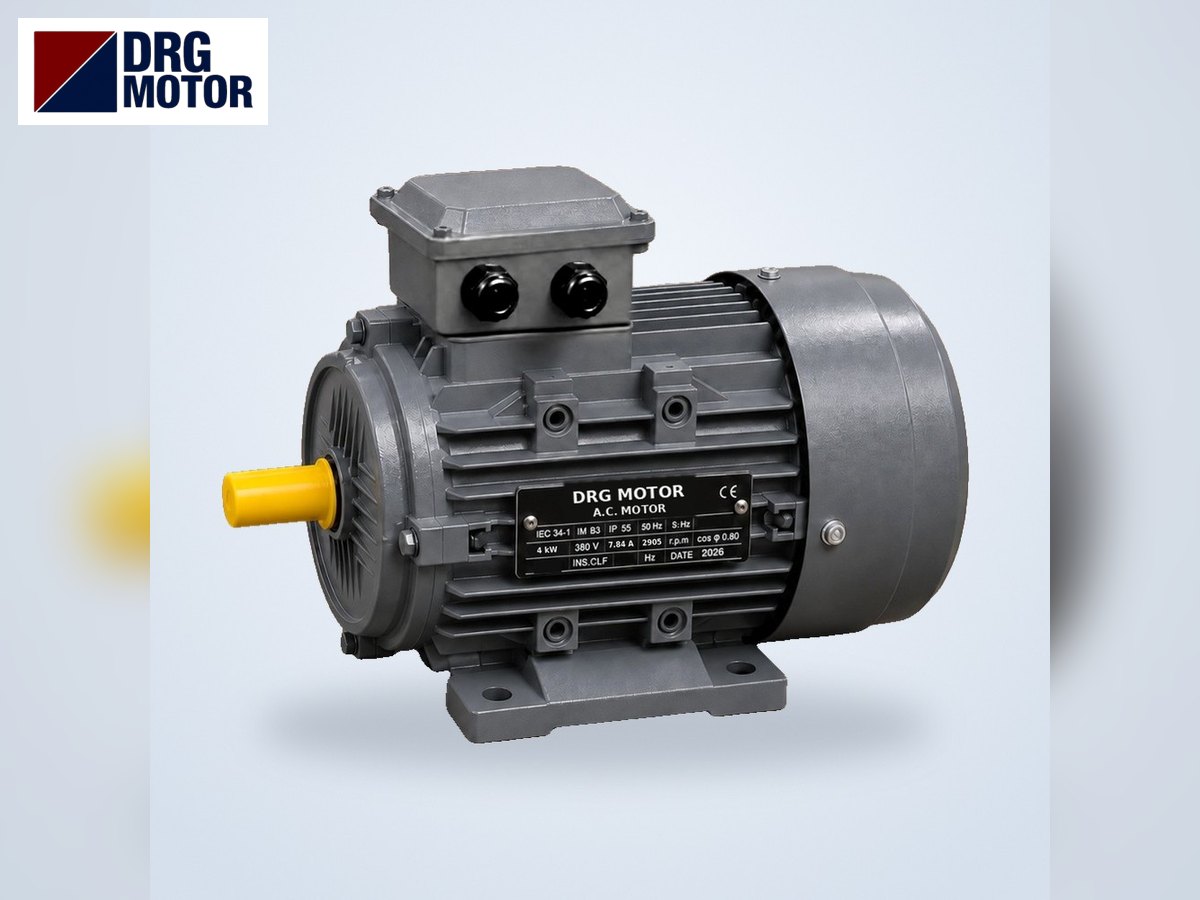
In a PVC and aluminium window workshop the electric motor mainly cuts and mills: on a double head saw it spins two circular blades, on a copy router it turns the cutter that opens lock and handle holes, and on an end milling machine it drives the tool that shapes the profile end. A welding machine joins profiles by melting them on a heated plate; there the motor at most moves the carriages, or is absent. Most corner cleaner tools work on compressed air. This page explains which motors in these machines a standard aluminium-housing IEC motor can cover and which it cannot.
DRG Motor is a manufacturer, supplier and seller of electric motors. We do not sell cutting machines, saw blades, milling cutters, high-speed router heads, servo axes, gearboxes or inverters; our share is the three-phase asynchronous motor used on these machines. The general frame of the series is on the Aluminium Housing Electric Motors page.
Which motor is in which machine on a profile line?
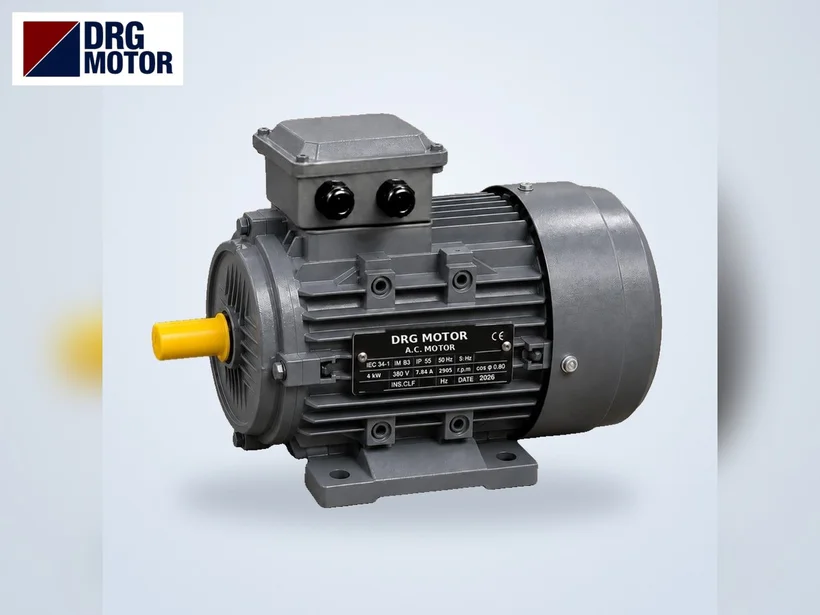
Double head cutting saw: blade straight on the motor shaft
A double head saw has one motor per head, and on most models the saw blade sits directly on the motor shaft without a belt. The head swivels between 45° and 90°, and the blade feeds into the profile on a pneumatic or hydropneumatic cylinder. Because the blade mounts on the shaft, the motor’s shaft diameter, shaft length and flange may be made for that machine; whether a standard motor fits the head is confirmed against the old motor’s dimensions, never guessed.
Copy router and water slot router
On a copy router the cutter reaches 12,000–14,000 rpm. Some machines get there with a standard three-phase motor and a step-up belt; on such a machine the motor can be replaced. Water slot routers, however, use heads around 16,000 rpm driven by inverter-fed high-speed special motors; those motors are outside our range.
End milling, corner cleaning and welding
An end milling machine cuts notches into the profile end; the tool sits on the shaft of a 2-pole motor, and the motor must stop within seconds when the operator releases the button. In corner cleaning, the tools that remove the weld bead mostly run on compressed air, and on some models on a milling motor around 3000 rpm. A welding machine is mainly a heater; any small drives moving the plate and carriages are the maker’s own parts.
Outfeed conveyor and chip extraction
On production lines, roller or belt conveyors carry cut parts to the next station at low speed through a gearbox. A separate fan or vacuum motor removes chips and PVC dust; on CNC double head saws that motor is included in the machine’s total power.
How many kW are profile machine motors? Values from maker data sheets
A) Motor powers stated in profile machine data sheets:
| Machine | Motor power | Single / total | Note |
|---|---|---|---|
| Double head saw, 450–500 mm blade | 2.2 kW × 2 | one motor per head | PVC and aluminium data sheet |
| Double head saw, 500 mm blade | 3 kW × 2 | one motor per head | 2800 rpm (50 Hz) |
| CNC double head, 500 mm blade | 3 kW × 2; 9.5 kW in total | total includes a 2.2 kW vacuum motor | servo axes |
| Copy router | 0.55 kW router; 0.75 kW triple drill | two motors | belt step-up to 14,000 rpm |
| Water slot router (three heads) | 0.55 kW × 3 | high-speed heads | 16,000 rpm |
| End milling machine | 1.47–1.5 kW | single motor | 2800 rpm, with braking circuit |
| Corner cleaner (PVC) | 1.2–2.4 kW machine total | cutters mostly pneumatic | 3000 rpm |
Saw heads stay at 2.2–3 kW, while routers and corner cleaners range from 0.55 to 2.4 kW. The total power given for CNC machines combines cutting, vacuum and axis motors and is not a single motor rating. A larger blade and a thicker aluminium wall call for a larger cutting motor.
B) Overlap with the DRG aluminium range: 0.55–4 kW 2-pole saw, router and extraction motors fall within our aluminium frames 71–112, and conveyor drives within small 4-pole models. Outside our range: high-speed router motors and spindles above 12,000 rpm, servo axis motors, machine-specific saw motors with long shafts or special flanges, and brake motors where braking is required. This line has no motor above 11 kW; for heavier drives such as profile bending see our article on section bending machine motor and gearbox selection.
Click to see current electric motor prices and order nowSEE PRICES →
What does an aluminium housing bring to a saw head?
Moving heads and low weight
On a double head saw the right head travels on a slide to the profile length, both heads swivel for the angle, and the motor moves with the head as the blade feeds. Motor weight is a direct load here: a light housing eases the swivel mechanism, the pneumatic feed cylinder and the right-hand slide. That is why aluminium housings are common on small and mid-power saw and router heads.
When is cast iron considered?
Cast iron is sturdier for motors on a fixed base that carry heavy belt load or take hard impacts; such loads are rare on a profile cutting line. Housing material does not set cut quality; true running of the blade depends on shaft and bearings.
Shaft, flange, speed and brake: a checklist
Shaft and flange
The saw blade is clamped to the motor shaft by a flange and nut; its bore is usually 30 or 32 mm, with a bush or special blade flange between bore and shaft. A standard IEC shaft diameter may therefore not suit, or the shaft may be too short. Measure the old motor’s shaft diameter and length, flange holes and the thread direction of the nut; if a special shaft is needed, the maker’s motor is preferred. Copy routers and conveyors use belt or gearbox connections, so a standard B3 or B5 motor matches more easily.
Speed and blade rim speed
Cutting motors in the data sheets run at about 2800 rpm at 50 Hz, so they are 2-pole. A 4-pole motor would turn the blade at half speed and spoil the cut surface on aluminium. 60 Hz values (3400 rpm) do not apply on a 50 Hz supply.
Brake and single phase
Cutting and milling machines are expected to stop the blade within a few seconds, either with a brake motor or an electronic braking circuit in the panel. Brake motors are not in our range; if the machine has an electronic brake, ask the machine maker whether it works with a standard motor. Small workshop water slot and router machines are also sold with single-phase 220 V motors; single-phase motors are outside our range and our models need a three-phase supply.
Chips, coolant mist and IP55
DRG motors are IP55: protected against aluminium chips, PVC dust and low-pressure water jets. High-pressure washing, steam cleaning and immersion are beyond that rating, and the blade’s lubricant mist should not be pointed at the housing. When cleaning with compressed air, do not blow chips into the motor fan cover. On a swivelling head, position the terminal box and cable entry so that the cable never pulls tight and the entry faces down or sideways at every angle.
Worked example: blade speed and line current
DRG-100L-2 has a rated speed of 2895 rpm. With a 450 mm blade the rim speed is π × 0.45 m × 2895 / 60 ≈ 68.2 m/s, with a 500 mm blade ≈ 75.8 m/s. Line assumption: two 3 kW saw heads, one 0.55 kW copy router and one 0.37 kW conveyor:
| Point | DRG model | Current 400 V | Note |
|---|---|---|---|
| Left and right saw head 3 kW | DRG-100L-2 | 5.71 A × 2 | about 44.5 A at start |
| Copy router 0.55 kW | DRG-712-2 | 1.24 A | belt step-up |
| Outfeed conveyor 0.37 kW | DRG-712-4 | 0.92 A | via a gearbox |
| All running together | — | 13.58 A | — |
The four motors draw about 13.58 A together. Started direct on line, each saw head briefly reaches 7.8 times its rated current; starting the two heads one after the other rather than together eases the fuse. These models have 230/400 V windings and run in star on a 400 V supply. The vacuum and compressed-air system is not part of this figure.
What we need for a quote
- Machine type: double head saw, copy router, end milling, corner cleaner or conveyor
- Photo of the old motor plate, kW and speed
- Whether the blade or cutter is on the motor shaft or belt-driven; blade diameter and bore
- Shaft diameter and length, flange and foot dimensions; shaft thread and nut direction
- Whether the machine has a brake, and what type
- Supply (three-phase or single-phase), daily operating hours and switching frequency
Aluminium housing DRG models for profile machines
Models matching saw, router, extraction and conveyor duties:
| Model | Power / rated speed | Frame · shaft D×E | Current 400 V · torque |
|---|---|---|---|
| DRG-712-4 | 0.37 kW / 1340 rpm (synchronous 1500) | 71 aluminium · 14×30 | 0.92 A · 2.64 Nm |
| DRG-712-2 | 0.55 kW / 2750 rpm (synchronous 3000) | 71 aluminium · 14×30 | 1.24 A · 1.91 Nm |
| DRG-801-2 | 0.75 kW / 2880 rpm (synchronous 3000) | 80 aluminium · 19×40 | 1.64 A · 2.49 Nm |
| DRG-90S-2 | 1.5 kW / 2895 rpm (synchronous 3000) | 90S aluminium · 24×50 | 3.06 A · 4.95 Nm |
| DRG-90L-2 | 2.2 kW / 2895 rpm (synchronous 3000) | 90L aluminium · 24×50 | 4.35 A · 7.26 Nm |
| DRG-100L-2 | 3 kW / 2895 rpm (synchronous 3000) | 100L aluminium · 28×60 | 5.71 A · 9.9 Nm |
| DRG-112M-2 | 4 kW / 2905 rpm (synchronous 3000) | 112M aluminium · 28×60 | 7.45 A · 13.1 Nm |
On heads that carry the blade on the motor shaft, these models are used only if shaft and flange dimensions match the old motor exactly. A woodworking circular saw works with a different load and blade layout; that machine is covered on our Circular Saw Machine Electric Motors page.
Live price table
Current prices of the aluminium versions:
| Model | Power / speed | Frame · current 400 V | Price |
|---|---|---|---|
| DRG-712-40.5 HP | 0.37 kW · 1500 rpm | Aluminium 71 · 0.92 A | $76.76 (€68.55) Details & buy → |
| DRG-712-20.75 HP | 0.55 kW · 3000 rpm | Aluminium 71 · 1.24 A | $78.51 (€70.11) Details & buy → |
| DRG-801-21 HP | 0.75 kW · 3000 rpm | Aluminium 80 · 1.64 A | $83.41 (€74.49) Details & buy → |
| DRG-90S-22 HP | 1.5 kW · 3000 rpm | Aluminium 90S · 3.06 A | $113.98 (€101.79) Details & buy → |
| DRG-90L-23 HP | 2.2 kW · 3000 rpm | Aluminium 90L · 4.35 A | $147.43 (€131.66) Details & buy → |
| DRG-100L-24 HP | 3 kW · 3000 rpm | Aluminium 100L · 5.71 A | $169.81 (€151.65) Details & buy → |
| DRG-112M-25.5 HP | 4 kW · 3000 rpm | Aluminium 112M · 7.45 A | $215.40 (€192.36) Details & buy → |
DRG MOTOR motors are guaranteed against material and manufacturing defects for 2 years from the delivery date (warranty certificate).
Motors in this power range
- DRG-801-2 – 0.75 kW – 2880 rpm – 80 aluminium
- DRG-90S-2 – 1.5 kW – 2895 rpm – 90S aluminium
- DRG-90L-2 – 2.2 kW – 2895 rpm – 90L aluminium
- DRG-100L-2 – 3 kW – 2895 rpm – 100L aluminium
Click to see current prices and order these motors nowSEE PRICES →
Browse the products, ask for a quote: every model sits on Buy Electric Motors Online. Write the machine type and blade connection and send plate and shaft photos through WhatsApp; we will match shaft, flange and speed together. Phone: +90 (542) 666 11 11.
Frequently asked questions
The motor of my double head saw burned out; can I fit a standard motor?
Yes if the blade is clamped to the shaft by a flange and the shaft diameter, length and motor flange follow standard IEC dimensions. If the shaft is long or specially threaded, a standard motor will not fit the head; then rewinding or the maker’s motor is needed.
What speed should an aluminium profile cutting motor have?
On a 50 Hz supply, 2-pole, about 2800–2900 rpm. If the data sheet says 3400 rpm, that is the 60 Hz value.
How many kW are used on PVC window machines?
Data sheets show 2.2–3 kW per saw head, around 0.55 kW on copy routers and around 1.5 kW on end milling machines. The machine plate gives the exact value.
Do you supply the high-speed motor of a water slot router?
No. Head motors around 16,000 rpm driven by an inverter are outside our range.
Contact: +90 (542) 666 11 11 · info@drgmotor.com · contact.


