 English
 Le français
 Türkçe

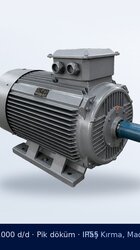
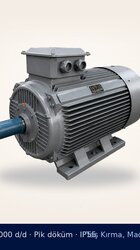
Even if the motor’s power and speed are right, if the side force the belt applies to the shaft end exceeds the permitted limit, the bearing fails early or the shaft suffers fatigue. This force comes not from the motor itself but from the drive arrangement; the seller can only assess it if pulley and belt details are provided.
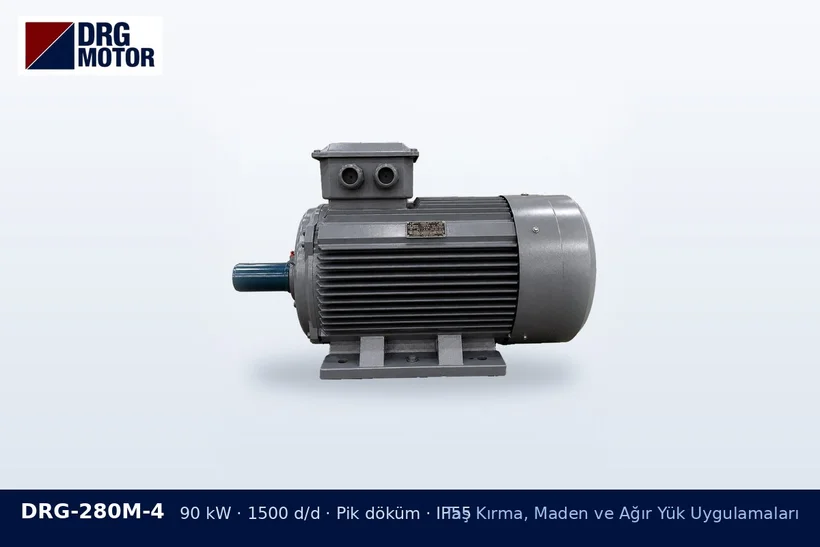
Where does the side force come from?
The belt carries torque as a pulling force around the pulley. This force is found by dividing the torque by the pulley radius. A 45 kW motor running at about 1475 rpm has a rated torque of about 291 Nm. On a pulley with a radius of 0.1 m (200 mm diameter), the transmitted tangential force is about 2.9 kN. The pre-tension applied so that the belt runs without slipping is added on top of this value; the total force felt by the shaft is therefore larger, and its factor varies with belt type. If the pulley diameter is halved, the tangential force doubles.
The point of application matters too
When the same force is applied further from the shaft shoulder, the bending moment on the bearing grows. A wide pulley overhanging the shaft, a pulley not pushed fully onto the shaft end, or an extra bush fitted in between all lengthen this lever arm. The permitted radial load values in the catalogue are given for a specific point of application.
Information to include in the order
- Motor pulley diameter and width
- Distance from the pulley centre to the shaft shoulder
- Belt profile and number of belts
- Driven pulley diameter and centre distance
- Direction of belt pull (horizontal, vertical, angled)
- Whether there is shock loading (crusher, mill, etc.)
With this information the load is assessed; if the limit is exceeded, a larger motor pulley, seating the pulley closer to the shaft shoulder or a different drive arrangement may be proposed. Confirm the permitted radial load of the selected model in writing before ordering. Checking the pulley diameters in advance with the pulley and belt calculator speeds up the process.
Options for heavy belt drives can be reviewed on application pages such as hammer crusher motor and among the cast iron frame motors.