 English
 Le français
 Türkçe

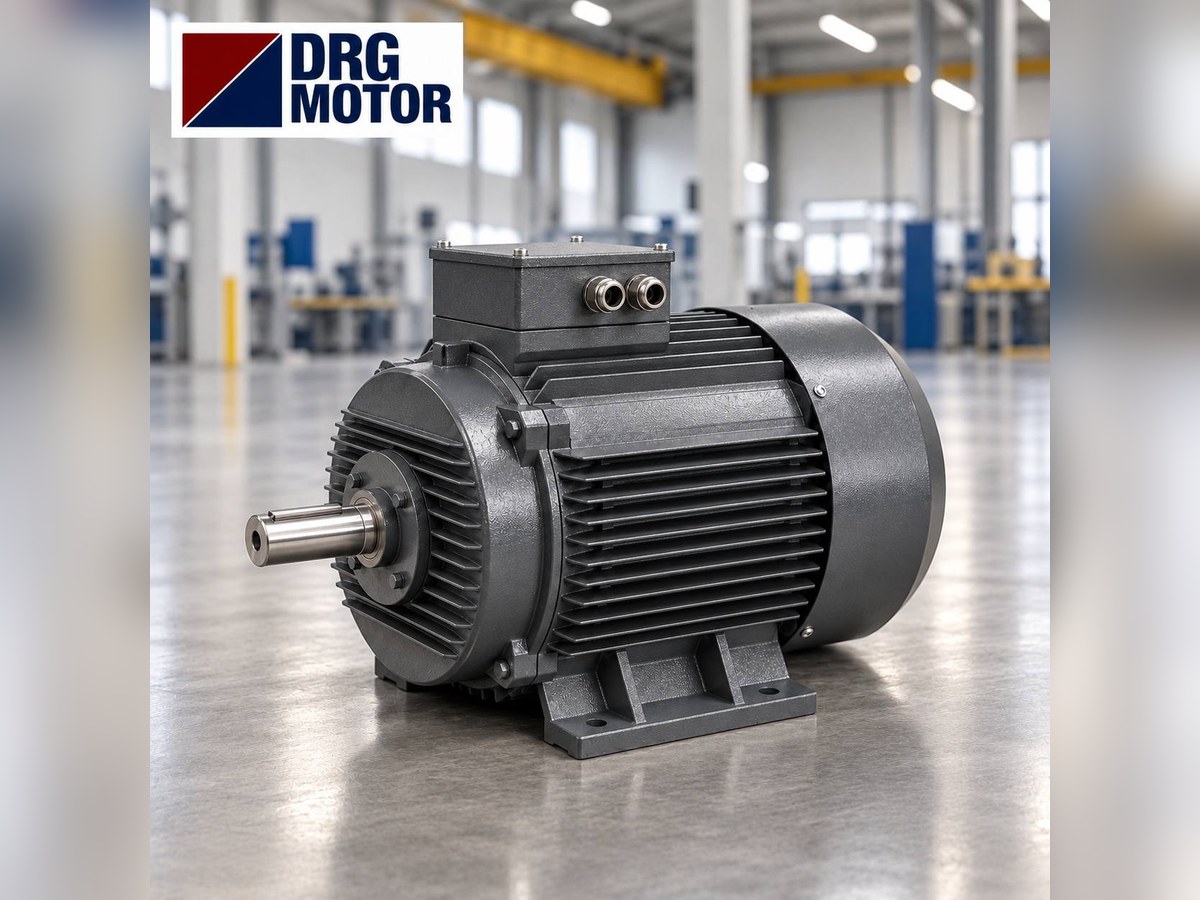
A belt conveyor motor turns the conveyor's drive pulley through a gearbox and so moves the belt and the material on it; its power is calculated from the belt length, the height the material is lifted and the tonnage. For the 10–45 m conveyors of a crushing and screening plant, catalogues mostly show motors between 3 and 37 kW. The motor is either an external motor and gearbox at the head of the conveyor or a drum motor built into the pulley.
This page covers conveyor types specific to crushing and screening plants, sourced power values, a worked example with a simple power formula, and the matching DRG range. You can see suitable motors on Buy Electric Motors Online; the plant's other machines are on the Stone Crushing Plant Motors page.
Which conveyors are found in a crushing and screening plant?
In a plant, conveyors sit at every point where material passes from one machine to the next, and each carries a different load:
- Crusher discharge conveyor: It takes the coarse, sharp material leaving the primary crusher. The loading point has impact idlers and long skirt plates; skirt friction raises power.
- Screen feed conveyor: It carries crushed material onto the screen. Since the screen is usually high, this conveyor is inclined and long; most of its power goes into lifting.
- Return conveyor: The closed-circuit belt that takes screen oversize back to the crusher.
- Product conveyors: They carry each fraction from the screen to stock or to a stacker. They can be short and light.
- Transfer and collecting belts: Short belts under screens, at crusher by-passes and dosing points.
Radial or telescopic stacker conveyors in the stockyard, with travel and slewing motors, are a separate subject; the short belt feeder under a hopper is a feeding unit, not a transport conveyor. This page focuses on fixed in-plant transport conveyors.
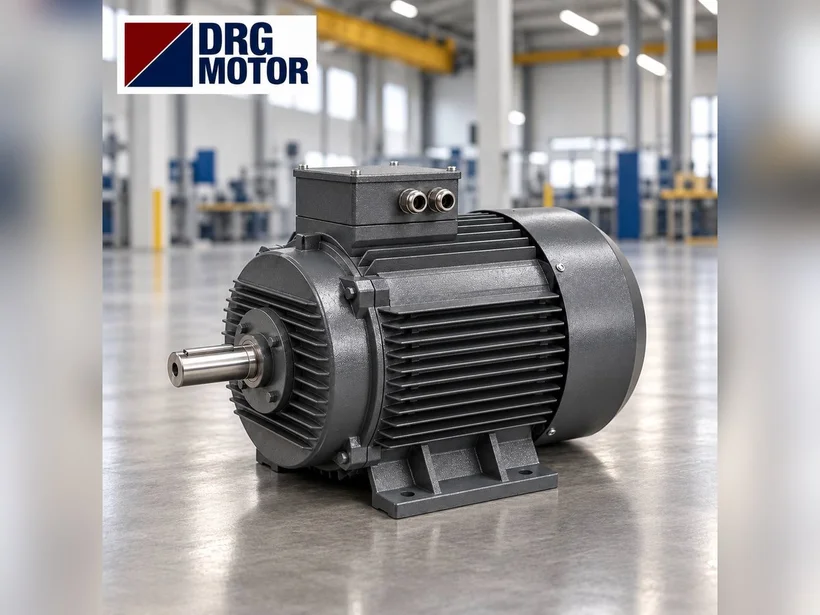
External motor and gearbox, or drum motor?
| Item | External motor + gearbox | Drum motor | Effect on selection |
|---|---|---|---|
| Motor location | Beside the pulley | Inside the pulley | Different parts to replace |
| Connection | Flange, coupling or belt | Oil-filled shell | Standard motor only in first |
| On failure | Only the motor is replaced | Whole drum unit replaced | Different downtime |
With an external drive a standard induction motor turns a gearbox mounted on the pulley shaft. The gearbox is either flanged directly to the motor (B5 or B14) or the motor sits on a separate base and is coupled. One manufacturer's data sheet states that the motor drives a shaft-mount reducer by V-belt and that the reducer has a backstop [3]. In this arrangement motor, gearbox and belt can each be replaced separately.
In a drum motor the squirrel-cage motor and gearbox are sealed inside the oil-filled pulley shell [6]. No rotating parts are left outside, it resists dust and water well and saves space in mobile and compact plants. But when the motor fails, a standard motor cannot be fitted; the drum unit is replaced from its manufacturer. DRG does not sell drum motors; it supplies motors for externally driven conveyors.
How many kW is a conveyor motor? Market values
A) Power seen in catalogues
| Conveyor / capacity | Motor power | Single or total | Source |
|---|---|---|---|
| Maker A, 500 mm, up to 8 m | 3 kW | Single motor | [1] |
| Maker A, 1000 mm, 26–32 m | 15 kW | Single motor | [1] |
| Maker A, 1000 mm, 61–70 m | 30 kW | Single motor | [1] |
| Maker B, 800 mm, 25 m, 400 t/h | 11 kW | Single motor | [2] |
| Maker B, 1600 mm, 45 m, 1800 t/h | 37 kW | Single motor | [2] |
| Maker C, 610 mm, 30.5 m, 227 t/h | 11.2 kW | Head pulley drive | [3] |
| Maker C, 1067 mm, 30.5 m, 907 t/h | 37.3 kW | Head pulley drive | [3] |
In this machine group, motor options of roughly 3–37 kW are seen depending on the manufacturer's model and capacity [1][2][3]. These values are the drive motor of a single conveyor. A plant may have ten or more conveyors; the plant's total conveyor power is their sum and must not be read as the power of one conveyor.
Power grows with three things: roller and belt friction as the conveyor gets longer, conveyed mass as tonnage rises, and lifting work as the incline increases. At the same 1000 mm width, a 26–32 m conveyor runs on 15 kW while a 61–70 m one needs 30 kW [1]. Long conveyors may use multiple drives; this is decided project by project.
B) The match in the DRG range
DRG Motor is an electric motor manufacturer, supplier and seller. Our range is 0.25–11 kW in aluminium frames and 0.55–355 kW in cast iron, 1000/1500/3000 rpm, 3-phase 230/400 V or 400/690 V; B3, B5, B14 and B35 mounting is specified with an order note. All 3–37 kW external drive motors of crushing and screening conveyors are in this range; aluminium frames can be chosen up to 11 kW. Drum motors are not within this range.
| Model | Power / speed | Frame · current 400 V | Price |
|---|---|---|---|
| DRG-100L2-44 HP | 3 kW · 1500 rpm | Cast iron 100L · 6.02 A | $203.84 (€182.05) Details & buy → |
| DRG-112M-45.5 HP | 4 kW · 1500 rpm | Cast iron 112M · 7.95 A | $254.38 (€227.18) Details & buy → |
| DRG-132S-47.5 HP | 5.5 kW · 1500 rpm | Cast iron 132S · 10.7 A | $342.01 (€305.44) Details & buy → |
| DRG-132M-410 HP | 7.5 kW · 1500 rpm | Cast iron 132M · 14.3 A | $394.89 (€352.66) Details & buy → |
| DRG-160M-415 HP | 11 kW · 1500 rpm | Cast iron 160M · 20.4 A | $568.76 (€507.94) Details & buy → |
| DRG-160L-420 HP | 15 kW · 1500 rpm | Cast iron 160L · 27.3 A | $678.13 (€605.61) Details & buy → |
| DRG-180M-425 HP | 18.5 kW · 1500 rpm | Cast iron 180M · 33.5 A | $873.49 (€780.08) Details & buy → |
| DRG-180L-430 HP | 22 kW · 1500 rpm | Cast iron 180L · 39.7 A | $919.45 (€821.13) Details & buy → |
| DRG-200L-440 HP | 30 kW · 1500 rpm | Cast iron 200L · 53.8 A | $1,235.00 (€1,102.93) Details & buy → |
| DRG-225S-450 HP | 37 kW · 1500 rpm | Cast iron 225S · 66.1 A | $1,527.18 (€1,363.87) Details & buy → |
Click to see current electric motor prices and order nowSEE PRICES →
How is power calculated? A simple formula and example
Conveyor power is the sum of three parts: turning the empty belt and idlers, moving the material horizontally and lifting it. One manufacturer splits this into four forces, adding scraper and skirt friction separately; it finds motor power with P = F·v/η and recommends 0.90 for mechanical efficiency [5]. A simpler approach is given in a university formula collection [4]:
N = f·(L + Lo)·(3.6·Gm·v + Qt) / 367 + Qt·H / 367 + Nz
- N: power at the drive pulley (kW); f: friction coefficient (example value 0.03); L: conveyor length (m); Lo: additional length (50 m).
- Gm: weight of belt and rotating idlers per metre (45 kg/m for an 800 mm belt); v: belt speed (m/s).
- Qt: capacity (t/h); H: lift height (m); Nz: additional power such as scrapers (0.8 kW for a scraper on an 800 mm belt).
Example: An 800 mm wide, 40 m long conveyor from the crusher outlet to the screen lifts 300 t/h by 8 m at a belt speed of 1.6 m/s.
- Friction and horizontal conveying: 0.03 × (40 + 50) × (3.6 × 45 × 1.6 + 300) / 367 ≈ 4.11 kW.
- Lifting: 300 × 8 / 367 ≈ 6.54 kW.
- Scraper: 0.8 kW. Total at the pulley: about 11.45 kW.
- With 0.90 mechanical efficiency for gearbox and belt losses, the requirement at the motor shaft is 11.45 / 0.90 ≈ 12.7 kW.
The next standard power step is 15 kW. If the same conveyor were horizontal, the lift share would disappear and the requirement would fall to about 5.5 kW; in this example more than half the power goes into height. At the same speed the belt can carry about 540 t/h of 1.6 t/m³ material (using the 25° three-idler trough, 15° surcharge table and an incline factor of 0.935 for about 11.5° [4]), so the belt width is sufficient for 300 t/h. This calculation is for preliminary sizing; the exact power comes from the conveyor manufacturer's design.
Speed, gearbox ratio and mounting
At the example belt speed of 1.6 m/s, a 500 mm diameter drive pulley turns at about 61 rpm. A 4-pole 15 kW motor (DRG-160L-4) runs at 1465 rpm, so the gearbox ratio is about 24. You can find the ratio from pulley diameter and belt speed with our gearbox output speed and torque calculator. The 4-pole motor is the most common choice on plant conveyors, because gearboxes are mostly selected for 1500 rpm input.
Mounting depends on the gearbox: with a shaft-mount reducer the motor can sit foot-mounted (B3) on a base above the reducer and drive it by belt; with a bevel-helical gearbox the motor is flanged (B5). The exact type comes from the conveyor manufacturer's drawing.
A backstop is essential on an inclined conveyor: when power is lost, the loaded belt runs back and dumps material at the loading point. The backstop is in the gearbox or on the pulley shaft, not in the motor; check that it stays in place when the motor is replaced.
Checklist for choosing a motor for a crushing and screening conveyor
- Conveyor nameplate or design: belt width, length, lift height, capacity.
- Old motor's power, speed, frame and mounting type; gearbox ratio and input flange.
- Full-load start: if a crusher or screen trips, the belt stops loaded. It then restarts full; the motor's starting torque must be enough. On DRG 4-pole motors the starting torque ratio Ts/Tn is 2.0–2.3.
- Starting: DRG motors from 4 kW up are 400/690 V and suitable for star-delta starting on a 400 V supply. Star connection leaves only a third of the starting torque, so long inclined belts that restart loaded are better served by a soft starter or inverter; compare on the star-delta starting page.
- Sequential operation: plant conveyors start in reverse order of flow, product belt first and feeder last. If one conveyor stops, all conveyors before it must stop. The panel is built around this interlock; if the new motor does not have the same speed, belt speeds no longer match.
- Environment: open air, heavy dust, rain and wash water; check terminal box entries and cable glands.
DRG motor options for belt conveyors
The table shows 4-pole cast iron models from the 3–37 kW range seen on crushing and screening conveyors:
| Model | Power / speed | Frame | Current 400 V |
|---|---|---|---|
| DRG-132S-4 | 5.5 kW / 1460 rpm | 132S cast iron | 10.7 A |
| DRG-132M-4 | 7.5 kW / 1460 rpm | 132M cast iron | 14.3 A |
| DRG-160M-4 | 11 kW / 1465 rpm | 160M cast iron | 20.4 A |
| DRG-160L-4 | 15 kW / 1465 rpm | 160L cast iron | 27.3 A |
| DRG-180L-4 | 22 kW / 1470 rpm | 180L cast iron | 39.7 A |
| DRG-200L-4 | 30 kW / 1475 rpm | 200L cast iron | 53.8 A |
| DRG-225S-4 | 37 kW / 1485 rpm | 225S cast iron | 66.1 A |
DRG MOTOR motors are guaranteed against material and manufacturing defects for 2 years from the date of delivery (warranty certificate). For general conveyor motor selection read our article on electric motor selection for conveyor belts, and for conveyors in recycling plants, recycling plant motor supply.
Motors in this power range
- DRG-132M-4 – 7.5 kW – 1460 rpm – 132M cast iron
- DRG-160M-4 – 11 kW – 1465 rpm – 160M cast iron
- DRG-160L-4 – 15 kW – 1465 rpm – 160L cast iron
- DRG-180M-4 – 18.5 kW – 1470 rpm – 180M cast iron
- DRG-180L-4 – 22 kW – 1470 rpm – 180L cast iron
- DRG-200L-4 – 30 kW – 1475 rpm – 200L cast iron
Click to see current prices and order these motors nowSEE PRICES →
Belt conveyor motor: FAQ
How many kW should a conveyor motor be?
It depends on belt length, lift height and tonnage. For 10–45 m conveyors in crushing and screening plants, catalogues show 3–37 kW. A preliminary calculation can be made with the formula above; the exact value is in the conveyor design.
Can an external motor replace a drum motor?
Yes, if the drive pulley is replaced together with its bearings and a gearbox. The motor inside a drum motor cannot be replaced on its own with a standard motor.
Why does the conveyor motor fail to start with a loaded belt?
With star-delta starting, starting torque drops to one third; on a long inclined belt this may not be enough. A seized idler, a mistracked belt or skirt plate friction also raise the load; carry out mechanical checks first.
How many amps does a 15 kW conveyor motor draw?
The 4-pole DRG-160L-4 draws 27.3 A at 400 V. Set the overload relay to the nameplate current.
Send us the conveyor dimensions, the old motor's nameplate and the gearbox label; we will identify the right motor together. Phone +90 (542) 666 11 11, e-mail [email protected], contact page. For all models and current prices, visit Buy Electric Motors Online.
Sources
- Hawk Plant – Belt Conveyors Technical Information – 500–1000 mm belts, 3–30 kW motor by conveyor length and width; drum diameter and speed.
- Polygonmach – PolyConv Bulk Material Handling Systems – PCB-600–1500: 400–1800 t/h, 800–1600 mm, 25–45 m, 11–37 kW; belt speed 0.8–2.5 m/s.
- Astec – Radial Stacker 100 ft [30.5 m] spec sheet – 30.5 m, 610–1067 mm belt, 227–907 t/h, 11.2–37.3 kW; TEFC motor, shaft-mount reducer with backstop, V-belt.
- FH Erfurt – Dimensioning of belt conveyors (formula collection, Dunlop) – drum power formula, f = 0.03, Lo = 50 m, tables for moving-part weight Gm and scraper power Nz.
- MEKA – Belt Conveyor Calculations – forces F1–F4 (empty belt, conveying, lifting, skirt friction), P = F·v/η, mechanical efficiency 0.90.
- Rulmeca – Motorized Pulleys for Aggregate and Sand Production – motorized pulley: squirrel-cage motor and gearbox sealed inside an oil-filled shell.


