 English
 Le français
 Türkçe

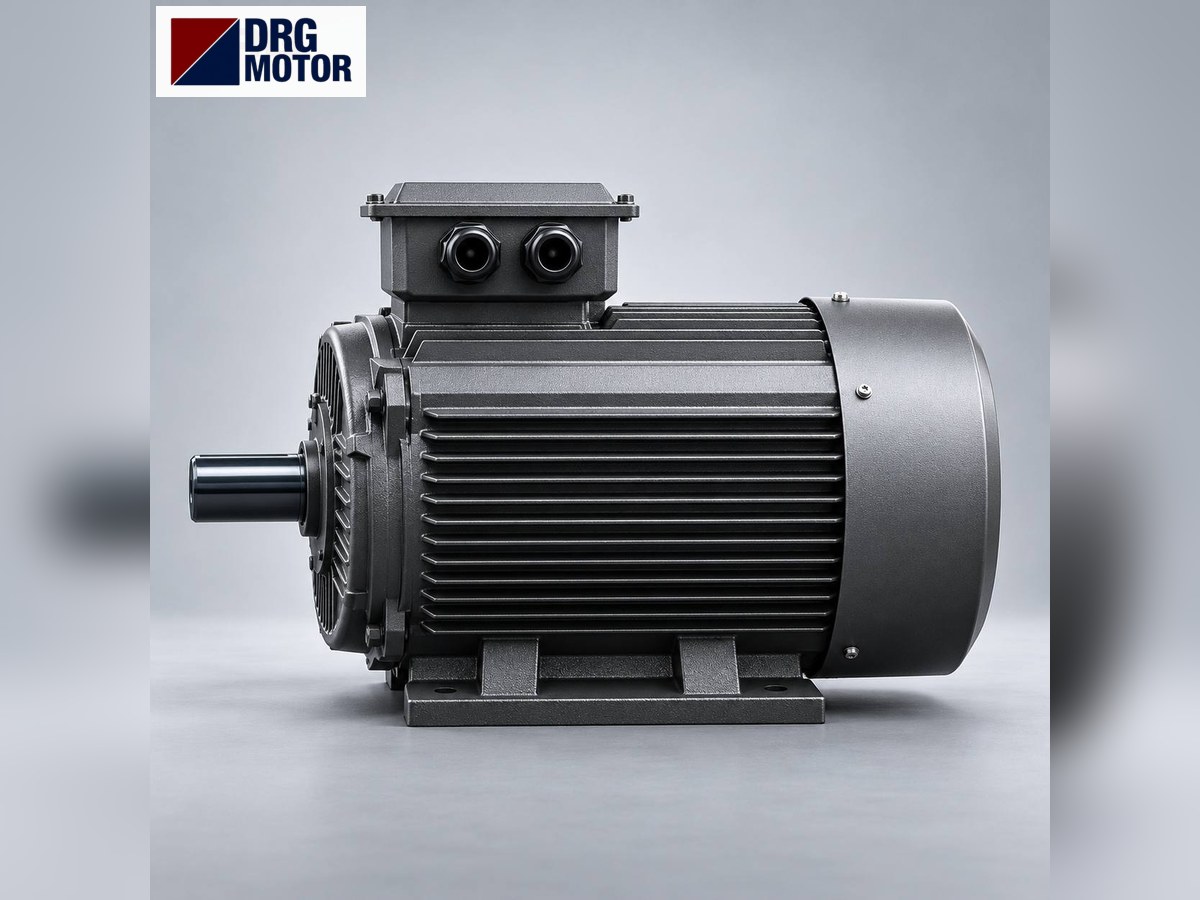
A split case pump motor is a foot-mounted three-phase induction motor that drives, through a flexible coupling, a high-flow centrifugal pump whose casing is split horizontally along the shaft axis and which has a double-suction impeller. In these pumps the motor is mostly 4-pole (about 1450–1490 rpm) and power often reaches hundreds of kilowatts: for example a split case pump delivering 1000 m³/h at 55 m needs about 178 kW of shaft power if pump efficiency is taken as 0.84, and runs on a 200 kW, 4-pole motor.
At this power level motor selection is not only about kW; supply and starting, shaft height, space on the baseplate and the 355 kW limit are considered together. The DRG range goes up to 355 kW; motors for larger split case pumps are outside it, and we separate this clearly below. Other pump pages are on Pump Motors; suitable motors and current prices on Buy Electric Motors Online.
What is a split case pump and why is it chosen for large flows?
Split case is the name of a casing and installation form; the principle is centrifugal and the layout is mostly horizontal-shaft. "Split casing" means the pump casing is divided into two parts along a horizontal plane containing the shaft axis. With the upper half removed, the impeller, bearings, wear rings and shaft seals are exposed without disturbing the suction and discharge pipes or the motor [1].
The impeller is double-suction: water enters it from both sides at once. This has two effects. First, the water arriving from both sides largely balances the hydraulic axial forces [1]. Second, for the same impeller diameter it carries roughly twice the flow of a single-suction impeller. The shaft is supported by bearings at both ends, and the suction and discharge ports sit horizontally opposite each other on both sides of the casing.
Where is it used?
- Main water transmission in municipal networks and booster stations.
- Chiller and cooling-tower circuits in large buildings and district cooling [1].
- Boiler feed, district heating and industrial cooling water [1].
- Bulk pumping to irrigation canals and sprinkler lines.
- Duty pump within an approved set on fire-water lines (the approval requirement is covered on a separate page).
How it differs from end-suction and inline pumps
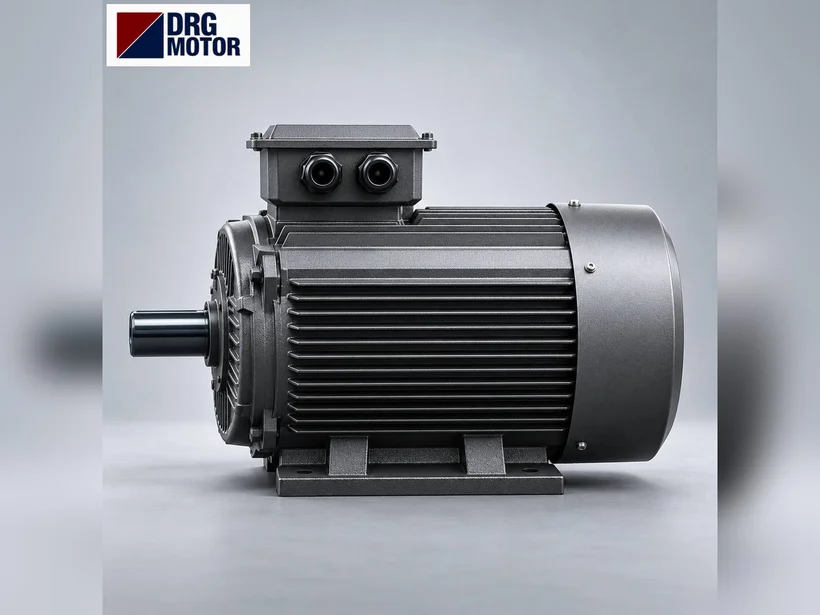
In an end-suction pump water enters at the end of the shaft, the impeller is single-suction and the shaft is supported on one side; it is economical at small and medium flows. In an inline pump suction and discharge share one axis, the motor usually sits on top and the pump is installed within the pipeline. A split case pump is built for large flow, low vibration and easy maintenance; it is heavy and needs a wide concrete foundation.
| Feature | End-suction | Inline | Split case |
|---|---|---|---|
| Impeller | Single-suction | Single-suction | Double-suction |
| Shaft support | One side | Motor bearing / one side | Both ends |
| Removed for service | Motor + bearing unit | Motor + top unit | Upper casing only |
| Motor mounting | B3 or flange | Vertical flange | B3 foot |
How the motor drives the pump
Split case pump and motor stand on a common baseplate with a flexible coupling between them. One manufacturer's catalogue supplies these pumps with a totally enclosed fan-cooled standard motor with IEC and DIN main dimensions and B3 (IM 1001) mounting [1]. No belts or gearboxes are used; motor speed is pump speed.
Because both ends of the pump shaft can protrude from the casing, the motor can be placed on the right or left of the pump according to the pipe layout; this determines the direction of rotation. When ordering the motor the direction is confirmed against the arrow on the pump plate; on a three-phase motor swapping two phases reverses it. Coupling alignment is done with shims and checked again once the pump reaches operating temperature. At this power, misalignment quickly shortens bearing and coupling life.
Click to see current electric motor prices and order nowSEE PRICES →
How many kW is a split case pump motor? Market models
Split case families range from small to very large casings; each casing has several motor steps depending on impeller diameter and pole number. The values below are a single motor per pump.
| Model group / capacity | Motor power | Single / total | Source |
|---|---|---|---|
| Maker A, smallest casing, 4-pole | 1.5–5.5 kW | Single motor | [1] |
| Maker A, mid casing, 4-pole | 18.5–110 kW | Single motor | [1] |
| Maker A, largest casing, 630 mm impeller | 250–630 kW | Single motor | [1] |
| Maker B, large model, 1450 rpm | 500 kW | Single motor | [2] |
| Maker C, largest drive in the range | up to 1,500 kW | Single motor | [3] |
In this pump group, motor options of roughly 1.5–630 kW are seen depending on the manufacturer's model and capacity; in the largest ranges drive power reaches 1,500 kW [1][3]. The same maker's range covers 10–2500 m³/h and 5–148 m [1]; as flow and head grow, the motor step grows too. If three pumps run in parallel in a booster station, each pump is sized with its own motor; the station's total installed power is not one pump's motor.
What overlaps with the DRG range and what does not
Split case pumps needing 1.5–355 kW motors at 1000/1500/3000 rpm have a counterpart in the DRG range. Large casings needing more than 355 kW (e.g. 400, 500, 630 kW steps), pumps driven by medium-voltage motors and low-speed models needing 750 rpm (8-pole) motors are outside the DRG range.
Worked example: 1000 m³/h, 55 m
Consider a split case pump in a municipal booster station with a duty point of 1000 m³/h and 55 m; pump efficiency read from the curve is 0.84.
- Q = 1000 / 3600 = 0.278 m³/s
- P = ρ·g·Q·H / η_pump = 1000 × 9.81 × 0.278 × 55 / 0.84 ≈ 178 kW
- One manufacturer gives adding a 5% motor safety margin to the maximum power on the curve as a method [1]: 178 × 1.05 ≈ 187 kW
- Selected standard rating: 200 kW, 4-pole
At this rating DRG-315L2-4 runs at 1490 rpm and draws 334 A at 400 V; its shaft diameter is 85 mm and shaft height 315 mm. If the same pump were driven by a 6-pole motor, speed would fall by about one third; by the affinity relation flow would drop to about 664 m³/h, head to about 24 m and power to about 52 kW. Changing the pole number therefore changes the pump's whole duty; the motor is always chosen with the same poles as the speed on the pump plate. See our affinity laws article and, for your own values, the Pump & Fan Motor Power Calculator.
Data needed for motor selection
The hydraulic selection, impeller diameter and station design are the job of the pump maker and designer; the motor supplier provides a motor matching the given shaft power, speed, mounting and ambient conditions. Checklist specific to split case pumps:
- Pump nameplate: type, impeller diameter, speed, rated flow and head.
- Which side of the pump the motor sits on and the direction of rotation.
- Old motor nameplate: kW, rpm, IEC frame (280–355 is common), voltage (400 V or medium voltage).
- Shaft height, shaft diameter and coupling hub; baseplate and foundation holes.
- Starting method and transformer capacity: at this power direct-on-line starting strains the supply.
- Does the pump start with the valve closed or open?
- Pump room ventilation: a large motor gives off considerable heat.
Starting and 4 poles
4 poles is the most common choice for split case pumps; in one manufacturer's catalogue 2-pole motors stop at 90 kW while 4-pole steps reach 630 kW, and 6 poles are used on casings with large impellers [1]. The starting current of the 200 kW DRG-315L2-4 is 7.1 times its rated current; with direct-on-line starting this current causes a noticeable voltage dip on the supply. Star-delta, a soft starter or an inverter is therefore used. In the DRG range motors above 4 kW are wound 400/690 V and suit star-delta starting on a 400 V supply. The exact mounting type and foundation dimensions come from the pump maker's drawing; at DRG the mounting type is given with the order note.
| Model | Power / speed | Frame · current 400 V | Price |
|---|---|---|---|
| DRG-180L-430 HP | 22 kW · 1500 rpm | Cast iron 180L · 39.7 A | $919.45 (€821.13) Details & buy → |
| DRG-225S-450 HP | 37 kW · 1500 rpm | Cast iron 225S · 66.1 A | $1,527.18 (€1,363.87) Details & buy → |
| DRG-250M-475 HP | 55 kW · 1500 rpm | Cast iron 250M · 97.6 A | $2,065.73 (€1,844.82) Details & buy → |
| DRG-280M-4125 HP | 90 kW · 1500 rpm | Cast iron 280M · 155 A | $3,268.56 (€2,919.03) Details & buy → |
| DRG-315S-4150 HP | 110 kW · 1500 rpm | Cast iron 315S · 187 A | $4,863.00 (€4,342.97) Details & buy → |
| DRG-315M-4180 HP | 132 kW · 1500 rpm | Cast iron 315M · 224 A | $5,621.72 (€5,020.55) Details & buy → |
| DRG-315L2-4270 HP | 200 kW · 1500 rpm | Cast iron 315L · 334 A | $7,115.64 (€6,354.71) Details & buy → |
| DRG-355M-4340 HP | 250 kW · 1500 rpm | Cast iron 355M · 418 A | $9,826.77 (€8,775.92) Details & buy → |
| DRG-355L-4430 HP | 315 kW · 1500 rpm | Cast iron 355L · 526 A | $11,417.31 (€10,196.37) Details & buy → |
Matching DRG motors
DRG Motor is a manufacturer, supplier and seller of electric motors. Range: aluminium frame 0.25–11 kW, cast iron 0.55–355 kW; 1000, 1500 and 3000 rpm; 3-phase, 230/400 V or 400/690 V; B3, B5, B14 and B35 (with order note). For split case pumps, B3 foot-mounted 4-pole cast iron motors are a direct match; above 355 kW is outside the range. Options at the high-power end:
| Model | Power / speed | Frame | Current 400 V |
|---|---|---|---|
| DRG-280M-4 | 90 kW / 1486 rpm | 280M cast iron | 155 A |
| DRG-315M-4 | 132 kW / 1488 rpm | 315M cast iron | 224 A |
| DRG-315L2-4 | 200 kW / 1490 rpm | 315L cast iron | 334 A |
| DRG-355M-4 | 250 kW / 1490 rpm | 355M cast iron | 418 A |
| DRG-355L-4 | 315 kW / 1490 rpm | 355L cast iron | 526 A |
The largest 4-pole model in the range, DRG-400M-4 (355 kW), is the limit. DRG MOTOR motors are guaranteed against material and manufacturing defects for 2 years from the delivery date (warranty certificate). For general topics in treatment and network applications see our article on water and wastewater treatment pump motors.
DRG motors for split case pumps
- DRG-250M-4 – 55 kW – 1485 rpm – 250M cast iron
- DRG-280M-4 – 90 kW – 1486 rpm – 280M cast iron
- DRG-315S-4 – 110 kW – 1488 rpm – 315S cast iron
- DRG-315L2-4 – 200 kW – 1490 rpm – 315L cast iron
- DRG-355M-4 – 250 kW – 1490 rpm – 355M cast iron
- DRG-355L-4 – 315 kW – 1490 rpm – 355L cast iron
Click to see current prices and order these motors nowSEE PRICES →
Split case pump motor: frequently asked questions
Why is the motor of a split case pump usually 4-pole?
A large double-suction impeller reaches a suitable tip speed around 1450 rpm; a higher speed multiplies both head and power and causes problems on the suction side. Small casings also use 2 poles.
Is there a DRG motor for a 400 kW split case pump?
No. The DRG range ends at 355 kW. Motors above 355 kW and medium-voltage motors must be obtained from the pump maker or a supplier offering that power.
On which side of the pump should the motor be?
Since both ends of the pump shaft can be used, the side is chosen from the plant's pipe and space layout; the chosen side determines the direction of rotation. The arrow on the pump plate governs.
How many amps does a 200 kW pump motor draw?
The 4-pole DRG-315L2-4 draws 334 A at 400 V and 352 A at 380 V. Cable size and switchgear are selected for this current and the starting method.
Send us the pump nameplate, the motor side and the transformer data, and we will confirm the right DRG model and starting option together. Reach us at +90 (542) 666 11 11 · [email protected] · contact. All models: Buy Electric Motors Online.
Sources
- Grundfos – HS horizontal split-case pumps data booklet, 50 Hz – motor P2 1.5–630 kW; 10–2500 m³/h, 5–148 m; double-suction impeller; long-coupled with B3 (IM 1001) TEFC standard motor; motor tables per model; 5% motor safety margin method.
- Wilo – SCP 400/660DV-500/4/50 product page – axially split case pump; 500 kW, 1450 rpm motor; range up to 17,000 m³/h.
- SEC-KSB – Omega axially split volute casing pump – double-entry impeller, horizontal or vertical installation; maximum drive rating 1,500 kW.


