 English
 Le français
 Türkçe

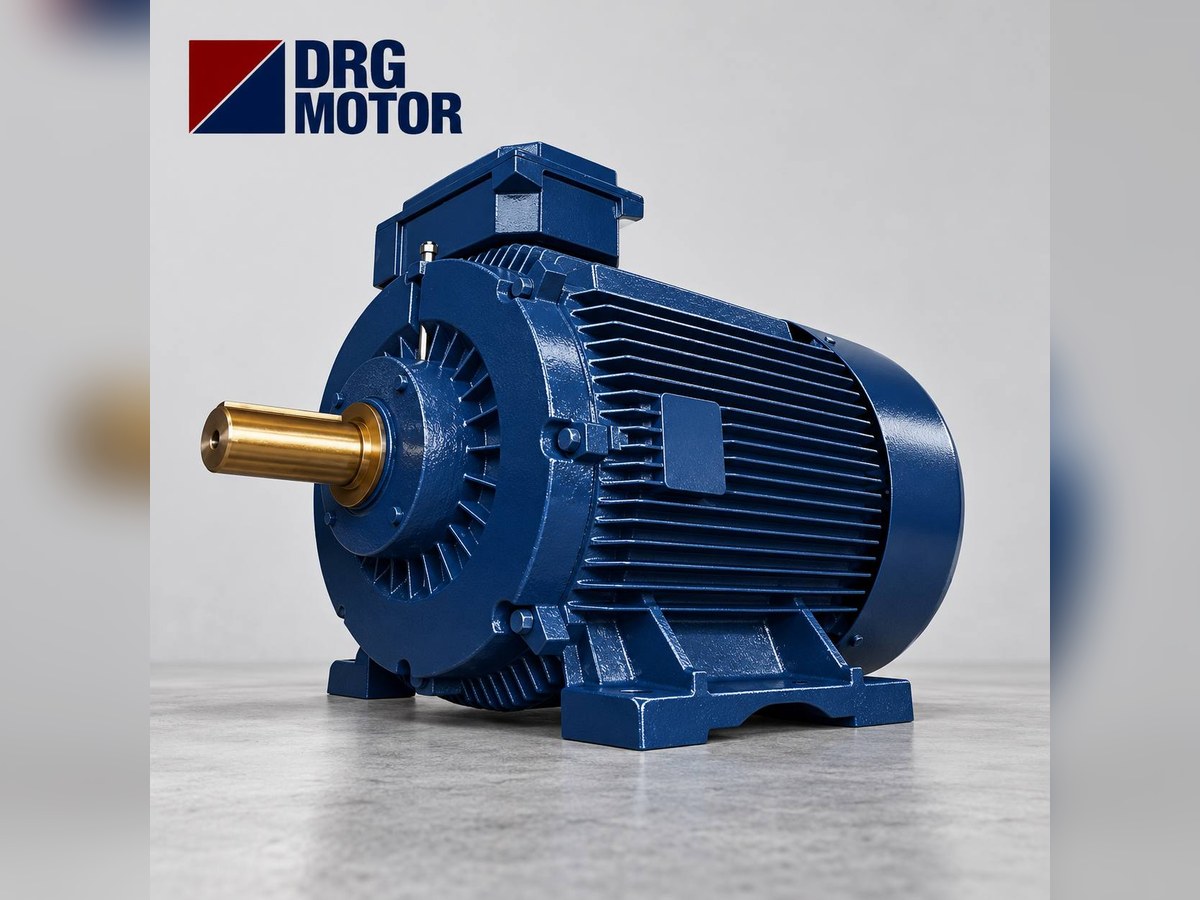
A gang saw (frame saw) is a reciprocating multi-blade saw that splits a marble or granite block into dozens of slabs in a single run. On a gang saw the electric motor does not push the blades directly: via belts it spins a heavy flywheel, whose crank and connecting rod then swing the blade frame to and fro. Choosing a gang saw motor is therefore about starting power to bring a heavy flywheel up to speed and rated power to carry the load through one cut that lasts for hours. Maker data sheets list main motors from 75 kW to 132 kW, with separate small motors for feed, water and the trolley.
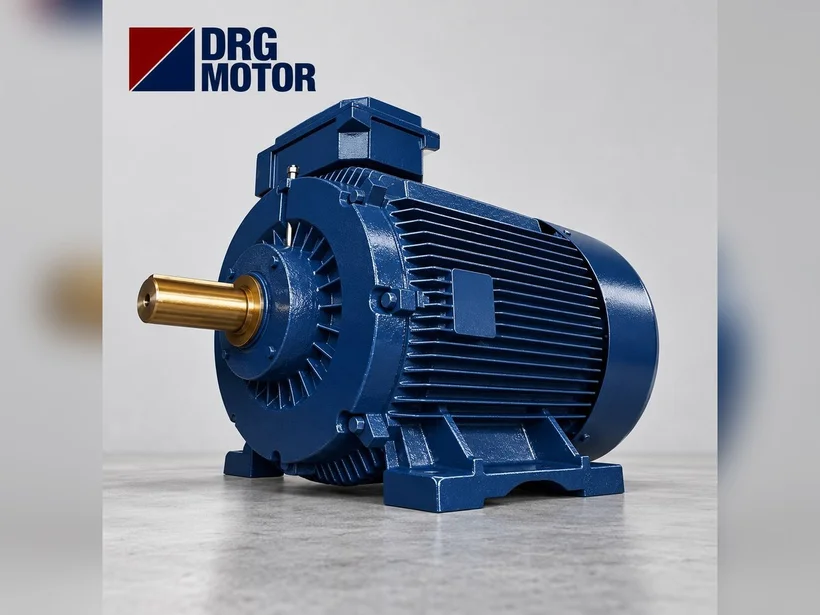
DRG Motor is a manufacturer, supplier and seller of electric motors. We do not sell gang saws, flywheels, gearboxes, hydraulic units, pump bodies or drives; what we sell are the standard three-phase motors used on the main and auxiliary drives of the saw. All power ratings are listed on Buy Electric Motors Online.
How does a gang saw work?
The block is rolled between the four columns of the saw on a rail trolley. Blades are tensioned in the frame carried by the columns, with gaps equal to the slab thickness. As the flywheel turns, the connecting rod pulls the frame back and forth with a 500–800 mm stroke; at the same time the frame or the block advances a few centimetres per hour and the blades sink into the block. Depending on size and hardness, a block is turned into slabs in one cut that lasts many hours.
Flywheel and crank mechanism
The flywheel absorbs the load swing created as the frame reverses on every stroke. The frame accelerates forward and back and stops at each end; the flywheel stores and returns that energy, so the motor draws a smoother current. On marble gang saws the flywheel turns at 92 rpm; on large granite saws its diameter reaches 4,500 mm. The crank, connecting rod, shaft and bearings belong to the machine; our subject is the motor that turns the flywheel.
How the motor connects to the flywheel
The main motor is foot-mounted on a slide rail or swing base that sets belt tension. The belt set from motor pulley to flywheel reduces the 1500 rpm motor speed to the low flywheel speed. Some makers separate the tensioning arrangement on the motor shaft from the flywheel belts, so that less side load reaches the motor bearing while belts are tightened. Belt tension that prevents slip also directly affects motor bearing life.
Marble gang saw and granite gang saw: the difference for the motor
Diamond-blade marble gang saw
For soft stones such as marble and travertine the blades carry diamond segments and the cut is cooled with water. Stroke rate is high (92 per minute in data sheets) and cutting feed can reach a few tens of centimetres per hour. Main motors in this series are 75–132 kW; because the load is steadier, the motor usually runs below rated power during the cut.
Steel-grit (abrasive) granite gang saw
For granite the blades are plain steel; the cutting is done by a mixture of steel shot or grit, lime and water poured under the blades. This mix is kept circulating by a slurry pump. Stroke rate is lower (67 per minute in one data sheet), blade count goes up to 180 and a cut lasts much longer than on marble. Data sheets list flywheel motors of 90–132 kW. Abrasive slurry is far more harmful than the watery mud of a marble saw: motor and pulley must be placed where they are protected from slurry splash.
Gang saw, block cutter and wire saw compared
A block cutter splits the block into strips with large rotating blades; a gang saw works by reciprocating rather than rotating and produces full-size slabs in one go. A multi-wire machine does the same job with endless diamond wires and uses large drive wheels instead of a flywheel and crank. The main motor’s load and starting differ on these three machines, so the motor of one is not a model for another.
Click to see current electric motor prices and order nowSEE PRICES →
How many kW is a gang saw motor? Values from maker data sheets
A) Main motor powers given in gang saw makers’ data sheets:
| Gang saw type / size | Motor power | Single / total | Note |
|---|---|---|---|
| Diamond-blade marble gang saw, 60 blades | 75 kW | Main motor; installed total 88.7 kW | maker data sheet, small model |
| Diamond blades, 70 blades | 110 kW | Main motor; total 132 kW | same data sheet |
| Diamond blades, 80 blades, 800 mm stroke | 110 kW | Main motor; total 132 kW | second maker |
| Diamond blades, 80 blades, 700 mm stroke | 132 kW | Main motor; total 160 kW | first data sheet, large model |
| Diamond blades, 90–100 blades | 110 kW | Main motor; lifting 7.5 + cutting 1.1 kW separate | third maker |
| Steel-abrasive granite gang saw, 180 blades | 90 kW | Flywheel motor; total 144 kW | fourth maker |
| Large steel-grit granite gang saw | 132 kW | Main motor; flywheel diameter 4,500 mm | fifth maker |
Depending on model, number of blades and stroke length, the main motor in this machine group is roughly 75–132 kW; with the auxiliaries added, installed total power reaches 88.7–160 kW. In these examples power does not always rise with blade count: the 180-blade granite saw is listed with 90 kW, the 80-blade marble saw with 132 kW. Frame mass, stroke rate and cutting method are what decide.
Auxiliary motors
Motors that work separately from the main drive and appear on their own lines in data sheets:
| Motor | Task | Rated power in data sheet | Drive |
|---|---|---|---|
| Fast lift / lower | Brings the frame quickly to the block | 3.7–11 kW | gearbox + screw |
| Slow lowering (cutting feed) | Feed of a few cm per hour | 1.1–2.2 kW | gearbox, often with inverter |
| Water pump | Cooling water to the blades | 2 × 3.7 or 2 × 5.5 kW | direct, coupled |
| Trolley travel | Moves the block in and out | 1.1–1.5 kW | geared |
The slurry pump and agitator motors of a granite gang saw are not always listed separately; their power is read from the pump plate or from application data. For water pump motors see also our Pump Motors category.
B) Gang saw ratings available from DRG
The 75, 90, 110 and 132 kW main motors and the 1.1–11 kW auxiliaries are standard ratings for us; all stay within our 355 kW limit and are available in 4 and 6-pole versions of our cast iron series. We found no gang saw main motor above 355 kW in the data sheets; such a request would be outside our range. If the old motor is 8-pole we have no direct equivalent; whether the pulley ratio can be changed is a decision for the machine maker.
Example: pulley ratio and torque from flywheel speed
Take a marble gang saw with 92 rpm flywheel speed, a 110 kW main motor and 800 mm blade stroke in its data sheet, driven by a 4-pole DRG-315S-4 (1488 rpm):
| Step | Operation | Result | Meaning |
|---|---|---|---|
| 1 | 1488 / 92 | ≈ 16.2 | ratio between motor pulley and flywheel |
| 2 | 9550 × 110 / 92 | ≈ 11,418 Nm | rated torque at the flywheel shaft (belt losses excluded) |
| 3 | 2 × 0.8 m × 92 / 60 | ≈ 2.45 m/s | mean blade speed |
| 4 | 988 / 92 | ≈ 10.7 | ratio needed with a 6-pole motor |
The flywheel shaft carries more than 11,000 Nm; belts and flywheel take this load, while rated torque at the motor shaft is 706 Nm. A replacement whose rated speed is even a few rpm off shifts flywheel and blade speed by the same proportion. Moving to a 6-pole motor lowers the pulley ratio to 10.7 but increases the frame size; size the new pulleys with the pulley and belt calculator, then get the machine maker’s approval.
Starting: heavy flywheel, long acceleration
At start the motor accelerates the stationary flywheel, frame and blades together. Because flywheel inertia is large, acceleration takes a long time and the motor draws several times its rated current throughout. If the saw is started with the blades resting in the block, the connecting rod forces them inside the cut on the first stroke; that is why many gang saws lift the frame slightly before starting.
Star-delta, soft starter, drive
The 110 kW DRG-315S-4 has a starting current 7 times its rated current (In = 187 A). Star connection brings current and torque down to around a third of their direct values; with a heavy flywheel, if the star step is not long enough a second surge appears at the switch to delta. Data sheets also show gang saws with fluid couplings and frequency control; in those solutions the motor stays standard and the coupling or drive softens the start. The star-delta starting page explains the trade-offs. For plants near quarries with long supply lines, check cable size with our motor cable size calculator.
Cutting feed and the inverter
The slow lowering motor sets a feed rate of a few centimetres per hour and is inverter-driven on most gang saws; on machines with constant power control, the controller watches main motor current and slows or speeds up the feed. Here the main motor’s current signal is an important input: if the new motor’s rated current differs from the old one, the current thresholds in the controller must be updated. The drive is part of the panel and is not supplied by us.
DRG motors suitable for gang saws
Sample 4-pole models for the main motor and auxiliary drives (current at 400 V):
| Model | Power / speed | Frame · shaft D×E | Current 400 V |
|---|---|---|---|
| DRG-100L1-4 | 2.2 kW / 1450 rpm | 100L cast iron · 28×60 | 4.52 A |
| DRG-160M-4 | 11 kW / 1465 rpm | 160M cast iron · 42×110 | 20.4 A |
| DRG-280S-4 | 75 kW / 1486 rpm | 280S cast iron · 75×140 | 129 A |
| DRG-280M-4 | 90 kW / 1486 rpm | 280M cast iron · 75×140 | 155 A |
| DRG-315S-4 | 110 kW / 1488 rpm | 315S cast iron · 85×170 | 187 A |
| DRG-315M-4 | 132 kW / 1488 rpm | 315M cast iron · 85×170 | 224 A |
Our motors are three-phase and IP55; foot-mounted B3 is used for the main motor, B5 or B35 for feed motors flanged to a gearbox. We confirm the match from the old nameplate and the gang saw maker’s documents: kW, speed, 400/690 V connection, frame size, mounting type, shaft diameter and key, pulley or gearbox connection and the wet or slurry environment. Without comparing this data we give no guarantee of a definite fit.
Live price table
Prices of our models in the powers found on gang saw main and auxiliary drives come live from the shop:
| Model | Power / speed | Frame · current 400 V | Price |
|---|---|---|---|
| DRG-112M-45.5 HP | 4 kW · 1500 rpm | Cast iron 112M · 7.95 A | $254.38 (€227.18) Details & buy → |
| DRG-132S-47.5 HP | 5.5 kW · 1500 rpm | Cast iron 132S · 10.7 A | $342.01 (€305.44) Details & buy → |
| DRG-132M-410 HP | 7.5 kW · 1500 rpm | Cast iron 132M · 14.3 A | $394.89 (€352.66) Details & buy → |
| DRG-160M-415 HP | 11 kW · 1500 rpm | Cast iron 160M · 20.4 A | $568.76 (€507.94) Details & buy → |
| DRG-280S-4100 HP | 75 kW · 1500 rpm | Cast iron 280S · 129 A | $2,916.93 (€2,605.00) Details & buy → |
| DRG-280M-4125 HP | 90 kW · 1500 rpm | Cast iron 280M · 155 A | $3,268.56 (€2,919.03) Details & buy → |
| DRG-315S-4150 HP | 110 kW · 1500 rpm | Cast iron 315S · 187 A | $4,863.00 (€4,342.97) Details & buy → |
| DRG-315M-4180 HP | 132 kW · 1500 rpm | Cast iron 315M · 224 A | $5,621.72 (€5,020.55) Details & buy → |
DRG MOTOR motors are guaranteed against material and manufacturing defects for 2 years from the delivery date (warranty certificate).
Motors in this power range
- DRG-132S-4 – 5.5 kW – 1460 rpm – 132S cast iron
- DRG-160M-4 – 11 kW – 1465 rpm – 160M cast iron
- DRG-280M-4 – 90 kW – 1486 rpm – 280M cast iron
- DRG-315S-4 – 110 kW – 1488 rpm – 315S cast iron
- DRG-315M-4 – 132 kW – 1488 rpm – 315M cast iron
Click to see current prices and order these motors nowSEE PRICES →
Browse products, request a quote: suitable models for the gang saw main motor and feed motors are on Buy Electric Motors Online. Message us a picture of the plate and of the belt layout on WhatsApp, or phone +90 (542) 666 11 11.
Frequently asked questions
If the gang saw motor keeps tripping, is the motor too small?
First check belt tension, lubrication of the frame guides and the cutting feed setting. If one of these is wrong, a larger motor will draw the same current. If the problem remains, measure current under load and compare it with the nameplate.
Does granite saw slurry damage the motor?
Steel-grit slurry sticks to the housing and fan cover and spoils cooling; if it gets into the terminal box it also weakens insulation. Keep the motor out of the slurry path and clean it regularly.
How many poles should a gang saw electric motor have?
The common layout in data sheets is a 4-pole motor with a belt-driven flywheel. If the pole count changes, the pulley ratio must change too; staying with the old motor’s pole count is the route with the fewest changes.
Unsure which flywheel motor fits your saw? Ring +90 (542) 666 11 11 or e-mail info@drgmotor.com; the contact page works too.


