 English
 Le français
 Türkçe

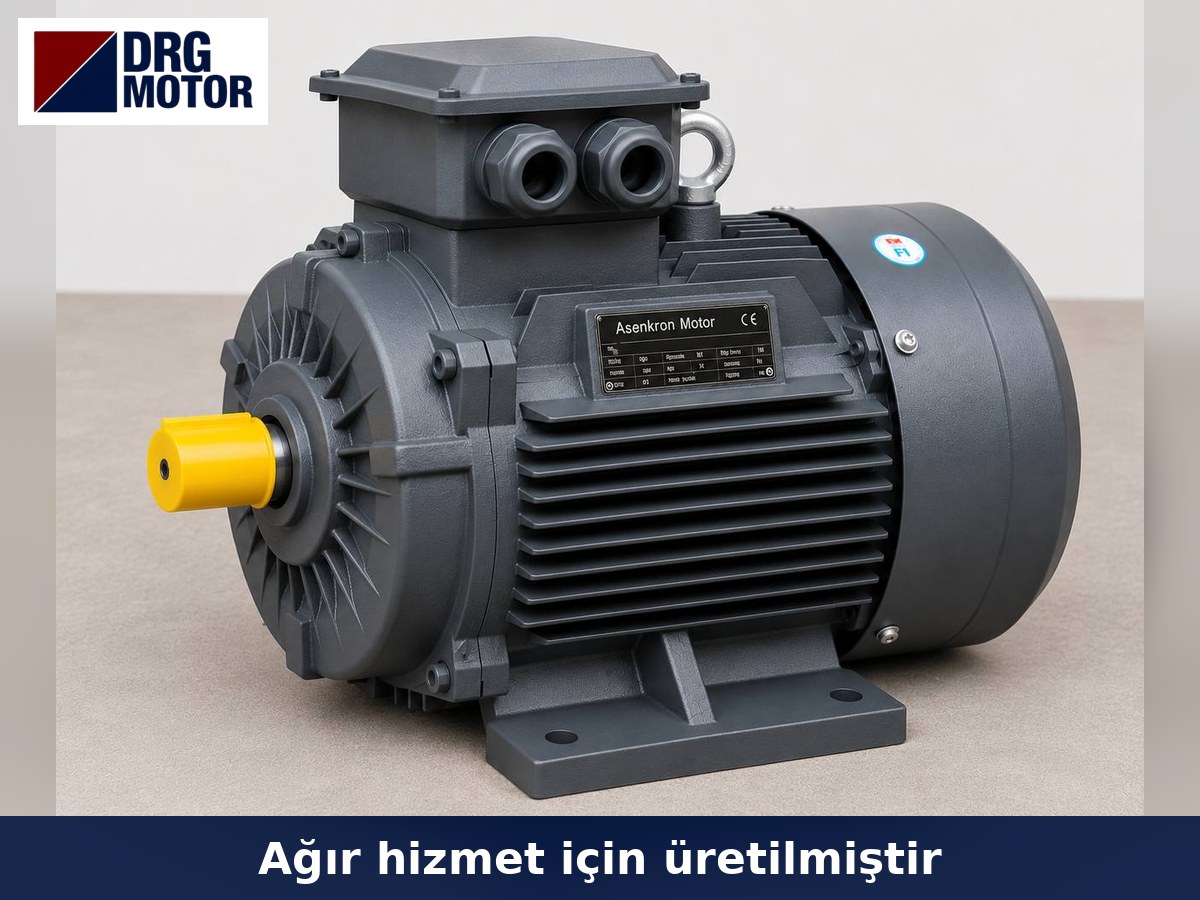
Cable production line motors drive every machine that turns copper or aluminium rod into finished cable: the drawing machine that reduces rod to fine wire, the buncher that twists the wires, the extruder that lays plastic insulation over the conductor and the take-up that winds the cable onto a reel. On a wire drawing machine the motor turns the capstans and drums, on a buncher it spins the cradle or rotor, on an extruder it drives the screw, and on the haul-off and take-up it carries the line speed. Manufacturer catalogues list 250–285 kW for a rod breakdown main motor, 15–110 kW for a tubular strander, 11–75 kW for an insulation extruder and 4–11 kW for haul-offs and take-ups.
DRG Motor is a manufacturer, supplier and seller of electric motors. We do not sell drawing or stranding machines, extruders, capstan wheels, gearboxes or drives; our part is the three-phase cage induction motor fitted to them. You will find every model in the Buy Electric Motors Online catalogue, while sister applications sit under General Purpose Industrial Electric Motors.
From rod to reel: which motor sits where on the line?
In a low-voltage cable plant the flow has four main steps: rod drawing, fine drawing with annealing, stranding and insulation extrusion. At the end of each step the wire or cable is wound onto a reel, and the next machine pays it off again. Some motors on the line therefore process the material, while others only hold tension and speed.
Rod breakdown drawing
Copper rod of about 8 mm passes through a row of diamond or carbide dies and comes out a few millimetres thick. A large main motor drives the drawing drums together through a gearbox, and the final capstan has its own motor. These motors run on drives and are stopped quickly when a wire breaks; in this class the main motor reaches hundreds of kilowatts.
Fine and multi-wire drawing
Fine wire machines draw 4, 8, 16 or 24 wires at once and usually carry an in-line annealer. Motor power is smaller than on rod breakdown; totals run from tens of kilowatts to a few hundred, while the annealing current comes from a separate DC unit. The drive manages the speed difference between drawing drums and take-up.
Bunchers and stranders
On a double-twist buncher the motor spins a cradle around the bobbin at high speed; the lay length is set by gears or by an electronic ratio. On a tubular strander a long tube body rotates and a separate motor drives the capstan. Rotor inertia is large, so acceleration and stopping ramps are long.
Insulation extruder and line auxiliaries
The extruder main motor turns the screw through a gearbox, and screw speed sets how much plastic is laid on the cable. While the cable passes through the cooling trough, a small circulation pump moves the water; then a caterpillar or wheel haul-off pulls the line at a set speed and the take-up fills the reel. For screw drive sizing see our plastic extruder motor selection article; pelletizing lines in recycling are covered on the plastic extruder and pelletizing machine motors page.
How many kW does a cable line motor need? Manufacturer catalogue values
A) What makers of cable line machines print for motor ratings in their brochures:
| Machine / model group | Motor power | Single / total | Note |
|---|---|---|---|
| Rod breakdown, 8 mm inlet, 9–13 drafts | 250–285 kW main motor; 55–75 kW capstan motor | two separate drives | first maker |
| Multi-wire fine drawing, 24 blocks, 0.08–0.32 mm outlet | 18 kW | total motor power of the machine | second maker |
| Double-twist buncher, 800 and 1000 mm bobbin | 15 kW and 22 kW | per machine | third maker |
| Tubular strander, 200–1250 mm bobbin | main motor 15–110 kW; capstan 0.75–45 kW | two separate motors | fourth maker |
| Insulation extruder, 50–90 mm screw | main motor 11–75 kW; haul-off 4–11 kW | separate drives | fifth maker |
| Double-wheel capstan after the cooling trough | 5.5 kW | single motor | sixth maker |
| Gantry take-up, 1250–3150 mm reel | winding 5.5–11 kW; lifting 2 × 1.1 … 2 × 3 kW; clamping 1.1–1.5 kW (6-pole) | each motor listed separately | seventh maker; traverse servo is separate |
Side by side, the catalogues show motors of roughly 0.75–285 kW on cable line machines: 250–285 kW for the rod breakdown main motor, 15–110 kW for tubular stranders, 11–75 kW for extruders, 15–22 kW for bunchers, 4–11 kW for haul-offs, capstans and take-ups, and 1.1–3 kW for reel lifting and clamping. Because one machine carries several motors, the table shows each drive rather than the installed total. Power grows with screw diameter, reel size and line speed.
B) Overlap with the DRG range: from the clamping motor up to the rod breakdown main drive, nearly every listed value sits between the smallest and the largest model of our cast iron series. 250 kW calls for a 355M frame, and 285 kW for the next step, 315 kW in a 355L frame; at this size the drive current limit is also rechecked. Servo motors for the traverse, motors prepared for encoder-based vector control and designs needing a separate cooling fan are outside our range; if you run such a motor, contact us with its nameplate.
Click to see current electric motor prices and order nowSEE PRICES →
Speed link between haul-off and extruder, with a worked example
On a cable line the motors work as a group locked to one line speed rather than one by one. If the screw speeds up and the haul-off lags, the insulation gets thicker; if the haul-off runs ahead, the conductor is left bare. Drives and line control build this synchronism; the motor’s job is to deliver steady torque at whatever frequency it receives.
Example: 5.5 kW motor on a 700 mm capstan wheel
Assumptions: wheel diameter 0.70 m, top line speed 400 m/min, transmission loss factor 0.95. The drive is the DRG-132S-4; its catalogue record gives 36.0 Nm rated torque, 1460 rpm rated speed and 10.7 A at 400 V.
| Step | Operation | Result | Comment |
|---|---|---|---|
| Wheel speed | 400 / (π × 0.70) | about 181.9 rpm | line speed ÷ circumference |
| Transmission ratio | 1460 / 181.9 | about 8.03 | belt or gearbox |
| Wheel torque | 36.0 × 8.03 × 0.95 | about 274.5 Nm | 0.95 transmission loss factor |
| Pulling force | 2 × 274.5 / 0.70 | about 784 N | at the wheel rim |
| Frequency at 100 m/min | 50 × 100 / 400 | 12.5 Hz | shaft fan moves little air |
Result: about 784 N of pulling force remains at the wheel, how much tension the line actually calls for is a figure only the builder of the line can give, so compare against that. When the line slows to 100 m/min the motor runs at 12.5 Hz. A motor cooled by the fan on its own shaft gets little air at that frequency; if the haul-off spends long periods at low speed with full torque, consider the next frame size or a separately ventilated design. Our output speed and torque tool shows how the ratio shifts with another wheel diameter.
Not to be confused with cable granulators
Shredders and granulators that recover copper from scrap cable are not part of this line; their loads are impact-type and their starts are heavy. Motor selection for those machines is covered in our cable granulator motor article.
DRG motors for cable machines
Our eight picks for the steps between reel clamping and rod drawing:
| Model | Power / speed | Frame · shaft D×E | Current 400 V |
|---|---|---|---|
| DRG-90L-6 | 1.1 kW / 945 rpm | 90L cast iron · 24×50 | 2.69 A |
| DRG-132S-4 | 5.5 kW / 1460 rpm | 132S cast iron · 38×80 | 10.7 A |
| DRG-160M-4 | 11 kW / 1465 rpm | 160M cast iron · 42×110 | 20.4 A |
| DRG-180L-4 | 22 kW / 1470 rpm | 180L cast iron · 48×110 | 39.7 A |
| DRG-225M-4 | 45 kW / 1485 rpm | 225M cast iron · 60×140 | 80.2 A |
| DRG-280S-4 | 75 kW / 1486 rpm | 280S cast iron · 75×140 | 129 A |
| DRG-315S-4 | 110 kW / 1488 rpm | 315S cast iron · 85×170 | 187 A |
| DRG-355M-4 | 250 kW / 1490 rpm | 355M cast iron · 100×170 | 418 A |
Catalogues show 6 poles for the reel clamping motors of take-ups, so the 6-pole DRG-90L-6 is included; the other drives are 4-pole. Small motors on the line can use aluminium frames (up to 11 kW), while drawing and extruder main drives use cast iron frames (up to 355 kW). Every model is three-phase; larger ratings also come with 690 V windings, protection is IP55 and insulation class F. Foot, flange and combined foot-flange builds (B3, B5, B35) are available, as are upright versions. For motors mounted straight onto an extruder gearbox, compare flange and shaft against the technical drawings.
Live price table
Prices for the models matching cable line ratings come live from the shop:
| Model | Power / speed | Frame · current 400 V | Price |
|---|---|---|---|
| DRG-90L-61.5 HP | 1.1 kW · 1000 rpm | Cast iron 90L · 2.69 A | $137.68 (€122.96) Details & buy → |
| DRG-132S-47.5 HP | 5.5 kW · 1500 rpm | Cast iron 132S · 10.7 A | $342.01 (€305.44) Details & buy → |
| DRG-160M-415 HP | 11 kW · 1500 rpm | Cast iron 160M · 20.4 A | $568.76 (€507.94) Details & buy → |
| DRG-180L-430 HP | 22 kW · 1500 rpm | Cast iron 180L · 39.7 A | $919.45 (€821.13) Details & buy → |
| DRG-225M-460 HP | 45 kW · 1500 rpm | Cast iron 225M · 80.2 A | $1,688.50 (€1,507.94) Details & buy → |
| DRG-280S-4100 HP | 75 kW · 1500 rpm | Cast iron 280S · 129 A | $2,916.93 (€2,605.00) Details & buy → |
| DRG-315S-4150 HP | 110 kW · 1500 rpm | Cast iron 315S · 187 A | $4,863.00 (€4,342.97) Details & buy → |
| DRG-355M-4340 HP | 250 kW · 1500 rpm | Cast iron 355M · 418 A | $9,826.77 (€8,775.92) Details & buy → |
DRG MOTOR motors are guaranteed against material and manufacturing defects for 2 years from the delivery date (warranty certificate).
Motors in this power range
- DRG-132S-4 – 5.5 kW – 1460 rpm – 132S cast iron
- DRG-160M-4 – 11 kW – 1465 rpm – 160M cast iron
- DRG-180L-4 – 22 kW – 1470 rpm – 180L cast iron
- DRG-280S-4 – 75 kW – 1486 rpm – 280S cast iron
- DRG-355M-4 – 250 kW – 1490 rpm – 355M cast iron
Click to see current prices and order these motors nowSEE PRICES →
What we need for a replacement and a quotation
On cable machines the motor is usually sized to the frame and gearbox of the machine. Ordering by kW alone leaves the machine idle for days when the shaft, flange or foot holes do not match. For a quotation, send:
- a photo of the old motor nameplate (power, speed, voltage, current, connection)
- machine type: drawing machine, buncher, tubular strander, extruder, haul-off or take-up
- mounting (B3, B5, B35 or vertical), shaft diameter and key size
- whether the motor is fed by a drive or direct on line, and the lowest operating speed
- daily operating hours and number of starts
- environment: distance to the annealer, cooling water splash, dust
- quantity and spare motor needs
Browse the products and request a quote: motors for your line are on the Buy Electric Motors Online page. Send the nameplate photo and machine type on WhatsApp or call +90 (542) 666 11 11.
Frequently asked questions
The main motor of our drawing machine is a DC motor. Can an induction motor replace it?
DC motors are common on older drawing machines. A drive-fed induction motor can take their place, but the drive, the controls and often the motor base change too. DC motors are not in our range.
What speed should a buncher motor have?
Cradle speed comes from the motor speed through a gear or belt ratio. Keep the pole number of the old motor and the ratios stay as they are; a different speed changes the lay length.
Can we also buy the reel lifting motor of the take-up from you?
Raising a loaded reel and keeping it up is a job for a brake motor, which you will not find among our products. For clamping and winding, a standard motor does the work.
Questions: +90 (542) 666 11 11 · info@drgmotor.com · contact.


