 English
 Le français
 Türkçe

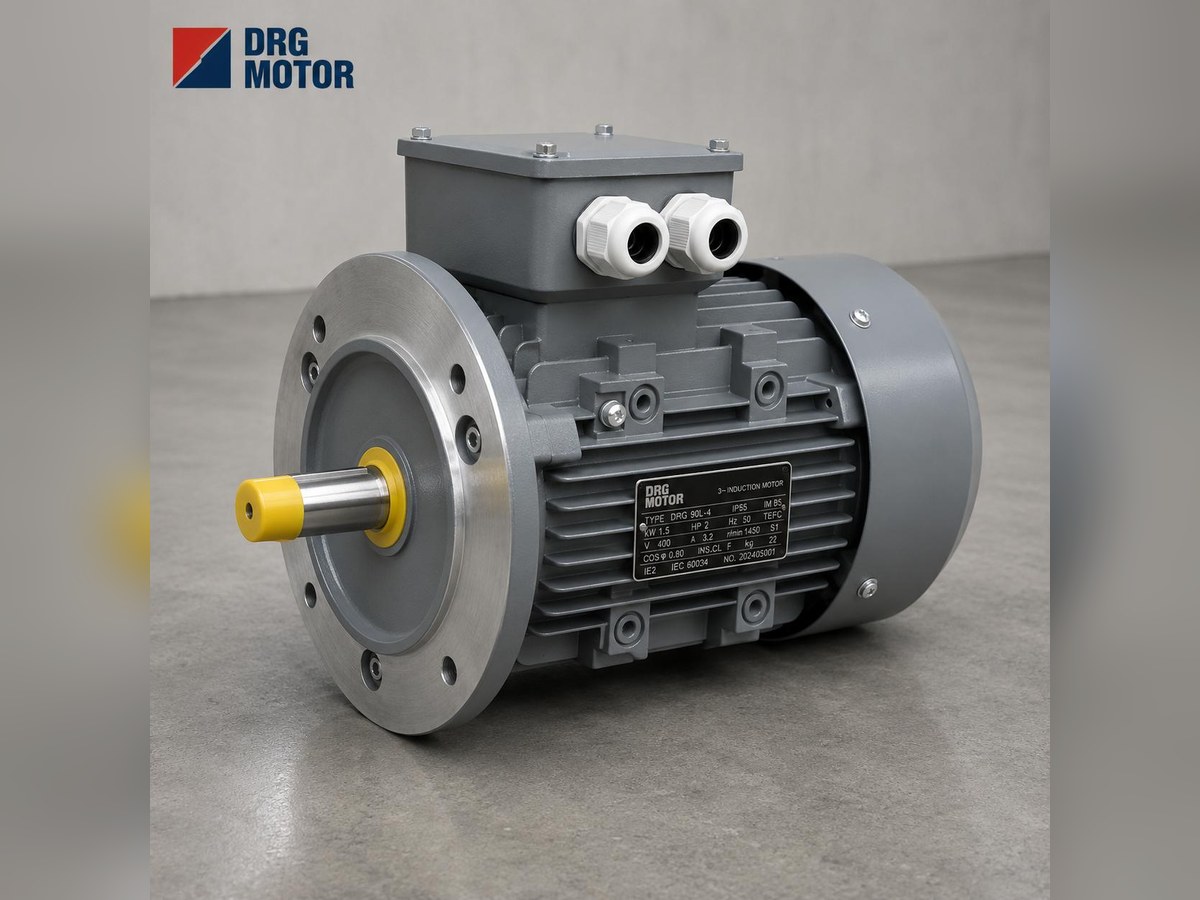
In ceramic tile and sanitaryware plants, clay, feldspar and quartz are ground with water in a drum ball mill until they become slip, the fluid ceramic body. The electric motor of the mill turns a heavy cylinder full of alumina or silica pebbles and raw material, through a gearbox and V-belts, at only 9–17 revolutions per minute. Maker catalogues list 0.75–160 kW drives for batch mills and, for continuous mills, from one 250 kW motor up to two 315 kW motors; the largest continuous types reach 800–1030 kW of main drive. A plant-wide overview sits in our ceramic plant motor article; here we stay with the slip mill alone.
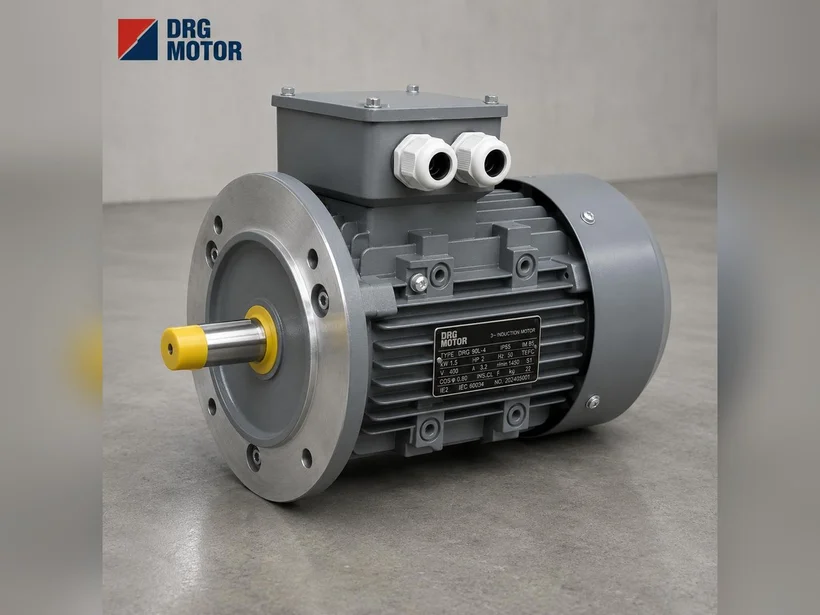
DRG Motor is a manufacturer, supplier and seller of electric motors. We do not sell the mill itself, the rubber lining, the grinding pebbles, gearboxes, fluid couplings, inverters or the casing of the slip pump. What we supply is the three-phase main motor that turns the cylinder and the auxiliary motor used for inching and positioning; our models are listed on Buy Electric Motors Online.
How does a ceramic slip mill work and what does the motor carry?
The cylinder turns about its horizontal axis; rubber lifters on the inner wall carry the pebbles up to a certain height, and as they fall and rub against each other they grind the raw material finer. The fineness of the slip depends on grinding time, pebble type and drum speed. The load on the motor comes from the centre of gravity of the rotating mass sitting off the axis: as the drum turns, the pebble and slip bed leans to one side and the motor delivers torque as if it were constantly lifting that bed.
Batch mill
A batch mill is charged with raw material, water and additives, the hatch is closed, and when grinding is complete it is stopped and discharged. The first maker’s catalogue gives an internal volume of 0.2–45 m³ and an installed power of 0.75–160 kW for this family. The drive unit consists of an electric motor, a gearbox and a final V-belt stage, built as a shaft-mounted assembly. To bring the discharge hatch to the bottom, the drum must stop in a set position, so a batch mill motor restarts with a full drum several times a day.
Continuous mills and modular lines
In a continuous mill raw material is fed at one end and slip is drawn off at the other without stopping; there is no loading and unloading downtime, so the motor runs at steady load for long hours. In the first maker’s continuous range the 35 and 40 m³ models use a single 250 kW main motor plus an 18.5 kW auxiliary motor; between 54 and 100 m³ the main drive is split between two motors. Modular lines run two or three separate cylinders in series, each with its own motor, gearbox, belts and inverter.
Heavy starting: getting a full drum moving
The 39.1 m³ batch slip mill in the catalogue holds 25.3 t of grinding media and 29.8 t of dry raw material, before water and the cylinder’s own mass are added. In a mill at rest the pebbles and slip settle at the bottom, and on starting the motor lifts this bed for the first time. That is why a mill motor faces a harder start than a fan or pump motor of the same rating, and why the starting method matters as much as the motor itself.
Soft starter, fluid coupling and inverter
The first maker offers the inverter as an option on batch mills up to 55 kW and as standard on larger ones; it gives a smooth start and accurate positioning of the loading hatch. On some continuous mills a fluid coupling sits between the main motor and the gearbox, and small auxiliary motors handle slow rotation and positioning. With a fluid coupling the motor accelerates unloaded and the coupling takes up the load gradually; with an inverter high torque is available at low shaft speed. Drives and couplings are not our products; the motor can be used in either arrangement.
Parking brake and positioning
In the catalogue, batch mills above 10 kW have a pneumatic parking brake that holds the cylinder in position when stopped; this brake belongs to the machine, not the motor. Brake motors are outside our range. On older drives without an inverter, a grinding counter stops the mill automatically, and positioning is done by hand or with the auxiliary motor.
How many kW is a ceramic mill motor? Catalogue values
A) Motor ratings published in maker catalogues for batch and continuous ceramic mills:
| Mill type / volume | Motor rating | Single / total | Note |
|---|---|---|---|
| Laboratory batch, 0.14–0.39 m³ effective | 0.75–2.2 kW | single motor | first maker’s catalogue |
| Glaze batch mill, 0.80–10.5 m³ | 5.5–55 kW | single motor | first maker’s catalogue |
| Body slip batch mill, 14.9–39.1 m³ | 55–160 kW | single motor | first maker’s catalogue |
| Batch mill, 0.2–15 t per batch | 5.5–110 kW | option range per model | second maker’s catalogue |
| Continuous mill, 32–36.5 m³ effective | 250 kW + 18.5 kW auxiliary | one main motor | first maker’s catalogue |
| Continuous mill, 49.5–92.3 m³ | 2×200 – 2×315 kW; auxiliary 2×15 – 2×22 kW | two main motors; total 400–630 kW | first maker’s catalogue |
| Continuous mill, 101–150 m³ | 800–1030 kW | main drive total | first maker, girth gear drive |
| Modular continuous line, 2–3 cylinders | 250–400 kW per cylinder | line total 500–1200 kW | first maker, inverter on each cylinder |
Set side by side, the catalogues show per-motor ratings climbing from 0.75 kW to 400 kW as the drum grows; modular lines with two or three cylinders add up to 500–1200 kW installed. The second maker also notes that power changes with lining and media type for the same drum, which is why two figures are given for one size.
B) Where the DRG range fits: any single mill motor between 0.75 and 315 kW finds a 4-pole cast iron counterpart in frames 80 to 355L, and the 15–22 kW auxiliary motors fit as well. Modular lines needing 400 kW per cylinder, girth gear drives of 800–1030 kW, older DC-motor types and medium voltage are outside our range. Because drum speed comes from the gearbox, 1000/1500 rpm is enough on the motor side.
Click to see current electric motor prices and order nowSEE PRICES →
Worked example: 39 m³ batch mill
Take the largest batch slip mill in the catalogue: 160 kW installed, 13 rpm drum speed. Its counterpart in our range is the DRG-315L1-4 (160 kW, 1,488 rpm, 271 A at 400 V, Ts/Tn 2.0, Is/In 7.1). Using that data sheet we calculated with python:
| Quantity | Operation | Result | Comment |
|---|---|---|---|
| Overall ratio | 1,488 / 13 | about 114.5 | gearbox × belt together |
| Torque at the drum shaft | 9,550 × 160 / 13 | about 117,500 Nm | lossless, at rated load |
| Rated torque at motor shaft | DRG-315L1-4 data sheet | 1,027 Nm | 1,027 × 114.5 ≈ 117,600 Nm |
| Direct-on-line starting current | 271 × 7.1 | about 1,924 A | Is/In = 7.1; heavy for the supply |
| Star-delta, star step | 1,924 / 3 | about 641 A | starting torque 2.0 / 3 ≈ 0.67 × Tn |
The last row carries the real message: star-delta starting cuts the starting current to a third, but the starting torque also falls to about two thirds of rated torque. That is often not enough to lift a settled pebble bed, which is why inverters are standard on large mills. To try belt and gearbox ratios use our gearbox output speed calculator; to compare starting methods see our star-delta page.
Keep the pole count when replacing the motor
Drum speed governs how the pebbles fall: faster, and they approach sticking to the shell; slower, and they only roll, so grinding takes longer. If you fit a motor with a different pole count while gearbox and pulleys stay the same, the drum speed changes too. Keep the speed on the old plate; if a different speed is needed, recalculate the ratio together with the mill maker.
Other motors along the slip line
Slip discharged from the mill passes a vibrating screen and an iron separator and goes to underground tanks, where slow stirrers stop it from settling; piston pumps then deliver it at high pressure to the spray dryer. Tank stirrers and blungers are a separate machine group, covered under "Ceramic Mixers and Grinders". For pump motors see the Pump Motors category; pump casing, pistons and valves are not supplied by us. If the screen runs on vibration motors, that is a separate product group: our vibration motors article.
Glaze mills
Glaze is ground on the same principle in smaller drums. The catalogue states that body mills used for glaze have a reinforced cylinder and a drive stronger than standard. Where the glaze room’s explosion risk assessment marks a solvent vapour or hazardous dust zone, motors in that zone must carry Ex/ATEX marking; we do not offer motors with that marking.
Mill drives with DRG motors
DRG candidates for the main and auxiliary mill drive, all 4-pole; currents refer to a 400 V supply:
| Model | Power / speed | Frame · shaft D×E | Current 400 V |
|---|---|---|---|
| DRG-100L1-4 | 2.2 kW / 1450 rpm | 100L cast iron · 28×60 | 4.52 A |
| DRG-132S-4 | 5.5 kW / 1460 rpm | 132S cast iron · 38×80 | 10.7 A |
| DRG-160M-4 | 11 kW / 1465 rpm | 160M cast iron · 42×110 | 20.4 A |
| DRG-180M-4 | 18.5 kW / 1470 rpm | 180M cast iron · 48×110 | 33.5 A |
| DRG-200L-4 | 30 kW / 1475 rpm | 200L cast iron · 55×110 | 53.8 A |
| DRG-250M-4 | 55 kW / 1485 rpm | 250M cast iron · 65×140 | 97.6 A |
| DRG-315M-4 | 132 kW / 1488 rpm | 315M cast iron · 85×170 | 224 A |
| DRG-315L1-4 | 160 kW / 1488 rpm | 315L cast iron · 85×170 | 271 A |
| DRG-355M-4 | 250 kW / 1490 rpm | 355M cast iron · 100×170 | 418 A |
| DRG-355L-4 | 315 kW / 1490 rpm | 355L cast iron · 100×170 | 526 A |
Mill drives of the larger sizes put a B3 foot-mounted motor onto tensioning rails beside the drum; on laboratory and glaze mills it mates with the gearbox through a B5 flange or the combined B35 foot-and-flange form. Every DRG motor is a three-phase asynchronous IEC machine; frame options run to 11 kW in aluminium and 355 kW in cast iron, with synchronous speeds of 1000, 1500 and 3000 rpm. For a mill, suitability is judged from the plate power and speed, the supply voltage with its connection (on 400 V a 400/690 V winding is delta-connected), the shaft and key, the foot hole pattern and the pulley size. We compare these with the mill maker’s documents to confirm the fit; without the dimensions we make no firm promise.
B5 flange dimensions for small mills
Values for frames flange-mounted to the gearbox on laboratory and glaze mills, mm:
| Frame | Shaft D×E | Flange P / M / N | Hole S |
|---|---|---|---|
| 100L | 28×60 | 250 / 215 / 180 | 14.5 |
| 132S/132M | 38×80 | 300 / 265 / 230 | 14.5 |
| 160M/160L | 42×110 | 350 / 300 / 250 | 18.5 |
Dimensions of large foot-mounted frames are on the technical drawings page. What to check on a motor that bolts to a gearbox by its flange is gathered in our flange motor for gearbox article.
Live price table
Current prices of the models matching batch and continuous mill ratings are read automatically from the shop:
| Model | Power / speed | Frame · current 400 V | Price |
|---|---|---|---|
| DRG-100L1-43 HP | 2.2 kW · 1500 rpm | Cast iron 100L · 4.52 A | $188.32 (€168.18) Details & buy → |
| DRG-132S-47.5 HP | 5.5 kW · 1500 rpm | Cast iron 132S · 10.7 A | $342.01 (€305.44) Details & buy → |
| DRG-160M-415 HP | 11 kW · 1500 rpm | Cast iron 160M · 20.4 A | $568.76 (€507.94) Details & buy → |
| DRG-200L-440 HP | 30 kW · 1500 rpm | Cast iron 200L · 53.8 A | $1,235.00 (€1,102.93) Details & buy → |
| DRG-250M-475 HP | 55 kW · 1500 rpm | Cast iron 250M · 97.6 A | $2,065.73 (€1,844.82) Details & buy → |
| DRG-315M-4180 HP | 132 kW · 1500 rpm | Cast iron 315M · 224 A | $5,621.72 (€5,020.55) Details & buy → |
| DRG-315L1-4200 HP | 160 kW · 1500 rpm | Cast iron 315L · 271 A | $6,135.24 (€5,479.15) Details & buy → |
| DRG-355M-4340 HP | 250 kW · 1500 rpm | Cast iron 355M · 418 A | $9,826.77 (€8,775.92) Details & buy → |
| DRG-355L-4430 HP | 315 kW · 1500 rpm | Cast iron 355L · 526 A | $11,417.31 (€10,196.37) Details & buy → |
DRG MOTOR motors are guaranteed against material and manufacturing defects for 2 years from the delivery date (warranty certificate).
Motors in this power range
- DRG-160M-4 – 11 kW – 1465 rpm – 160M cast iron
- DRG-250M-4 – 55 kW – 1485 rpm – 250M cast iron
- DRG-315M-4 – 132 kW – 1488 rpm – 315M cast iron
- DRG-315L1-4 – 160 kW – 1488 rpm – 315L cast iron
- DRG-355M-4 – 250 kW – 1490 rpm – 355M cast iron
Click to see current prices and order these motors nowSEE PRICES →
Browse the products, ask for a quote: models suited to your mill are listed on Buy Electric Motors Online. For a first assessment, a WhatsApp message with the drum volume, the old motor’s plate and whether the drive uses an inverter or a fluid coupling is enough; you can also phone +90 (542) 666 11 11.
Frequently asked questions
Should a ball mill motor be 4-pole or 6-pole?
Both are used, because drum speed is reduced by gearbox and pulleys. On replacement the old motor’s speed decides; a different pole count is not fitted without changing the ratio.
Why does the mill motor trip on starting?
A full drum that has stood for a long time needs high breakaway torque and a long run-up. Overload setting, starting method and supply capacity should be reviewed together; low torque in star-delta is a common cause.
What does the price of a mill motor depend on?
It depends on rating, pole count, frame size and mounting; the table above shows current shop prices.
To reach us: +90 (542) 666 11 11 · info@drgmotor.com · contact form.


