 English
 Le français
 Türkçe

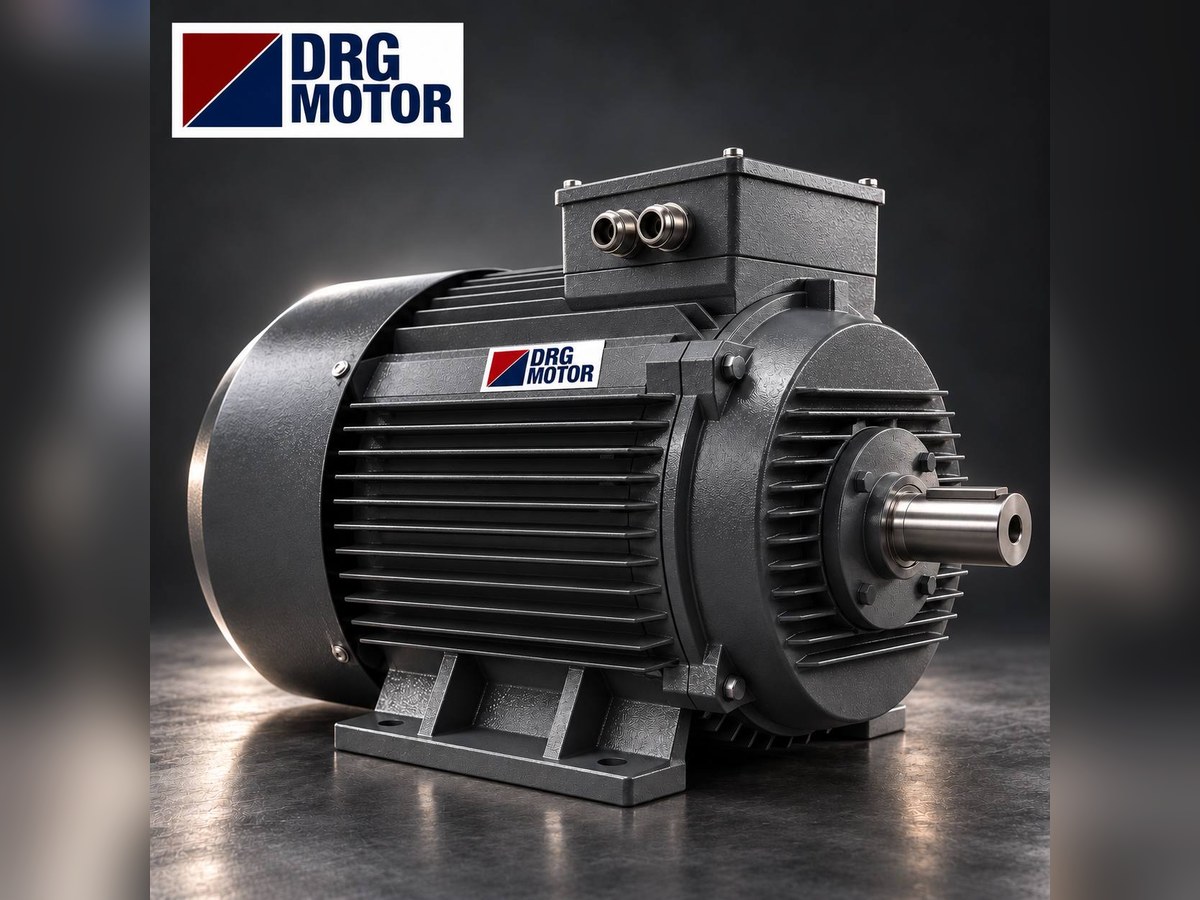
A piston air compressor motor is the electric drive that rotates the crankshaft, usually through a belt and the flywheel pulley. On industrial piston compressors this is a three-phase induction motor that stops and restarts many times a day on the command of the pressure switch. That is why the motor for a piston compressor is chosen not by kW alone but together with its starting behaviour, the pulley ratio and the shaft end size.
DRG Motor does not sell compressors; it supplies the electric motor for three-phase industrial piston compressors. Below you will find how the motor works in the compressor, the market power range and the DRG models that match it.
How the motor works in a piston compressor
In a piston compressor the motor drives the large flywheel pulley on the pump by belt. The flywheel also acts as a cooling fan, blowing air over the cylinders. The pulley ratio brings the motor's high speed down to the pump's lower working speed. In one manufacturer's catalogue the belt-driven workshop and industrial models have pump speeds between 530 and 1303 rpm, which clearly shows that motor speed is reduced by the pulleys.
Start-stop operation
When tank pressure reaches the set upper value the pressure switch cuts the motor; as air is used the pressure falls and at the lower value the motor starts again. If consumption is irregular this cycle repeats many times an hour. Every start pulls a current well above the rated value, and with it the winding heats up a little further; the shorter the gap between starts, the less time the motor has to cool.
Small directly driven models
On some small compressors the motor is tied to the pump without a belt; in manufacturers' catalogues this layout mostly appears on small single-phase workshop models or on special 1:1 coupled systems. In such designs the motor is often built as part of the compressor and may not be replaceable with a standard IEC motor.
Loaded start and the unloader valve
The hardest moment for the motor is the start. If compressed air remains in the cylinder and discharge line, the piston works against that pressure from the first turn; this is called a loaded start. If starting torque is not enough, the motor cannot gain speed, the current stays high and the thermal protection opens.
What the unloader valve does
On piston compressors, the unloader (relief) valve that works with the pressure switch vents the air between pump and check valve when the motor stops, so the motor starts unloaded next time. One manufacturer's brochure states plainly that its dual pressure switch systems vent the compressor for unloaded starting.
How a valve fault affects the motor
If the unloader valve is blocked or the check valve leaks, the motor starts against load every time, and a new motor will struggle for the same reason. Check the valve and check valve before replacing the motor; the topic is covered further in our article why a compressor motor burns out. For the technical side of starting torque see compressor motor starting torque.
Single stage and two stage: effect on motor choice
In a single-stage pump the air is compressed to final pressure in one cylinder. In a two-stage pump the first cylinder raises the air to an intermediate pressure; after the intercooler it reaches final pressure in a second, smaller cylinder. In manufacturers' catalogues single-stage series are usually listed for 10 bar, two- and three-stage series for 14–40 bar.
Power rises with pressure
Raising the same amount of air to a higher pressure takes more shaft power. One catalogue shows that 14 bar two-stage models in the same power class deliver less air than the 10–11 bar models. Raising pressure without raising motor power pushes the motor above its plate rating.
Pump speed and pulley ratio
Two-stage pumps often turn slower than single-stage ones; in the same catalogue the 14 bar models run at 530–896 rpm. That means a larger pulley ratio between motor and pump. On replacement, keeping the pole count and pulley diameter is the safest way not to upset this ratio.
Small single-phase compressors and the DRG range
Home and small workshop compressors commonly use 230 V single-phase motors; in manufacturers' catalogues this class sits at 0.75–2.2 kW. Single-phase compressor motors are not in the DRG range. What DRG covers is the industrial piston compressor connected to a three-phase supply. If you need a motor for a single-phase compressor you can ask us, but the products in our range are three-phase.
Voltage and connection on a three-phase compressor
Winding voltage splits by power. DRG models of 3 kW and below carry a 230/400 V winding, so a 400 V line takes them in star with a direct start. From 4 kW upward the winding is 400/690 V; the same line feeds them in delta, which lets the panel use a star-delta start. In one manufacturer's catalogue star-delta starting is used from the 4 kW (5.5 hp) class upwards. Before changing the panel arrangement you can look at the star-delta starting page.
Click to see current electric motor prices and order nowSEE PRICES →
Pulley diameter, speed and shaft end
Pump speed follows from motor speed and the ratio of pulley diameters: n_pump = n_motor × d_motor / d_flywheel. The target is the pump speed given by the compressor maker; that limit must not be exceeded.
Rounding to a standard pulley size
Example: on a 7.5 kW compressor with a 400 mm flywheel pulley and a required pump speed of 795 rpm, the motor pulley calculated for a 4-pole DRG-132M-4 (1460 rpm) is about 218 mm. If that size is not available and the next standard size of 224 mm is chosen, the pump turns at about 818 rpm; that is roughly 3% faster, and the power demand rises by about the same proportion. When rounding like this, going to the smaller side protects the motor.
| Motor | Motor pulley | Flywheel pulley | Pump speed | Belt speed |
|---|---|---|---|---|
| DRG-132M-4 · 1460 rpm | 218 mm | 400 mm | 795.7 rpm | 16.7 m/s |
| DRG-132M-4 · 1460 rpm | 224 mm | 400 mm | 817.6 rpm | 17.1 m/s |
| DRG-132S2-2 · 2930 rpm | 112 mm | 400 mm | 820.4 rpm | 17.2 m/s |
The last row shows a 2-pole motor: the pulley drops to half the diameter. On a very small pulley the belt wrap angle shrinks and slip increases. You can repeat the calculation with your own sizes in the pulley and belt calculator.
Shaft end and pulley hub
The pulley hub sits on the motor shaft with a key. Shaft size changes with frame: in DRG data it is 28×60 mm on the 100L and 112M frames and 38×80 mm on the 132 frame. Moving from 3 kW to 5.5 kW takes the frame from 100L to 132S, so the old pulley hub will not fit the new shaft. Fit the pulley without overhanging the shaft end and as close to the bearing as possible; belt pull loads the shaft and bearing sideways.
| Model | Power / speed | Frame · shaft D×E | Current 400 V |
|---|---|---|---|
| DRG-100L1-4 | 2.2 kW / 1450 rpm | 100L aluminium · 28×60 | 4.52 A |
| DRG-100L2-4 | 3 kW / 1450 rpm | 100L cast iron · 28×60 | 6.02 A |
| DRG-112M-4 | 4 kW / 1450 rpm | 112M cast iron · 28×60 | 7.95 A |
| DRG-132S-4 | 5.5 kW / 1460 rpm | 132S cast iron · 38×80 | 10.7 A |
| DRG-132M-4 | 7.5 kW / 1460 rpm | 132M cast iron · 38×80 | 14.3 A |
| DRG-132S2-2 | 7.5 kW / 2930 rpm | 132S cast iron · 38×80 | 13.7 A |
No firm decision until the fit is confirmed
When choosing a piston compressor motor, kW, speed, voltage and connection, frame and mounting type, shaft diameter and key, flange size and the pulley connection are confirmed against the old motor and the compressor maker's documents. Until the operating pattern (daily running hours, starts per hour) and the compressor connection are clear, no motor is promised as an exact fit.
Information to send us
- Picture of the current nameplate (kW, rpm, V, A)
- Whether the compressor is single or two stage, and its working pressure
- Motor and flywheel pulley diameters, belt type
- Foot-hole spacing and shaft size of the motor
- Hours of running per day and stops/starts per hour
If you want to know how motor power is estimated from tank volume, flow and pressure, our article piston compressor motor: tank volume, flow, pressure covers it in detail.
Motor power in piston compressors
We look at power in two steps: the motor ratings found in catalogues, and the part of them DRG can supply.
A) Power in manufacturers' catalogues
In piston compressor series on the market, motor power is distributed as below. Values are one motor per compressor; on twin compressor sets the number of motors doubles and the total is counted separately.
| Model group | Motor power | Single / total | Note |
|---|---|---|---|
| Workshop type, single-phase 230 V | 0.75 – 2.2 kW | Single motor | Maker A catalogue; not in DRG range |
| Belt drive, three-phase, single and two stage (10–14 bar) | 1.5 – 7.5 kW | Single motor | Maker A catalogue |
| Industrial, single stage, 10 bar | 1.5 – 15 kW | Single motor | Maker A catalogue |
| Industrial, lubricated, 10–35 bar | 1.5 – 15 kW | Single motor | Maker C catalogue |
| High pressure, 35 bar | 2.2 – 18.5 kW | Single motor | Maker B catalogue |
| Multi-stage, 15–40 bar | 1.5 – 45 kW | Single motor | Maker A catalogue, largest model |
Depending on maker and pressure, piston air compressors show motor options of about 0.75–45 kW; on three-phase industrial models the range is 1.5–45 kW. As capacity and pressure grow, the motor moves up a size.
B) Where the DRG range fits
DRG Motor is a manufacturer, supplier and seller of electric motors. Our range is three-phase, with aluminium housings up to 11 kW and cast iron up to 355 kW, and both 2- and 4-pole versions at each step; in power terms that spans the full 1.5–45 kW band of three-phase piston compressors. Single-phase 0.75–2.2 kW workshop compressors and motors with a compressor-specific shaft or flange are outside our range.
Live price table
Two- and four-pole motors between 1.5 and 22 kW, in aluminium or cast iron, picked for piston compressors:
| Model | Power / speed | Frame · current 400 V | Price |
|---|---|---|---|
| DRG-90L-42 HP | 1.5 kW · 1500 rpm | Aluminium 90L · 3.3 A | $137.59 (€122.88) Details & buy → |
| DRG-90S-22 HP | 1.5 kW · 3000 rpm | Aluminium 90S · 3.06 A | $113.98 (€101.79) Details & buy → |
| DRG-100L1-43 HP | 2.2 kW · 1500 rpm | Aluminium 100L · 4.52 A | $179.76 (€160.54) Details & buy → |
| DRG-100L-24 HP | 3 kW · 3000 rpm | Cast iron 100L · 5.71 A | $177.89 (€158.87) Details & buy → |
| DRG-112M-45.5 HP | 4 kW · 1500 rpm | Cast iron 112M · 7.95 A | $254.38 (€227.18) Details & buy → |
| DRG-132S-47.5 HP | 5.5 kW · 1500 rpm | Aluminium 132S · 10.7 A | $326.47 (€291.56) Details & buy → |
| DRG-132M-410 HP | 7.5 kW · 1500 rpm | Cast iron 132M · 14.3 A | $394.89 (€352.66) Details & buy → |
| DRG-160M-415 HP | 11 kW · 1500 rpm | Cast iron 160M · 20.4 A | $568.76 (€507.94) Details & buy → |
| DRG-160M2-220 HP | 15 kW · 3000 rpm | Cast iron 160M · 26.5 A | $570.23 (€509.25) Details & buy → |
| DRG-180L-430 HP | 22 kW · 1500 rpm | Cast iron 180L · 39.7 A | $919.45 (€821.13) Details & buy → |
DRG MOTOR motors are guaranteed against material and manufacturing defects for 2 years from the delivery date (warranty certificate).
Motors in this power range
- DRG-90L-4 – 1.5 kW – 1445 rpm – 90L aluminium
- DRG-100L-2 – 3 kW – 2895 rpm – 100L cast iron
- DRG-112M-4 – 4 kW – 1450 rpm – 112M cast iron
- DRG-132M-4 – 7.5 kW – 1460 rpm – 132M cast iron
- DRG-160M-4 – 11 kW – 1465 rpm – 160M cast iron
Click to see current prices and order these motors nowSEE PRICES →
Frequently asked questions
Questions we often get from owners looking for a piston compressor motor:
Aluminium or cast iron frame for a piston compressor?
Both housings exist up to 11 kW. Electrical values are the same; the choice depends on mounting position, weight and ambient conditions. Foot dimensions and shaft height are the same for both materials within one IEC frame.
Does moving up one motor size help?
As long as the pump stays the same it gives no more air. A power increase only makes sense if the compressor maker approves the pump for a higher speed or pressure.
Where can I see piston compressor motor prices?
The live table above shows the current price of the selected models; all power ratings are listed in the shop.
Browse the products, ask for a quote: models are on the Buy Electric Motors Online page. Send the plate photo and pulley sizes via WhatsApp or call +90 (542) 666 11 11; the contact page works as well.

