 English
 Le français
 Türkçe

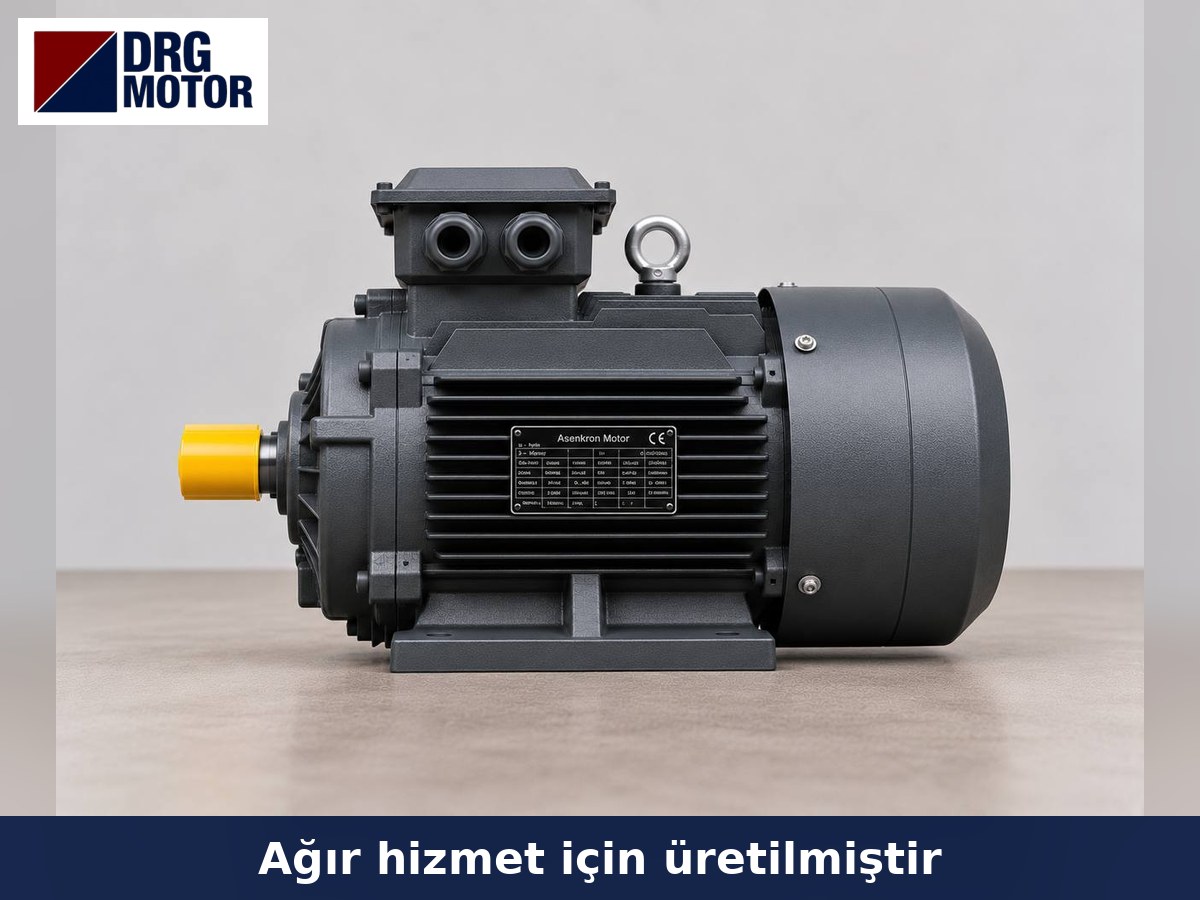
In a meat plant, mincing and size reduction are spread over three machines: the block flaker that splits frozen blocks into thick flakes, the industrial grinder that pushes meat through the knife-and-plate set with a worm, and the bowl cutter that turns meat into a fine batter with fast knives in a rotating bowl. The motor carries a different load in each. Maker catalogues list 7.5–15 kW for block flakers, 4.5–140 kW for the grinder working worm and 15–55 kW for the cutter knife drive. For plate sizes, starting torque and reversing on a counter-top butcher’s mincer, see our industrial meat mincer motor article; this page looks at a whole production line.
DRG Motor is a manufacturer, supplier and seller of electric motors. We do not sell the grinder, the cutter, knife and plate sets, gearboxes or variable frequency drives; our part is the three-phase asynchronous motor that drives the flaker, the worm or the knife shaft. All models are listed on the Buy Electric Motors Online page.
What do the motors do on a size-reduction line?
In a plant making sausages, salami, meatballs and burgers, meat often arrives as frozen blocks at around −18 °C. Blocks go first to the flaker, then to the grinder or straight to the cutter; minced or emulsified meat is then fed to the filling machine. Each station has its own load profile: impact-type and intermittent on the flaker, heavy starting with a full hopper on the grinder, and a large knife shaft accelerating to high speed on the cutter.
Frozen block flaker and guillotine
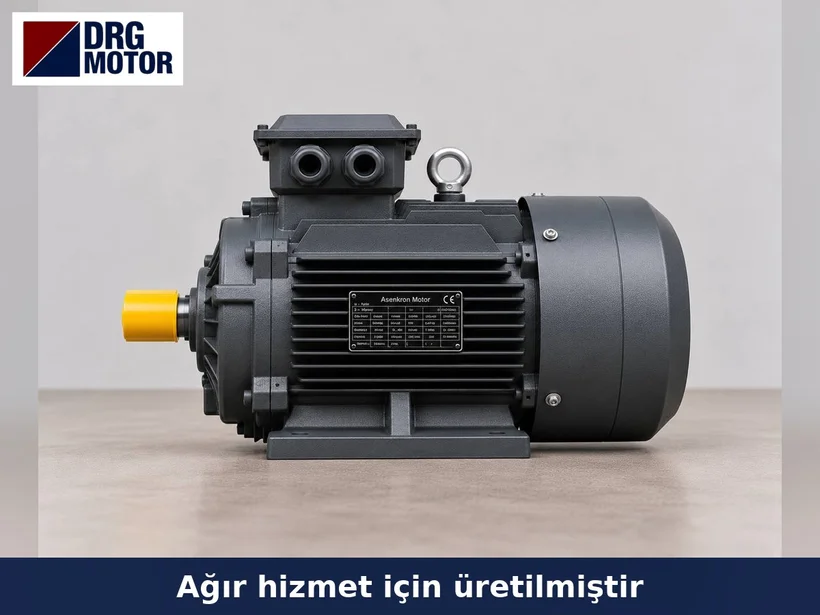
In a flaker, a drum or knife rotor cuts the block into flakes; in a guillotine, a blade slices it. One maker’s sheet gives −15 °C as the lowest block temperature for its pre-breaker. The motor needs a torque peak every time the blade enters the block, so a foot-mounted cast iron frame with a belt or gearbox connection is common.
Industrial grinder: working worm and feed worm
Large grinders have two worms. The feed worm takes meat from the hopper and pushes it to the working worm, which presses it against the knife and plate. On a frozen-block model, the two worms have separate motors, both run from frequency converters. As the plate diameter goes from 114 mm to 400 mm, the working worm motor rises from a few kW to well over one hundred kW.
Bowl cutter: knife motor and bowl motor
On a bowl cutter, most of the machine power sits on the knife shaft; the motor that turns the bowl is about a tenth of it. One maker’s comparison table gives knife speeds of 1400/2800 rpm for a 20 litre cutter, 1500/3000 or 1000–3600 rpm for 45–80 litre models and 1000–4000 rpm for the 120 litre model. Two fixed steps come from a pole-changing motor; a variable range comes from a drive. Large cutters also carry small extra motors for the loader arm and the unloading disc.
How many kW for a meat grinder motor? Catalogue values
A) Motor powers given in maker catalogues and data sheets for flakers, grinders and bowl cutters:
| Machine / drive | Motor power | Single / total | Note |
|---|---|---|---|
| Frozen block flaker | 7.5 kW | single motor | first maker, full load current 15 A at 415 V |
| Frozen block pre-breaker | 15 kW | single motor | first maker |
| Block flaker, 600×600×230 mm block | 11 kW | single motor | second maker |
| Frozen block guillotine | 7.5 kW | drive power | third maker |
| Grinder, 114 mm plate | 4.5/6 kW | two-speed single motor | fourth maker, small model |
| Grinder, 130 mm plate | 14/18 kW; frequency-controlled version 30 kW | working worm | fourth maker |
| Grinder, 200 mm plate | 45/90 kW; frequency-controlled version 100 kW | working worm | fourth maker |
| Frozen block grinder, 200 mm | 55 kW + 11 kW | working + feed worm separate | fifth maker |
| Bowl cutter 50–80 litres | 15–22 kW knife; 1.5 kW bowl | two separate motors | sixth maker, standard motor |
| Bowl cutter 135 litres | 30 kW knife (option 55 kW); 3 kW bowl | two separate motors; loader 0.74 kW | sixth maker |
Put side by side, the catalogues give these ranges: about 7.5–15 kW on block flakers, 4.5–140 kW on the grinder working worm (200 kW on the largest frequency-controlled version), 11–18.5 kW on the feed worm, 15–55 kW on the cutter knife and 1.5–3 kW on the cutter bowl. Values with a slash (such as 14/18 kW) are the steps of one two-speed motor; in the cutter rows, knife and bowl motors are listed separately.
B) Overlap with the DRG range: every power in the table falls within the 0.55–355 kW span of our cast iron frames; 1.5–3 kW bowl motors match 90L–100L frames, 7.5–15 kW flaker and knife motors 132M–160L, and 45–140 kW large grinder motors 225M–315 frames. What falls outside our range is not the power but the motor type: a two-speed pole-changing motor is something we do not supply. On these machines a single-speed motor with a separate drive can be chosen; the conditions are below.
Click to see current electric motor prices and order nowSEE PRICES →
Single speed plus drive instead of a two-speed motor
On a grinder the low step is used for frozen and tough meat and the high step for fresh meat; on a cutter low speed mixes and high speed cuts fine. If a single-speed motor replaces a pole-changing one, its rated speed and power are chosen for the HIGH step and the low step is obtained by reducing frequency. Running the motor above mains frequency to reach the high speed can push the shaft and bearings beyond what the machine maker allows.
Example: a grinder rated 14/18 kW
Suppose the old motor plate reads 1500/3000 rpm and 14/18 kW. The high step corresponds to 18 kW at 2 poles; the model in our range for this is DRG-160L-2 (18.5 kW, 2940 rpm, 32.5 A at 400 V). For the low step, the drive goes down to about 25 Hz. A self-ventilated motor gets less air at low speed; if the machine runs for long periods at full torque on the low step, a separate cooling fan or the next frame size should be considered. The control panel also has to be rearranged, because the machine’s circuit was built for a two-speed motor.
Worked example: current budget of a small size-reduction line
Take a line of four machines close to the catalogue values and give each its counterpart from our range. The grinder and the cutter knife run on drives; the flaker and the bowl start direct on line:
| Machine | DRG equivalent | Current 400 V | Starting |
|---|---|---|---|
| 7.5 kW block flaker | DRG-132M-4 | 14.3 A | direct: 14.3 × 7.5 ≈ 107.2 A |
| 18 kW grinder working worm | DRG-160L-2 | 32.5 A | drive ramp |
| 15 kW cutter knife drive | DRG-160M2-2 | 26.5 A | drive ramp |
| 1.5 kW cutter bowl | DRG-90L-4 | 3.3 A | direct: 3.3 × 7 ≈ 23.1 A |
| All four running | — | 76.6 A | sum of rated currents |
At full load the line draws about 76.6 A. On the two large drive-fed motors, starting current stays limited by the drive ramp; the short peak of the 7.5 kW flaker starting direct is about 107.2 A. Starting the flaker while the other machines are running means sizing the main fuse of the line for this peak. The overload, fuse and contactor selection tool can be used for contactor and overload values.
Why does the plate current differ from the data sheet?
One flaker data sheet gives a full load current of 15 A at 415 V for its 7.5 kW motor; at the same power, the plate of our 4-pole DRG-132M-4 shows 14.3 A for 400 V. The difference comes from voltage and motor design. The overload relay is always set to the current on the plate of the motor actually fitted, not to the machine data sheet.
Cold rooms, wash-down and where the motor sits
DRG motors are standard industrial motors with painted cast iron or aluminium frames and IP55 protection; they do not touch the meat. On size-reduction machines the motor sits outside the product zone, in the machine’s closed drive compartment or under the frame. When the line is washed with pressurised water, the jet is not aimed at the motor and covers and seals stay closed. If the wet zone needs a stainless steel motor washed down directly, that type is outside our range; ask us in that case. Machines moved from a cold room into a warm hall can collect condensation inside the frame, so make sure the motor is dry after a long stop.
Many small butcher-scale mincers come with a single-phase motor; we do not offer single-phase motors, and refitting such a mincer with a three-phase motor, where the shop has a three-phase supply, follows the points in our three-phase versus single-phase article. A brake motor that stops the cutter knife quickly is also not in our range; braking comes from the machine’s own device or an electronic brake in the panel. For running the worm forward and reverse, see forward-reverse contactor wiring.
DRG motors on a mincing and size-reduction line
Eight models covering the power steps of the line, from bowl drive to large grinder worm:
| Model | Power / speed | Frame · shaft D×E | Current 400 V |
|---|---|---|---|
| DRG-90L-4 | 1.5 kW / 1445 rpm | 90L cast iron · 24×50 | 3.3 A |
| DRG-132M-4 | 7.5 kW / 1460 rpm | 132M cast iron · 38×80 | 14.3 A |
| DRG-160M-4 | 11 kW / 1465 rpm | 160M cast iron · 42×110 | 20.4 A |
| DRG-160M2-2 | 15 kW / 2945 rpm | 160M cast iron · 42×110 | 26.5 A |
| DRG-160L-2 | 18.5 kW / 2940 rpm | 160L cast iron · 42×110 | 32.5 A |
| DRG-180M-4 | 18.5 kW / 1470 rpm | 180M cast iron · 48×110 | 33.5 A |
| DRG-200L1-2 | 30 kW / 2960 rpm | 200L cast iron · 55×110 | 52.1 A |
| DRG-250M-4 | 55 kW / 1485 rpm | 250M cast iron · 65×140 | 97.6 A |
Flaker and bowl drives use 4-pole motors; the cutter knife and the high step of the grinder worm use 2- or 4-pole motors depending on the machine, and a replacement keeps the old pole number. On a meat line, aluminium frames up to 11 kW suit the small bowl and loader motors; for impact work such as the flaker and grinder worm, cast iron frames (up to 355 kW) are more usual. Foot B3, flange B5/B14 and combined B35 mounting are available. Before ordering, photograph the plate power and speed, whether it is star or delta at 400 V, shaft diameter and key size, foot hole spacing or flange diameter, and the pulley or coupling side. We compare these with the documents of your mincing line together; we confirm fit only after seeing those dimensions.
Live price table
Prices of the models that match a size-reduction line come live from the store:
| Model | Power / speed | Frame · current 400 V | Price |
|---|---|---|---|
| DRG-90L-42 HP | 1.5 kW · 1500 rpm | Cast iron 90L · 3.3 A | $144.14 (€128.73) Details & buy → |
| DRG-132M-410 HP | 7.5 kW · 1500 rpm | Cast iron 132M · 14.3 A | $394.89 (€352.66) Details & buy → |
| DRG-160M-415 HP | 11 kW · 1500 rpm | Cast iron 160M · 20.4 A | $568.76 (€507.94) Details & buy → |
| DRG-160L-420 HP | 15 kW · 1500 rpm | Cast iron 160L · 27.3 A | $678.13 (€605.61) Details & buy → |
| DRG-160M2-220 HP | 15 kW · 3000 rpm | Cast iron 160M · 26.5 A | $570.23 (€509.25) Details & buy → |
| DRG-160L-225 HP | 18.5 kW · 3000 rpm | Cast iron 160L · 32.5 A | $714.00 (€637.65) Details & buy → |
| DRG-200L1-240 HP | 30 kW · 3000 rpm | Cast iron 200L · 52.1 A | $1,273.02 (€1,136.88) Details & buy → |
| DRG-250M-475 HP | 55 kW · 1500 rpm | Cast iron 250M · 97.6 A | $2,065.73 (€1,844.82) Details & buy → |
DRG MOTOR motors are guaranteed against material and manufacturing defects for 2 years from the delivery date (warranty certificate).
Motors in this power range
- DRG-90L-4 – 1.5 kW – 1445 rpm – 90L cast iron
- DRG-132M-4 – 7.5 kW – 1460 rpm – 132M cast iron
- DRG-160M2-2 – 15 kW – 2945 rpm – 160M cast iron
- DRG-160L-2 – 18.5 kW – 2940 rpm – 160L cast iron
- DRG-250M-4 – 55 kW – 1485 rpm – 250M cast iron
Click to see current prices and order these motors nowSEE PRICES →
Browse the products, ask for a quote: motors for the machines on your line are on the Buy Electric Motors Online page. Write the grinder plate diameter or the cutter volume in litres and add the motor plate photo on WhatsApp; you can also reach us by phone on +90 (542) 666 11 11.
Frequently asked questions
Should a cutter knife motor be 2-pole?
It depends on the machine. The knife shaft is driven directly or by belt; knife speed comes from motor speed and pulley ratio together. Keeping the old pole number means the pulleys need not change.
Can a bigger motor go on a frozen-block grinder?
Yes, if the worm, gearbox and key can carry the torque; the machine maker confirms that. With a bigger motor, cable size, fuse and overload setting are recalculated too.
Where can I see the current price of a mincing line motor?
The live table above pulls store data each time the page opens; grinder and cutter power models are listed there.
For questions: +90 (542) 666 11 11 · info@drgmotor.com · contact.


