 English
 Le français
 Türkçe

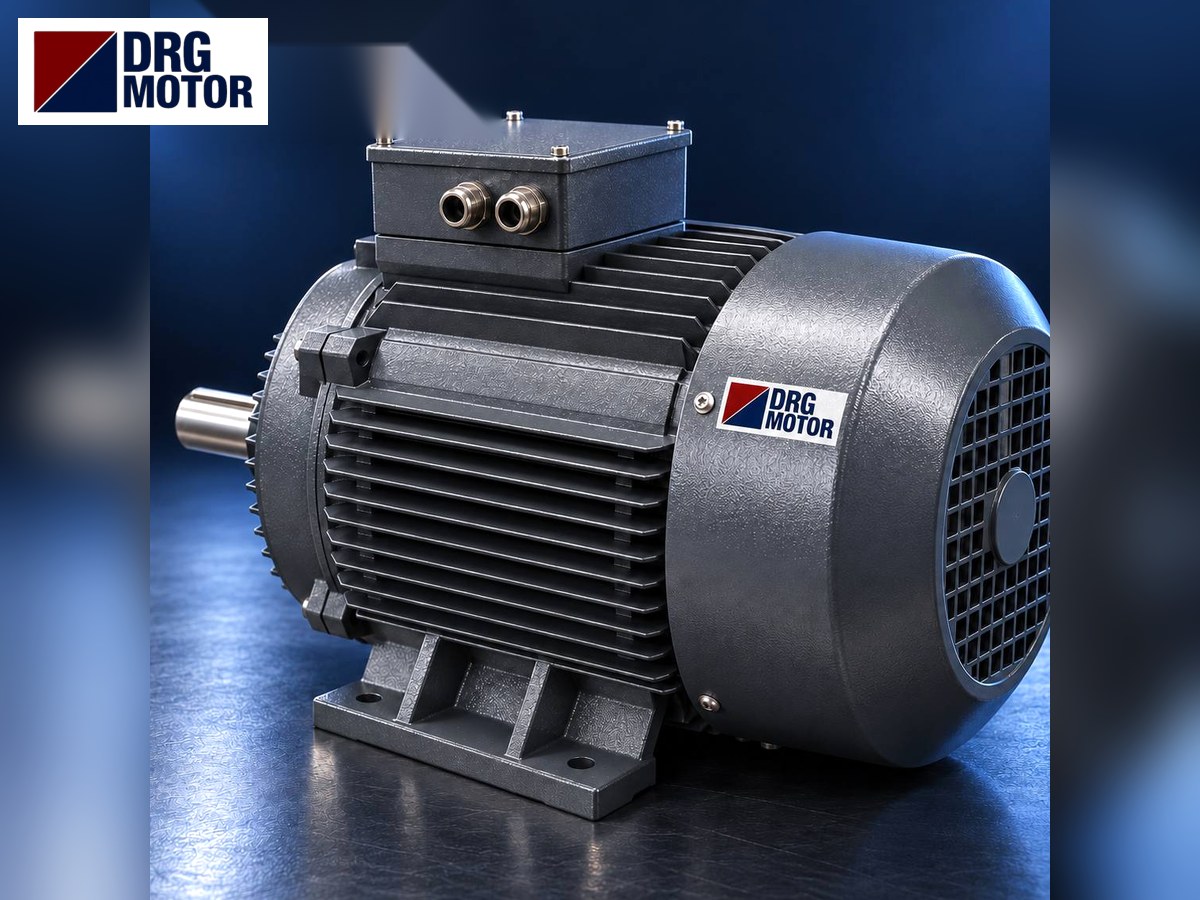
A recycling conveyor motor is the drive behind the belts and apron feeders that move waste from the bunker to the sorting cabin and on to screens, crushers or the baling press. In most cases a 4-pole three-phase motor sits on the input of a gearbox and turns the drum or chain sprocket at low speed. These motors are only a few kilowatts on a waste line, yet choosing them is less simple than it looks: the load is uneven, the belt often has to start full, and material wraps round the drums.
This page is about the electric motor that turns the conveyor. DRG Motor does not sell conveyors, belts, chains or gearboxes; what we deliver is a motor matched to the handling line you already run or to the line a builder is designing. Options are on the Buy Electric Motors Online page.
Handling and feeding equipment on a waste line
In a quarry a conveyor usually carries one free-flowing material. In a waste plant, bags, cardboard, wood, rope, cans and demolition rubble travel together on the same line. Each stage therefore uses a different carrier, and the load on the motor changes with it.
Steel apron feeder
This is the first machine to meet the mixed waste tipped by the truck: overlapping steel pans fixed to chains draw material slowly from the bottom of the bunker. It copes with impact and sharp pieces better than a belt. The motor is usually connected to a gearbox in foot or flange mounting, and feed speed is mostly set with an inverter. Starting with a full bunker is the hardest task this machine asks of the motor.
Sorting (picking) cabin belt
A wide, slow belt inside the cabin where operators pick by hand. Speed is set to suit picking performance, so inverter operation is common. The load is light but spread out; the belt is long and usually slides on a slider bed, so friction loss is clearly higher than on a roller-supported belt.
Chain and hinged steel conveyors
For swarf, small scrap and sharp-edged pieces a hinged steel belt or scraper chain replaces the rubber belt. The weight of heavy chain and pans adds to the carried load; this dead weight must not be forgotten when the motor power is worked out.
Inclined belts and elevating conveyors
Belts that lift material to the sorting cabin, the trommel inlet or the baler hopper are the strongest carriers in the plant. The steeper the slope, the greater the lifting work, and cleats or flights stop material from sliding back. A backstop in the gearbox may prevent a loaded belt from running back after a stop.
Metering feeders and vibrating chutes
Small feeders in front of crushers, granulators and separators keep the material flowing evenly. Screw and belt metering feeders run on standard motors, while vibrating chutes use a vibration motor. Vibration motors form a separate product group; let us know what you need. For background, see the vibration motors article.
How wrapping, punctures and blockages load the motor
Most failures begin with the material, not the motor; the motor just sees the result as extra current.
Film, rope and wire wrapping
Stretch film, baling twine and cable offcuts wind themselves round drive and tail drums and return idlers. As the layer thickens, belt tension and friction grow and motor current creeps up over weeks. Measuring current regularly and cleaning the drums is the simplest way to catch this build-up before the overload trips.
Sharp pieces and belt damage
Broken glass, sheet edges or reinforcing bar can cut the belt or jam between belt and drum. At that moment the motor quickly approaches its breakdown torque. Steel apron carriers are preferred at such points; motor protection should be set to the nameplate current, and pull-wire switches and the emergency stop circuit kept in working order.
Bunker bridging and surges
Bulky waste can bridge in the bunker and then collapse, dropping a large load onto the feeder at once. An inverter can slow the feeder or reverse briefly to clear the jam; that function is set by the drive supplier and machine builder. DRG does not supply drives, but our motors have windings suited to inverter use and we share nameplate data for drive setup.
Motor power on conveyors and feeders
A) Powers seen on equipment in the market
The rows below come from the equipment list of a sorting plant and from waste conveyor and feeder catalogues; each row is the motor of one carrier:
| Equipment / size | Motor power | Single / total | Note |
|---|---|---|---|
| Sorting and transfer belts (1.2–1.5 m belt) | 1.5–7.5 kW | one motor per belt | equipment list of a sorting plant |
| Inclined baler feed conveyor | 7.5 kW | single motor | strongest belt on the same list |
| Waste belt conveyor, 650–1400 mm, up to 60 m | 2.2–15 kW | single motor | manufacturer catalogue, by length and incline |
| MSW apron feeder, 1.5–3 m chute | 4–7.5 kW | single motor | manufacturer catalogue, light series |
| Steel apron waste feeder, 1–3 m pans | 5.5–18 kW | single motor | manufacturer catalogue, by width |
| Hinged steel belt (swarf, small scrap) | 2.2 kW | single motor | manufacturer catalogue, heavy type |
Depending on model, belt width, length and incline, motors of roughly 1.5–18 kW are seen in this equipment group.
B) What the DRG range covers
The whole band lies inside the DRG range: 1.5–11 kW with either aluminium or cast iron housing, 15 and 18.5 kW in cast iron. The usual speed for carriers is 4-pole, about 1500 rpm; lower drum speed comes from the gearbox ratio.
Click to see current electric motor prices and order nowSEE PRICES →
Working out the power: an inclined feed belt
On a slider-bed belt, the pull equals the friction between belt and bed plus the force needed to lift the material. Belt makers' tables give 0.30–0.35 for a rubber belt sliding on a steel bed. A simple approach:
- Friction: F₁ = μ × (mload + mbelt) × g × cos α
- Lift: F₂ = mload × g × sin α
- Shaft power: P = (F₁ + F₂) × v; for motor power, add gearbox and drive losses plus a starting margin.
Worked example: 20 m belt at 25°
Take a 1.2 m wide, 20 m long belt rising at 25° to a sorting cabin. Average load 35 kg/m, carrying-side belt weight 12 kg/m, speed 0.5 m/s, friction factor 0.30.
- Total mass on the belt: (35 + 12) × 20 = 940 kg, of which 700 kg is load. Height gain 20 × sin 25° ≈ 8.45 m.
- F₁ = 0.30 × 940 × 9.81 × cos 25° ≈ 2,507 N; F₂ = 700 × 9.81 × sin 25° ≈ 2,902 N.
- Shaft power: (2,507 + 2,902) × 0.5 ≈ 2.70 kW. Dividing by 0.85 for gearbox and drive losses gives ≈ 3.18 kW.
- A 1.3 margin for loaded starts and wrapping build-up: ≈ 4.1 kW. The next standard step is 5.5 kW: DRG-132S-4 (1460 rpm, 36 Nm).
Drum speed and gearbox ratio
With a 400 mm drive drum, 0.5 m/s belt speed means a drum speed of 0.5 × 60 / (π × 0.4) ≈ 23.9 rpm. With a 1460 rpm motor the ratio needed is 1460 / 23.9 ≈ 61. Torque at the drum is about 5,409 N × 0.2 m ≈ 1,082 Nm; the 36 Nm rated torque of the 5.5 kW motor gives about 2,196 Nm through a ratio of 61 in a loss-free calculation, leaving a margin for starting too. Re-run the numbers for your own belt with our ratio tool.
Length, slope, load and duty pattern: a selection list
- Belt or pan width, centre distance and height difference.
- Material type and approximate load per metre; wet paper, rubble and plastic film weigh very differently.
- Bed type: slider bed or rollers? On apron and chain carriers, the chain and pan weight.
- Number of shifts per day and starts per hour; frequent stop-start heats the motor.
- Starting method: direct, star-delta, soft starter or inverter.
- Gearbox type, input flange and ratio; the old motor nameplate and shaft size.
- Surroundings: open air, rain, dust; splashing water on belts near the washing section.
Starting a loaded belt
A waste belt almost never starts empty. 4-pole DRG motors deliver 2.0–2.4 times rated torque at start and in most cases lift a loaded belt on direct-on-line starting. Star-delta cuts this torque to about a third, which on long, steep feed belts may not be enough on its own. For background on starting methods see the star-delta starting tool.
Gearbox connection and mounting
With shaft-mounted bevel or parallel-shaft gearboxes the motor usually sits on the gearbox with a B5 flange; older lines built with a foot motor, coupling and separate gearbox use B3. Flange dimensions must be compared with the gearbox input specification. B5 dimensions of frames common at conveyor powers (mm):
| Frame | Shaft D×E | Flange P / M / N | Hole S |
|---|---|---|---|
| 90S/90L | 24×50 | 200 / 165 / 130 | 12 |
| 100L/112M | 28×60 | 250 / 215 / 180 | 14.5 |
| 132S/132M | 38×80 | 300 / 265 / 230 | 14.5 |
| 160M/160L | 42×110 | 350 / 300 / 250 | 18.5 |
| 180M/180L | 48×110 | 350 / 300 / 250 | 18.5 |
Fit is only stated once kW, speed, voltage, frame, mounting type, shaft diameter and key, and the gearbox or coupling interface have been checked against the existing nameplate and the machine builder's drawing.
DRG motors for conveyors and feeders
DRG Motor is a manufacturer, supplier and seller of electric motors. The 4-pole ratings used most on waste handling lines are in our range in both aluminium and cast iron, and run outdoors and in dusty areas with IP55 protection. Sample models:
| Model | Power / speed | Frame · shaft D×E | Current 400 V |
|---|---|---|---|
| DRG-100L1-4 | 2.2 kW / 1450 rpm | 100L cast iron · 28×60 | 4.52 A |
| DRG-112M-4 | 4 kW / 1450 rpm | 112M cast iron · 28×60 | 7.95 A |
| DRG-132S-4 | 5.5 kW / 1460 rpm | 132S cast iron · 38×80 | 10.7 A |
| DRG-132M-4 | 7.5 kW / 1460 rpm | 132M cast iron · 38×80 | 14.3 A |
| DRG-160L-4 | 15 kW / 1465 rpm | 160L cast iron · 42×110 | 27.3 A |
| DRG-180M-4 | 18.5 kW / 1470 rpm | 180M cast iron · 48×110 | 33.5 A |
Live price table
Prices for motors in the power steps used most on conveyors and feeders come live from the shop:
| Model | Power / speed | Frame · current 400 V | Price |
|---|---|---|---|
| DRG-90L-42 HP | 1.5 kW · 1500 rpm | Cast iron 90L · 3.3 A | $144.14 (€128.73) Details & buy → |
| DRG-100L1-43 HP | 2.2 kW · 1500 rpm | Cast iron 100L · 4.52 A | $188.32 (€168.18) Details & buy → |
| DRG-100L2-44 HP | 3 kW · 1500 rpm | Cast iron 100L · 6.02 A | $203.84 (€182.05) Details & buy → |
| DRG-112M-45.5 HP | 4 kW · 1500 rpm | Cast iron 112M · 7.95 A | $254.38 (€227.18) Details & buy → |
| DRG-132S-47.5 HP | 5.5 kW · 1500 rpm | Cast iron 132S · 10.7 A | $342.01 (€305.44) Details & buy → |
| DRG-132M-410 HP | 7.5 kW · 1500 rpm | Cast iron 132M · 14.3 A | $394.89 (€352.66) Details & buy → |
| DRG-160M-415 HP | 11 kW · 1500 rpm | Cast iron 160M · 20.4 A | $568.76 (€507.94) Details & buy → |
| DRG-160L-420 HP | 15 kW · 1500 rpm | Cast iron 160L · 27.3 A | $678.13 (€605.61) Details & buy → |
| DRG-180M-425 HP | 18.5 kW · 1500 rpm | Cast iron 180M · 33.5 A | $873.49 (€780.08) Details & buy → |
DRG MOTOR motors are guaranteed against material and manufacturing defects for 2 years from the delivery date (warranty certificate).
Motors in this power range
- DRG-90L-4 – 1.5 kW – 1445 rpm – 90L cast iron
- DRG-100L2-4 – 3 kW – 1450 rpm – 100L cast iron
- DRG-132S-4 – 5.5 kW – 1460 rpm – 132S cast iron
- DRG-160M-4 – 11 kW – 1465 rpm – 160M cast iron
- DRG-180M-4 – 18.5 kW – 1470 rpm – 180M cast iron
Click to see current prices and order these motors nowSEE PRICES →
Pick a motor or ask us: every model in conveyor and feeder sizes is on the Buy Electric Motors Online page. Send the belt length, incline and old nameplate by WhatsApp and we will suggest the right frame and rating.
Belts in quarries and crushing-screening plants are covered separately on our Belt Conveyor Motor page; the recycling motor supply article may also help.
Frequently asked questions
How many kW should a waste conveyor motor be?
Work out the pull from belt length, incline and load per metre, multiply by speed, then add gearbox loss and a starting margin. Plant belts usually end up at 1.5–7.5 kW; long, steep feed belts need more.
Why is an inverter used on apron feeders?
To match feed speed to the capacity of the crusher or separator downstream and to soften the surge when a bunker bridge collapses. The machine builder chooses the drive; entering the motor nameplate data into it is enough.
My conveyor motor keeps tripping; should I go bigger?
First check wrapping on drums and idlers, belt tension and gearbox oil, and measure current while running. A current that stays above the plate value on a clean, well-tensioned belt means the motor is genuinely too small.
Where is the price of a waste conveyor motor shown?
Once power, speed and housing are known, the live table here and the product card give the price.
Send the belt dimensions and old nameplate and we will choose together: phone +90 (542) 666 11 11, WhatsApp +90 542 666 11 11, e-mail [email protected], contact page. All ratings: Buy Electric Motors Online.


