 English
 Le français
 Türkçe

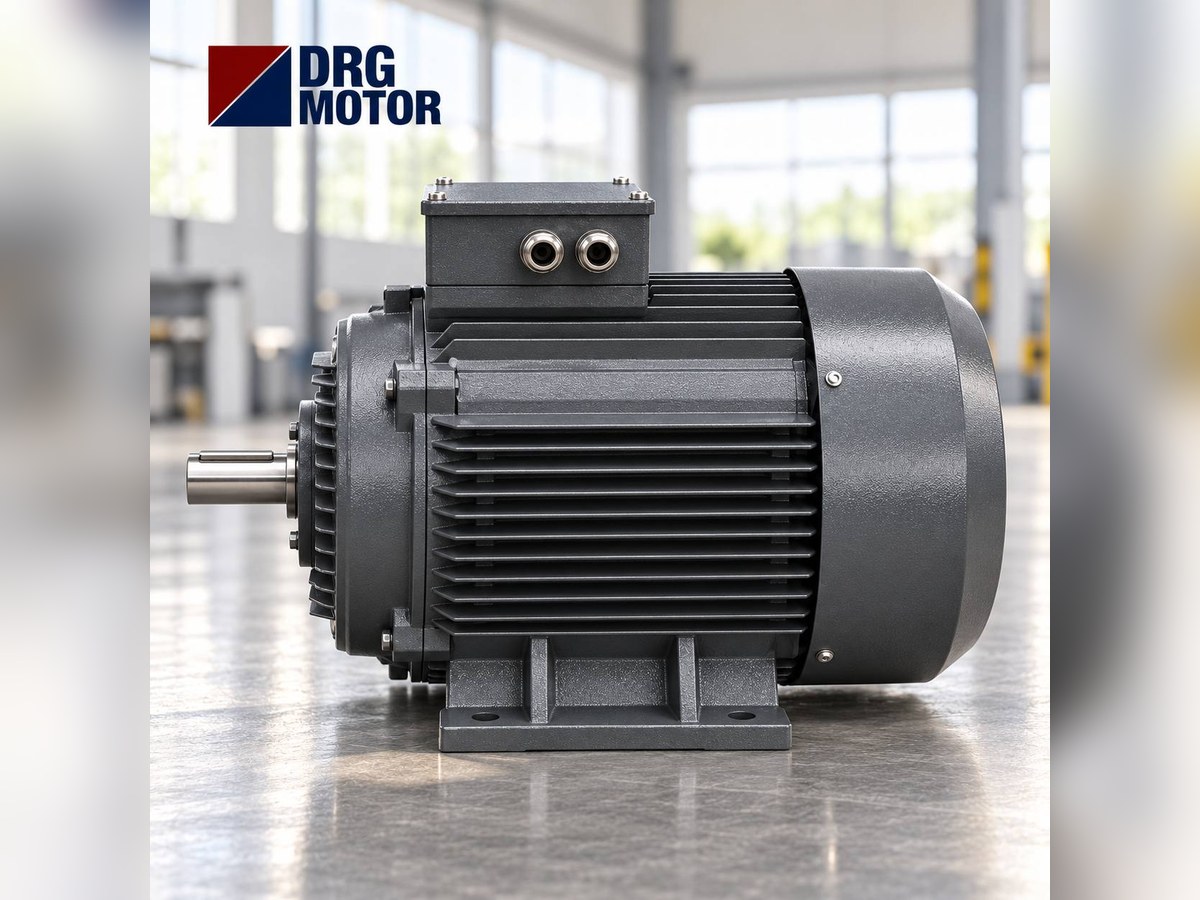
A roller mill electric motor is the 4-pole three-phase motor that turns the fast roll of a flour mill roller mill through belts and pulleys, while the slow roll is carried along by the mill's internal gearing or toothed belt. In manufacturers' catalogues the motor power per machine ranges from 5.5 kW to 45 kW depending on roll length and machine type; the feed roll is turned by a separate 0.55–0.75 kW geared motor. In the same mill, motor power can differ several times between the first break and the last reduction passage.
This page explains the types of roller mill, the drive arrangement, a passage-by-passage motor map and which part the DRG range covers. For the pulley ratio, current and spare motor arithmetic when replacing one roll motor, see our article Flour Mill Roller Motor Selection and Spare Motor Supply. Machines elsewhere in the mill are handled under the Flour Mill Electric Motors category; ready models are on Buy Electric Motors Online.
Roller mill types: single pair, two-sided and 8-roll
A roller mill breaks or reduces the product by passing it between two steel rolls turning towards each other at different speeds. Machines are classified by the number of rolls and decks, and the number of motors depends on this.
Single-pair roller mill
One body holds a single roll pair and one main motor. It is found in small-capacity mills and on separate lines such as maize or rye. Roll length varies from 500 to 1250 mm, and motor power grows with length.
Four-roll (two-sided) roller mill
This is the standard machine of flour mills: the same body holds two separate roll pairs, right and left. Each side may serve a different passage, for example second break on one side and a reduction passage on the other. For this reason most machines have one motor per side, and the two motors may differ in power. Some maker sheets give a single maximum installed power for the machine; when writing the load list, check on the machine plate whether the sides are driven separately or together.
Eight-roll (double-deck) roller mill
Product from the upper roll pair drops straight into the lower pair without intermediate sifting. It is used mostly on the first break and first reduction passages to save space. One maker sheet gives a maximum installed power of 37 kW for an 8-roll machine with 1000–1250 mm rolls. Because the upper and lower pairs are loaded differently, their motors draw different currents.
Belt drive and the fast-to-slow roll ratio
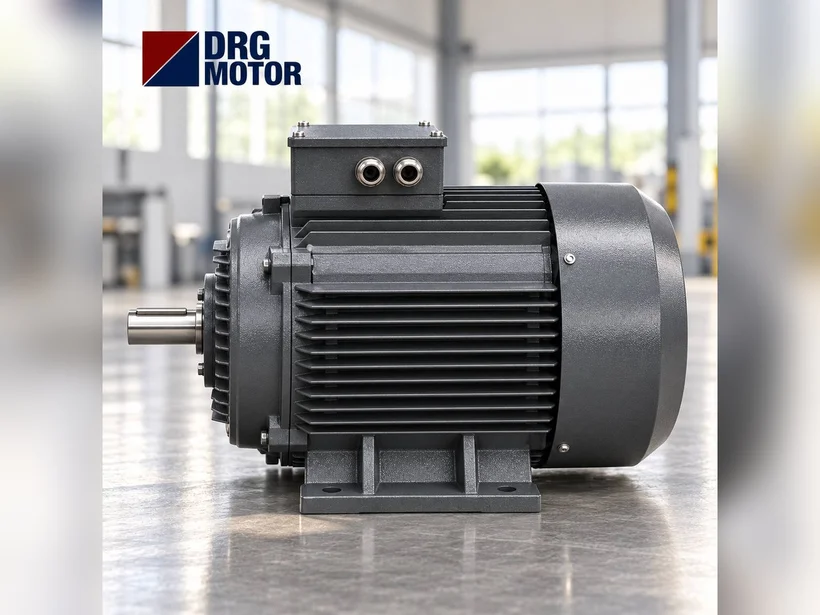
In the classic machine the motor sits beside or below the mill, foot-mounted (B3) on slide rails, and turns the fast roll through belts. The slow roll is linked to the fast roll by a pair of gears or a toothed belt; this link stops the slow roll catching up with the fast roll and returns the braking power to the fast roll.
The differential ratio changes with the passage
Catalogues offer fast-to-slow ratios of 1.25:1, 1.5:1, 2:1 and 2.5:1. One maker sheet lists 1.25 for the grinding (reduction) pair and 2.33 for the break pair. For example, on a break roll turning at 620 rpm a 2.5:1 ratio gives a slow roll speed of 248 rpm; on a reduction roll at 560 rpm a 1.23:1 ratio gives about 455 rpm. The ratio belongs to the machine and does not change when the motor is replaced.
How does braking power affect the motor?
The slow roll receives the force of the fast roll through the product and is braked by the gearing. According to a technical publication, on smooth passages the braking power at the slow roll clearly exceeds the grinding power; since the fixed-ratio gearing returns this power to the fast roll, the main motor only covers the real grinding power and the losses. In designs where each roll has its own motor and inverter, the braking power has to be recovered electrically; according to the same publication the fast roll motor must then be chosen considerably larger than on a fixed-ratio machine.
Feed roll motor
The feed roll, which spreads the product like a curtain along the roll, turns on a separate geared motor, on most new machines through an inverter on board. The catalogue value is 0.55–0.75 kW. This motor is usually one unit with its gearbox; after a failure the motor alone cannot be replaced without checking the gearbox flange and shaft size.
Catalogue motor power by roll length
| Machine / roll length | Motor power | Single or total | Note |
|---|---|---|---|
| Single pair, 500–600 mm | 7.5 kW | Single motor | Maker catalogue, small model |
| Single pair, 800 mm | 11 kW | Single motor | Same catalogue, mid model |
| Single pair, 1000 mm | 15 kW | Single motor | Same catalogue |
| Single pair, 1250 mm | 18.5 kW | Single motor | Same catalogue, large model |
| Two-sided, 800–1250 mm | 5.5 – 37 kW | Selectable motor | Maker catalogue, option list |
| Two-sided, 1000 mm | 18.5 kW | Per roll pair | Maker sheet, maximum value |
| Two-sided, 1000–1250 mm | 45 kW | Max. installed power | Maker sheet, B1 passage |
| 8 rolls, 1000–1250 mm | 37 kW | Max. installed power | Maker sheet, double deck |
| Feed roll | 0.55 – 0.75 kW | Geared motor | Three maker catalogues |
In the roller mill group, main motor options of about 5.5–45 kW are seen, depending on the manufacturer's model and capacity. In one maker's single-pair series, power rises steadily with roll length: 7.5 kW at 500–600 mm, 11 kW at 800 mm, 15 kW at 1000 mm, 18.5 kW at 1250 mm. When a single maximum installed power is given for a two-sided machine, it refers to the heaviest passage (B1); the same machine used on a reduction passage runs with a much smaller motor.
Click to see current electric motor prices and order nowSEE PRICES →
Power difference between break and reduction passages
Break (fluted) rolls open the whole wheat and scrape semolina from the bran; reduction (smooth) rolls grind semolina into flour. Because the quantity of product and the degree of grinding differ, motor load changes from passage to passage.
A passage-by-passage motor map: a measured example
A measurement study in an 80 tonne per day wheat mill recorded the installed motors and actual draw of 18 passages. The table below summarises those data by passage group:
| Passage group | Roll type / length | Installed motor | Measured draw |
|---|---|---|---|
| 1st break (1S) | Fluted, 1250 mm | 45 kW | 36.17 kW |
| 2nd break (2S) | Fluted, 1250 mm | 30 kW | 23.56 kW |
| 3rd break (3S) | Fluted, 1250 mm | 22 kW | 20.11 kW |
| 4th–5th break | Fluted, 1000 mm | 11 – 15 kW | 9.35 – 12.31 kW |
| Sizing and middlings | Fluted/smooth, 1000–1250 mm | 11 – 15 kW | 7.32 – 8.68 kW |
| Reduction (1V–7V) | Smooth, 1000–1250 mm | 7.5 – 15 kW | 3.45 – 5.68 kW |
Three conclusions follow from the map. First, motor power falls along the flow: the first break takes all the wheat and later passages handle less and less product. Second, on reduction passages the motors mostly ran below half of their installed power; the authors note that oversized motors raise the investment and the need for power factor correction. Third, in the same mill the 11 kW motor of the fifth break passage was permanently overloaded, so any downsizing must be done by measuring passage by passage.
A specific-energy approach for a first estimate
The same study measured specific energy between 4.955 and 24.26 kWh/t across passages, and 12.03 kWh/t on the first break. Motor power can be estimated roughly as P = Q × e / η_belt (Q: product entering the passage, t/h; e: specific energy, kWh/t).
- First break, 2.5 t/h wheat, e = 12 kWh/t: 2.5 × 12 = 30 kW; with 0.95 for belt losses, 30 / 0.95 ≈ 31.6 kW. The next standard step is 37 kW: DRG-225S-4, 1485 rpm; rated current 66.1 A (400 V).
- One reduction side, 0.7 t/h semolina, e = 7.6 kWh/t: 0.7 × 7.6 = 5.32 kW; 5.32 / 0.95 ≈ 5.6 kW. The next step is 7.5 kW: DRG-132M-4, 1460 rpm; rated current 14.3 A (400 V).
This approach is for preliminary sizing only; e changes with wheat hardness, tempering moisture and roll gap. The final power comes from the machine builder's passage list.
Limits of the DRG range on roller mills
DRG Motor is a manufacturer, supplier and seller of electric motors. The range covers 0.25–11 kW in aluminium frames and 0.55–355 kW in cast iron frames; 1000, 1500 and 3000 rpm; 3-phase, 230/400 V or 400/690 V. Mounting B3, B5, B14 or B35 is stated in the order note. All belt-driven main motors of roller mills from 5.5 to 45 kW fall within this range, and the 4-pole (1500 rpm) option common on roller mills exists at every step. Aluminium frames can be chosen up to 11 kW, but a cast iron frame suits the slide rails and vibration of a roller mill better.
Outside the range are: the machine-specific geared unit of the feed roll (DRG supplies the motor, the gearbox is supplied separately), direct-drive permanent-magnet synchronous motors fitted to each roll and motors with drives built into the machine, and points where the hazardous-area classification requires an Ex motor. The DRG range has no Ex motors.
| Model | Power / speed | Frame · current 400 V | Price |
|---|---|---|---|
| DRG-132S-47.5 HP | 5.5 kW · 1500 rpm | Cast iron 132S · 10.7 A | $342.01 (€305.44) Details & buy → |
| DRG-132M-410 HP | 7.5 kW · 1500 rpm | Cast iron 132M · 14.3 A | $394.89 (€352.66) Details & buy → |
| DRG-160M-415 HP | 11 kW · 1500 rpm | Cast iron 160M · 20.4 A | $568.76 (€507.94) Details & buy → |
| DRG-160L-420 HP | 15 kW · 1500 rpm | Cast iron 160L · 27.3 A | $678.13 (€605.61) Details & buy → |
| DRG-180M-425 HP | 18.5 kW · 1500 rpm | Cast iron 180M · 33.5 A | $873.49 (€780.08) Details & buy → |
| DRG-180L-430 HP | 22 kW · 1500 rpm | Cast iron 180L · 39.7 A | $919.45 (€821.13) Details & buy → |
| DRG-200L-440 HP | 30 kW · 1500 rpm | Cast iron 200L · 53.8 A | $1,235.00 (€1,102.93) Details & buy → |
| DRG-225S-450 HP | 37 kW · 1500 rpm | Cast iron 225S · 66.1 A | $1,527.18 (€1,363.87) Details & buy → |
| DRG-225M-460 HP | 45 kW · 1500 rpm | Cast iron 225M · 80.2 A | $1,688.50 (€1,507.94) Details & buy → |
Checklist for choosing a roller mill motor
- Machine type: single pair, two-sided or 8-roll; does each side have its own motor?
- Passage name (B1, C3 and so on) and the power given by the machine builder for that passage.
- Roll length and diameter; diameters of the motor pulley and the roll pulley.
- Speed and frame of the old motor: keep 4 poles, and the shaft and foot dimensions must match the slide rails.
- Running current: the ammeter reading while grinding is the basis for any decision to downsize or upsize.
- Starting: the machine starts empty with rolls apart; from 4 kW upwards DRG windings are 400/690 V, which allows star-delta starting on a 400 V network. For the trade-offs, read the star-delta starting guide.
- Environment: flour dust and zone classification.
DRG motor options for roller mills
| Model | Power / speed | Frame | Current 400 V |
|---|---|---|---|
| DRG-132S-4 | 5.5 kW / 1460 rpm | 132S cast iron | 10.7 A |
| DRG-160L-4 | 15 kW / 1465 rpm | 160L cast iron | 27.3 A |
| DRG-180L-4 | 22 kW / 1470 rpm | 180L cast iron | 39.7 A |
| DRG-200L-4 | 30 kW / 1475 rpm | 200L cast iron | 53.8 A |
| DRG-225S-4 | 37 kW / 1485 rpm | 225S cast iron | 66.1 A |
| DRG-225M-4 | 45 kW / 1485 rpm | 225M cast iron | 80.2 A |
You can work out pulleys and belts with the pulley belt calculator and take frame dimensions from the technical drawings page.
DRG MOTOR motors are guaranteed against material and manufacturing defects for 2 years from the delivery date (warranty certificate).
Motors in this power range
- DRG-132M-4 – 7.5 kW – 1460 rpm – 132M cast iron
- DRG-160M-4 – 11 kW – 1465 rpm – 160M cast iron
- DRG-180M-4 – 18.5 kW – 1470 rpm – 180M cast iron
- DRG-200L-4 – 30 kW – 1475 rpm – 200L cast iron
- DRG-225S-4 – 37 kW – 1485 rpm – 225S cast iron
Click to see current prices and order these motors nowSEE PRICES →
Roller mill motor: frequently asked questions
How many kW should a roller mill motor be?
It depends on roll length and passage. Catalogues show 5.5–45 kW per machine; a single-pair 1000 mm machine is supplied with 15 kW, while the B1 passage of two-sided machines goes up to 45 kW.
Can a first break mill and a reduction mill use the same motor?
Even if the machine is the same, the load is not. In the measured example the first break drew 36 kW while the reduction passages drew 3.5–5.7 kW. The motor is chosen for the real load of the passage.
Why are roller mill motors 4-pole?
A 1500 rpm class motor comes down to the fast roll speed range of 400–650 rpm with reasonable pulley diameters. A different number of poles changes the pulley ratio and upsets roll speed.
Where can I see a roller mill motor price list?
Prices for the roller mill codes appear in the live table further up this page. For other power levels see the store page.
Tell us which machine and passage it is and share a photo of the old plate; we will reply with a suitable DRG code. Phone +90 (542) 666 11 11, e-mail [email protected], contact page, WhatsApp wa.me/905426661111. Every code in the store can be reviewed on Buy Electric Motors Online.


