 English
 Le français
 Türkçe

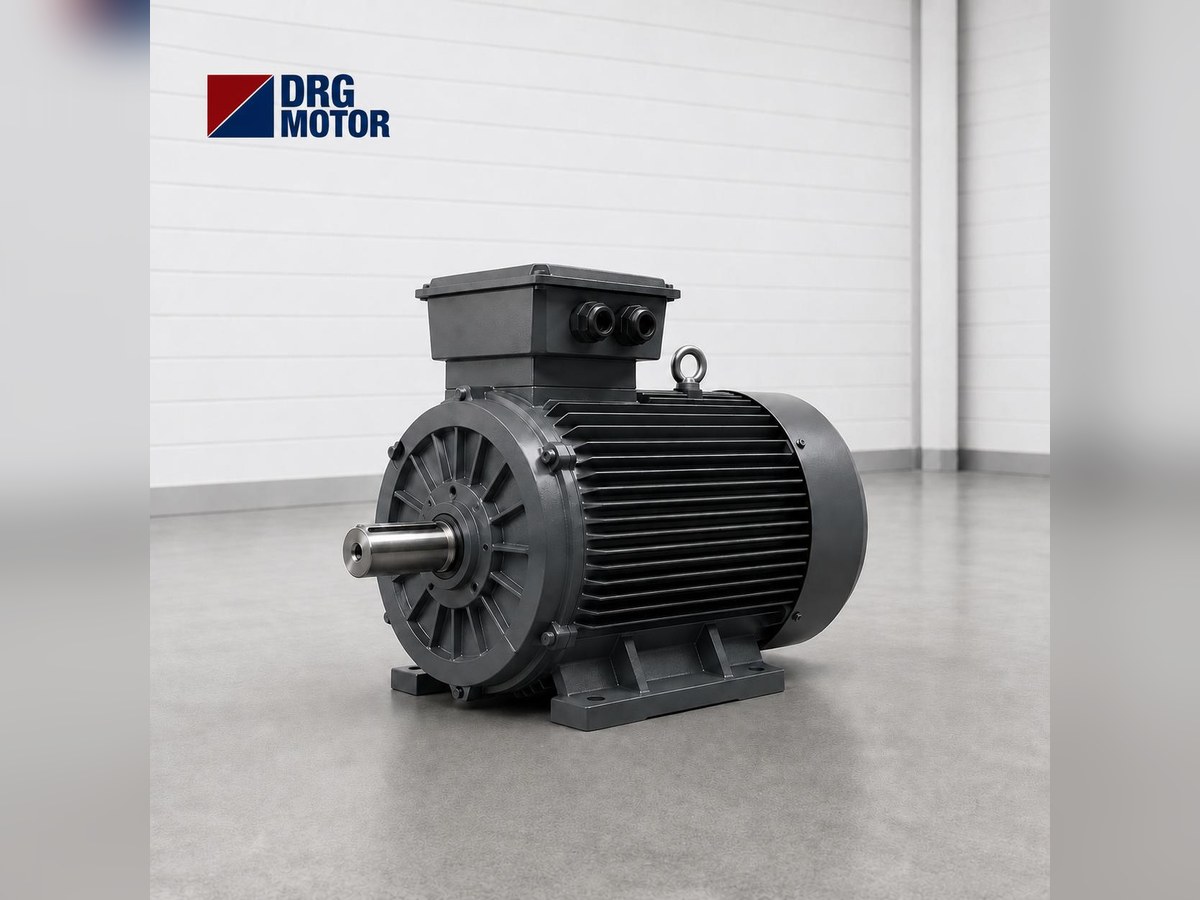
In a brick, roof tile or ceramic plant, conveyors carry two very different loads: a heap of wet, sticky clay in the preparation section, and after shaping, fragile, unfired green bricks, tiles or ceramic pieces. In the first case the belt motor is chosen for heavy, loaded starts; in the second for gentle acceleration and synchronised running with the other machines. This page treats the two groups separately; on all of them the motor usually turns the drum or drive shaft through a gearbox.
DRG Motor is a manufacturer, supplier and seller of electric motors. We do not sell belts, rollers, drums, chains, gearboxes or inverters; the same goes for machines, hydraulic power packs, pumps and fan impellers. Our share is the three-phase motor driving these conveyors; models are on Buy Electric Motors Online.
Belt conveyors in clay preparation
Clay leaving the box feeder travels on rubber belts between crushers, roller mills, mixer and ageing silo. In one brick plant quotation these are smooth, abrasion-resistant belts with textile plies; the drive drum is rubber-lagged and crowned, Ø290/375 mm, belt speed about 50 m/min, and the drum is turned by a shaft-mounted geared motor.
Sticky clay and scrapers
Wet clay sticks to the belt and builds up between drum and rollers on the return side. One belt maker advises sprinkling a thin layer of dry sand at the loading point and fitting a scraper on the return side. Build-up raises belt tension and drum load; the motor draws more current for the same flow. That is why a clay belt motor is chosen with a margin over a clean belt.
Distributor belts and tramp metal
In front of roller mills, distributor-levelling belts spread the clay across the roll: a distributor rotating above a flat rubber belt, adjusted in height, lays clay over the whole width of the cylinder. The distributor has its own small motor. Permanent magnets and metal detectors are fitted to the same belts; they protect crushers and mills and have nothing to do with the belt motor.
Green brick, roof tile and ceramic handling lines
The clay column leaving the extruder goes to the cutting table, then to grouping belts and the setting machine. Here the load is light but the product is fragile: a jerky start or a jolt crushes a green brick corner or cracks a tile.
Cutting table and grouping belts
On the cutter a motorised synchronising belt carries the column at extruder speed, and the cutting carriage travels at the same speed while it cuts. One cutter maker lists a 0.75 kW clutch, a 1.5 kW cutting and a 0.75 kW pusher motor in this group. The cut bricks pass spacing rollers and reach the grouping belt, where individual belt speeds are adjusted to arrange the bricks for the setting machine’s grippers. Synchronised motion is usually done with an inverter, sometimes with a servo motor; servo motors are not in our range.
Tile trays and chain transfers
After pressing, roof tiles are placed one by one on trays; a chain transfer carries the trays to the dryer loader or, for glazed tiles, the glazing line. A roof tile line feasibility report gives the chain transfer a single 3 kW motor. The rack chain inside the dryer is a separate, larger haulage unit; in one plant quotation it is 18.5 kW, with the motor outside the dryer.
Ceramic tile lines: belt, roller and glazing sections
From press to kiln, ceramic tile passes through multi-belt sections (two or three narrow belts), roller sections and flat belt sections. On the glazing line the tile flows at constant speed under the glaze bell and the digital printer; a speed ripple changes glaze thickness. These sections use small right-angle (bevel-helical) geared motors; one gear maker presents a 0.55–3 kW series for ceramic glazing and transfer sections. On roller sections, general conveyor catalogues show 0.37–1.5 kW per section.
How many kW is a conveyor motor? Catalogue values
A) Motor ratings seen in maker catalogues, plant quotations and feasibility reports:
| Conveyor / location | Motor power | Single / total | Note |
|---|---|---|---|
| Clay belt conveyor, roof tile line | 5.5 kW | per belt; 10 belts total 55 kW | feasibility report |
| Cutting table sync belt and clutch | 0.75 + 1.5 + 0.75 kW | three geared motors in the cutter group | cutter maker |
| Green brick grouping belt (before setting) | 3–11 kW | total of the belt/chain group | line maker’s table |
| Roof tile tray chain transfer | 3 kW | single motor | feasibility report |
| Dryer rack chain haulage unit | 18.5 kW | single motor | plant quotation sheet |
| Ceramic glazing line and transfer belts | 0.55–3 kW | geared motor, per section | gear maker’s ceramic series |
| Roller conveyor section (general catalogue) | 0.37–1.5 kW | per section | conveyor maker’s catalogue |
Depending on maker model, belt width and length, this conveyor group shows motors of roughly 0.37–18.5 kW: the low end on ceramic and green ware belts, the high end on long clay belts and dryer haulage. The line total is not one belt’s rating; on the tile line in the table ten belts add up to 55 kW.
B) Where DRG fits: the whole 0.37–18.5 kW span is in our range; 4-pole aluminium 71–80 frames for small belts, 4-pole cast iron 100L–132M frames for clay belts, a 180M frame for dryer haulage. On compact geared motors where gearbox and motor share one housing, replacing only the motor is not always possible; we judge that together from the plate and flange.
Click to see current electric motor prices and order nowSEE PRICES →
Worked example: power margin and gearbox ratio on a clay belt
The 800 mm rubber belt in the quotation has an average flow of 50 m³/h; wet clay weighs 1.45 t/m³, belt speed is 50 m/min and the drive drum is Ø375 mm. Assume the belt rises 6 m:
| Step | Operation | Result | Comment |
|---|---|---|---|
| Clay flow as mass | 50 m³/h × 1.45 t/m³ | about 72.5 t/h = 20.1 kg/s | average flow of the 800 mm belt |
| Power for 6 m lift alone | 20.1 × 9.81 × 6 | about 1.2 kW | friction and empty belt excluded |
| Drum speed at 50 m/min belt | 50 / (π × 0.375) | about 42.4 rpm | Ø375 mm crowned drive drum |
| Gearbox ratio with DRG-132S-4 | 1,460 / 42.4 | about 34.4 | shaft-mounted gearbox |
| Torque on the drum shaft at 5.5 kW | 9,550 × 5.5 / 42.4 | about 1,240 Nm | gearbox losses excluded |
The 1.2 kW needed for lifting alone is small next to the 5.5 kW used on clay belts: the difference is friction on loaded idlers, scrapers, mud stuck to the drum and starting with a full belt. The margin grows with belt length and incline. Check gearbox ratio and output torque with our gearbox output speed tool; for long belts in crushing and screening plants, see our belt conveyor motor page.
Starting, speed control and environment
After a stoppage a clay belt usually restarts with clay still on it; a green ware belt must accelerate without any jolt. The two cases call for different answers.
Starting a loaded clay belt
Direct-on-line, the motor starts with full torque; on our small 4-pole frames starting torque is about 2.0–2.4 times rated torque. That is usually enough to move a sticky, loaded belt, but it can make belts or drum lagging slip. Inclined belts need a backstop or brake against run-back; one belt maker requires it on conveyors with inclined sections. The brake sits on the gearbox side; brake motors are not in our range.
Gentle acceleration with an inverter on green ware
On the cutting table, grouping and glazing lines, belt speed is set by an inverter both for synchronisation and soft starting. A belt crawling at low frequency all shift long can overheat a self-cooled motor; a separately powered fan cowl is then the usual fix. Drives are not in our range, but our motors can be used with them.
Dust, glaze spray and the kiln area
The clay section has dust, the glazing line water and glaze spray; our motors are IP55. Belt motors at kiln and dryer exits may sit near hot casings: send us a reading of the air temperature at that exact spot, and keep the motor where cool air reaches its fan. Nothing in our production is meant for mounting inside the firing tunnel.
DRG motors for production line conveyors
Four-pole models of ours for clay, green ware and ceramic belts (current at 400 V):
| Model | Power / speed | Frame · shaft D×E | Current 400 V |
|---|---|---|---|
| DRG-711-4 | 0.25 kW / 1340 rpm | 71 aluminium · 14×30 | 0.66 A |
| DRG-712-4 | 0.37 kW / 1340 rpm | 71 aluminium · 14×30 | 0.92 A |
| DRG-801-4 | 0.55 kW / 1400 rpm | 80 cast iron · 19×40 | 1.31 A |
| DRG-802-4 | 0.75 kW / 1420 rpm | 80 cast iron · 19×40 | 1.75 A |
| DRG-90S-4 | 1.1 kW / 1445 rpm | 90S cast iron · 24×50 | 2.48 A |
| DRG-90L-4 | 1.5 kW / 1445 rpm | 90L cast iron · 24×50 | 3.3 A |
| DRG-100L1-4 | 2.2 kW / 1450 rpm | 100L cast iron · 28×60 | 4.52 A |
| DRG-112M-4 | 4 kW / 1450 rpm | 112M cast iron · 28×60 | 7.95 A |
| DRG-132S-4 | 5.5 kW / 1460 rpm | 132S cast iron · 38×80 | 10.7 A |
| DRG-132M-4 | 7.5 kW / 1460 rpm | 132M cast iron · 38×80 | 14.3 A |
On clay belts with shaft-mounted gearboxes the motor is usually B5-flanged to the gearbox; small right-angle gearboxes often take a B14 flange; belt drives use a foot-mounted B3. For an order, give us the plate data and the shaft, key and flange measurements of each belt motor; we match them with the conveyor drawing, and only then say whether the motor fits as is.
B5 dimensions for flanged belt motors
B5 flange values of frames common on belt gearboxes, mm:
| Frame | Shaft D×E | Flange P / M / N | Hole S |
|---|---|---|---|
| 71 | 14×30 | 160 / 130 / 110 | 10 |
| 80 | 19×40 | 200 / 165 / 130 | 12 |
| 90S/90L | 24×50 | 200 / 165 / 130 | 12 |
| 132S/132M | 38×80 | 300 / 265 / 230 | 14.5 |
On a hollow-input gearbox the bore, key and spigot fix the motor: D, E and N have no tolerance for substitution. For B14 dimensions see our technical drawings.
Outside our range
Servo motors (synchronised cutting and robotic transfer axes), brake motors (inclined belts and lifting transfers), single-phase motors and the vibration motors used on vibrating feed troughs are not in our range. Belts running through a solvent glaze room or a classified dust area need Ex-approved motors, an approval our standard series does not hold.
Live price table
Prices of our models in conveyor ratings come live from the shop:
| Model | Power / speed | Frame · current 400 V | Price |
|---|---|---|---|
| DRG-711-40.37 HP | 0.25 kW · 1500 rpm | Aluminium 71 · 0.66 A | $73.16 (€65.33) Details & buy → |
| DRG-801-40.75 HP | 0.55 kW · 1500 rpm | Cast iron 80 · 1.31 A | $91.72 (€81.91) Details & buy → |
| DRG-90S-41.5 HP | 1.1 kW · 1500 rpm | Cast iron 90S · 2.48 A | $124.09 (€110.82) Details & buy → |
| DRG-100L1-43 HP | 2.2 kW · 1500 rpm | Cast iron 100L · 4.52 A | $188.32 (€168.18) Details & buy → |
| DRG-112M-45.5 HP | 4 kW · 1500 rpm | Cast iron 112M · 7.95 A | $254.38 (€227.18) Details & buy → |
| DRG-132S-47.5 HP | 5.5 kW · 1500 rpm | Cast iron 132S · 10.7 A | $342.01 (€305.44) Details & buy → |
| DRG-132M-410 HP | 7.5 kW · 1500 rpm | Cast iron 132M · 14.3 A | $394.89 (€352.66) Details & buy → |
| DRG-160M-415 HP | 11 kW · 1500 rpm | Cast iron 160M · 20.4 A | $568.76 (€507.94) Details & buy → |
DRG MOTOR motors are guaranteed against material and manufacturing defects for 2 years from the delivery date (warranty certificate).
Motors in this power range
- DRG-801-4 – 0.55 kW – 1400 rpm – 80 cast iron
- DRG-90L-4 – 1.5 kW – 1445 rpm – 90L cast iron
- DRG-112M-4 – 4 kW – 1450 rpm – 112M cast iron
- DRG-132S-4 – 5.5 kW – 1460 rpm – 132S cast iron
- DRG-160M-4 – 11 kW – 1465 rpm – 160M cast iron
Click to see current prices and order these motors nowSEE PRICES →
Browse the products, ask for a quote: belt motors are on Buy Electric Motors Online. Plate photos for each belt motor, shared on WhatsApp, let us prepare a list in one go; on +90 (542) 666 11 11 describe which section each belt serves.
Frequently asked questions
What speed should a roof tile conveyor belt motor have?
Usually a 4-pole motor (about 1,400–1,460 rpm) with a gearbox; belt speed is the product of ratio and drum diameter, so a motor with different poles would change it.
Can a ceramic conveyor motor be replaced on its own?
Yes, if the motor is attached to the gearbox by an IEC flange; if motor and gearbox share one housing, the change must be planned together with the gearbox.
Questions: info@drgmotor.com · contact. For general motor choice in ceramic plants, see our ceramic plant guide.


