 English
 Le français
 Türkçe

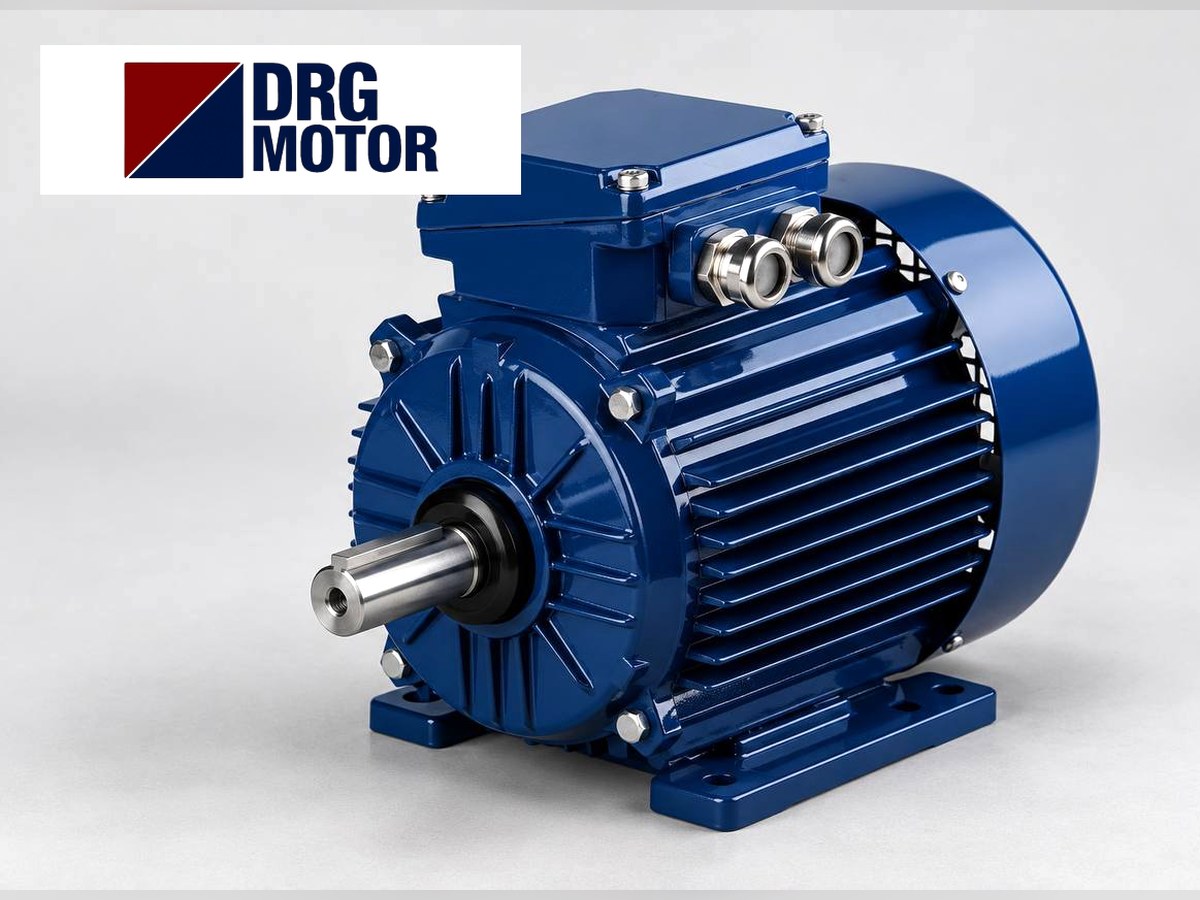
In a marble or granite plant, the roller or belt conveyor that carries a slab from one machine to the next is driven by a motor that turns the rollers or the belt slowly through a gearbox; the sawn, honed or polished slab moves on that surface without sliding. A marble conveyor motor is therefore small: data sheets from makers of stone line conveyors mostly give 0.55–2.2 kW for one conveyor module. The real task is not the size of the power but running reliably in water and slurry, with frequent stops and starts, at a low speed set by an inverter.
Let us state our scope first: DRG Motor is a manufacturer, supplier and seller of electric motors. We do not sell the conveyor frame, rollers, chain, belt, gearbox, drive (inverter) or the hydraulic unit that lifts the tables; what we sell is the three-phase induction motor coupled to the gearbox or drive shaft. Suitable models are listed on Buy Electric Motors Online.
Conveyor and transfer layouts on a slab line
A slab leaving the block saw changes place many times between calibrating, honing, polishing, resin and cut-to-size stations. At every stop its face has to be protected, veined fragile stone must not be knocked and the line rhythm must hold. Because the load is individual pieces rather than bulk material, these conveyors behave differently from the belt conveyors of a crushing plant: the load gathers at one point, moves, then stops again.
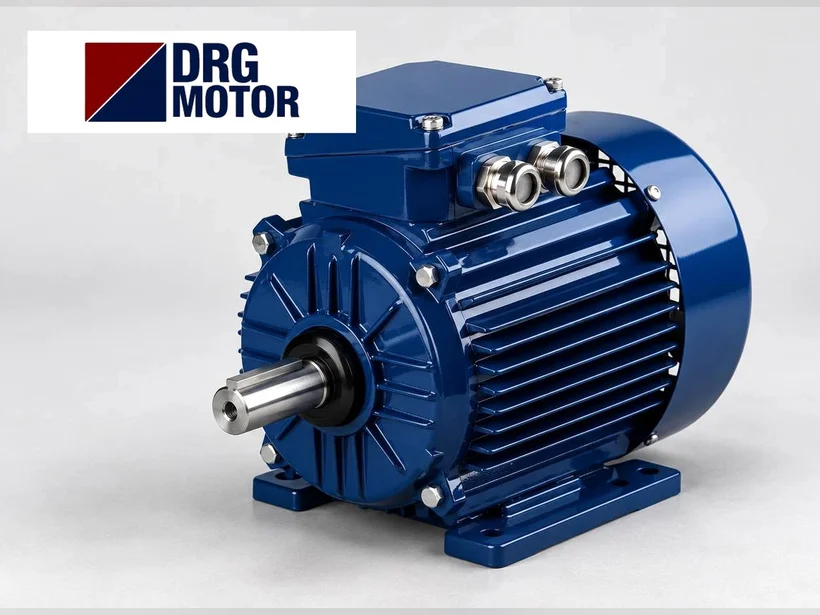
Roller slab conveyor
Steel, stainless or rubber-coated rollers sit in a frame; their pitch is chosen so that the shortest slab always rests on at least two or three rollers. One stone line maker lists 100 mm rollers on 30 mm shafts and 60 mm rollers on 20 mm shafts, with nylon, galvanised, stainless and neoprene-coated tubes as options. The motor turns the roller group together through a chain sprocket.
Belt infeed and outfeed tables
Thin, cracked or mesh-backed slabs can sag between rollers, so a flat belt table carries them instead. The feed belt inside a calibrating or polishing machine is the machine’s own drive and belongs to that machine’s page; here only the separate tables in front of and behind the machines are covered.
Direction-changing transfer table
Where the line turns 90 degrees, a transfer table sits at the crossing of two conveyors: the roller group carrying the slab and a belt or chain group running at right angles take over in turn after a lifting stroke. Such a table has at least two drive motors and a lifting device. If lifting is done by a hydraulic or pneumatic cylinder, the power for the hydraulic unit is calculated separately.
Turntable and rotating platform
A turntable rotates a slab, or turns A-frames in the yard, without changing its travel direction. One maker’s sheet describes a wheel-mounted platform on a circular rail, 3600 mm outer diameter and 40 t capacity, rotated by an inverter with acceleration and deceleration ramps. At this load the motor is set by wheel rolling resistance, gearbox ratio and ramp time; the sheet gives no power, so this page states no kW figure either.
How does the motor turn the rollers?
One motor, a chain and sprockets
In the commonest layout a geared motor pulls a chain under the frame and the sprocket at the end of each roller takes its share. A single drive point is easy to service, but as the chain gets longer its tension and wear grow. Long lines are therefore split into modules of about 3–6 m, each with its own motor, able to stop and start independently.
Slip (accumulating) rollers
Some conveyors have a friction clutch between roller and sprocket. If a slab is held at the front, the rollers behind it slip instead of pushing, so slabs never ride over each other. The motor then carries the slip friction as extra load and may run without stopping; that loss belongs in the power check.
Motorised rollers (motor inside the roller)
Drum drives with the motor built inside the roller and 24/48 V motor rollers are not standard IEC motors and are not in our range. A failed roller of that kind is replaced with the roller maker’s spare. Converting the line to an external geared motor drive is a job for the conveyor builder.
How many kW does a slab conveyor motor need? Market values
A) Motor powers found in manufacturer data sheets:
| Conveyor type | Motor power | Single / total | Note |
|---|---|---|---|
| Stone line roller table, 600 mm wide, 1–4 m long | 0.55 kW | Single motor | maker data sheet, main motor |
| Inter-process roller conveyor, 6 m/min | 0.75 kW | Single motor | second maker, standard model |
| Heavy-duty slab conveyor, 5–20 m/min, up to 1000 kg per metre | 0.75–2.2 kW | Per module | second maker, heavy series |
| General heavy powered-roller conveyor, up to 3000 kg per metre, 1–20 m/min | 0.75–10 kW | Per line | domestic conveyor catalogue, not stone-specific |
Depending on model, slab load and speed, this equipment group shows motor options of about 0.55–2.2 kW per conveyor module; on very long or block-carrying heavy roller lines the value can reach 10 kW. One line can hold dozens of modules; adding them up gives the line’s installed power, which is a different figure from one conveyor’s motor.
B) Overlap with the DRG range: from 0.55 up to 10 kW, every value falls within our 4-pole (1500 rpm) and 6-pole (1000 rpm) motors, aluminium or cast iron. Motors built into rollers, low-voltage DC roller drives and inclined sections needing a brake motor are outside our range.
Click to see current electric motor prices and order nowSEE PRICES →
Worked example: a roller module carrying two granite slabs
A gearbox maker’s roller conveyor method finds the load torque from the rolling resistance of the carried and rotating mass; it suggests a friction factor of 0.05–0.1 and, for frequent start-stop, the load factor from its catalogue. Assumptions: two 3200 × 2000 × 30 mm granite slabs (about 1040 kg in total at an assumed 2700 kg/m³), rollers 300 kg, roller diameter 100 mm, speed 8 m/min, motor 1400 rpm.
| Step | Operation | Result | Comment |
|---|---|---|---|
| Roller speed | 8 / (π × 0.1) | 25.5 rpm | from line speed |
| Gear ratio | 1400 / 25.5 | about 55 | chain ratio taken as 1 |
| Torque at roller | 1340 × 9.81 × 0.1 × 0.05 | 65.7 Nm | μ = 0.1, radius 0.05 m |
| Torque at motor shaft | 65.7 / (55 × 0.8 × 0.9) | 1.66 Nm | gearbox 0.8, chain 0.9 |
| Friction power | 1.66 × 1400 / 9550 | 0.24 kW | at steady speed |
| Selection | margin for start, slip and load factor | 0.55–0.75 kW | DRG-801-4 / DRG-802-4 |
The calculation gives steady-speed power and comes out small. Three things push the choice up: the acceleration torque while the slab gets moving, the clutch loss of slip rollers and a chain made heavy by slurry. The 0.55–0.75 kW values in data sheets include these margins. Ratio and output torque can be checked on our gearbox output speed and torque calculator page.
Protecting the motor in wet cutting areas
Water splash and IP55
On slab lines the stone surface is nearly always wet; water dripping from rollers and splashed slurry reach the motor frame. Our motors are IP55: designed against water jets from any direction, but not chosen for pressure-hose washing or for sitting in slurry. If the line is hosed down, fit a shield over the motor and keep the hose off it.
Motor position and terminal box
Mount the motor on the high side of the conveyor frame where possible, not on the lower side where water gathers. The cable gland of the terminal box should face down and the cable should form a drip loop before entering. A cooling fan that sucks in slurry runs unbalanced, so keep the area around the fan cover clean.
Slurry, chain and rising current
Dried cutting slurry acts like abrasive paper in the chain and roller bearings. Within weeks rolling resistance increases, motor current approaches the nameplate value and the overload relay begins to trip. Before fitting a larger motor, check roller bearings and chain tension, and log the current at no load and under load.
Speed setting, starting and slab slip
Slab conveyors are usually fed by an inverter: speed follows the rhythm of the machines before and after, and start and stop ramps are set. Without a ramp, rollers starting suddenly slide under a wet, polished slab; the slab stays put, the rollers spin and may mark the surface. Inverters are not in our range; our standard motors can be supplied from one with suitable settings. A motor running long at very low frequency gets less cooling from its own fan; if the line will run well below about 20 Hz for long periods, changing the gear ratio may be the better fix.
On small modules connected direct-on-line, starting current and the number of starts matter. On the DRG-802-4, for instance, starting current is 6.6 times rated current and starting torque 2.3 times rated torque; size the contactor and overload relay from these ratios on the product page of the model you pick. Star-delta starting is not needed at these small powers; see star-delta starting for details.
Gearbox connection and mounting type
On slab conveyors the motor is usually flanged to a gearbox. Worm and helical-bevel gearboxes accept a B5 (large flange) or B14 (small flange) motor at the input. B5 dimensions from our catalogue (mm):
| Frame | Shaft D×E | Flange P / M / N | Hole S |
|---|---|---|---|
| 80 | 19×40 | 200 / 165 / 130 | 12 |
| 90S/90L | 24×50 | 200 / 165 / 130 | 12 |
| 100L/112M | 28×60 | 250 / 215 / 180 | 14.5 |
Our catalogue does not give B14 small-flange dimensions; if the gearbox input is B14 we confirm the size with you. If the motor sits on a base and drives through a belt or chain, a foot-mounted B3 is chosen, and B35 when both feet and flange are needed. The correct type comes from the conveyor maker’s drawing. If the gearbox is sound and only the motor is changed, our article on flange motor selection for gearboxes will guide you.
DRG motors for slab conveyors
Our models in the powers commonly used on slab conveyors (current at 400 V):
| Model | Power / speed | Frame · shaft D×E | Current 400 V |
|---|---|---|---|
| DRG-801-4 | 0.55 kW / 1400 rpm | 80 cast iron · 19×40 | 1.31 A |
| DRG-802-4 | 0.75 kW / 1420 rpm | 80 cast iron · 19×40 | 1.75 A |
| DRG-90S-4 | 1.1 kW / 1445 rpm | 90S cast iron · 24×50 | 2.48 A |
| DRG-90L-4 | 1.5 kW / 1445 rpm | 90L cast iron · 24×50 | 3.3 A |
| DRG-100L1-4 | 2.2 kW / 1450 rpm | 100L cast iron · 28×60 | 4.52 A |
| DRG-90S-6 | 0.75 kW / 935 rpm | 90S cast iron · 24×50 | 1.93 A |
Our motors are three-phase, IP55 and offered at 1000/1500/3000 rpm; up to 3 kW the winding is 230/400 V. The mounting is chosen with the order: B3, B5, B14, B34, B35 and their vertical versions. For a new motor to fit the existing conveyor, power, speed, voltage, frame size, shaft diameter and key and the gearbox flange are checked together; the old nameplate and the conveyor maker’s documents are the basis of that comparison. We give no general fit promise beyond that.
Live price table
Prices for our motors in powers suited to slab conveyors come live from the shop:
| Model | Power / speed | Frame · current 400 V | Price |
|---|---|---|---|
| DRG-802-60.75 HP | 0.55 kW · 1000 rpm | Cast iron 80 · 1.43 A | $106.98 (€95.54) Details & buy → |
| DRG-801-40.75 HP | 0.55 kW · 1500 rpm | Cast iron 80 · 1.31 A | $91.72 (€81.91) Details & buy → |
| DRG-90S-61 HP | 0.75 kW · 1000 rpm | Cast iron 90S · 1.93 A | $109.90 (€98.15) Details & buy → |
| DRG-802-41 HP | 0.75 kW · 1500 rpm | Cast iron 80 · 1.75 A | $101.93 (€91.03) Details & buy → |
| DRG-90L-61.5 HP | 1.1 kW · 1000 rpm | Cast iron 90L · 2.69 A | $137.68 (€122.96) Details & buy → |
| DRG-90S-41.5 HP | 1.1 kW · 1500 rpm | Cast iron 90S · 2.48 A | $124.09 (€110.82) Details & buy → |
| DRG-90L-42 HP | 1.5 kW · 1500 rpm | Cast iron 90L · 3.3 A | $144.14 (€128.73) Details & buy → |
| DRG-100L1-43 HP | 2.2 kW · 1500 rpm | Cast iron 100L · 4.52 A | $188.32 (€168.18) Details & buy → |
DRG MOTOR motors are guaranteed against material and manufacturing defects for 2 years from the delivery date (warranty certificate).
Motors in this power range
- DRG-802-4 – 0.75 kW – 1420 rpm – 80 cast iron
- DRG-90S-4 – 1.1 kW – 1445 rpm – 90S cast iron
- DRG-90L-4 – 1.5 kW – 1445 rpm – 90L cast iron
- DRG-100L1-4 – 2.2 kW – 1450 rpm – 100L cast iron
- DRG-90L-6 – 1.1 kW – 945 rpm – 90L cast iron
Click to see current prices and order these motors nowSEE PRICES →
Browse the products, ask for a quote: all models are on Buy Electric Motors Online. Share photos of the conveyor motor and gearbox nameplates over WhatsApp or phone +90 (542) 666 11 11, and we will check the match together.
Frequently asked questions
Should a slab handling system motor be 4-pole or 6-pole?
If the gear ratio stays the same, keep the speed of the old motor. On a new module a 6-pole motor reaches the same roller speed with a smaller gear ratio; the choice follows the gearbox catalogue.
Can one motor drive a whole marble transfer line?
On short lines yes, but separate motorised modules are preferred to leave gaps between slabs and hold them at stations. Separate modules also stop one motor fault from halting the whole line.
For questions call +90 (542) 666 11 11, e-mail info@drgmotor.com or use the contact page. All models and marble conveyor motor options are on Buy Electric Motors Online.


